
Key takeaways
What's inside
Best weight for kettlebell swings is almost always heavier than a first-time buyer expects, because the swing is a hip hinge rather than a shoulder raise. Get it wrong and you either train your arms by accident or stall immediately. This guide gives the numbers and the bells.
As an Amazon Associate we earn from qualifying purchases at no extra cost to you. Product prices and availability are accurate as of the date shown and are subject to change.
As an Amazon Associate we earn from qualifying purchases at no extra cost to you. Product prices and availability are accurate as of the date shown and are subject to change.




By Chris Parker
🛒 Best Price Today on Amazon
Prime members get fast, free shipping on everything above, plus member-only deals. New members get a 30-day free trial — cancel anytime.
Start 30-Day Prime Free Trial →See Today’s Amazon DealsHow to Pick the Best Weight for Kettlebell Swings
The best weight for kettlebell swings is set by the hips snapping forward, not by the arms lifting. That means the bell needs to be heavy enough for your hips to feel it, which for most adults is well above the weight that feels comfortable to hold at arm’s length. Below are the numbers that work.
Starting Weight by Experience and Size
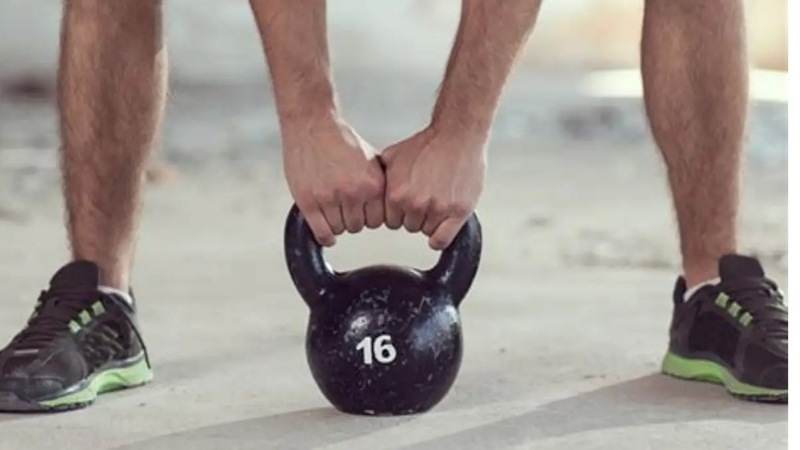
For most untrained men, 16 kg (35 lb) is the standard entry point, moving to 20-24 kg (44-53 lb) within a few months. For most untrained women, 8-12 kg (18-26 lb) is the usual start, moving to 16 kg (35 lb) as technique settles.
Body size shifts these numbers less than people expect, because the swing is driven by hip power rather than absolute mass. Training history matters more: someone who already deadlifts will usually start a full size up from someone with no lifting background at all.
Footprint and Storage Before You Buy
Kettlebells occupy little floor area but the swing itself needs a clear arc. Allow roughly 6 x 6 ft (1.8 x 1.8 m) of floor and around 8 ft (2.4 m) of ceiling height, because the bell rises to chest or eye level and your arms extend above that on the backswing.
A single 16 kg bell sits in a footprint of roughly 8 x 8 in (20 x 20 cm) and can live beside a bookshelf. Adjustable bells take more space when their plate trays are counted. Measure the swing arc, not just the storage spot, before ordering.
Handle Width, Diameter and Finish
Handle diameter around 33-38 mm suits most hands for two-handed swings, and the handle window needs to be wide enough for both hands side by side, generally 5 in (13 cm) or more of usable span. Narrow handles on cheap bells force an overlapping grip that pinches.
Finish decides how the bell feels after ten minutes. Powder coat holds chalk and stays predictable when hands sweat; painted cast iron gets slippery; vinyl coating is quiet on floors but bulks up the handle. For swings specifically, powder coat is the safest default.
Jumping Up: Increment Size in Kettlebells
Kettlebells traditionally step in 4 kg (roughly 9 lb) intervals, which is a large jump when you are moving from 16 kg to 20 kg. Adjustable bells solve this with smaller increments, at the cost of a bulkier shape and a mechanism that must be checked before every set.
A practical route is to buy one bell at your working weight and one a size up, then use the heavier bell for lower-rep sets until it becomes your standard. Two bells cover a year of progression more cheaply than an adjustable model in most cases.
Market and Seasonal Context Worth Knowing
Cast iron kettlebells are heavy shipping items, and that shapes their pricing in ways that other equipment escapes. Deep discounts on heavy bells cluster around the late-year sales period precisely because shipping cost dominates the margin, so the timing of a purchase genuinely matters here.
Late summer into autumn is also when home training demand rises, as darker evenings and colder weather make the trip to a gym less appealing. A single bell that lives in the corner of a room removes both the travel time and the excuse, which is most of the reason swings suit this season.
On the equipment itself, the mid tier is where the choice is widest and the compromises are clearest. Below it you typically get a rougher casting seam inside the handle, thinner paint that chips at the horns, and a base that is not perfectly flat. None of those are dangerous, but the seam is worth checking by hand.
The steadier trend is that home training is treated as permanent rather than temporary, and manufacturing quality at the mid tier has improved to match. A powder-coated bell bought now should outlast several sets of bands and any plastic-shelled dumbbell in the same room.
Top Picks Once You Know the Best Weight for Kettlebell Swings
Once you know the best weight for kettlebell swings, these six options cover the standard sizes, the adjustable route and the budget entry point. Each entry notes the finish, the handle and the honest weakness, since with kettlebells the weakness is almost always in the handle or the casting.
| Product | Type | Finish | Typical Sizes | Best For |
|---|---|---|---|---|
| Yes4All Powder Coated | Cast iron | Powder coat | 10-70 lb (4.5-32 kg) | Best value single bell |
| Amazon Basics Cast Iron | Cast iron | Painted or coated | 10-60 lb (4.5-27 kg) | Budget entry |
| Kettlebell Kings Powder Coat | Cast iron | Powder coat | Wide range | Handle quality |
| Bowflex SelectTech 840 | Adjustable | Moulded | 8-40 lb (3.6-18 kg) | Small spaces |
| CAP Barbell Vinyl Coated | Cast iron | Vinyl | Light to mid | Floor protection |
| Titan Fitness Competition Style | Steel | Painted steel | Sized by colour | Consistent dimensions |
Yes4All Powder Coated Kettlebell
This is the default recommendation for a first bell at the best weight for kettlebell swings. The powder coat holds chalk, the handle is wide enough for two hands on the common sizes, and the price per pound is among the lowest available for a cast iron bell.
Casting quality varies between units, so run a hand around the inside of the handle when it arrives and take fine sandpaper to any seam you can feel. The base is flat enough for goblet squats and racked work but not machined to competition standards.
Amazon Basics Cast Iron Kettlebell
The budget entry point, and entirely adequate for learning the movement. The shape is conventional, the sizes cover the usual starting range, and if you decide kettlebell training is not for you the outlay has been small.
Painted finishes get slippery once hands sweat, which is the main practical drawback during longer swing sets. Chalk helps, and so do gloves, though most experienced lifters prefer to move to a powder-coated bell rather than fight the finish.
Kettlebell Kings Powder Coated
The handle is where this brand earns its price: a smooth finish with no casting seam to catch, and a window wide enough for two hands without overlap. Over long swing sets that difference is felt in the palms rather than in the hips.
It costs meaningfully more per pound than budget cast iron, and the performance difference on a first bell is comfort rather than capability. Worth it for anyone who swings several times a week; unnecessary for someone still deciding.
Bowflex SelectTech 840 Adjustable
Covering roughly 8-40 lb (3.6-18 kg) in one unit, this replaces three or four cast bells and solves the 4 kg jump problem. For a shared living room where a row of iron bells is not acceptable, it is the practical answer.
The shape is boxier than a cast bell, which alters the feel at the bottom of the swing, and the selection mechanism must be confirmed seated before every set. It also must not be dropped, which cast iron tolerates without complaint.
CAP Barbell Vinyl Coated Kettlebell
Vinyl coating protects hard floors and keeps noise down, which matters in a flat with neighbours below. In the lighter sizes it suits early technique practice and two-handed swings at a controlled tempo without a mat underneath.
The coating thickens the handle and can feel tacky rather than grippy once warm. Vinyl also splits at the horns after heavy use, and the lighter size range means most people outgrow it for swings within a few months.
Titan Fitness Competition Style Kettlebell
Competition-style bells keep the same external dimensions across weights, so the movement pattern does not change as you get stronger. That consistency is genuinely useful once you own two or three sizes and rotate between them within a session.
The 35 mm handle is standardised rather than sized to your hands, and painted steel needs chalk once you sweat. They also cost more than plain cast iron for the same weight, so they suit committed users rather than first-time buyers.
Frequently Asked Questions
These are the questions that decide whether a first kettlebell gets used or ends up under a bed, and they come up in every sizing discussion.
Is it better to start too light or too heavy?
Slightly too light, but only slightly. A bell that is far too light turns the swing into a front raise and teaches the wrong pattern, which is harder to correct than starting a size down. Most people find the best weight for kettlebell swings one size above their instinct.
How do I know the bell is too light?
If your arms are doing the lifting and the bell floats rather than being thrown by the hips, it is too light. Another sign is being able to do thirty unbroken swings on the first attempt without your breathing changing much.
Should I buy one bell or two?
One to start, then a second a size up once your technique is consistent, usually after four to eight weeks. Two bells covering consecutive sizes handle a year of progression and cost less than most adjustable models.
How much space do swings actually need?
Roughly 6 x 6 ft (1.8 x 1.8 m) of clear floor and about 8 ft (2.4 m) of ceiling, with nothing breakable behind you on the backswing. Check the real dimensions of the area you intend to use before ordering a bell.
See More:
- Ankle weights best
- Best rated ankle weights
- Best home workout equipment budget
- Best resistance bands for men
Final Thoughts
The best weight for kettlebell swings is the one heavy enough to force the hips to do the work, which for most men means starting at 16 kg (35 lb) and for most women 8-12 kg (18-26 lb). Buy a powder-coated bell at that size, add one size up when technique settles, and measure your swing arc before the bell arrives.



Write Your Review
No reviews yet. Be the first to share your experience!