
Key takeaways
What's inside
Best power cages for home gym shortlists usually collapse once two measurements are taken: ceiling height and the floor area left after the rack goes in. This guide compares five cages on steel gauge, upright dimensions, hole spacing and safety systems, so the shortlist survives contact with an actual room.
As an Amazon Associate we earn from qualifying purchases at no extra cost to you. Product prices and availability are accurate as of the date shown and are subject to change.

#1 Pick

#2 Pick

#3 Pick
#4 Pick

#5 Pick

#6 Pick

#7 Pick

As an Amazon Associate we earn from qualifying purchases at no extra cost to you. Product prices and availability are accurate as of the date shown and are subject to change.
By Chris Parker
🛒 Best Price Today on Amazon
Prime members get fast, free shipping on everything above, plus member-only deals. New members get a 30-day free trial — cancel anytime.
How to Choose the Best Power Cages for Home Gym Builds
The best power cages for home gym use change what a room can be used for, and they are also the hardest purchase to return once assembled. Four specifications decide whether it works in practice: the space it needs, the steel it is made from, the safety system it uses, and how stable it stays without being bolted down.

Footprint, Ceiling Height and Clearance
The best power cages for home gym rooms typically stand 83 to 86 in (211 to 218 cm) tall, which needs a ceiling around 88 to 90 in (224 to 229 cm) to allow pull-ups without knuckles hitting plaster. Basements and garages with service pipes are where this goes wrong, so measure to the lowest obstruction rather than the ceiling itself.
Footprint runs roughly 48 to 53 in (122 to 135 cm) wide and 48 to 60 in (122 to 152 cm) deep depending on the depth of the cage. Add about 24 in (61 cm) of clearance on each side for loading plates and stepping in and out, plus room at the front for a bench and for a bar to sit clear of the uprights.
Delivery is its own problem. These ship as long boxes of steel weighing 130 lb (60 kg) or more in total, and the uprights on their own are awkward for one person to carry safely. Measure the actual area where the rack will live before ordering, including the doorway and any turn at the top of a staircase.
Steel Gauge, Upright Size and Hole Spacing
Almost every home cage uses 2 x 2 in (5 x 5 cm) uprights, so the steel gauge is the variable that really matters. Fourteen-gauge tube is the budget standard and holds up perfectly well for the loads most home lifters actually use. Eleven-gauge is thicker, heavier and noticeably more rigid under a loaded bar.
On the best power cages for home gym training, hole spacing decides how precisely safeties and J-cups can be set. Standard spacing of 2 in (5 cm) is workable. Racks offering 1 in (2.5 cm) spacing through the bench-press zone let you set safety bars close enough to the chest to matter when training alone.
Rated capacity is quoted as a combined figure and should be read with some scepticism. Ratings of 800 lb (363 kg) are common on budget frames, and real working comfort tends to arrive some way below that. For most home lifters, anything rated at or above 700 lb (318 kg) will not be the limiting factor.
Safety System, Stability and Bolting Down
Safety bars come as pin-and-pipe, straps or flip-down arms. Pin-and-pipe is the common budget solution and it works, though the pipe rotates and eventually shows wear. Straps absorb a dropped bar more quietly and are kinder to the knurling, but they need a deep cage and careful tensioning to sit level.
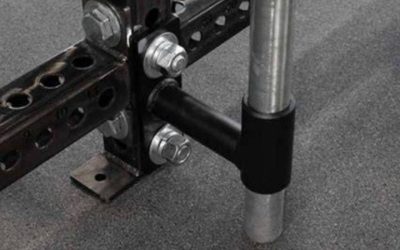
Stability without bolting depends almost entirely on the mass of the frame itself. A rack weighing around 130 lb (60 kg) will shift slightly during aggressive pull-ups or a racked bar returning hard. Some budget cages have no floor-mounting holes at all, so weight-plate storage pegs at the rear become the practical way to anchor them.
Where Power Cage Pricing Sits Right Now
The tiers are unusually clear in this category. Entry-level 14-gauge cages sit at the bottom, mid-range 11-gauge racks with tighter hole spacing occupy the middle, and commercial-weight frames sit some way above that. Each step buys rigidity and accessory compatibility rather than a higher number on the capacity sticker.
Freight is the reason prices behave the way they do. Steel is heavy and expensive to move, so meaningful discounts on racks appear rarely and tend to cluster into a single period each year rather than rotating month by month. Local pickup, where it is offered, often saves more than any seasonal sale does.
Top Picks: 5 Power Cages Worth the Floor Space
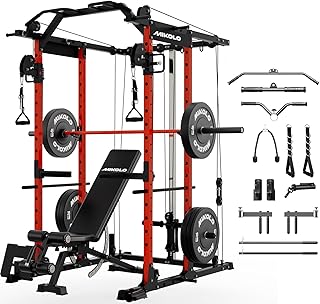
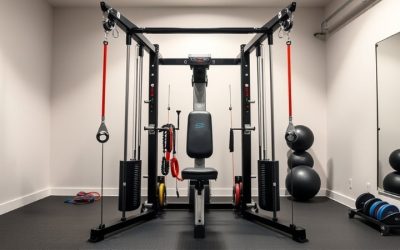
These five cover the practical range of the best power cages for home gym use, from a budget walk-in frame to a wall-mounted rack that folds flat. Figures below are manufacturer specifications. None of these are competition frames, and none should be used for barbell work without safeties correctly set.
| Cage | Steel | Rated capacity | Height | Best for |
|---|---|---|---|---|
| Fitness Reality 810XLT Super Max | 2 x 2 in, 14 gauge | ~800 lb / 363 kg | ~83.5 in / 212 cm | First rack on a budget |
| Titan Fitness T-3 Series | 2 x 2 in, 11 gauge | High | Full height options | Long-term expansion |
| Titan T-3 Wall-Mounted Folding | 2 x 2 in, 11 gauge | High | Wall dependent | Shared garages |
| REP Fitness PR-1000 | 2 x 2 in | Mid | ~84 in / 213 cm | Low ceilings |
| Sunny Health Power Zone Cage | 2 x 2 in | Mid | Full height | Simple assembly |
Fitness Reality 810XLT Super Max Power Cage
This is the most heavily reviewed budget cage on the market, and it earns that position. The 2 x 2 in (5 x 5 cm) frame is rated around 800 lb (363 kg), the walk-in space is generous, the safety bars adjust across nineteen separate height levels, and rear stability bars stop the frame twisting under load.
The rack weighs only about 133 lb (60 kg), which is light enough to shift slightly during hard pull-ups, and there are no holes at all provided for bolting it down to the floor. Hole spacing is not the tighter one-inch pattern either, so bench safeties cannot be set nearly as precisely as on a mid-tier rack.
Titan Fitness T-3 Series Power Rack
The T-3 is the usual step up from a budget frame, and the difference is felt immediately. Eleven-gauge steel in 2 x 2 in (5 x 5 cm) uprights makes it noticeably more rigid under load, and the accessory ecosystem is deep enough that the rack grows into a full station over the years rather than being replaced by one.
It costs meaningfully more, weighs a good deal more and takes longer to assemble, often two to four hours with a second person for the uprights. Powder-coat finish on the hardware is average, and shipping damage to box corners is common enough that inspecting everything on delivery is worth the few minutes it takes.
Titan Fitness T-3 Wall-Mounted Folding Rack
When the room has another job during the week, a folding rack is the only honest answer. It mounts to the wall, swings flat when it is not in use, and gives back nearly all of the floor area it occupied. For a shared garage or a room that doubles as anything else, that changes the calculation entirely.
It has to be bolted into studs at the correct spacing or into solid masonry, which rules out plasterboard-only walls and almost every rental property. Depth when deployed is shallower than on a full cage, so the bar path sits closer to the wall, and pull-ups need the rack unfolded rather than stowed away.
REP Fitness PR-1000 Power Rack
At around 84 in (213 cm) tall, the PR-1000 sits between a full-height cage and a short rack, which makes it the sensible pick for basements and garages with a low ceiling or with exposed pipework overhead. It is also the entry point into a wider system, so accessories remain available as the setup develops.
The lower height reduces headroom for taller lifters doing pull-ups, and the frame is lighter than the heavy-duty racks, so it benefits a good deal from the optional plate storage that anchors it without bolting. It is not the rack for anyone planning to load past a serious working weight within a few years.
Sunny Health and Fitness Power Zone Cage
This one wins on ease of setup. Assembly is simpler and faster than most competitors, the instructions are clear, and one reasonably capable person can complete it in an afternoon without specialist tools. For a first rack where the goal is squatting safely rather than building a system, that matters.
The accessory range is narrower than Titan or REP, so expanding later usually means generic third-party attachments. The frame is lighter than the heavier budget cages, and the finish scuffs at the J-cup contact points noticeably sooner. It handles moderate loads well and is not aimed at heavy lifting.
Frequently Asked Questions
These are the questions that come up once the shortlist is down to two or three racks and a tape measure has finally been taken to the ceiling. The answers below assume a single-car garage or a spare bedroom rather than a purpose-built gym with proper commercial clearance overhead and a concrete slab.
How much ceiling height do I actually need?
Allow 88 to 90 in (224 to 229 cm) up to the lowest obstruction for a full-height cage with comfortable pull-ups. Below that, a short rack around 84 in (213 cm) works but cuts overhead clearance further still. Measure up to pipes, lights and garage door tracks rather than to the ceiling surface itself.
Do the best power cages for home gym use need bolting down?
Not usually, provided the frame is heavy enough and the training stays moderate. Lighter budget racks move slightly during aggressive pull-ups, and loading plates onto rear storage pegs adds the mass that solves it. Some cages have no floor-mounting holes at all, so check that before planning to anchor one.
Can I drop a loaded barbell inside a cage?
Onto correctly set safety bars, yes, since that is exactly what they are there for. Onto the bare floor, no, not without a platform built for the purpose, and certainly not on a suspended timber floor. Never train barbell lifts inside a rack with the safeties set above the depth you actually reach at the bottom.
Is 14-gauge steel strong enough for home training?
For the large majority of home lifters, yes. Fourteen-gauge 2 x 2 in (5 x 5 cm) uprights handle the working loads most people reach comfortably. Eleven-gauge buys rigidity and a longer upgrade path rather than raw safety, and it matters most to heavier lifters and anyone planning a lot of attachments.
See More:
- Best gym bench for home
- Best weight benches home gym
- Best at home full body workout equipment
- Best resistance bands workout
- Best resistance bands leggings
Final Thoughts
The best power cages for home gym builds are chosen by measurement first and specification second. Settle ceiling height, footprint and delivery access, then compare steel gauge, hole spacing and safety systems. Budget frames handle ordinary home training well. Measure the room carefully before ordering anything.


Write Your Review
No reviews yet. Be the first to share your experience!