
Key takeaways
What's inside
Best selectable dumbbells are judged on the mechanism first, because the selector is what breaks, jams or slows you down. This guide compares six sets by selector type, change speed in seconds, increment size in lb and kg, storage footprint, and the specific failure points that each design quietly brings with it.
As an Amazon Associate we earn from qualifying purchases at no extra cost to you. Product prices and availability are accurate as of the date shown and are subject to change.


#2 Pick

#3 Pick

#4 Pick

#5 Pick

#7 Pick

As an Amazon Associate we earn from qualifying purchases at no extra cost to you. Product prices and availability are accurate as of the date shown and are subject to change.
By Chris Parker
🛒 Best Price Today on Amazon
Prime members get fast, free shipping on everything above, plus member-only deals. New members get a 30-day free trial — cancel anytime.
How to Compare the Best Selectable Dumbbells
Every selectable dumbbell solves the same problem, replacing a whole rack of fixed weights with a single pair, and they differ mainly in how the plates are locked onto the handle. On any best selectable dumbbells shortlist, that mechanism determines change speed, how the dumbbell feels in the hand, and what eventually goes wrong.
Selector Types: Dial, Twist, Pin and Screw-Lock
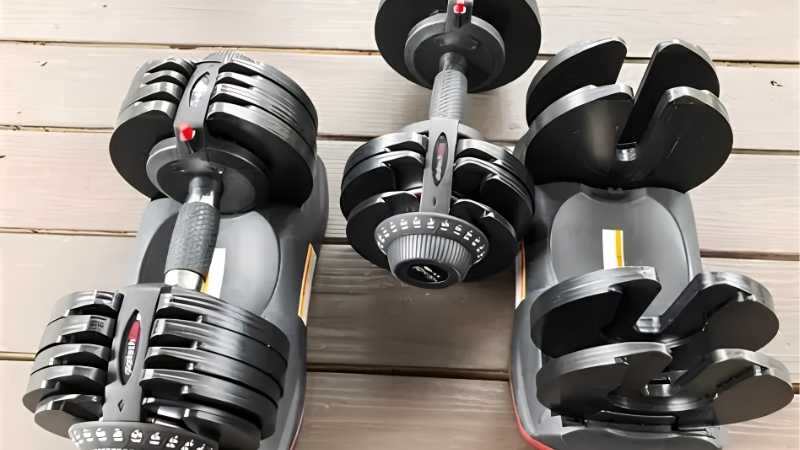
Dial systems turn a knob at each end to pick up plates, giving two-second changes at the cost of plastic housings that crack if they are knocked. Twist-handle systems rotate the grip itself while the dumbbell sits in its cradle, and they are mostly steel with fewer exposed parts to damage in normal use.
Pin systems drop a selector pin through a stack inside a cage, which is slower but mechanically simple, while screw-lock designs use individual plates and a locking screw. The screw-lock approach takes ten to fifteen seconds per change and is the most tolerant of rough handling by a clear margin.
Change Speed and Increment Size
Change speed decides what you can realistically programme. Two to four seconds keeps drop sets and supersets viable, five to ten seconds is fine for straight sets, and anything past thirty seconds quietly removes certain training styles from your options regardless of how good the dumbbells feel in the hand.
Increment size decides how long the set stays useful to you. Steps of 2.5 lb (1.1 kg) let curls and lateral raises progress properly, while 5 lb (2.3 kg) steps amount to a 20 per cent jump at 25 lb. Fine steps matter most below 30 lb (13.6 kg), where the small muscle groups are doing most of the work.
Footprint, Drop Rules and Failure Points
A pair sitting in cradles occupies about 20 x 12 in (51 x 30 cm) and stands 9 to 10 in (23 to 25 cm) tall, so it stores neatly under a bed frame, while block designs halve that footprint again. Measure the storage corner and the 6 x 6 ft (183 x 183 cm) training area before ordering either type.
None of these should be dropped: a fall from 18 to 24 in (46 to 61 cm) can crack a housing or bend a selector rail, and warranties normally exclude it. Mid-tier is where the best selectable dumbbells sit, because below it plastic replaces steel and 5 lb steps replace 2.5 lb ones together.
Top Picks: Best Selectable Dumbbells by Mechanism
Six sets covering every common selector design, so the best selectable dumbbells for fast circuit work are not confused with the ones built to survive a decade. Specifications are manufacturer figures for range, increment and mechanism, and cost is described as a tier rather than a number.
| Set | Selector | Range per dumbbell | Increment |
|---|---|---|---|
| Bowflex SelectTech 552 | Dual dial | 5–52.5 lb (2.3–23.8 kg) | 2.5 lb to 25 lb |
| Bowflex SelectTech 1090 | Dual dial | 10–90 lb (4.5–41 kg) | 5 lb (2.3 kg) |
| NUOBELL 80 lb Classic | Twist handle | 5–80 lb (2.3–36 kg) | 5 lb (2.3 kg) |
| PowerBlock Elite EXP | Pin and adders | 5–50 lb, expandable to 90 lb | 2.5 lb with adders |
| Core Home Fitness | Dial | 5–50 lb (2.3–22.7 kg) | 5 lb (2.3 kg) |
| Ironmaster Quick-Lock 75 lb | Screw-lock plates | 5–75 lb (2.3–34 kg) | 2.5 lb (1.1 kg) |
Bowflex SelectTech 552: Best Increments for General Training
5 to 52.5 lb (2.3 to 23.8 kg) with 2.5 lb steps up to 25 lb, selected by turning a dial at each end in about two seconds. Those fine steps below 25 lb are why it suits accessory work, since lateral raises and curls can progress without a five-pound cliff edge.
Above 25 lb the steps widen to 5 lb, which is exactly where some lifters still want fine control. At 16.9 in (43 cm) it is long on floor presses, the storage tray is plastic, and the dial mechanism is the part most likely to jam if a plate has not seated correctly in the tray.
Bowflex SelectTech 1090: Best High Ceiling with Fast Changes
10 to 90 lb (4.5 to 41 kg) per hand in 5 lb steps, with the same two-second dial change. For rows, squats and heavy pressing it reaches loads that would otherwise need a barbell and rack, which is a genuine space saving in a room that has neither.
The 10 lb starting weight is too heavy for shoulder isolation, and 5 lb steps are coarse at the lower end. At 17.5 in (44 cm) it interferes on floor work, and controlling a 90 lb dumbbell to the floor without dropping it takes real discipline at the end of a set.
NUOBELL 80 lb Classic: Best Twist Mechanism
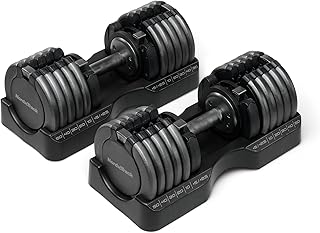
5 to 80 lb (2.3 to 36 kg) in 5 lb steps, changed by twisting the handle while the dumbbell sits in its cradle. The outer shape never changes with load and the construction is mostly metal, so it feels closer to a fixed dumbbell than any dial-based design here.
The 5 lb increment is too coarse for arm isolation work, and the dumbbell must be docked in its cradle to change weight, which noticeably slows drop sets. It also sits in the premium tier, so the cost per pound of steel is high next to plain rubber hex weights.
PowerBlock Elite EXP: Best Space Efficiency
A pin-selected block roughly 12 x 6 x 9 in (30 x 15 x 23 cm), covering 5 to 50 lb (2.3 to 22.7 kg) and expandable to 70 and then 90 lb. Small adder weights give real 2.5 lb steps, and the pin design has fewer parts that can jam than a dial mechanism.
Your hand sits inside the cage, which limits wrist rotation on curls and feels unfamiliar at first. Pin changes are slower than a twist or dial, and the boxy profile is awkward on floor presses and renegade rows compared with round-ended designs.
Core Home Fitness: Best Short Selectable Dumbbell
5 to 50 lb (2.3 to 22.7 kg) in 5 lb steps at roughly 14.5 in (37 cm), the shortest selectable set in this group. That compactness genuinely improves floor presses and close-grip work, where longer adjustables catch the torso and push the elbows away from the ribs.
The 5 lb increment is the compromise, and the 50 lb ceiling arrives sooner than expected on rows and split squats. There is no expansion kit, so outgrowing it means buying a heavier second set rather than upgrading the one you already own.
Ironmaster Quick-Lock 75 lb: Best Durability
Steel handles loaded with individual plates from 5 to 75 lb (2.3 to 34 kg) in 2.5 lb steps, held by a locking screw. There is no housing to crack and no dial to jam, and the knurled steel handle gives the most secure grip of anything in this comparison.
Ten to fifteen seconds per change effectively rules out supersets and drop sets, and the dumbbell gets physically longer as plates are added to the handle. Plate trees also take more floor space than a pair of cradles, so it trades convenience and footprint for long-term mechanical simplicity.
Frequently Asked Questions
These four questions decide which mechanism suits a particular household, and the answers matter far more when picking the best selectable dumbbells than the total weight printed on the side of the box ever will.
Which selector mechanism lasts longest?
Screw-lock plate systems have the fewest parts that can fail, followed by twist handles with mostly metal construction. Dial systems are the fastest but depend on plastic housings, and pin designs sit somewhere in between. Handling matters as much as design, since knocks and drops cause the majority of failures.
Can selectable dumbbells be dropped?
No. Manufacturers specify controlled placement, and a drop from 18 to 24 in (46 to 61 cm) can crack a housing or bend a rail. If you train close to failure on presses, work over a bench or stop a repetition earlier than you would with fixed hex weights.
How fast should weight changes be?
Two to four seconds keeps supersets and drop sets practical, five to ten seconds suits straight sets comfortably, and anything slower reshapes your programming. Match the mechanism to how you actually train rather than to how quickly the marketing video makes it look.
Are they better than fixed pairs?
For space and coverage, yes: a single pair replaces an entire rack. Fixed rubber hex weights still win on durability, handle feel and rough handling, which is why a common home setup is one selectable pair covering the working range plus a single heavy fixed pair kept for rows.
See More:
- Hot yoga mat best
- Best dumbbells exercises
- Best workout dumbbells
- Best back exercises using dumbbells
- Best exercise upright bike
- Best exercise stationary bike
Final Thoughts
The best selectable dumbbells are chosen by mechanism first, increment size second and footprint third. Take a dial or twist system if change speed matters most, a screw-lock design if long-term durability does, keep every set off the floor rather than dropping it, and measure the storage corner carefully before ordering.


Write Your Review
No reviews yet. Be the first to share your experience!