
Key takeaways
What's inside
Best budget adjustable dumbbell shopping is really a question about what you are willing to give up. Every step down in price removes something specific: fine increments, change speed, steel, or warranty. This guide names each trade-off in order, then compares six options. Knowing which trade-off you accept is the job.
As an Amazon Associate we earn from qualifying purchases at no extra cost to you. Product prices and availability are accurate as of the date shown and are subject to change.


As an Amazon Associate we earn from qualifying purchases at no extra cost to you. Product prices and availability are accurate as of the date shown and are subject to change.
By Chris Parker
🛒 Best Price Today on Amazon
Prime members get fast, free shipping on everything above, plus member-only deals. New members get a 30-day free trial — cancel anytime.
How to Choose the Best Budget Adjustable Dumbbell
Cheap adjustable dumbbells are not worse versions of expensive ones; they are different compromises. Picking the best budget adjustable dumbbell means deciding which of four things you can live without, because at the low end you will be giving up at least two of them.
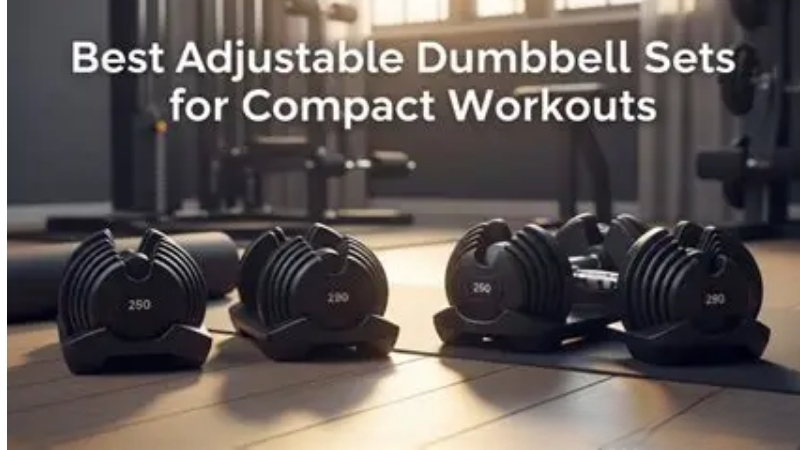
What Each Price Step Removes
The mid tier is where the choice is widest, and below it the substitutions are consistent. First to go is the fine increment: 2.5 lb (1.1 kg) steps become 5 lb (2.3 kg), which stalls smaller lifts long before the ceiling weight matters to anyone.
Next is change speed. Selectorised mechanisms give way to threaded collars, taking adjustment from two or three seconds to 30 to 60 seconds per side. That is workable for slow strength work and genuinely obstructive for circuits or drop sets.
Then materials and cover. Steel gives way to more plastic in the housing, and warranties shorten from ten years to two or one. None of those four appear in a headline specification, which is why comparing prices alone tends to produce a purchase people regret within months.
Increment Size Versus Ceiling Weight
People shop for the ceiling and are limited by the step. A pair reaching 50 lb (22.7 kg) covers pressing and squatting for most home lifters, but if it only moves in 5 lb jumps, curls and lateral raises stall almost immediately at working loads of 10 to 30 lb (4.5 to 13.6 kg).
Plate-loaded handles invert this. They are the cheapest option here and give the finest steps available, down to 1.25 lb (0.57 kg) per side, because you choose the plates. What they cost you is time, and that cost is paid on every single weight change.
Footprint, Storage and Floor Load
Footprint for the best budget adjustable dumbbell is roughly 3 sq ft (0.28 sq m) with cradles, though plate-loaded sets need more because the loose plates have to live somewhere and do not stack neatly against a wall.
Shelf rating is the number people skip. A 50 lb pair plus cradles totals near 118 lb (54 kg), which exceeds what many domestic shelves are rated to carry. Floor-standing cradles avoid the question, and on suspended timber a plate set is worth spreading with matting.
Training area is separate: about 6 x 6 ft (1.8 x 1.8 m) of clear floor, plus your standing height and roughly 20 in (50 cm) of ceiling for overhead work. Measure the shelf, the floor area and the doorway before ordering anything at this weight.
Durability, Warranty and the Set-Down Rule
Failure modes follow the mechanism. Threaded collars work loose during high-repetition sets and need checking between them. Selector pins have few moving parts and long track records. Dial systems carry the most plastic, and the CPSC recalled over 3.7 million dial units in June 2025 after plates separated from handles.
Warranty length is the clearest signal at this end, running from one or two years on budget imports to ten on established pin systems. Spare parts availability matters more over five years: a brand selling replacement pins, collars and cradles makes a cheap set repairable rather than disposable.
One rule holds regardless of price: no adjustable dumbbell should be dropped, and impact voids most cover. If your training ends sets with the weight leaving your hands, a cheap fixed pair is a safer purchase than a cheap adjustable one.
Top Picks: Best Budget Adjustable Dumbbell Options
Six best budget adjustable dumbbell options below, ordered from cheapest to the point where spending more stops making sense. A fixed pair is included at the end, because at the light end it is often the more honest answer.
| Set | Mechanism | Smallest step | Main trade-off |
|---|---|---|---|
| Yes4All Spinlock Set | Threaded collar | 1.25 lb (0.57 kg) | 30-60 s per side |
| CAP Adjustable Dumbbell Set | Threaded collar | Plate dependent | Same, plus storage |
| Core Fitness Adjustable | Slide selector | 5 lb (2.3 kg) | Coarse steps, more plastic |
| Bowflex Results Series 552 | Dual dial | 2.5 lb (1.1 kg) | Short warranty, 16.9 in |
| PowerBlock Elite EXP | Selector pin | 2.5 lb (1.1 kg) | Square shape |
| CAP Rubber Hex Pairs | None | Per pair bought | Space and cost per step |
Yes4All Spinlock Set: Cheapest With the Finest Steps
Threaded steel handles with cast iron plates and screw-on collars. Because you choose the plates, steps as small as 1.25 lb (0.57 kg) per side are possible, finer than any selectorised set at any price, and plates can be added over months rather than all at once.
Changing weight takes 30 to 60 seconds per side, ruling out circuits and drop sets. Collars work loose during high-repetition sets and must be checked. Loaded length grows quickly and crowds the ribs on rows. Budget tier, and slow by design.
CAP Adjustable Dumbbell Set: Spinlock With a Case
The same threaded handle and cast iron plate arrangement, usually supplied as a graduated set in a moulded case. The case is the real difference: loose plates otherwise migrate around a room, and a defined home is what keeps a cheap set usable.
Adjustment speed is identical to any spinlock set, so the same 30 to 60 seconds per side applies. The case occupies permanent floor space. Plate counts sometimes fall short of the listing, so check before the return window closes. Budget tier.
Core Fitness Adjustable: Cheapest Selectorised
A slide-selector pair covering 5 to 50 lb (2.3 to 22.7 kg) per hand in 5 lb steps, sold with moulded cradles. It undercuts the better-known selectorised sets substantially while keeping quick weight changes and a broadly conventional dumbbell shape.
Steps of 5 lb throughout stall smaller movements at the light end, which is the main compromise. There is more plastic in the housing than the steel-heavy alternatives, and the selector needs the dumbbell seated squarely. Build tolerances vary between units. Budget to mid tier.
Bowflex Results Series 552: Fine Steps at Mid Price
A dual-dial pair covering 5 to 52.5 lb (2.3 to 23.8 kg), stepping 2.5 lb (1.1 kg) below 25 lb, with changes taking about three seconds. It is the cheapest route to genuinely fine increments combined with fast adjustment.
The handle stays 16.9 in (43 cm) at every weight. Warranty is short relative to pin-based competitors and the housing carries the most plastic here. The CPSC recalled over 3.7 million earlier SelectTech units in June 2025, so check serial numbers on anything used. Mid tier.
PowerBlock Elite EXP: Where Spending More Stops Paying
A selector-pin block covering 5 to 50 lb (2.3 to 22.7 kg) per hand with 2.5 lb adders, expandable to 70 or 90 lb (32 or 41 kg). Steel and high-impact polymer, few moving parts, and the longest warranty in this group make it the sensible ceiling for a budget search.
The rectangular shape presses awkwardly against the forearm and thigh. Adder weights sit inside the block and slow adjustment. It must never be dropped, and expansion kits are separate purchases. Mid tier, and the point where paying more buys little.
CAP Rubber Hex Pairs: The Honest Alternative
Fixed rubber-coated hex dumbbells with no mechanism at all. At the light end, two or three pairs often cost less than a cheap adjustable set, tolerate being dropped, never need checking, and will outlast every option above them.
Cost per step is high across a full range, and a graduated set needs several feet of wall run and a floor rated for it. Rubber smells strongly when new. Gaps between pairs are fixed at purchase. Budget to mid tier per pair.
Frequently Asked Questions
These four questions cover what people ask when comparing the best budget adjustable dumbbell options, mostly about what gets cut at each price. Answers stay with equipment; for training questions or an existing injury, speak to a certified trainer and your doctor.
What do I give up by buying cheap?
Usually two of four things: fine increments, change speed, steel content and warranty length. Below the mid tier, 2.5 lb steps become 5 lb, selectorised mechanisms become threaded collars, and cover shortens from ten years to one or two.
Are spinlock dumbbells worth it?
For slow strength work on a tight budget, yes, and they give the finest increments available at any price. For circuits or drop sets, no: 30 to 60 seconds per side makes those formats impractical, and collars need checking between high-repetition sets.
Is a cheap adjustable better than fixed pairs?
Not always. At light weights, two or three fixed pairs often cost less than a cheap adjustable set, tolerate being dropped and never fail. Adjustables win once the range you need spans more than three or four weights.
How much should I spend to stop compromising?
Around the point where you get 2.5 lb increments, a selectorised mechanism and a long warranty together. Above that, extra spending mostly buys shape and finish rather than function, which is why the mid tier is where most home lifters should stop.
See More:
- Best beginner jump rope
- Best boxing jump rope
- Best boxer jump rope
- Best cheapest yoga mat
- Best workout exercise equipment
Final Thoughts
The best budget adjustable dumbbell is the one whose compromise you can actually live with. Spinlock sets trade time for the finest steps, cheap selectorised sets trade increments for speed, and at light weights fixed pairs beat both. Check your shelf rating before ordering.


Write Your Review
No reviews yet. Be the first to share your experience!