
Key takeaways
What's inside
Best gym equipment for full body workout setups should be judged by the gaps they leave, not the exercises they list. Five patterns matter: push, pull, hinge, squat and carry. Most single purchases cover three and quietly miss two. This guide maps that coverage, then five picks. Vertical pulling is the usual missing one.
As an Amazon Associate we earn from qualifying purchases at no extra cost to you. Product prices and availability are accurate as of the date shown and are subject to change.


As an Amazon Associate we earn from qualifying purchases at no extra cost to you. Product prices and availability are accurate as of the date shown and are subject to change.
By Chris Parker
🛒 Best Price Today on Amazon
Prime members get fast, free shipping on everything above, plus member-only deals. New members get a 30-day free trial — cancel anytime.
How to Choose the Best Gym Equipment for Full Body Workout Coverage
Exercise counts on packaging are close to meaningless. A more useful test for the best gym equipment for full body workout is pattern coverage: whether a purchase lets you push, pull, hinge, squat and carry, and which of those it leaves you unable to load properly.
The Five Patterns and Where Gaps Appear
Pushing and squatting are the easiest to cover, since dumbbells handle both from the first purchase. Hinging and carrying follow closely, needing only a heavy enough load and floor you can set weight down on without damaging it.
Vertical pulling is where home setups fail. Pull-ups need a bar with 8 ft (244 cm) of ceiling, and pulldowns need a cable stack or a rack. Without either, a band and a door anchor is the only route, and band tension is not equivalent to weight for progression.
Heavy squatting is the second gap. Dumbbells cap out at what you can get into position, typically well below what your legs can handle, so a rack and barbell is the only route past that ceiling. Recognising both gaps early saves buying twice.
Weight Ceiling and Increment Size
Ceiling requirements differ sharply by pattern. Isolation work sits around 10 to 30 lb (4.5 to 13.6 kg), pressing around 30 to 50 lb (13.6 to 22.7 kg), and rowing and carrying commonly climb past 50 lb (22.7 kg) per hand for trained lifters within a couple of years.
Increment size matters inversely. Steps of 2.5 lb (1.1 kg) are close to mandatory below 30 lb, where a 5 lb jump is a 20 percent increase. Above 50 lb the same step is under ten percent, which is why high-ceiling sets with coarse steps still work well for the heavy patterns.
Footprint, Ceiling Height and Floor Load
Footprint for the best gym equipment for full body workout scales with ambition. Dumbbells plus cradles claim about 3 sq ft (0.28 sq m). A stowable bench stands in roughly 1.5 sq ft (0.14 sq m). A power rack needs about 4 x 4 ft (1.2 x 1.2 m) plus a 7 ft (213 cm) bar path and walking clearance.
Ceiling height is the hard limit. Full-height racks stand 80 to 92 in (203 to 234 cm) and need clearance above for pull-ups, so 8 ft (244 cm) is the practical minimum. Standing overhead pressing needs your height plus about 20 in (50 cm) regardless of what you own.
Floor load matters once plates arrive. A rack plus a full plate set concentrates several hundred pounds into a small area, which is irrelevant on a concrete slab and worth spreading with plywood and matting on a suspended timber floor. Measure the room, ceiling and doorway before ordering.
Assembly, Permissions and Buying Order
Boxes at the rack end are dense rather than bulky, and assembly commonly runs two to four hours with two people and a socket set. Some racks are designed to be bolted down, which is frequently prohibited in rented properties, so check before ordering rather than after.
Buying order determines how many gaps you carry at once. Dumbbells then a bench covers four patterns in roughly 4.5 sq ft (0.42 sq m). Bands close the vertical pull gap cheaply. A rack closes the heavy squat gap last and costs the most space by a wide margin.
Durability, Limits and Learning the Patterns
Each category fails differently. Adjustable dumbbells are damaged by impact and must never be dropped. Bands degrade with sunlight and age and can snap without warning. Rack wear points are welds, pop-pin holes and the powder coat where the bar contacts steel.
Barbell squatting and pressing are worth learning properly rather than from a manual. If you are new to loading these patterns, or returning after an injury, work with a certified coach and check with your doctor before starting a new programme.
Top Picks for the Best Gym Equipment for Full Body Workout
Five best gym equipment for full body workout picks below, listed in the order that closes the most gaps for the least space. Few people buy all five, and the first two cover four of the five patterns, which is why they belong at the start of any sensible sequence.
| Pick | Covers | Gap left | Footprint |
|---|---|---|---|
| PowerBlock Elite EXP | Push, squat, hinge, carry | Vertical pull | About 3 sq ft (0.28 sq m) |
| Flybird Adjustable Bench | Pressing angles, rows | Nothing on its own | Folds and stands |
| Yes4All Cast Iron Kettlebell | Hinge, carry, squat | Heavy pressing | About 1 sq ft (0.09 sq m) |
| Bodylastics Stackable Bands | Vertical and horizontal pull | Measurable load | Fits a drawer |
| REP PR-1100 Power Rack | Heavy squat, pull-ups | Needs bar and plates | About 4 x 4 ft (1.2 x 1.2 m) |
PowerBlock Elite EXP: Covers Four Patterns
A selector-pin adjustable dumbbell running 5 to 50 lb (2.3 to 22.7 kg) per hand, expandable to 70 or 90 lb (32 or 41 kg), in a cube of roughly 12 x 6 x 6.25 in (30 x 15 x 16 cm). It handles pushing, squatting, hinging and carrying from a single purchase.
Vertical pulling is the gap it cannot close on its own. It must never be dropped, which constrains heavy carries. The rectangular shape presses awkwardly against the forearm at first, and the block needs a bench to reach its full pressing range. Mid tier.
Flybird Adjustable Bench: The Multiplier
A folding multi-angle bench weighing about 28 lb (12.7 kg) at roughly 49 x 16 in (125 x 40 cm), rated between 700 and 800 lb (318 and 363 kg) by model. It adds incline pressing, chest-supported rows and step work without adding meaningful stored footprint.
It covers no pattern alone, so it is always a second purchase rather than a first. The common criticism is sitting too tall in the flat position, which costs leg drive. Warranty is typically one year against ten or more on heavier benches. Budget tier.
Yes4All Cast Iron Kettlebell: Hinge and Carry Without Restrictions
A single-piece cast iron bell with powder coat and a flat base. It loads hinging and carrying patterns and, unlike an adjustable dumbbell, tolerates being set down hard, which is exactly what heavy carries taken near failure require.
Weights step roughly 4 kg (8.8 lb) apart, so progression is coarse and each size is a separate purchase. It is a poor tool for heavy pressing. Handle seams vary between units and powder coat abrades palms. Learn swing technique from a certified coach. Budget tier.
Bodylastics Stackable Bands: Closes the Pull Gap Cheaply
Clip-on rubber tubes with handles, ankle straps and a door anchor, fitting into a drawer. The door anchor is what matters here: it enables vertical and horizontal pulling in a rented flat with no rack, no ceiling clearance and no wall fixings.
Tension is not equivalent to weight, so progression cannot be tracked precisely against the other patterns. Rubber degrades with sunlight and age and can snap without warning. Door anchors need a firmly latching door. Budget tier, and the cheapest gap closer here.
REP PR-1100 Power Rack: Closes the Heavy Squat Gap
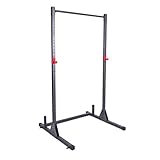
A 14-gauge rack with 2 x 2 in (51 x 51 mm) uprights that stands without bolting down, which makes it viable where drilling is prohibited. It includes a pull-up bar and takes standard J-cups and safety bars, closing both remaining gaps at once.
Thinner steel flexes more under heavy load than an 11-gauge rack, and hole spacing is wider so safety bar placement is less precise. It needs 8 ft (244 cm) of ceiling for pull-ups, a bar and plates to be useful, and about 4 x 4 ft (1.2 x 1.2 m) permanently. Budget to mid tier.
Frequently Asked Questions
These questions cover what people ask when planning the best gym equipment for full body workout coverage, mostly about sequence and gaps. Answers stay with equipment; for technique or an existing injury, work with a certified coach and your doctor.
What should I buy first?
Adjustable dumbbells, then a folding bench. That pairing covers pushing, squatting, hinging and carrying in roughly 4.5 sq ft (0.42 sq m) of storage. Vertical pulling is the remaining gap, and a band set with a door anchor closes it for very little money.
Can I train everything without a rack?
Most patterns, yes. The two things a rack adds are heavy squatting above what you can lift into position with dumbbells, and a pull-up bar. If your ceiling is under 8 ft (244 cm) or you cannot drill, bands and dumbbells cover the rest.
Do resistance bands really replace a cable machine?
For movement coverage, largely. For measurable progression, no, because band tension changes through the range and is not equivalent to a stated weight. Most people use bands to close the pull gap and track progress on the weighted patterns instead.
How much ceiling height do I need?
Around 8 ft (244 cm) for a rack with pull-ups, and your standing height plus about 20 in (50 cm) for overhead pressing. Under a sloped ceiling or a low beam, seated and lying work remains fully available, which is often what makes a small room workable.
See More:
- Best beginner jump rope
- Best boxing jump rope
- Best boxer jump rope
- Best cheapest yoga mat
- Best workout exercise equipment
Final Thoughts
The best gym equipment for full body workout coverage is chosen by the gaps it leaves. Dumbbells and a bench cover four patterns cheaply, bands close vertical pulling, and a rack closes heavy squatting at the highest space cost. Check your ceiling height and permissions before ordering.





Write Your Review
No reviews yet. Be the first to share your experience!