
A ski erg machine buying guide should explain the differences between resistance systems, pulling mechanisms, frame designs, and workout monitors. Choosing the right trainer requires understanding how the equipment converts pulling effort into resistance. This guide covers the technical features, practical trade-offs, and purchasing considerations that matter most.
Quick Verdict: What Should You Look for in a Ski Erg Machine?
A ski erg is a stationary training machine that uses repeated pulling movements to simulate aspects of cross-country skiing.
It typically features handles connected to a resistance system through cords or another mechanical transmission.
Many well-known ski ergs use air resistance, although alternative mechanisms exist.
The best machine depends on the user’s intended workout style, available space, installation options, and preference for performance tracking.
Buyers should prioritize:
-
Resistance mechanism: Predictable effort characteristics suitable for training.
-
Pulling system: Smooth cord travel and reliable handle return.
-
Handle design: Comfortable grips and appropriate movement range.
-
Mounting: Secure wall attachment or compatible freestanding support.
-
Frame construction: Stable operation and suitable component quality.
-
Workout monitor: Useful performance measurements.
-
User compatibility: Appropriate handle height and pulling geometry.
-
Maintenance: Accessible inspection and replacement procedures.
-
Noise: Acceptable sound for the intended environment.
-
Warranty and support: Clear coverage and replacement-part availability.
For users interested in structured, measurable ergometer workouts, performance monitoring and resistance behavior deserve particular attention.
For general home exercise, simplicity, fit, and a secure installation may be more important than advanced connected features.
Understanding How Ski Erg Machines Work
The central mechanism of a ski erg converts a pulling movement into resistance.
Different resistance systems achieve this in different ways.
The Basic Pulling Mechanism
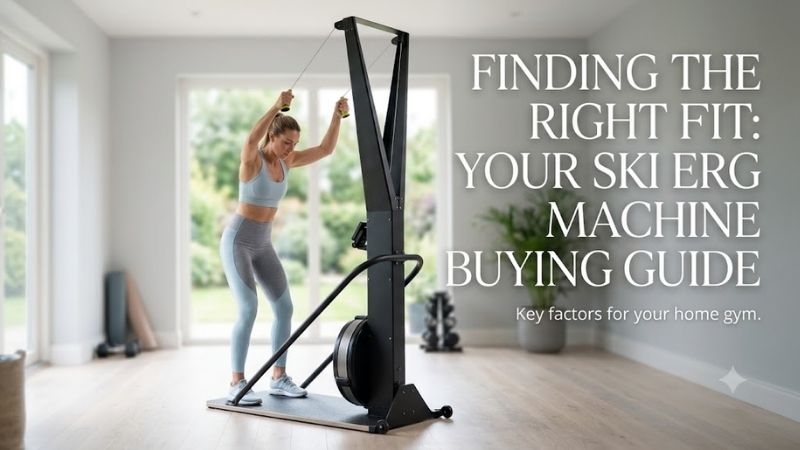
Most ski ergs feature handles connected to a resistance assembly.
The user pulls the handles downward or through another approved movement pattern.
The pulling force drives the mechanism.
A return system then restores the handles toward their starting position.
The exact design may include synthetic cords, pulleys, spools, flywheels, and other components.
These mechanical features influence the pulling feel, durability, and maintenance requirements.
Air Flywheel Resistance
Air-resistance machines use a rotating fan flywheel.
Pulling the handles accelerates the flywheel, while air movement creates aerodynamic resistance.
The resistance is dynamically related to the user’s effort.
In general, stronger pulls produce greater flywheel speed and resistance.
This differs from a fixed weight stack or a conventional resistance selector.
Handle Return Systems
The return mechanism is responsible for drawing the handles back after a pull.
Its design affects cord tension and movement consistency.
Unexpected slack or uneven return can indicate mechanical problems.
A suitable ski erg should provide the intended handle movement without catching or abnormal resistance.
Double-Poling and Alternating Techniques
Some ski ergs support simultaneous two-arm pulling and alternating-arm movements.
These techniques involve different timing and coordination.
However, not every machine supports identical exercises.
Buyers should verify the manufacturer’s documented operating techniques.
Ski Erg Training Compared With Outdoor Skiing
A ski erg simulates certain aspects of skiing but does not reproduce every element of outdoor cross-country movement.
It provides a stationary pulling exercise rather than complete skiing locomotion.
The movement can involve the arms, torso, and lower body, depending on technique.
Actual exercise demands vary with the user and machine.
Comparing Ski Erg Resistance Systems
Resistance is a major point of difference between ski-style trainers.
Air Resistance
Air resistance responds dynamically to pulling effort.
This can make it useful for a broad range of exercise intensities.
However, the feel depends on flywheel design, airflow, and mechanical characteristics.
Air-resistance equipment also produces airflow sound.
Magnetic Resistance
Magnetic systems use magnetic forces within a rotating mechanism.
Some offer manual settings, while others use electronic controls.
They may provide a different resistance feel from air systems.
However, they are not automatically quieter or more durable in every implementation.
Friction-Based Resistance
Some exercise machines use friction contact to create resistance.
If a ski-style trainer uses this mechanism, maintenance and wear characteristics should be reviewed.
Friction systems vary, and buyers should understand the exact construction.
Electronic Resistance Control
Some machines offer electronically controlled resistance or programmed workouts.
These can be convenient when structured changes are desired.
However, electronic controls increase complexity and may introduce power requirements.
Resistance Comparison Table
| Resistance system | How it operates | Main advantage | Main consideration |
|---|---|---|---|
| Air | User accelerates a fan flywheel | Effort-responsive resistance | Airflow noise |
| Magnetic | Magnetic force influences rotating mechanism | Controlled adjustment possible | Range varies |
| Friction | Mechanical contact produces resistance | Potentially simple design | Wear and maintenance |
| Electronic control | Console adjusts supported resistance system | Programmable changes | Power and service needs |
The best resistance type depends on the intended training, not the number of advertised levels.
Flywheel Design and Damper Settings
Air-resistance flywheels are important to understand because their behavior differs from that of many exercise bikes.
Flywheel Inertia
A flywheel’s rotational inertia influences how its speed changes when force is applied.
However, flywheel weight alone does not describe the entire resistance system.
Diameter, mass distribution, airflow, drivetrain design, and monitoring calculations can all matter.
What the Damper Changes
On machines with airflow dampers, changing the damper position alters how much air enters the flywheel housing.
This changes the flywheel’s operating characteristics.
It does not add a fixed number of pounds of resistance.
Damper Setting vs. Workout Intensity
A higher damper setting does not automatically produce a better workout.
Users can generate substantial effort at different damper settings by changing pulling force and technique.
The appropriate setting should support comfortable, controlled movement and the intended training.
Drag Factor
Some performance monitors estimate a drag factor reflecting flywheel deceleration characteristics.
This can help describe the effective operating behavior of an air flywheel.
However, drag-factor systems and values are not necessarily interchangeable across different manufacturers.
Comparing Different Air-Resistance Machines
Two air-resistance ski ergs may use different flywheel designs and measurement algorithms.
A matching damper number does not establish identical resistance.
Performance comparisons require compatible measurement methods.
Handle Design, Cords, and Movement Quality
Handle Shape
Handles should provide secure and comfortable grip throughout the pulling movement.
Grip shape affects hand positioning and the feel of the exercise.
Some designs accommodate different techniques.
Handle Material
Handle materials and coverings influence durability and contact comfort.
However, appearance alone does not establish grip quality.
Consider the manufacturer’s intended usage and cleaning guidance.
Synthetic Drive Cords
Many ski ergs use synthetic cords to transmit force.
Cord quality, routing, and wear resistance matter.
Inspect cords as directed by the manufacturer.
Pulley and Spool Mechanisms
Pulleys and spools guide cord movement.
Their construction affects the pulling mechanism and maintenance requirements.
Unexpected noise or resistance may indicate misalignment or wear.
Handle Return Consistency
The handles should return smoothly according to the machine’s design.
Unusual slack, sticking, or inconsistent return should be investigated.
Adjustable Handle Position
Not every machine offers the same starting handle height.
Check whether the configuration suits the user.
Users with significantly different body proportions may need to consider handle travel and available movement range carefully.
Frame Construction and Mounting Options
Wall-Mounted Frames
Wall-mounted ski ergs can conserve floor space.
However, secure structural attachment is essential.
Follow the exact manufacturer’s mounting specifications.
Freestanding Frames
Freestanding models or compatible stands avoid permanent wall attachment.
They generally occupy more floor area.
Check stand stability and assembly requirements.
Frame Materials
Manufacturers may use aluminum, steel, or other structural materials.
Material choice alone does not prove durability.
Consider complete construction and intended loading.
Installation Hardware
Wall fasteners must match the structural material and installation instructions.
Never assume ordinary drywall anchors are suitable.
Equipment Weight
Machine weight matters during delivery, installation, and relocation.
Some configurations may require assistance during assembly.
User Load and Pulling Forces
Ski ergs experience repeated forces from pulling movements.
The frame and mounting system must accommodate the manufacturer’s intended loads.
Avoid modifying the machine or installing it on unsupported structures.
Workout Monitoring and Performance Data
Workout monitors are particularly important for buyers who want consistent tracking.
Time and Distance
Many consoles display duration and calculated distance.
However, stationary ergometer distance is generally a performance calculation rather than physical travel.
Compare distance across machines only when measurement systems are compatible.
Pace
Pace metrics can help structure workouts and monitor changes over time.
The calculation method depends on the monitor.
Power Output
Some monitors estimate power in watts.
This can be useful when tracking effort.
However, accuracy and comparability depend on the machine’s measurement system.
Stroke Rate
Stroke rate indicates the frequency of completed pulls.
It can help users maintain a consistent rhythm.
Heart Rate Monitoring
Some machines support compatible heart rate devices.
Check compatibility with the exact monitor and sensor.
Workout Programs
Advanced monitors may offer intervals, targets, and stored sessions.
These features may be useful for regular training.
However, a reliable basic monitor may be sufficient for many users.
Connectivity and Fitness Applications
Bluetooth Compatibility
Bluetooth may allow communication with compatible external devices.
The exact data available depends on the protocol and implementation.
App-Based Workout Tracking
Some systems support workout records and connected training applications.
Verify the specific compatibility before buying.
Online Training Features
Certain machines may support connected training environments.
However, the availability of software services and features can change.
Do not purchase solely based on an unverified software promise.
Data Consistency
If you intend to compare workouts over time, consistent equipment and measurement methods are important.
Switching between different machine types may produce data that is not directly comparable.
Noise and Practical Home Use
Airflow Noise
Air-resistance ski ergs produce airflow sound during operation.
Higher flywheel speeds can increase that sound.
Mechanical Sound
Cords, pulleys, spools, and bearings may produce additional noise.
Normal operating sounds should be distinguished from signs of wear or damage.
Wall Transmission
A wall-mounted machine may transmit some vibration through its attachment points.
Actual effects depend on building construction.
Floor Stand Vibration
Freestanding machines transfer forces through their base.
Suitable flooring and correct assembly are important.
Noise-Sensitive Spaces
For apartments or shared rooms, assess the exact machine’s acoustic characteristics and installation needs.
No resistance type should be assumed universally silent.
Durability and Maintenance Requirements
Inspecting Drive Cords
Inspect cords for fraying, damage, or unusual wear.
Follow the manufacturer’s replacement criteria.
Checking Pulleys
Pulleys and related mechanisms should operate correctly.
Unusual movement or noise may indicate a service issue.
Cleaning the Flywheel Area
Air-resistance systems may collect dust and debris.
Clean only according to the manufacturer’s instructions.
Monitor Maintenance
Electronic monitors may use batteries or other power arrangements.
Follow the maintenance recommendations.
Replacement Parts
Check whether cords, handles, pulleys, monitors, and other service components are available.
Warranty Coverage
Review coverage periods and exclusions.
Do not interpret warranty length alone as a guarantee of reliability.
Choosing a Ski Erg for Your Budget
Basic Ski-Style Trainers
Lower-cost machines may offer simplified resistance and tracking.
Determine whether their mechanisms match the intended exercise.
Midrange Equipment
Midrange products may include better monitoring, stronger support, or added adjustment features.
Evaluate the practical value of those upgrades.
Premium Ski Ergs
Premium machines may appeal to users who value detailed performance tracking and long-term component support.
However, the added cost should be justified by actual needs.
Wall Stand and Installation Costs
A wall-mounted unit may require professional installation.
A freestanding configuration may require a separate stand.
Compare the complete equipment and setup cost.
Maintenance and Service Costs
Consider replacement parts and support availability.
Long-term ownership value is more important than initial price alone.
Choosing a Ski Erg for Different Users
Beginners
Beginners should prioritize manageable effort, suitable handle geometry, and straightforward controls.
Experienced Athletes
Experienced users may value consistent performance metrics, resistance responsiveness, and structured workout features.
Home Gym Owners
Choose a configuration that fits the room and does not interfere with other equipment.
Apartment Residents
Installation restrictions and noise may determine whether wall-mounted or freestanding equipment is practical.
Taller Users
Check handle reach, machine height, and available pulling clearance.
Shared Household Use
A broad operating range and intuitive controls can help accommodate different users.
Ski Erg vs. Other Cardio Equipment
| Equipment | Movement | Main advantage | Main trade-off |
|---|---|---|---|
| Ski erg | Repeated pulling | Compact upright configuration | Installation and pulling clearance |
| Rowing machine | Seated rowing | Coordinated leg and pulling exercise | Long frame |
| Vertical climber | Climbing | Upright coordinated movement | Balance and height |
| Air bike | Seated cycling with handles on supported designs | Variable effort | Larger footprint |
| Cable trainer | Cable resistance exercise | Exercise variety | Different loading mechanism |
Ski Erg vs. Rowing Machine
A ski erg generally uses a standing pulling movement.
A rowing machine uses seated movement along a rail.
Both can employ air resistance, but their mechanics and body positions differ.
Ski Erg vs. Vertical Climber
A vertical climber coordinates the arms and legs in a guided climbing movement.
A ski erg focuses on pulling handles through a resistance system.
Neither is universally better.
Ski Erg vs. Air Bike
An air bike uses pedaling and, on certain models, moving handles.
A ski erg uses repeated pulling without a conventional cycling saddle.
Choose according to preferred exercise movement.
Setting Up a Ski Erg Machine
Select the Installation Location
Measure the required operating area and ceiling height.
Choose an Approved Mounting Method
Use manufacturer-approved wall mounting or a compatible floor stand.
Follow the Assembly Instructions
Secure every required component correctly.
Check Handle and Cord Operation
Verify that the mechanism moves as intended before exercising.
Set the Resistance Configuration
Use recommended damper or resistance settings appropriate to the machine.
Begin With Controlled Technique
Establish smooth movement before increasing effort.
Inspect After Use
Check for damage, unusual sounds, or mounting problems.
Common Buying Mistakes
Comparing Damper Settings as Fixed Resistance Levels
Air resistance does not function like a simple weight-stack selector.
Ignoring Installation Requirements
Wall construction and anchoring are critical.
Overlooking the Floor Stand Cost
Some stands are optional accessories.
Buying Based on Flywheel Weight Alone
Overall resistance behavior depends on more than flywheel mass.
Assuming Every Ski Erg Has Comparable Metrics
Performance calculations vary.
Neglecting Cord Maintenance
The pulling mechanism requires appropriate inspection and care.
Frequently Asked Questions
What Is the Most Important Feature in a Ski Erg Machine?
A reliable pulling mechanism, suitable resistance system, and secure installation are essential. Performance tracking becomes especially important for structured training.
Is Air Resistance Better Than Magnetic Resistance?
Neither is universally superior. Air resistance responds dynamically to pulling effort, while magnetic systems may offer a different adjustment experience.
Does a Higher Damper Setting Mean More Resistance?
It changes airflow and flywheel behavior on supported air-resistance systems. It does not represent a standardized fixed resistance weight.
Can a Ski Erg Be Used for Different Workout Intensities?
Yes, depending on the machine and individual capability. Air-resistance machines can respond to changes in pulling effort.
Do Ski Erg Cords Need Replacement?
Cords may require replacement when worn or damaged. Follow the manufacturer’s inspection and service instructions.
Is a Premium Ski Erg Worth the Cost?
It may be worthwhile when durable construction, consistent workout metrics, and replacement-part support matter to the buyer. The decision should reflect intended use and ownership requirements.
Conclusion
A ski erg machine should be selected according to resistance behavior, pulling mechanics, installation compatibility, and long-term serviceability. Air-resistance models offer effort-responsive workouts, while other resistance systems may suit different preferences. Prioritize secure mounting, comfortable handle travel, useful monitoring, and reliable component support before paying for additional technology .







Write Your Review
No reviews yet. Be the first to share your experience!