
Key takeaways
-
Your standing height and natural head movement.
-
Treadmill step-up height.
-
Additional elevation during incline operation.
-
Manufacturer-required overhead clearance.
-
Low ceiling fixtures, beams, or sloped ceilings.
Choosing a folding treadmill means balancing running comfort, workout performance, and storage space. A compact machine may fit your room but lack sufficient stride length, while a full-size model may be difficult to move. This folding treadmill buying guide explains the specifications, safety features, and practical trade-offs that matter before purchasing.
Quick Answer: What Should You Look for in a Folding Treadmill?
The best folding treadmill is one that safely supports your intended activity, accommodates your natural stride, fits your available space, and provides an appropriate combination of speed, incline, and controls.
For most buyers, running surface dimensions, manufacturer-approved usage, folding design, and weight capacity deserve more attention than advertising claims about horsepower or advanced workout technology.
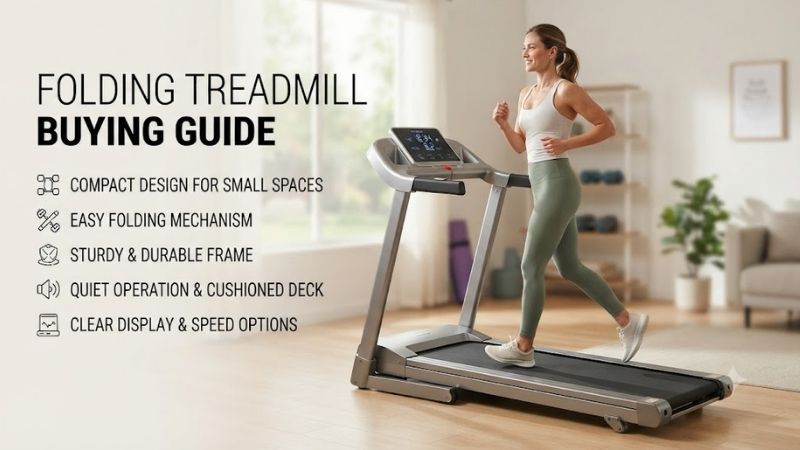
Essential Folding Treadmill Specifications
| Feature | Walking-Focused Buyers | Regular Runners | Why It Matters |
|---|---|---|---|
| Running deck length | Approximately 50–55 in may be suitable | 55–60 in or longer is often preferable | Accommodates natural stride |
| Running deck width | Around 18–20 in | Around 20–22 in | Provides lateral foot-placement room |
| Maximum speed | 6–10 mph may be sufficient | 10–12 mph or more, depending on pace | Supports intended workout speeds |
| Incline | Optional; 0–10% offers variety | Adjustable incline can support varied workouts | Changes walking and running demands |
| User weight capacity | At least the user’s body weight | At least the user’s body weight | Ensures use stays within the manufacturer’s limit |
| Folding type | Manual, assisted, or fold-flat | Often assisted deck-up folding | Affects storage convenience |
| Controls | Basic buttons and display | Accessible speed and incline adjustments | Makes adjustments easier during workouts |
| Safety | Emergency stop, secure folding mechanism | Same, with adequate running clearance | Reduces avoidable equipment hazards |
These are general shopping guidelines rather than universal minimum requirements. Body height alone cannot determine the perfect deck length, and a treadmill’s maximum speed does not independently prove that it is suitable for sustained running.
The most important rule: Choose the running surface and equipment design for your actual activity before considering extra software features, entertainment screens, or advertised motor horsepower.
1. Understand the Different Types of Folding Treadmills
Not every folding treadmill stores in the same way. Understanding its folding mechanism helps prevent one of the most common purchasing mistakes: buying a treadmill that technically folds but still occupies too much space.
Deck-Up Folding Treadmills
Common for traditional home running treadmills
Many use hydraulic or gas-assisted systems to reduce the effort required to lift and lower the deck.
Advantages: Full-length running belts, conventional handrails, and reduced stored floor length.
Disadvantages: The treadmill becomes tall when folded, may remain heavy, and requires sufficient clearance around the moving deck.
Best for: Buyers who want a proper running treadmill and have enough ceiling height for vertical storage.
Fold-Flat Treadmills
Designed for compact horizontal storage
Some models also incorporate automatic folding systems.
Advantages: Potentially easier storage against a wall or in a suitable low-height space.
Disadvantages: Not every fold-flat treadmill fits beneath furniture, and compact designs may involve compromises in running area or control layout.
Best for: Apartment residents and buyers who must reclaim their exercise space after workouts.
Folding Walking Pads
Primarily intended for walking rather than running
They typically have lower profiles and smaller walking belts than conventional treadmills.
Advantages: Compact storage, simple operation, and suitability for many under-desk walking setups.
Disadvantages: Shorter or narrower belts, lower speed limits, and fewer support features.
Best for: Walking-focused buyers who do not require a conventional running treadmill.
A folding walking pad should not automatically be treated as suitable running equipment simply because its advertised maximum speed seems adequate.
2. Choose the Right Running Deck Size
The running surface is one of the most important specifications because it directly affects usable stride space.
How Long Should a Folding Treadmill Belt Be?
A running belt must accommodate your normal forward and backward foot movement.
Shorter decks may be suitable for walking or controlled jogging, but faster running generally increases the importance of having sufficient belt length.
| Deck Length | Typical Purchasing Consideration |
|---|---|
| Under 50 in | Compact walking and limited jogging, if manufacturer-approved |
| 50–54 in | Walking and jogging with relatively moderate strides |
| 55–59 in | Versatile walking and running for some users |
| 60 in or longer | More room for longer strides and faster running |
These categories are approximate rather than strict fit rules.
A 60-inch belt may be beneficial for a tall runner, but the ideal size also depends on actual stride mechanics and preferred speed.
Likewise, a shorter person may still prefer additional length when performing faster workouts.
Buying recommendation: If regular running is a major priority and available space permits, a 60-inch deck is a sensible starting point.
How Wide Should the Running Belt Be?
Belt width provides space for normal side-to-side variation during movement.
A narrow belt may be adequate for controlled walking but feel restrictive during faster running.
For conventional running treadmills, approximately 20 inches is a practical starting point. Wider 22-inch decks may appeal to buyers who prefer additional lateral space.
However, a larger running belt also increases the overall equipment footprint.
Buying recommendation: Prioritize a comfortable running area rather than choosing the narrowest possible machine solely to save a few inches.
Why Exterior Dimensions Can Be Misleading
Manufacturers usually list both running surface dimensions and overall treadmill dimensions.
These measurements serve different purposes.
The running surface determines usable belt space. Exterior dimensions determine how the equipment fits into your room.
For example, a treadmill with a 20 × 60-inch running surface can have a total frame length exceeding 75 inches.
Always review both figures before purchasing.
3. Evaluate Motor Power Without Falling for Marketing Claims
Motor horsepower is one of the most prominently advertised treadmill specifications, but it can also be one of the most misleading.
Peak Horsepower vs. Rated Power
Manufacturers may describe treadmill motors using peak horsepower, continuous horsepower, rated input power, or other measures.
These figures are not automatically comparable.
Peak horsepower may refer to a short-duration maximum under particular conditions rather than a sustainable operating level.
Continuous-duty ratings are more relevant to sustained use, but the details depend on the manufacturer’s measurement methods.
An advertised 4 HP peak motor should not automatically be considered more capable than a motor with a lower continuous-duty rating.
What Motor Specifications Should You Prioritize?
Look for a treadmill specifically intended by its manufacturer for your planned activity.
For frequent running, consider whether the treadmill is designed for repeated running sessions rather than occasional walking.
Useful information includes manufacturer-approved usage limits, warranty terms, cooling requirements, and whether the equipment provides sufficient speed under its stated load conditions.
Avoid choosing a treadmill based on horsepower alone. Motor ratings do not independently establish durability, noise, or running performance.
Are Brushless Motors Better?
Brushless motors eliminate mechanical brushes from the motor design and can provide advantages in certain applications.
However, a brushless treadmill is not automatically quieter, more durable, or more powerful than every brushed-motor alternative.
Controller quality, mechanical construction, cooling, operating loads, and maintenance also affect overall performance.
Treat motor type as one design consideration rather than a universal ranking system.
4. Match the Speed Range to Your Workouts
A treadmill’s maximum speed should suit your intended walking or running pace.
Higher maximum speed can offer more flexibility, but it should not become the main purchasing criterion unless you actually need it.
Walking and Light Exercise
For general walking, a treadmill that supports comfortable lower speeds and gradual speed adjustments is usually sufficient.
A 6 mph maximum may already exceed what many walking-focused users need.
Low starting speeds and responsive controls may be more valuable than an unusually high maximum.
Jogging and Recreational Running
Buyers who regularly jog should prioritize an adequate running deck, stable handrails, and accessible speed controls.
A treadmill capable of 10 mph may offer enough speed flexibility for many recreational routines.
However, verify that the equipment is designed for running rather than only walking.
Faster Running and Interval Workouts
Faster workouts place greater importance on running room, quick controls, equipment stability, and the manufacturer’s intended operating conditions.
A 12 mph maximum corresponds to a five-minute-mile belt pace, but that numerical capability alone does not establish whether the treadmill is appropriate for repeated fast intervals.
Buy equipment designed for your intended running application rather than assuming every treadmill with a high top speed performs equally well.
5. Understand Treadmill Incline Features
Incline changes the angle of the running deck and allows users to vary their workouts without relying solely on speed changes.
Manual vs. Powered Incline
Manual incline generally requires the user to stop the treadmill and adjust the deck or support mechanism.
It is usually less convenient for sessions requiring frequent changes.
Powered incline allows adjustments using treadmill controls while following the manufacturer’s operating instructions.
This can be useful for workouts involving gradual hill profiles or programmed changes.
Incline Percentage vs. Incline Levels
Some treadmill manufacturers advertise incline as a percentage, while others describe numbered levels.
These values are not interchangeable.
For example, a treadmill offering 15 incline levels does not necessarily have a maximum 15% incline.
Always verify the actual deck angle or grade information when comparing models.
How Much Incline Do You Need?
A 10–12% maximum incline can provide meaningful variety for many home workouts.
A 15% incline offers additional range for buyers who specifically want steeper treadmill sessions.
However, higher incline capability is not automatically necessary.
Buyers focused on steady, level running may benefit more from a larger running deck or better controls than from paying for additional incline range.
Use incline gradually, within your abilities and the treadmill’s operating instructions.
6. Compare Folding Mechanisms and Storage Dimensions
A treadmill that folds is not necessarily easy to store. Some folding machines weigh over 200 lb and remain almost six feet tall when stored vertically.
Measure the Treadmill in Both Positions
Before purchasing, record the machine’s complete dimensions in its operating and folded configurations.
| Measurement | Why It Matters |
|---|---|
| Unfolded length | Determines the floor space needed during workouts |
| Unfolded width | Affects placement between furniture and walls |
| Folded length | Determines how much floor space remains occupied |
| Folded height | Critical for vertical storage and ceiling clearance |
| Product weight | Affects delivery, assembly, and repositioning |
| Step-up height | Influences required overhead clearance |
| Required safety clearance | Determines the actual usable workout area |
A folding treadmill measuring 76 inches long while operating might reduce to approximately 44 inches in stored length. However, its height may increase substantially when the deck is raised.
That reduction is useful only when your room accommodates the folded configuration safely.
Hydraulic Folding vs. Automatic Folding
Hydraulic-assisted systems reduce the effort needed to raise or lower the deck. They still require the user to operate the folding mechanism correctly.
Automatic folding systems use powered components to perform some or all of the folding process.
Automatic systems may be convenient for frequent storage, but they introduce motors, actuators, or additional moving components that could require servicing.
Neither approach is universally better.
For buyers who fold their treadmill after every workout, ease of operation deserves significant consideration. For those who rarely fold it, running surface and equipment quality may be more important.
Transport Wheels and Equipment Weight
Transport wheels can make repositioning easier, but they do not eliminate the challenges associated with moving heavy equipment.
A treadmill weighing 250 lb may be manageable when rolling over a suitable hard floor but difficult to maneuver over thick carpet, thresholds, or uneven surfaces.
Do not assume that transport wheels make a treadmill safe to move up stairs.
Check the manufacturer’s relocation instructions and arrange appropriate assistance when necessary.
7. Check Weight Capacity and Frame Stability
User weight capacity is a necessary specification, but it should not be treated as a complete measure of treadmill quality.
Understanding Manufacturer Weight Limits
Treadmills have maximum user weight ratings that must be respected.
For example, if a machine has a stated 300 lb limit, a buyer above that weight should select appropriately rated equipment.
However, the rating does not independently establish stability, belt comfort, or durability.
Frame design, deck construction, folding joints, equipment assembly, and floor conditions also affect treadmill behavior.
Why Frame Construction Matters
Traditional folding treadmills use mechanisms that allow the running deck to pivot relative to the console and support structure.
These mechanisms must remain properly secured during use.
Before operating a treadmill, verify that its deck is fully positioned and any required locking components are engaged.
Do not use a machine with loose structural connections, damaged folding mechanisms, or unusual movement.
Does a Heavier Treadmill Mean Better Stability?
Not necessarily.
A heavier treadmill may have a substantial frame and deck assembly, but equipment weight alone cannot establish stability under running loads.
A well-designed lighter treadmill may be more suitable for some users than a heavier machine with a poorly matched running surface.
Evaluate the entire design rather than treating weight as a quality score.
8. Evaluate Cushioning and Running Deck Construction
Treadmill cushioning systems are intended to influence the mechanical feel of the running surface.
However, manufacturers describe these systems using different terminology, and their performance claims may not be based on comparable measurements.
What Treadmill Cushioning Does
A treadmill typically includes a moving belt supported by a deck and underlying cushioning or suspension components.
These components affect how the surface responds under foot strikes.
Some machines use multiple cushioning zones, while others rely on a more uniform deck design.
A cushioning system may change perceived firmness, but the existence of additional cushions does not prove a specific reduction in injury risk.
Is More Cushioning Always Better?
No.
Running surface preference varies between users.
Some prefer a firmer, more responsive surface, while others prefer a softer feel.
The appropriate choice depends on personal preference, intended activity, and how the machine behaves during use.
If possible, try a treadmill at your normal walking or running speed before purchasing.
Do not assume that terms such as orthopedic deck, shock absorbing, or joint-friendly demonstrate a medically established benefit.
Belt Thickness and Deck Durability
Manufacturers may advertise belt thickness, multiple belt layers, or specialized deck coatings.
These features can be relevant to construction and maintenance, but they do not independently demonstrate longer service life.
Durability depends on the complete system, including belt materials, rollers, alignment, tension, user load, and maintenance.
Look for clear manufacturer instructions and accessible replacement parts.
9. Compare Displays, Controls, and Workout Programs
The treadmill console affects how easily you can monitor and adjust workouts.
A larger touchscreen is not automatically a better choice than conventional buttons.
Basic LCD Consoles
Traditional consoles usually show information such as speed, time, distance, incline, and estimated calorie expenditure.
They are often suitable for buyers who want straightforward manual workouts.
Their main benefit is simplicity.
However, displays showing estimated calories should not be treated as precise measurements of energy expenditure.
Touchscreen Consoles
Touchscreen-equipped treadmills may offer workout libraries, entertainment features, and more detailed training interfaces.
These can be convenient for buyers who enjoy guided workouts.
However, some functions may depend on internet access, compatible applications, or an active subscription.
Before buying, verify which features remain usable without a paid membership.
Physical Controls and Quick-Adjustment Buttons
Accessible speed and incline controls are particularly valuable during workouts.
Quick-adjust buttons or dials can make it easier to change settings without navigating menus.
For regular running, control accessibility may be more important than screen size.
Also check where the emergency stop mechanism is positioned and how it must be used.
Bluetooth and Fitness App Compatibility
Bluetooth connectivity does not guarantee compatibility with every fitness application.
Some treadmills support basic heart-rate connections, while others use communication protocols for speed, incline, or workout data.
If a particular app matters to you, confirm explicit compatibility with the exact treadmill model and software version.
Do not assume that all Bluetooth-enabled treadmills offer the same connectivity features.
10. Plan Your Home Gym Space Before Buying
A folding treadmill should fit safely when operating, not just when stored.
This is particularly important for bedrooms, apartments, basement gyms, and multipurpose rooms.
Measure the Full Exercise Area
Start by measuring the available floor space.
Then subtract the clearance needed for nearby furniture, doors, and other obstacles.
Your final placement must satisfy the manufacturer’s minimum clearance requirements.
Do not position a treadmill with its rear directly against a wall unless that placement explicitly meets the machine’s safety instructions.
A user who loses balance must have an unobstructed area behind the moving belt.
Check Ceiling Height
Treadmill height includes more than the physical height of the deck.
The user stands above the room’s floor, and incline settings can raise parts of the walking surface further.
Consider:
-
Your standing height and natural head movement.
-
Treadmill step-up height.
-
Additional elevation during incline operation.
-
Manufacturer-required overhead clearance.
-
Low ceiling fixtures, beams, or sloped ceilings.
For example, a tall user on an elevated treadmill platform may require considerably more headroom than when standing directly on the floor.
If overhead clearance is limited, calculate the necessary space using the actual treadmill dimensions and the manufacturer’s guidance.
Consider Flooring and Vibration
Running produces repeated mechanical forces that can transmit through the treadmill and surrounding floor.
Hard floors, lightweight construction, and upper-story rooms can all affect how vibration is perceived.
A manufacturer-approved treadmill mat may help protect flooring and reduce some transmission, but it cannot guarantee sound isolation.
Avoid placing a treadmill on unstable or excessively soft surfaces.
For unusual structural conditions or concerns about floor loading, consult a qualified building professional rather than relying on a generic treadmill weight recommendation.
Check Electrical Requirements
Most US home treadmills operate using standard household electrical service, but their installation requirements vary.
Some manufacturers specify a dedicated circuit, particular outlet characteristics, or restrictions on extension cords.
Follow the exact treadmill manual.
Never assume that a power strip or extension cable is appropriate for motorized exercise equipment.
Position the power cord to avoid contact with the moving belt, folding mechanism, and normal walking paths.
11. Understand Treadmill Safety Features
The most useful safety features are those that directly support correct operation and reduce avoidable hazards.
Emergency Stop Systems
Many conventional treadmills include a magnetic safety key or similar emergency stop mechanism.
The key typically attaches to the user with a clip so that the treadmill can stop when the connection is pulled away.
Check the manufacturer’s instructions for correct attachment and operation.
An emergency stop does not eliminate the possibility of falls or injuries.
Secure Folding Locks
A folding treadmill should remain properly secured in its intended operating and storage positions.
Inspect the folding system regularly for looseness, damage, or unusual movement.
Do not use a treadmill if the deck cannot be locked or positioned according to the manual.
Controlled Deck Lowering
Some treadmills use hydraulic or damped mechanisms to lower the deck gradually.
These systems can reduce the effort associated with unfolding, but users should still keep hands, feet, children, and pets clear of moving parts.
Never stand beneath or behind an unsecured folding deck.
Children and Pets
Moving treadmill belts and folding mechanisms pose risks to children and animals.
Keep them away from the machine during operation.
When the treadmill is not in use, secure it as instructed by the manufacturer and prevent unauthorized operation.
Do not allow children to play near the moving belt or folding joints.
12. Consider Maintenance, Warranty, and Long-Term Ownership
The cost of a treadmill does not end with the initial purchase.
Folding treadmills contain belts, rollers, motors, electronics, and movable structural components that may require inspection or servicing.
Belt Lubrication and Alignment
Some treadmills require periodic belt lubrication.
Others use different deck and belt arrangements with model-specific maintenance instructions.
Do not apply lubricant simply because a general online guide recommends it.
Use only the products and procedures specified for your exact treadmill.
Belt tracking should also be inspected. A belt that drifts significantly to one side, slips, or produces unusual friction may require maintenance.
Stop using equipment that develops abnormal operating behavior.
Warranty Coverage
Examine warranty terms for the frame, motor, parts, electronics, and labor separately.
A long frame warranty does not mean every component is covered for the same duration.
Also check whether warranty service includes technician visits or requires the customer to arrange shipping.
Warranty conditions can depend on residential use, correct installation, maintenance, and other restrictions.
Replacement Parts
Common replacement components may include belts, rollers, safety keys, consoles, and electrical parts.
Availability varies by brand and model.
Before investing in an expensive treadmill, determine whether the manufacturer provides parts and authorized support in the United States.
A treadmill with unavailable replacement parts may become impractical to repair even when its frame remains usable.
13. How Much Should You Spend on a Folding Treadmill?
A folding treadmill’s value depends on its intended use.
Spending more can be justified by a larger running deck, better storage features, appropriate capacity, or improved service support.
However, expensive software features do not necessarily improve the mechanical suitability of a treadmill.
Folding Treadmill Budget Categories
| Approximate Budget | Typical Shopping Focus | Key Consideration |
|---|---|---|
| Under $500 | Compact walking and entry-level folding machines | Verify running suitability and belt dimensions |
| $500–$1,000 | Walking, jogging, and selected recreational running models | Balance deck length, incline, and warranty |
| $1,000–$1,500 | Full-size home running treadmills | Prioritize deck size and intended running use |
| $1,500–$2,500 | More feature-rich home treadmills | Evaluate controls, build, storage, and service |
| Above $2,500 | Premium home training equipment | Pay for capabilities you will actually use |
These are approximate US shopping categories, not verified live price quotations or guarantees of product quality.
A treadmill costing $900 may suit a particular user better than a $2,000 model if it offers the appropriate dimensions and features.
When Is a Premium Treadmill Worth It?
Paying more may make sense when you run frequently, require a large belt, share equipment with several household members, or need specialized storage features.
A premium touchscreen alone is not a strong reason to upgrade if you primarily use manual workouts.
Prioritize mechanical suitability and ownership support before entertainment features.
14. Folding Treadmill vs. Nonfolding Treadmill
Both designs can be suitable for home workouts, but they serve different priorities.
| Feature | Folding Treadmill | Nonfolding Treadmill |
|---|---|---|
| Storage | Running deck or console can fold | Typically remains in operating position |
| Floor space when stored | May be reduced | Usually unchanged |
| Running surface | Varies from compact to full-size | Varies from compact to full-size |
| Moving components | Includes folding mechanism | No deck-folding mechanism |
| Convenience | Useful in multipurpose rooms | Useful in dedicated gyms |
| Stability | Depends on individual design | Depends on individual design |
| Maintenance | Includes inspection of folding components | Does not require folding-joint inspection |
Who Should Choose a Folding Treadmill?
Choose a folding model when you need to reclaim floor space, use a multipurpose room, or want a machine that can be placed in a designated storage position.
A full-size folding treadmill can still provide a conventional running surface.
However, confirm that the folded machine fits your room and can be moved safely.
Who Should Choose a Nonfolding Treadmill?
A nonfolding treadmill may be preferable if you have a dedicated home gym and do not need storage flexibility.
Eliminating the folding mechanism may simplify the design, but it does not automatically guarantee better durability or stability.
Compare individual models rather than assuming one category is universally superior.
15. How to Choose a Folding Treadmill for Your Specific Needs
Best Specifications for Beginners
Beginners should focus on accessible controls, suitable walking space, low starting speeds, and a secure operating configuration.
A large touchscreen or high maximum speed is generally less important than ease of use.
Best Specifications for Regular Runners
For regular running, prioritize a comfortable belt, preferably around 20 × 60 inches when suitable for your stride and room, along with a manufacturer-approved running design.
Responsive speed controls, suitable incline capability, and clear maintenance guidance are also valuable.
Best Specifications for Small Apartments
Buyers in apartments should measure folded dimensions, operating clearances, equipment weight, and storage access.
A fold-flat model may be convenient, but it must still provide an appropriate running surface and safe placement.
Best Specifications for Taller Users
Taller users may benefit from longer running decks, particularly at faster paces.
A 60-inch belt is worth considering, but comfort depends on actual stride length rather than height alone.
Also check overhead clearance, especially if the treadmill offers powered incline.
Best Specifications for Shared Family Use
A shared treadmill should accommodate the needs of every intended user.
Check weight capacity, belt dimensions, speed range, and ease of adjustment.
The machine must remain within the manufacturer’s limits for all users.
Best Specifications for Guided Workouts
If guided workouts motivate you, compare supported applications, subscription requirements, compatibility, and available controls.
Determine whether the treadmill remains useful without ongoing membership payments.
Do not sacrifice the correct belt size or safe operating requirements for a preferred app.
16. Common Folding Treadmill Buying Mistakes
Buying Based Only on Maximum Speed
A treadmill capable of 12 mph is not automatically superior to one with a lower maximum speed.
A larger deck, appropriate capacity, and accessible controls may have greater practical value.
Ignoring Folded Height
Some folding treadmills become considerably taller when stored.
Measure height as carefully as length and width.
Choosing the Wrong Belt Length
A short belt can limit stride comfort during faster running.
Select the running surface for your actual activity.
Assuming Every Folding Mechanism Works the Same Way
Manual, assisted, and automatic folding systems have different operating and maintenance requirements.
Review the manufacturer’s instructions before purchasing.
Paying Extra for Features You Will Not Use
A premium touchscreen, training subscription, or connected workout ecosystem may be unnecessary for basic treadmill exercise.
Buy features that directly improve your intended use.
Overlooking Warranty Restrictions
Warranty coverage may vary depending on the component, usage conditions, and service requirements.
Review the complete terms rather than relying on a single advertised warranty duration.
Frequently Asked Questions
What Is the Best Type of Folding Treadmill for Home Use?
For regular running, a conventional deck-up folding treadmill with an appropriately sized running belt is a sensible starting point.
For limited space, a fold-flat design may be more convenient.
The best option depends on your workout needs, storage dimensions, and ability to operate the folding mechanism safely.
Is a 55-Inch or 60-Inch Running Deck Better?
A 60-inch deck provides additional stride room and is often preferable for taller users or faster running.
A 55-inch deck may be sufficient for many walking and jogging routines.
Neither dimension guarantees the right fit, so consider your natural stride and intended pace.
How Much Horsepower Does a Folding Treadmill Need?
There is no single horsepower number that establishes whether a treadmill suits every user.
Motor rating methods differ, and the practical requirement depends on load, speed, operating duration, cooling, and machine design.
Choose a treadmill intended for your activity rather than relying on advertised peak horsepower.
Can You Run Every Day on a Folding Treadmill?
A folding treadmill designed for regular running may accommodate frequent use, provided the activity remains within its manufacturer’s operating and maintenance requirements.
The folding mechanism does not automatically make a machine unsuitable for regular workouts.
However, training frequency should also reflect individual fitness, recovery, and physical limitations.
How Long Does a Folding Treadmill Last?
There is no reliable universal lifespan.
Service life depends on construction, usage, maintenance, environmental conditions, and component availability.
A treadmill used occasionally for walking may experience different mechanical demands from one used regularly for faster running.
Review the manufacturer’s service recommendations and warranty coverage.
Can You Put a Folding Treadmill in an Upstairs Apartment?
Potentially, but suitability depends on the building, floor structure, machine weight, operating vibration, and applicable building restrictions.
A folding treadmill can still transmit significant vibration through an upper-story floor.
Use a suitable installation location and follow the manufacturer’s requirements. Seek professional assessment if structural capacity is uncertain.
Conclusion
The best folding treadmill is one that provides enough running space, supports your intended workout speeds, and fits safely in both its operating and stored positions. For regular running, a full-size deck around 20 × 60 inches is a useful starting point; for walking and jogging, a smaller model may be sufficient. Prioritize manufacturer-approved use, weight capacity, accessible controls, a practical folding mechanism, and reliable maintenance support before paying extra for advanced displays or software features.
Write Your Review
No reviews yet. Be the first to share your experience!