
Our Top Picks
Best Stair Climbers for Effective Home Cardio
The best stair climber for most homes is a compact stepmill or mini stepper with a real, repeatable step height, adjustable resistance, and enough clearance for your tallest user—rather than the machine with the highest maximum speed.
Your choice mainly depends on four questions: Do you want a continuous staircase or short stepping strokes? How much room and ceiling height do you have? Will you use it occasionally or several times per week? And do you need quiet, low-impact operation for an apartment? The comparison below separates those decisions instead of treating every stair machine as interchangeable.

EFFICRAFT Stairmaster Machine with LED Screen, Commercial Grade Stair Climber, 15 Speed Levels Stair Master for Exercise at Home, 30-164 Steps/Min, White Iron Shell
Chosen because it specifies Commercial Grade Stair Climber and 15 Speed Levels Stair Master for Exercise at Home.
View on Amazon
MERACH Stair Stepper with Adjustable Resistance, Foldable Stair Climber
Chosen because it specifies Foldable Stair Climber.
View on Amazon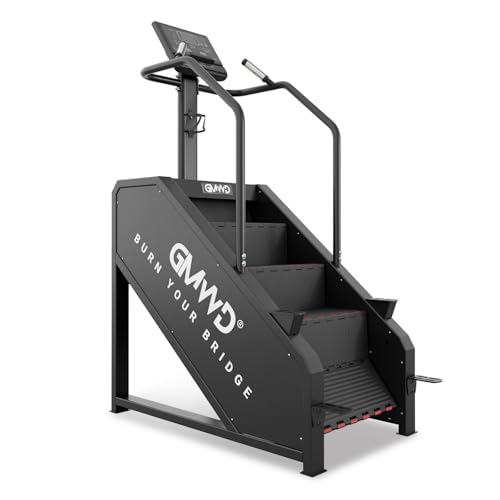
GMWD Stair Stepper Machine, Commercial Grade Stair Climber, Stair Machine for Cardio, 15 Resistance Levels, 24-164 Steps/Min, Exercise Machine with LED Display for Home, Black
Chosen because it specifies Commercial Grade Stair Climber and Stair Machine for Cardio.
View on Amazon
SunHome Stair Stepper Machine, 660LBS Commercial Grade Stair Climber with 15 Resistance Levels, Stair Master for Cardio and Lower Body Workouts, LED Screen
Chosen because it specifies Stair Master for Cardio and Lower Body Workouts and LED Screen.
View on AmazonQuick picks by home situation
| Home situation | Best machine type | Useful target specifications | Main compromise |
|---|---|---|---|
| Apartment or shared-wall home | Hydraulic mini stepper | 18–24 in footprint, under 30 lb, adjustable stroke, no motor | Shorter stride and less precise resistance control |
| Small home gym | Compact motorized stepper or compact stepmill | 24–36 in wide, 5–8 in step height, transport wheels | Usually costs more and may need a dedicated outlet |
| Frequent, demanding training | Commercial-style stepmill | 8–10 in steps, 250–350 lb capacity, 20+ resistance or speed levels | Large footprint, substantial ceiling requirement, higher price |
| Lowest purchase cost | Basic mini stepper | 12–18 in width, 20–30 lb, simple hydraulic resistance | Heat buildup and faster seal wear during long sessions |
Head-to-head: mini steppers, compact steppers, and stepmills
Mini steppers: best for limited space and light-to-moderate use
A mini stepper uses two small pedals connected to hydraulic cylinders or resistance mechanisms. The footprint is often about 18 to 24 inches long and 12 to 16 inches wide, so it can fit in a closet or under a desk. The Xiser Commercial Mini Stairmaster is a well-known example of the compact, non-motorized format; its platform-style design is more substantial than many low-cost household mini steppers.
The benefit is simple storage, low noise, and no motor to maintain. The limitation is the step pattern. Most mini steppers provide independent pedal travel rather than a full staircase motion. A typical usable stroke may be roughly 4 to 8 inches, and the stroke can become shorter as resistance rises. That makes them useful for intervals, but less similar to climbing actual stairs.
Hydraulic cylinders can also become hot. For that reason, a mini stepper marketed for continuous long sessions is worth treating cautiously unless the manufacturer specifies a duty cycle. For apartment use, place it on a dense rubber mat and avoid allowing the pedals to bottom out forcefully.
Compact motorized steppers: the balanced home-gym option
A compact motorized stepper gives you more consistent speed, a smoother stride, and clearer resistance or workout control than a basic mini stepper. Look for independent pedals, a handrail that does not wobble, and a step height of at least 6 inches if you want a noticeable climbing sensation. A 6- to 8-inch step is usually easier to fit under a residential ceiling than the 8- to 10-inch steps found on commercial stepmills.
Some machines use rotating steps, while others use two reciprocating pedals. Rotating steps feel more like ascending a staircase because each step arrives at a fixed height. Reciprocating pedals can feel more elliptical or bouncing, depending on the linkage. Neither is automatically better: rotating steps favor stair specificity, while reciprocating designs are often quieter and easier to make compact.
Commercial-style stepmills: the closest match to real stairs
The StairMaster 4G and StairMaster 8Gx represent the larger stepmill category. These machines use a continuous revolving staircase rather than two pedals. The result is a more predictable step height, stable rhythm, and familiar stair-climbing feel. They are the strongest choice for someone who wants frequent, serious stair sessions and has a dedicated training area.
Expect a larger footprint—commonly around 3 by 5 feet before allowing room to mount and dismount—and considerable vertical clearance. A 10-inch step can raise your hips and head much higher than a compact pedal machine. A useful safety calculation is:
Required ceiling clearance = user height + maximum pedal elevation + safety margin.
For example, a 72-inch user on a machine that raises the standing surface 10 inches should not shop for a room with only 82 inches of clearance. Add at least 6 to 10 inches for posture, arm movement, and measurement error, producing a practical target of 88 to 92 inches or more. Confirm the manufacturer’s clearance diagram before delivery.
What matters most when comparing the best stair climbers
Step height and stride feel
Step height is more important than a headline speed number. Lower steps are easier to control and generally suit apartments, beginners, and lower ceilings. Higher steps create a stronger climbing pattern but require more hip and knee movement. A machine with a short pedal stroke can still display a high step count, so inspect the actual pedal travel or step height in the specification sheet.
Also check whether the pedals move independently. Independent motion lets one foot stabilize while the other descends, whereas linked pedals can feel more predictable but less like ordinary stairs. Try to keep your full foot supported; a narrow pedal that encourages standing on the toes can become uncomfortable during longer sessions.
Resistance control
Basic steppers often use hydraulic resistance that changes as the cylinders heat. Mechanical resistance, magnetic resistance, or a motor-controlled stepmill usually provides better repeatability. For interval training, look for at least 10 distinct settings or a speed range that can be changed without stepping off. For steady cardio, smoothness matters more than having dozens of levels.
Do not confuse resistance with step height. Increasing resistance may make a pedal harder to press without making the climbing motion taller. If your goal is a staircase-like feel, compare both measurements separately.
Footprint, storage, and ceiling clearance
Measure the machine assembled, not just the boxed dimensions. Add at least 24 inches at the front for mounting and 18 to 24 inches on the sides where possible. A foldable console does not necessarily reduce the floor space occupied by the base.
For a room with an 8-foot ceiling, a compact stepper with a 6-inch stroke is usually easier to accommodate than a full stepmill. Mark the user’s estimated head position on the wall and perform several deep step motions before ordering. This catches low beams, ceiling fans, and lighting fixtures that a basic floor measurement misses.
Noise and neighbors
Motor noise, pedal impact, and vibration are separate issues. A quiet motorized machine can still transmit thumps through a hard floor. Rubber feet and a dense equipment mat reduce vibration, but they will not correct a loose linkage or worn cylinder. Avoid locking the knees and dropping onto the bottom of each stroke; controlled movement is quieter and places less stress on the frame.
For an apartment, a non-motorized mini stepper is generally the safest noise choice. If you choose a motorized unit, favor magnetic or electronically controlled resistance, a rigid frame, and a published decibel figure measured at a stated distance. Manufacturer noise numbers are only useful when the measurement conditions are clear.
Assembly and delivery
Mini steppers commonly require pedal, handle, or display installation and may be usable within 15 to 45 minutes. Larger stepmills can require two or more adults, a wide doorway, and careful leveling. Before purchase, measure every turn from the entrance to the final room. A machine that fits the workout space may not fit through a narrow hallway or around a stair landing.
Check whether the delivery service brings the unit inside, whether the console arrives attached, and whether a standard grounded outlet is sufficient. Never use an extension cord unless the manufacturer explicitly permits it.
Ownership realities: what wears first
- Hydraulic cylinders: They may lose resistance or develop leaks, especially after repeated long sessions. Allow them to cool and follow the stated duty cycle.
- Pedal bushings and pivots: Squeaks, side-to-side movement, and uneven pedal travel often begin here. Inspect fasteners periodically and use only the lubricant specified by the manufacturer.
- Belts, chains, and step rollers: Continuous stepmills accumulate dust and require regular cleaning and tension checks. A contaminated roller can create noise and an uneven rhythm.
- Handrails and leveling feet: These are safety-critical. Tighten loose hardware and stop using the machine if the frame rocks or the rail shifts.
- Displays and batteries: Simple displays may use replaceable batteries, while motorized machines need mains power. Confirm whether workout data can be viewed without an app or subscription.
After each week of regular use, wipe sweat from the rails and frame, vacuum around moving parts, and check for oil or hydraulic residue. Every month, inspect bolts, pedals, cables, and unusual sounds. A small maintenance routine is cheaper than continuing to exercise on a machine with a developing mechanical fault.
Bottom line
Choose a mini stepper when storage, price, and apartment noise dominate. Choose a compact motorized stepper when you want a more repeatable workout without dedicating a room. Choose a StairMaster-style stepmill when authentic step height, sustained training, and commercial durability justify the footprint and ceiling demands.
Before buying, verify the actual step height, maximum user weight, assembled dimensions, clearance diagram, noise information, warranty, and assembly requirements. Those details predict whether a stair climber will become a regularly used cardio tool—or an expensive obstacle in the corner of the room.



Write Your Review
No reviews yet. Be the first to share your experience!