
Our Top Picks
The best Garmin watches for most buyers are the Forerunner 265 for serious training value, the Forerunner 165 for affordable running, the Forerunner 965 or 970 for triathlon and maps, the Venu 3 for everyday health and smart features, and the Instinct 3 for rugged outdoor use.
Best Garmin watches at a glance
| Model | Best for | Case and display | Battery life | Approximate market range |
|---|---|---|---|---|
| Forerunner 165 | New runners and value buyers | 43 mm; AMOLED; 1.2 in | Up to 11 days; up to 19 hours GPS | $200–$300 |
| Forerunner 265 | Regular runners and multisport training | 42 or 46 mm; AMOLED | Up to 15 days; up to 20–24 hours GPS, depending on size | $350–$450 |
| Forerunner 570 | Advanced training without flagship pricing | 42 or 47 mm; AMOLED | Up to 11 or 18 days; up to 18–20 hours GPS | $500–$600 |
| Forerunner 965 | Triathlon, navigation, and long training sessions | 47 mm; AMOLED; titanium bezel | Up to 23 days; up to 31 hours GPS | $500–$650 |
| Forerunner 970 | Top-end endurance training | 47 mm; AMOLED; titanium bezel | Up to 15 days; up to 26 hours GPS | $700–$800 |
| Venu 3 | Everyday wear and general wellness | 45 mm; AMOLED | Up to 14 days; up to 26 hours GPS | $350–$450 |
| Instinct 3 Solar | Hiking, work, and rugged outdoor use | 45 or 50 mm; monochrome MIP | Up to 28 days or more with solar; potentially unlimited in battery-saver conditions | $400–$500 |
Battery figures vary with GPS mode, music, screen settings, temperature, phone notifications, and sensor use. Solar claims are particularly dependent on several hours of strong outdoor light rather than ordinary indoor wear.

Garmin vívoactive® 5, Health & Fitness GPS Smartwatch, 42mm, Ivory
Chosen because it specifies Health & Fitness GPS Smartwatch and 42mm.
View on Amazon
Garmin vívoactive® 5, Health & Fitness GPS Smartwatch, 42mm, Black
Chosen because it specifies Health & Fitness GPS Smartwatch and 42mm.
View on Amazon
Garmin Forerunner® 165, Running Smartwatch, 43mm, Black
Chosen because it specifies Running Smartwatch and 43mm.
View on Amazon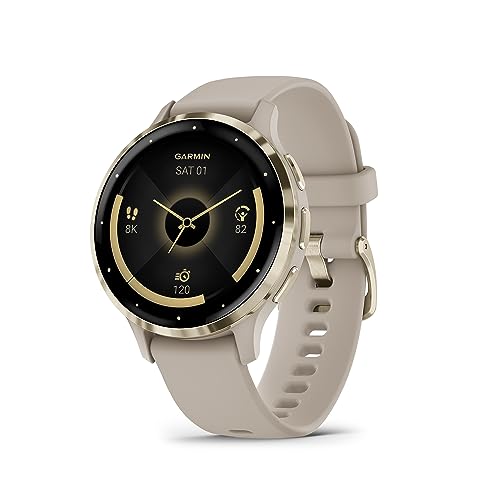
Garmin Venu® 3S, Premium Fitness Smartwatch, 41mm, French Gray
Chosen because it specifies Premium Fitness Smartwatch and 41mm.
View on AmazonWhich Garmin should you buy?
For the first running watch: Forerunner 165
The Forerunner 165 is the sensible starting point if you want pace, distance, GPS routes, heart-rate data, structured workouts, recovery guidance, and daily activity tracking without paying for navigation or advanced multisport hardware. Its AMOLED screen is bright and easy to read, while the 43 mm case fits a wide range of wrists.
Choose the Music version only if you want to leave your phone behind and listen through compatible wireless headphones. Otherwise, the standard model is the better value. The main limitation is that the 165 is designed around running rather than complex triathlon plans, detailed maps, or extensive training analytics.
For the best training value: Forerunner 265
The Forerunner 265 is the strongest all-around choice for runners who train several times each week. It adds a more complete training ecosystem, multisport profiles, training readiness, race widgets, better workout customization, and a choice of 42 mm and 46 mm cases. The smaller 265S is easier to wear overnight; the larger 265 provides a longer battery run and more screen area.
Its AMOLED display costs some battery compared with Garmin’s older MIP screens, but the trade-off is excellent visibility indoors and attractive maps, charts, and workout screens. It is worth paying for over the 165 if you follow structured plans, combine running with cycling or swimming, or want more useful feedback between workouts.
For advanced training: Forerunner 570
The Forerunner 570 targets athletes who want newer training analysis and a premium AMOLED interface without moving to the largest flagship. It supports running, cycling, swimming, multisport sessions, recovery metrics, training readiness, daily suggested workouts, and a broad set of performance data. Its 42 mm and 47 mm versions make it more adaptable than a single-size flagship.
The extra cost makes sense for frequent training, especially when workout planning and recovery information affect what you do each day. It is less compelling for casual runners who mainly need reliable GPS and pace alerts; those buyers will see more value from the 165 or 265.
For maps and long-distance events: Forerunner 965 or 970
The Forerunner 965 remains a highly capable endurance watch with full-color maps, turn guidance, long battery life, training load analysis, triathlon support, and a lightweight design. It is a particularly good choice for runners and triathletes who regularly navigate unfamiliar routes but do not need the newest hardware.
The Forerunner 970 is the premium option. It adds newer sensors and features such as a built-in flashlight, ECG capability in supported regions, and expanded performance tools. ECG availability depends on local regulatory approval and does not replace medical evaluation. The 970 is worth paying for when you will use navigation, advanced training metrics, long workouts, or the newest sensor platform. It is excessive for step counting and occasional treadmill sessions.
For daily wear: Venu 3
The Venu 3 prioritizes a polished everyday experience. It has a sharp AMOLED display, sleep tracking, heart-rate monitoring, stress and activity features, recovery-oriented information, phone notifications, calls through a connected phone, and a more lifestyle-focused interface than the Forerunner range.
It can record runs and workouts well, but it is not the best choice for athletes who need deep race planning, full-color topographic maps, or detailed multisport workflows. Choose the Venu 3 when you will wear the watch all day and want health and smart features to matter as much as training data.
For harsh conditions: Instinct 3 Solar
The Instinct 3 is the practical outdoor choice. Its rugged polymer construction, high-contrast display, physical buttons, water resistance, compass and navigation tools, outdoor activity profiles, and excellent endurance suit hiking, field work, travel, and camping. The Solar version can dramatically reduce charging frequency in bright conditions.
Its monochrome MIP screen is easier to read in direct sunlight and remains economical, but it looks less refined indoors than an AMOLED display. It is also bulkier in the 50 mm size. Pick it for durability and battery life rather than for a sleek office watch or detailed color mapping.
GPS, health, and training features: what is worth paying for?
- Dual-band GPS: Most valuable in cities, wooded areas, and routes surrounded by tall buildings. It is less important on open roads and tracks.
- Maps: Worth the upgrade if you run or hike in unfamiliar places. Turn guidance can prevent wrong turns and reduce phone dependence.
- Training readiness and recovery tools: Useful for people training consistently. They are trend indicators, not diagnoses or instructions that override how you feel.
- Advanced running metrics: Helpful when you follow a coached or structured plan. Casual runners may not use ground-contact time, running dynamics, or detailed load metrics.
- ECG and extra health sensors: Potentially useful for compatible users, but availability varies by country and these features should not be used to diagnose a condition. Speak with a qualified healthcare professional about concerning symptoms or readings.
- Music storage: Worth paying for only if phone-free workouts are a priority.
- AMOLED: Best for vibrant indoor viewing. MIP is generally the better choice for always-on outdoor readability and maximum endurance.
Decision matrix by situation
| Your situation | Best choice | Why | What to avoid paying for |
|---|---|---|---|
| Running once or twice weekly | Forerunner 165 | Core GPS and workout features at a manageable price | Maps and flagship sensor upgrades |
| Running 3–5 times weekly | Forerunner 265 | Better training guidance and multisport support | 970-level features unless racing seriously |
| Triathlon or frequent structured training | Forerunner 570 or 970 | More complete training and event workflows | Venu-focused lifestyle features if training is the priority |
| Hiking and remote travel | Instinct 3 Solar or Forerunner 965 | Choose rugged battery life or color maps, respectively | AMOLED if charging access is limited |
| Mostly daily health and notifications | Venu 3 | Comfortable lifestyle interface and strong everyday battery | High-end race analytics |
Case size and comfort matter more than a specification sheet
A 47–51 mm watch can provide a larger screen and better battery, but it may catch on sleeves or feel heavy during sleep. Smaller wrists usually suit 40–43 mm cases, while 45–47 mm offers a useful middle ground. Measure around the wrist with a flexible tape, then compare that circumference with the manufacturer’s strap range. Leave enough room to slide one finger under the band during normal wear; tightening too far can make overnight wear uncomfortable and can produce inconsistent readings.
Ownership costs and maintenance
A simple cost-per-use calculation explains why the more expensive model is not always the better bargain. A $250 Forerunner 165 used four times weekly for three years provides approximately 624 workouts, or about $0.40 per workout before accessories. A $750 Forerunner 970 used once weekly for the same period provides about 156 workouts, or about $4.80 per workout. The flagship becomes easier to justify when it replaces a separate navigation device, supports frequent racing, or is worn every day.
The parts most likely to wear first are the silicone strap, charging contacts, and occasionally the screen surface from abrasive contact. Rinse sweat and salt from the watch with fresh water, dry the charging area before connecting it, and avoid charging while the port is wet. Do not use household solvents or abrasive cleaners. Replace a stretched or cracked strap rather than over-tightening it, and keep firmware updated so GPS and sensor behavior remain current.
For most people, the Forerunner 265 is the best Garmin watch to buy. Select the 165 to control spending, the 965 or 970 for navigation and serious endurance training, the Venu 3 for everyday wear, and the Instinct 3 when ruggedness and charging independence matter more than a fashionable display.

Write Your Review
No reviews yet. Be the first to share your experience!