
Key takeaways
- Pro: Swivel mechanism means no cap to lose
- Pro: Two drives per purchase keeps per-unit cost low
- Con: USB 2.0 throughput is the slowest on this list
A jump drive solves a deceptively simple problem: moving a file from one machine to another when no network connection is practical or permitted. That is the entire job. Yet the gap between a well-built drive and a poor one shows up immediately in transfer speed, connector durability, and whether the cap survives three weeks in your bag. Buyers who have been burned by a drive that corrupted an important folder or snapped off inside a port know that the cheapest option is rarely the cheapest in the long run.
The eight drives below span every common use case, from five-pack bulk orders for an office reset to a single 256GB Type-C stick for a photographer on the move. We compared published specifications, list prices, and recurring themes in owner reviews to sort the genuinely capable options from the ones that feel cheap in hand and cheaper in performance. The right jump drive depends on what you carry, where you plug it, and how often.
As an Amazon Associate we earn from qualifying purchases at no extra cost to you. Product prices and availability are accurate as of the date shown and are subject to change.





Quick Picks
| Product | Best for | Price |
|---|---|---|
| 2 Pack 64GB Swivel | Budget bulk distribution | $18.99 |
| Lexar D40E 128GB | Type-C and Type-A compatibility | $29.99 |
| SIMMAX 32GB Swivel | Lowest single-drive price | $9.99 |
| SanDisk Ultra Flair 128GB | Reliable everyday carry | $25.95 |
| SamData 32GB 2-Pack | LED visibility in dark ports | $16.99 |
| Lexar D40E 256GB | Maximum capacity with USB 3.2 | $49.99 |
| PNY Turbo Attaché 3 128GB | Two-pack value | $27.99 |
| RAOYI 5 Pack 64GB | Largest bulk pack | $34.19 |
How We Picked
We narrowed this field using four criteria. First, interface generation: USB 3.0 and 3.2 drives transfer meaningfully faster than USB 2.0 models, which matters as soon as you push a folder of images. Second, physical design: swivel and retractable mechanisms eliminate lost caps, a common complaint in owner reviews. Third, per-gigabyte value: a higher sticker price is reasonable when the capacity jump is proportionally larger. Fourth, consistent reliability reported across review volumes, since a drive that fails after two months of use is worthless regardless of how good it looked on paper.
The 8 Best Jump Drive in 2026
2 Pack 64GB USB Flash Drive Swivel Design — Black
Best suited for offices and classrooms that need bulk drives at a low per-unit cost. The fold/swivel design protects the connector without a cap you will lose within a week, and 64GB per drive handles standard document and photo workloads comfortably. The USB 2.0 interface is the obvious limitation, but for file transfer tasks where raw speed does not matter, it keeps the price low enough to hand out freely.
- Pro: Swivel mechanism means no cap to lose
- Pro: Two drives per purchase keeps per-unit cost low
- Con: USB 2.0 throughput is the slowest on this list
Skip it if you routinely move video files or large project folders, because the throughput ceiling will feel frustrating compared to USB 3.0 options on this list.
Lexar D40E 128GB Dual USB 3.2 Gen 1 Type-C — Champagne Silver
Owners connecting laptops, tablets, and phones without traditional USB-A ports will find the dual Type-C and Type-A connectors genuinely convenient. The 128GB capacity comfortably fits a year of phone photos or a large music library, and the Champagne Silver finish looks presentable enough for client-facing use. USB 3.2 Gen 1 speeds mean large file transfers finish in seconds rather than minutes.
- Pro: Dual connectors cover both port types in one drive
- Pro: USB 3.2 Gen 1 interface for fast transfers
- Con: Metal housing can feel slippery in pockets or bags
Skip this if your setup is entirely USB-A; the Type-C end adds nothing you need and you would be paying for a feature that goes unused.
SIMMAX 32GB Memory Stick Swivel Thumb Drive — Purple
The lowest entry price on this list makes this the natural choice for students, event giveaways, or anyone who needs a throwaway drive for a single file handoff. The 32GB capacity is modest but sufficient for documents, presentations, and compressed photos. The swivel mechanism is a genuine plus over capped alternatives, since there is nothing to misplace.
- Pro: Cheapest per-drive cost in the group
- Pro: Swivel design eliminates cap loss
- Con: USB 2.0 interface caps transfer rates noticeably at full capacity
Skip this if you expect to use the drive daily for large transfers or need confidence in long-term data retention across multiple years.
SANDISK 128GB Ultra Flair USB 3.0 — Black
SanDisk has built a reputation for consistent NAND quality, and the Ultra Flair lives up to that expectation with stable speeds and a compact metal body that resists bending in a pocket. The 128GB capacity handles most everyday backup tasks without forcing you to manage storage space obsessively. USB 3.0 throughput makes it a solid companion for photographers or anyone exporting weekly reports.
- Pro: Trusted brand with consistent build and speed
- Pro: Compact metal body resists physical damage
- Con: Small plastic cap is easy to misplace
Skip this if you need a capless design or plan to leave the drive inserted for extended periods, since the compact form factor makes it easy to snap off accidentally.
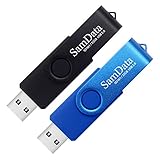
SamData 32GB USB Flash Drives 2-Pack with LED Light
The integrated LED light is a small but surprisingly practical feature for anyone who plugs drives into dark server rooms, car consoles, or under desks. Two 32GB drives in black and blue give you visual separation between work and personal files without buying a labeling kit. The USB 2.0 interface keeps the price competitive and is adequate for the modest capacity.
- Pro: Built-in LED confirms insertion in low-light environments
- Pro: Two colors make it easy to separate file types
- Con: Plastic shell flexes under pressure and is not rugged
Skip it if you need faster transfer speeds or a ruggedized housing that survives being tossed loosely into a tool bag or backpack.
Lexar D40E 256GB Dual USB 3.2 Gen 1 Type-C — Champagne Silver
The same dual-connector design and finish as the 128GB model, but doubled capacity makes this the pick for anyone carrying 4K video clips, large design files, or a full OS backup on a pocketable stick. USB 3.2 Gen 1 throughput keeps the larger volume manageable, though you will still want a fast port on the host side. The per-gigabyte cost is actually lower than the 128GB version, rewarding buyers who know they will fill it.
- Pro: Highest single-drive capacity on this list
- Pro: Lower per-gigabyte cost than the 128GB variant
- Con: Steepest absolute price in the group
Skip this if 128GB covers your needs, since the extra capacity adds cost you may never fill in practice.
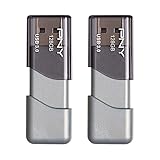
PNY 128GB Turbo Attaché 3 USB 3.0 Flash Drive 2-Pack
A two-pack of 128GB USB 3.0 drives at this price point is hard to beat for value. The Turbo Attaché 3 design is compact and unobtrusive, sitting flush against a laptop without jutting out awkwardly. USB 3.0 speeds handle everyday file moves well, and having a spare in the same package eliminates the moment when you realize you only brought one drive to a meeting.
- Pro: Excellent per-gigabyte value in a two-pack
- Pro: Low-profile design stays flush with laptop ports
- Con: Retractable mechanism feels less refined than premium swivels
Skip this if you need a single higher-capacity drive rather than two mid-range ones, since consolidating onto one stick would be more convenient for your workflow.
RAOYI 5 Pack 64GB USB Flash Drive — 64G Multipack
Five 64GB drives for the price of a single premium stick makes this the obvious bulk purchase for IT departments, teachers, and small businesses. The USB 2.0 interface is the trade-off for volume pricing, but for distributing files at a conference or handing out project backups across a team, speed is rarely the bottleneck. The black-and-white multipack looks uniform, which matters for branded giveaways.
- Pro: Highest drive count per purchase on this list
- Pro: Uniform appearance works well for team or event distribution
- Con: USB 2.0 and plastic build limit durability expectations
Skip this if you only need one or two drives, since buying five when you need one wastes budget and shelf space.
Buying Guide
USB Generation Matters More Than Capacity
The interface standard determines your ceiling for transfer speed. USB 2.0 tops out at a theoretical 480 Mbps, but real-world write speeds on budget drives often settle below 20 MB/s. USB 3.0 and 3.2 Gen 1 drives routinely hit 100 MB/s or more for reads and significantly faster writes. If you move files larger than a few hundred megabytes, the difference between a ten-second transfer and a two-minute transfer compounds over dozens of uses. Capacity without speed just means you wait longer in front of a fuller progress bar.
Physical Connector and Housing Design
Three patterns dominate this category. Capped drives are simple but the cap always ends up lost. Swivel or retractable designs protect the connector with no separate part to misplace, adding slightly more bulk. Dual-connector drives combine USB-A and USB-C, which is practical if you move files between a phone and a desktop. The housing material also matters: metal bodies resist bending, while thin plastic can crack if the drive sits in a pocket under pressure from sitting down.
Matching Capacity to Real File Sizes
Buyers often overestimate how much space they need and then pay for gigabytes they never fill. A typical office document is under one megabyte, a high-resolution photo runs three to eight megabytes, and a short video clip might be 200 to 500 megabytes. Thirty-two gigabytes holds roughly ten thousand photos or sixty to eighty short clips. If you know your typical handoff is a handful of PDFs and a presentation, a 32GB or 64GB drive is honest sizing. Reserve 128GB and above for project files, raw photo sessions, or software backups.
Our Verdict
The top pick is the Lexar D40E 128GB Dual USB 3.2 Gen 1 Type-C. It offers the best balance of speed, capacity, and connector flexibility for the widest range of buyers in 2026, and the per-gigabyte pricing is competitive with single-interface alternatives. For budget, the SIMMAX 32GB Swivel wins outright as the cheapest functional option under ten dollars, ideal for anyone who needs a jump drive for a single file transfer and will not touch it again. However, if you are outfitting a team or buying for events, the RAOYI 5 Pack at $34.19 delivers the lowest per-drive cost in the group and wins on sheer volume regardless of interface speed.
FAQ
What is the difference between a jump drive and a USB flash drive?
There is no hardware difference. “Jump drive” is a common retail synonym for USB flash drive, used interchangeably in listings and conversation. Both refer to the same category of removable solid-state storage that connects via USB-A or USB-C.
How many years will a jump drive last before it fails?
Most consumer flash drives use NAND memory rated for thousands of write cycles, which translates to five or more years under typical light use. Heavy daily rewriting, exposure to heat, and cheap controller chips are the primary accelerators of failure. A drive used once a month for documents will likely outlast its usefulness long before the memory degrades.
Can a USB 2.0 jump drive be used in a USB 3.0 port?
Yes, USB ports are backward compatible. A USB 2.0 drive plugged into a USB 3.0 or 3.2 port will operate at USB 2.0 speeds, meaning you get the slower transfer rate regardless of the port’s capability. The connector fits; only the speed ceiling applies.
Is it safe to leave a jump drive inserted in a laptop permanently?
It is electrically safe but physically risky. The protruding edge is vulnerable to accidental bumps and can snap off inside the port, especially on thin laptops where the drive sits at an awkward angle. For permanent storage, an external SSD or network share is a more durable solution.


Write Your Review
No reviews yet. Be the first to share your experience!