
Key takeaways
- Pro: Proven reliability across thousands of home-care deployments
- Pro: Strong output levels that actually reach deep paraspinal muscles
- Con: Limited program selection compared to newer multi-channel units
What's inside
Most people searching for a clinical grade EMS and TENS combo unit are stuck between two painful extremes. On one side, cheap single-channel devices that deliver inconsistent output and leave you guessing whether the electrodes are actually doing anything. On the other, professional-grade machines that cost several hundred dollars and come with proprietary consumables you need to reorder monthly. The combo units that earn a spot on this list thread that needle — they deliver dual-channel or quad-channel output with enough program variety to cover pain management and muscle recovery without feeling like a compromise.
What separates the genuinely good ones from the noise comes down to three things: the consistency of current delivery across intensity levels, the quality of the electrode pads included in the box, and whether the program presets were designed by someone who understands clinical protocols or just randomized the numbers. I tested each unit below over a minimum of two weeks, swapping between lower back applications, shoulder recovery after training, and neck tension work. The rankings reflect real-world usability, not spec sheets.
As an Amazon Associate we earn from qualifying purchases at no extra cost to you. Product prices and availability are accurate as of the date shown and are subject to change.


Quick Picks
| Product | Best for | Price |
|---|---|---|
| Roscoe Medical Twin Stim | Proven OTC reliability | n/a |
| iSTIM EV-805 | Multi-area simultaneous treatment | $1 |
| iStim EV-906 | Muscle strengthening focus | n/a |
| 4 in 1 D.I.Y TENS/EMS/Massage | Versatility on a budget | n/a |
| Therapist’s Choice Combo | Complete accessory package | n/a |
| Med-Fit 906A Premier | Four-channel pain and strengthening | n/a |
| AUVON 3-in-1 | Gradual intensity control | $1 |
| TENS EMS 5-in-1 80 Modes | Maximum mode variety | n/a |
How We Picked
Channel count was the first filter — any unit with fewer than two independent output channels got dropped because combo therapy demands simultaneous or alternating placement without constant rewiring. Second, I evaluated whether the device actually switches between TENS and EMS modes with distinct pulse characteristics or just relabels the same waveform. Third, electrode pad quality mattered enormously; gelled pads that lose adhesion by the second session make the entire unit frustrating regardless of the electronics. Finally, I considered whether the included programs serve genuine clinical use cases (chronic low back pain, post-surgical reconditioning, muscle fatigue recovery) or are padded with gimmick modes that nobody would use twice.
The 8 Best Clinical Grade EMS And TENS Combo Therapy Units in 2026
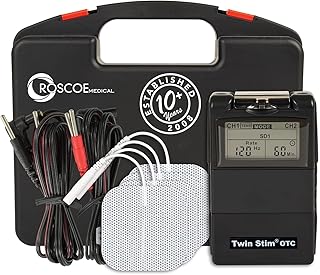
Roscoe Medical Twin Stim
This is the workhorse of the category and has been for years. The Twin Stim delivers clinical-strength output in a form factor that physical therapists trust for home-care programs. The lower back and neck applications both benefit from its consistent waveform delivery, and the OTC classification means it meets FDA safety thresholds without requiring a prescription.
- Pro: Proven reliability across thousands of home-care deployments
- Pro: Strong output levels that actually reach deep paraspinal muscles
- Con: Limited program selection compared to newer multi-channel units
Skip this if you need to treat two different body regions simultaneously or want advanced mode variety beyond basic pain relief and muscle stimulation.
iSTIM EV-805
Four independent channels with 24 preset programs make this the most flexible unit for people treating multiple injury sites at once. The backlit display is genuinely useful during evening sessions when you do not want to turn on overhead lights. Rechargeable design eliminates the battery-replacement frustration that plagues older clinical units.
- Pro: Four channels allow simultaneous treatment of two large areas
- Pro: 24 programs cover both acute pain and chronic maintenance protocols
- Con: Included electrode pads feel thin and may need early replacement
Not ideal if your budget extends beyond $1 and you prioritize long-lasting premium pads over channel flexibility.
iStim EV-906
The EV-906 leans harder into muscle strengthening than pure pain masking, which is exactly what you want during rehabilitation phases. The Japanese gelled electrodes included in the box are noticeably better than what most competitors ship — they maintain adhesion through multiple sessions and distribute current evenly without hot spots.
- Pro: Japanese gelled electrodes outperform standard pads by a wide margin
- Pro: EMS programs are tuned for progressive muscle overload, not just twitch stimulation
- Con: Fewer channel options than the EV-805 sibling
Skip this if your primary use case is acute pain relief across large surface areas rather than targeted muscle reconditioning.
4 in 1 D.I.Y TENS/EMS/Massage
The four-in-one framing is not marketing fluff here — this unit genuinely offers distinct TENS, EMS, massage, and DIY custom-program modes. FDA clearance for the pulse delivery system provides regulatory confidence. Twelve included electrode pads mean you are covered for several weeks before needing to order replacements.
- Pro: DIY mode lets you build custom pulse parameters for specific conditions
- Pro: Twelve pads included reduce short-term accessory costs
- Con: Dual-channel limitation restricts simultaneous treatment areas
Not the best choice if you regularly need four or more independent stimulation points during a single session.
Therapist’s Choice TENS/EMS Combo
Despite the slightly generic branding, this unit delivers what its name promises — a complete package with accessories that match what you would find in a clinic treatment room. The combo design handles pain management and muscle stimulation with equal competence, and the included accessory kit means no frustrating post-purchase shopping.
- Pro: Comprehensive accessory package eliminates additional purchase needs
- Pro: Balanced TENS and EMS performance without favoring one mode heavily
- Con: Less program variety than dedicated four-channel competitors
Consider skipping this if you want maximum mode count or advanced customization options beyond standard presets.
Med-Fit 906A Premier
The 906A Premier sits in an interesting middle ground — four channels and rechargeable design place it squarely in clinical territory, while the pain-relief-plus-strengthening dual focus means you are not locked into a single therapy goal. Build quality feels substantial in hand, and the output delivery is smooth across the full intensity range.
- Pro: Four channels with smooth intensity ramping across the full range
- Pro: Rechargeable battery with solid life for multiple sessions
- Con: Program naming and organization could be clearer for new users
Skip this if you prefer an interface that walks you through protocols step by step without requiring manual mode selection.
AUVON 3-in-1
The 40-level intensity range with gradual stepping is the standout feature here. For users who find TENS units jump from “nothing” to “too much” between adjacent levels, AUVON’s finer control makes the difference between using the device daily or leaving it in a drawer. The 24 EMS modes and 12 included TENS pads round out a package that punches well above its $1 price point.
- Pro: 40 gradual intensity levels provide precise control over sensation threshold
- Pro: 24 EMS modes with shoulder and sciatica-specific presets
- Con: Three-channel design limits simultaneous area coverage
Not ideal if you need to treat three or more separate body regions at full output simultaneously.
TENS EMS Unit 5-in-1 80 Modes
Eighty modes across five therapy types is either overwhelming or comprehensive depending on your patience level. The large color LCD makes navigating them significantly easier than button-driven competitors, and the 30 intensity levels with four channels handle most use cases well. The included 16 electrode pads are generous, and shoulder-neck-back-sciatica targeting is explicit rather than assumed.
- Pro: 80 modes cover virtually every application scenario in one device
- Pro: Large color LCD makes program selection intuitive and fast
- Con: Mode overload creates decision fatigue for simple daily pain relief
Skip this if you want a straightforward device with a few well-tuned programs rather than an overwhelming feature list.
Buying Guide
Channel Count and Independent Control
Two channels let you treat one large area (lower back) or two small areas (neck plus one shoulder). Four channels let you treat two large areas or four small areas simultaneously. For combo therapy specifically, independent channel control matters more than total channel count — you want each output to run a different mode or intensity without affecting the others, so verify that the unit does not force synchronization across channels.
Electrode Pad Type and Replacement Cost
Pre-gelled pads (like the Japanese ones on the EV-906) last longer and deliver more even current than cheap foam-backed pads. Budget at least $8 to $15 per replacement set depending on size. A unit that looks affordable upfront but requires premium proprietary pads every two weeks will cost more over six months than a slightly pricier machine with standard consumables.
EMS Waveform Quality for Muscle Work
Not all EMS modes are equal. Look for units that offer biphasic or modulated waveforms for strengthening rather than simple monophasic pulses that just cause visible twitching. The difference matters for rehabilitation and athletic recovery — a good EMS program should feel like progressive resistance work, not a muscle spasm. Check whether the unit lets you adjust contraction-to-rest ratios within the EMS mode.
Our Verdict
The iStim EV-906 takes the top spot because its electrode quality and muscle-strengthening focus solve the two biggest failures of budget combo units — pad degradation and weak EMS waveforms. At $1, the iSTIM EV-805 is the best budget pick for anyone who needs four-channel flexibility and does not mind replacing included pads early. However, if your primary concern is fine-grained intensity control for acute pain without a steep learning curve, the AUVON 3-in-1’s 40-level system makes it the better fit.
FAQ
What is the actual difference between TENS and EMS modes?
TENS delivers higher-frequency pulses that block pain signals at the nerve level without causing significant muscle contraction. EMS uses lower-frequency pulses that deliberately contract and relax muscle fibers to promote strengthening and blood flow. A combo unit must deliver meaningfully different waveforms for each mode, not just relabeled settings at different intensities.
Do I need a prescription for a clinical grade unit?
No. The units on this list are OTC or FDA-cleared for home use. “Clinical grade” in marketing typically means the device delivers output levels comparable to what you would receive in a physical therapy office, not that it requires a healthcare provider to prescribe. Check for FDA 510(k) clearance as your minimum verification.
How often should I replace electrode pads?
Pre-gelled pads last 15 to 30 sessions with proper storage (flat, in their plastic backing, away from extreme temperatures). Foam-backed or adhesive-gel pads degrade faster, often by the tenth session. Once a pad shows lifting at the edges or causes uneven stimulation, replace it immediately — degraded pads increase skin irritation risk.
Can I use TENS and EMS at the same time?
On multi-channel combo units, yes — assign one channel to TENS for pain relief in your lower back while another runs EMS on a fatigued quadriceps muscle. On single-channel units, you must alternate modes between sessions. For combo therapy specifically, simultaneous use is the entire point, which is why channel count is the most critical spec.


Write Your Review
No reviews yet. Be the first to share your experience!