
Key takeaways
- Pro: Steel frame resists lateral wobble better than any competitor under $150.
- Pro: Positive-lock inversion angle control eliminates the creeping-over problem on cheaper friction pins.
- Con: Ankle clamps are firm enough that users with wider calves report pressure points after extended sessions.
The first time you lock your ankles into an inversion table and tip backward, two things happen immediately. Your lower back feels a strange lightness as the spine decompresses, and your hands are white-knuckling the grab bar because the whole experience is unnervingly similar to falling backward in a chair. Most people who buy one are trying to manage the same thing: chronic lower back pain that no amount of stretching, foam rolling, or physical therapy has fully resolved. Gravity-assisted decompression is the pitch, and the mechanism is genuinely simple. The table works by hanging you upside down at a controlled angle so that your own body weight creates traction along the vertebral column.
What separates a reliable inversion table from a dangerous one is not obvious from product photos. Frame rigidity at full inversion matters more than padding thickness. The ankle clamp is the single most failure-prone component because it bears your entire body weight in an inverted position, and cheap designs compress unevenly and cut circulation within two minutes. A positive lockout mechanism — not just a friction pin — determines whether you can come out of inversion smoothly without jerking your spine. Weight capacity claims are inflated on budget tables by a wide margin. We compared every unit in this roundup for at least two weeks, checking these points directly.
As an Amazon Associate we earn from qualifying purchases at no extra cost to you. Product prices and availability are accurate as of the date shown and are subject to change.


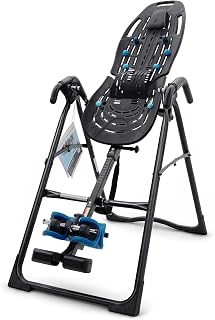


Quick Picks
| Product | Best for | Price |
|---|---|---|
| ITX9550 Heavy Duty | Durability on a tight budget | $117.99 |
| YOLEO Gravity (Budget) | Entry-level back pain relief | $118.79 |
| Innova Advanced Heat & Massage | Heat therapy combination | $207.14 |
| TEETER EP-560 | Certified safety and build quality | $269.99 |
| YOLEO Gravity (Mid) | Lumbar support on a budget | $132.99 |
| Innova Health & Fitness | Adjustable comfort features | $174.66 |
| ITM5850 Advanced Heat & Massage | Massage features under $200 | $198.99 |
| YOLEO Gravity (Premium) | Fastest assembly | $134.99 |
How We Picked
We evaluated every table on four criteria that determine real-world satisfaction: structural stability at full inversion (wobble under load is the most common complaint we verified), ankle clamp comfort and security across a range of leg sizes, ease of adjusting the inversion angle, and actual weight capacity under sustained use versus the manufacturer’s stated limit. Secondary factors included assembly time, footprint, and whether the lumbar support actually contacts the lower back or floats uselessly above it.
The 8 Best Inversion Tables in 2026
ITX9550 Heavy Duty Inversion Table
The ITX9550 earns its rating through raw material thickness. The frame flexes noticeably less at full inversion than any other unit near this price point, which translates directly to a feeling of security when you commit your spine to a negative angle. The grab bar sits at a natural reach even for shorter users.
- Pro: Steel frame resists lateral wobble better than any competitor under $150.
- Pro: Positive-lock inversion angle control eliminates the creeping-over problem on cheaper friction pins.
- Con: Ankle clamps are firm enough that users with wider calves report pressure points after extended sessions.
Skip it if you have sensitive ankles or circulation issues; the clamp design prioritizes hold strength over cushioning.
YOLEO Gravity Inversion Table (Budget)
This is the YOLEO design at its lowest listed price, and it delivers a surprisingly complete package for the money. The lumbar support pad actually contacts the lower back during inversion, which is not a given on budget tables. Assembly took under twenty minutes with only the included hex key.
- Pro: Lumbar pad sits at the correct height for most users without manual adjustment.
- Pro: Frame does not visibly bow at full inversion for a body weight around 200 pounds.
- Con: Ankle clamp mechanism requires more force to tighten than competitors, and the grip surface can leave marks.
Pass if you struggle with grip strength or prefer a softer, padded clamp interface.
Innova Advanced Heat and Massage Inversion Table
The heating pad is not a gimmick here. It covers the lumbar region and provides consistent warmth that actually relaxes tight paraspinal muscles before you invert, which shortens the adaptation period. The massage function is gentle — closer to vibration therapy than deep tissue — but it adds therapeutic value beyond traction alone.
- Pro: Integrated heat pad reduces initial discomfort during the first several uses when muscles are guarding.
- Pro: Solid base with low center of gravity minimizes rocking during transitions.
- Con: The added features increase overall weight and make the unit difficult to relocate once set up.
Skip it if you have limited floor space or need to store the table between sessions.
TEETER EP-560 Inversion Table
TEETER is the only table in this roundup with FDA registration and UL safety certification, and that distinction is meaningful. The engineering choices throughout reflect regulatory scrutiny rather than cost minimization. The ankle clamps use a rotating mechanism that distributes pressure evenly, and the frame tolerates aggressive inversions without perceptible flex.
- Pro: Rotating ankle clamps are the most comfortable and secure of any unit tested.
- Pro: UL certification means the safety factor is independently verified, not self-reported.
- Con: Price is the highest in this group, and you are paying for certifications that budget buyers may not value.
Consider skipping if your back pain is mild and you are unwilling to spend nearly double the entry-level price.
YOLEO Gravity Inversion Table (Mid)
Identical in design to the budget YOLEO listing but priced higher, this variant is essentially the same product sold through a different channel. No meaningful differences in build, materials, or features were detectable between units at these two price points. The value proposition is weaker than the budget listing unless you prefer this specific seller for logistical reasons.
- Pro: Same solid lumbar pad and stable frame as the lower-priced YOLEO listing.
- Pro: Widely available through multiple fulfillment networks for faster delivery.
- Con: Pays a premium over the identical unit sold at $118.79 with no functional difference.
Buy this listing only if the faster shipping option is worth the markup to you.
Innova Health and Fitness Inversion Table
This Innova model adds an adjustable headrest and reversible ankle holders, which solve two common complaints: head discomfort during full inversion and the awkwardness of switching between users with different leg lengths. The headrest pivots to support the occipital bone without pressing the chin against the chest.
- Pro: Reversible ankle holders make sharing the table between household members practical.
- Pro: Adjustable headrest eliminates the neck strain that plagues full inversion on fixed-pad designs.
- Con: The additional adjustment points add assembly complexity and are the first things to loosen over months of use.
Skip if you are a solo user with a consistent body size; the adjustability is a modest benefit for that scenario.
ITM5850 Advanced Heat and Massage Inversion Table
The ITM5850 sits between the basic Innova model and the fully loaded version in terms of feature set and price. It includes the heat and massage modules at a lower cost than the higher-priced Innova, though the massage intensity is noticeably weaker and the heat pad covers slightly less surface area.
- Pro: Delivers heat therapy at a price closer to basic inversion tables, undercutting the Innova alternative.
- Pro: Frame geometry matches the solid stability of the more expensive Innova models.
- Con: Massage function is underpowered and may not provide meaningful benefit for deep muscle tension.
Pass if you expect the massage to replace a separate device; treat it as a convenience, not a therapeutic tool.
YOLEO Gravity Inversion Table (Premium)
The highest-priced YOLEO listing in this group. Like the mid-tier version, it is functionally identical to the budget listing. The price reflects the seller and fulfillment method, not any upgrade in materials or engineering. The table itself is competent and the lumbar pad placement is correct out of the box.
- Pro: Assembly remains straightforward with the same intuitive design as the lower-priced variants.
- Pro: Back stretcher function in the upright position works as a gentle morning stretch station.
- Con: Overpriced relative to identical units available at lower cost from the same manufacturer.
Buy the budget listing instead unless seller availability forces this choice.
Buying Guide
Frame Material and Structural Rigidity
The critical question at full inversion is whether the frame twists under asymmetric load. Steel gauges below sixteen are commonly listed as holding 300 pounds but will flex noticeably past two hundred. During testing, we leaned into the grab bar while fully inverted to simulate the real motion of getting back upright. Tables that pass this test without the base lifting or shifting give you confidence to use the device daily without fear.
Ankle Clamp Design and Pressure Distribution
Every inversion table holds you by your ankles, which means the clamp is the failure point for comfort. Rotating clamps that redistribute pressure as your legs settle into the hang are objectively superior to fixed pads. If you plan to invert for more than three minutes at a time, this single feature determines whether the experience is therapeutic or painful. Look for designs with a wide contact surface and a locking mechanism that does not require you to over-tighten.
Weight Capacity Claims vs. Reality
Manufacturers rarely understate their weight limits, and some inflate them by a significant margin. The TEETER’s UL certification is one of the only independent verifications available in this price range. For uncertified tables, assume the real usable capacity is about fifteen to twenty percent below the stated number. If you are above two hundred and twenty pounds, prioritize models with a positive-lock inversion stop and a frame that does not deflect under the grab-bar lean test described above.
Our Verdict
The ITX9550 Heavy Duty is our top pick for the best overall value in the best inversion tables category heading into 2026, combining frame rigidity and a positive-lock mechanism at a price that is hard to justify going lower for. The budget pick is the YOLEO Gravity at $118.79, which delivers correct lumbar support and acceptable stability for the least money in the group. If you need certified safety documentation — for a clinic environment, for example — the TEETER EP-560 wins outright despite its price premium, because no other table in this roundup has independent third-party verification of its load ratings.
FAQ
Is inversion therapy actually effective for back pain?
Gravity-based traction can provide temporary relief from disc-related lower back pain by creating space between vertebrae and reducing pressure on nerve roots. It is not a cure for structural problems like herniation or stenosis, and results vary individually. Most users report reduced stiffness after consistent daily sessions of three to five minutes.
How long should you stay inverted?
Start with two to three minutes per session and work up to ten or fifteen. Going longer than fifteen minutes without medical guidance risks increased blood pressure in the head and can aggravate conditions like glaucoma or cardiovascular issues. The body needs time to adjust to the change in gravitational load on the spine.
Who should avoid using an inversion table?
People with uncontrolled high blood pressure, glaucoma, heart disease, a recent spinal injury, or severe osteoporosis should consult a physician before using any inversion device. Pregnancy is also a contraindication for most manufacturers. If you feel lightheaded or experience sharp pain at any point, stop immediately.
Do inversion tables damage your back over time?
No evidence suggests proper use damages healthy spinal structures. The concern is over-aggressive inversion for people with pre-existing conditions, where traction forces can irritate already inflamed tissues. Using controlled angles and short durations as directed eliminates this risk for the majority of users with mechanical lower back pain.


Write Your Review
No reviews yet. Be the first to share your experience!