
Key takeaways
What's inside
Best weight bench workouts are built on three angles — flat, 30 degrees and 45 degrees — and a load range wide enough to press and row from all of them. This guide covers the movements a bench actually unlocks, the load band each one sits in, and the equipment the whole programme needs to work properly in a home gym.
As an Amazon Associate we earn from qualifying purchases at no extra cost to you. Product prices and availability are accurate as of the date shown and are subject to change.
As an Amazon Associate we earn from qualifying purchases at no extra cost to you. Product prices and availability are accurate as of the date shown and are subject to change.




By Chris Parker
🛒 Best Price Today on Amazon
Prime members get fast, free shipping on everything above, plus member-only deals. New members get a 30-day free trial — cancel anytime.
Start 30-Day Prime Free Trial →See Today’s Amazon DealsHow to Equip a Bench-Based Training Programme
A bench is less a piece of equipment than a platform that multiplies what a pair of dumbbells can do for you. The four criteria below cover what the best weight bench workouts demand of the bench itself, the load range, and the space around both.
The Three Angles That Matter
Flat covers pressing, flyes, skullcrushers and hip thrusts, and it is the angle most sessions start from. Thirty degrees shifts pressing toward the upper chest and is the single most used incline in most programmes. Forty-five degrees supports chest-supported rows and seated shoulder work without loading the lower back.
A bench offering twelve positions is not twelve times better than one offering four. What matters is that flat, 30 and 45 degrees are all available and that the seat adjusts independently, because a fixed seat at steep angles lets you slide down during pressing.
Decline is the one angle worth having but rarely essential. It adds a pressing variation and lets you do decline sit-ups, but most programmes run perfectly well without it, so treat it as a bonus rather than a requirement when comparing benches.
Load Range: Pressing, Rowing and Everything Between
The best weight bench workouts span a wide load band. Flyes and rear delt work sit at 15-30 lb (7-14 kg), pressing at 35-70 lb (16-32 kg), and chest-supported rows often higher still, which means one adjustable pair covering 5 to 80 lb serves the entire programme.
Increment size matters most at the light end of that band. A 5 lb jump on a 20 lb fly is a 25 percent increase you simply cannot bridge in one session, so sets offering 2.5 lb (1.1 kg) steps below 25 lb make the accessory half of the best weight bench workouts genuinely progressible.
Pad Width, Stability and Frame Rating
For the best weight bench workouts, a pad around 10-11 in (25-28 cm) feels narrow under the shoulders when pressing heavy, while 12-13 in (30-33 cm) supports more but restricts shoulder blade movement slightly. Neither is wrong; the wider pad suits pressing, the narrower one suits rowing.
Capacity should be at least 600 lb (272 kg) for dumbbell training once your bodyweight is subtracted from the figure, and 800 lb (363 kg) if a barbell will ever rest across the bench. Rubber feet matter more than the rating, because a bench that slides gets used less whatever it can hold.
Footprint: What a Bench Session Occupies
A bench measures roughly 50 x 25 in (127 x 64 cm) open, but the working area is far larger. Allow about 7 x 6 ft (2.1 x 1.8 m) so you can swing dumbbells at the bottom of a press and step around the frame between sets without shuffling.
Ceiling clearance matters for seated overhead pressing, so allow around 8 ft (2.4 m), measured at the point where you actually sit rather than at the highest point in the room. Measure the real space, including any light fitting, before ordering a bench you cannot easily return.
Top Picks: Gear for the Best Weight Bench Workouts
Six items cover the whole set of best weight bench workouts, though only two of them are needed to start training this week. The table shows the role each fills and the order to buy them in, so you can spread the cost rather than committing to everything before you know your working loads.
| Item | Role | Key spec | Buy order |
|---|---|---|---|
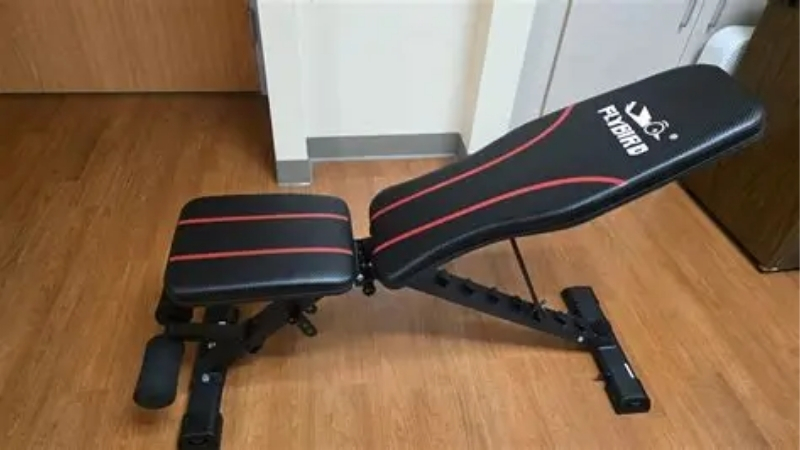
| FLYBIRD Adjustable Bench | All three angles | Folds upright, ladder adjust | First |
| Bowflex SelectTech 552 | Presses, flyes, rows | 5-52.5 lb, 2.5 lb steps | First |
| REP Fitness AB-3000 | Heavy pressing upgrade | Around 1000 lb rated | Later |
| NÜOBELL 80 lb | Heavy press and row | 5-80 lb per hand | Later |
| Amazon Basics Rubber Hex | One fixed pressing pair | Instant setdown | Later |
| BalanceFrom Rubber Mat | Stability and noise | Roughly 6-8 mm | Apartment |
FLYBIRD Adjustable Weight Bench
The efficient first bench, because it reaches every angle the programme needs and folds upright to roughly 28 x 18 in when you are done. The ladder adjustment is fast enough to change angle mid-superset without breaking the flow of a session.
The narrow pad gives less to brace against during heavy rows, and the light frame creeps on hard flooring without a mat underneath. Keep the heaviest pressing within a load where you see no flex at the pivot point.
Bowflex SelectTech 552
One pair covering 5 to 52.5 lb with 2.5 lb steps runs almost the entire bench programme, from light flyes through moderate pressing. That fine increment at the bottom of the range is what makes accessory work progressible rather than static.
Heavy pressing and chest-supported rowing will pass 52.5 lb within a year or two for most people who train consistently. The dumbbells also return to the cradle to change weight, which slows down drop sets and superset sequences noticeably.
REP Fitness AB-3000 Adjustable Bench
The upgrade when pressing gets heavy. Around 1000 lb of rating and a wide ladder of positions mean the bench stops being a variable, and the pad stays genuinely flat under an off-centre row rather than deflecting at one corner.
It is heavy to reposition and does not fold, so it needs a permanent spot of roughly 55 x 26 in (140 x 66 cm). Confirm that space exists before ordering, because returning a bench this size is not a simple undertaking.
NÜOBELL 80 lb
Eighty pounds per hand keeps pressing and rowing progressing for years, and the twist-handle change is fast enough that supersets between bench angles stay fluid rather than turning into extended rest periods.
Five-pound increments throughout mean light fly and rear delt work loses fine progression. The price is roughly double an entry set, and the mechanism has more moving parts to keep clean than a simple pin-based block system.
Amazon Basics Rubber Encased Hex Dumbbells
One fixed pair at your regular pressing weight removes the changeover delay on the movement you repeat most. You can set them down instantly, nothing jams mid-set, and the rubber encasing protects the floor when a set ends abruptly.
They give you exactly one weight and claim about 30 x 10 in (76 x 25 cm) of permanent floor. Buy them once you know the load you actually press rather than guessing, because a pair at the wrong weight is hard to justify keeping.
BalanceFrom Puzzle Exercise Mat
The mat stops the bench feet skating on laminate, spreads the load across a wider area and takes the edge off noise transmitted to a flat below. In an apartment it is what makes an early-morning bench session possible at all.
Interlocking foam tiles compress permanently under a bench foot over time and leave visible dents. That is cosmetic rather than structural, but budget for replacing a tile or two after a couple of years in a fixed position.
Frequently Asked Questions
These four questions cover the practical side of building the best weight bench workouts into a training week — which movements to prioritise, session structure, whether a barbell is needed and how many angles genuinely matter.
Which movements should the workouts contain?
Flat and incline dumbbell press, chest-supported row, single-arm row, seated shoulder press, flyes and skullcrushers cover the upper body completely. Add hip thrusts and Bulgarian split squats using the bench as a platform and the lower body is largely covered too.
How should I structure a bench session?
Press first while you are fresh, then row, then finish with accessory work at lighter loads. Three to four working sets per movement in the 8-12 rep range suits most people, with two upper-body sessions a week rather than one long one.
Do I need a barbell for the best weight bench workouts?
No. Dumbbells cover every pressing and rowing pattern a bench supports, and single-arm variations add range of motion a barbell cannot. A barbell adds heavier bilateral loading, but it also demands a rack, safety arms and considerably more floor space than most home gyms have.
How many incline positions do I actually use?
Three angles cover almost everything: flat, around 30 degrees and around 45 degrees. Benches advertising twelve positions are not more useful, so judge the adjustment mechanism and the independent seat adjustment rather than counting the positions on the spec sheet.
See More:
- Ankle weights best
- Best rated ankle weights
- Best home workout equipment budget
- Best resistance bands for men
Final Thoughts
The best weight bench workouts need a bench reaching flat, 30 and 45 degrees with an independently adjusting seat, plus one dumbbell pair spanning roughly 15 to 70 lb. Prioritise the mechanism over the position count, measure the 7 x 6 ft working area before ordering, and speak to a certified trainer if you are unsure about your pressing setup.


Write Your Review
No reviews yet. Be the first to share your experience!