
Key takeaways
What's inside
Best yoga bag for mat and blocks is a capacity question before it is anything else. A standard block is 9 x 6 x 4 in (23 x 15 x 10 cm), and two of them plus a rolled mat is more volume than most bags marketed for yoga will actually take. Capacity is the specification nobody publishes properly. Measure first.
As an Amazon Associate we earn from qualifying purchases at no extra cost to you. Product prices and availability are accurate as of the date shown and are subject to change.
As an Amazon Associate we earn from qualifying purchases at no extra cost to you. Product prices and availability are accurate as of the date shown and are subject to change.






By Chris Parker
🛒 Best Price Today on Amazon
Prime members get fast, free shipping on everything above, plus member-only deals. New members get a 30-day free trial — cancel anytime.
Start 30-Day Prime Free Trial →See Today’s Amazon DealsChoosing the Best Yoga Bag for Mat and Blocks
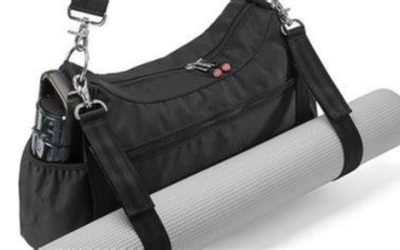
The best yoga bag for mat and blocks comes in two shapes, and only one carries props. A tube bag holds a rolled mat and almost nothing else, while a duffel or tote holds blocks, a strap and a towel alongside the mat. Which you need depends entirely on what leaves the house with you. Props decide the shape you need. Tubes carry mats only.
Block Dimensions
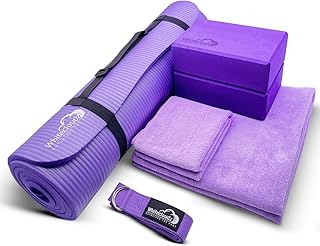
Standard foam blocks measure 9 x 6 x 4 in (23 x 15 x 10 cm), and the thinner version is 3 in (7.6 cm) deep. Two blocks side by side need roughly 9 x 12 in (23 x 30 cm) of internal space, more than a slim tube bag provides. That rules out the tube shape immediately, whatever the listing claims about capacity.
Cork blocks share those exact dimensions but weigh considerably more, often around 2 to 3 lb (0.9 to 1.4 kg) each on their own before the mat goes in. Two cork blocks plus a dense mat can pass 12 lb (5.4 kg) in total, and at that point shoulder strap width matters more than any other feature on the whole bag.
Length and Rolled Diameter
Measure your rolled mat across before ordering. Thin mats roll to about 4 in (10 cm), standard 5 to 6 mm mats reach 5 to 6 in (13 to 15 cm), and a wide 26 in mat rolls thicker again. Compare that to the stated internal diameter rather than assuming. Thick mats defeat fixed-size bags every time. Measure across the roll.
Length matters as much as diameter. A 71 to 74 in (180 to 188 cm) mat will not fit a bag built around the standard 68 in (173 cm) length, and forcing it bends the ends permanently. Check both figures on the listing, since many bags only publish one of them. Length matters as much as diameter here. Check both figures.
Footprint and Comfort
A loaded bag needs somewhere to live between sessions, which is the quiet ongoing cost of owning the best yoga bag for mat and blocks. Expect a corner about 8 x 28 in (20 x 71 cm) for a full duffel, far more than a rolled mat standing alone takes up. Plan that corner in advance, before the bag arrives.
Comfort scales with weight. Under 8 lb (3.6 kg) a plain strap is fine; above that, look for a padded shoulder strap at least 1.5 in (38 mm) wide. A separate wet pocket matters more than most people expect, since a damp mat left inside a closed bag starts to smell within a few days of being packed away.
Top Picks by Capacity
The six below run from a simple tube to full duffels with pockets. If you carry two blocks, skip the tube bags entirely, since they are built for mats alone. Each entry names a real drawback, because capacity, weight and price pull directly against one another here. Buy the shape that matches your props.
| Bag | Type | Blocks? | Best for |
|---|---|---|---|
| Gaiam Deluxe | Duffel | Yes | Full kit |
| Aurorae | Tube | Tight | Mat, towel |
| Manduka Go | Duffel | Yes | Heavy mats |
| Hugger Mugger | Tote | Yes | Loading |
| Yogiii | Tube | No | Budget |
| Gaiam Tote | Tote | Yes | Wide mats |
Gaiam Deluxe Yoga Mat Bag
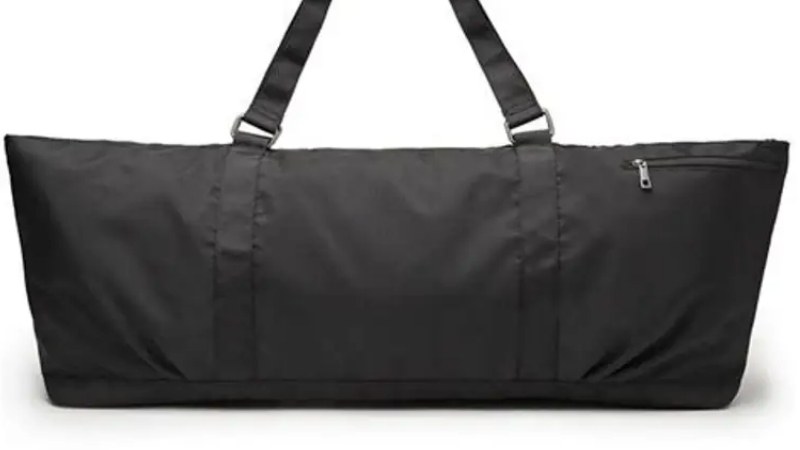
This is the default answer for anyone carrying a mat, two blocks, a strap and a water bottle in a single trip to class. The main compartment takes a rolled mat, the side pockets swallow the props, and the price sits below what specialist brands charge. It is the best yoga bag for mat and blocks on price.
The fabric and zips are mid range rather than hard-wearing, and a fully loaded bag is heavier on the shoulder than the strap padding suggests. Check the internal length if your mat is longer than 68 in (173 cm), since the standard version is built around that size. Zips are the part that eventually fails.
Aurorae Bag
A tube bag with a full-length zip is the easiest kind to load, because the mat slides in rather than being forced through a drawstring opening. Aurorae’s version adds a pocket that takes a towel and keys, which covers a class where blocks are provided by the studio. Full-length zips make loading far easier.
Two blocks will not fit alongside a mat in a tube, whatever the listing implies. If your studio supplies props, that is irrelevant; if it does not, this is the wrong shape of bag. Check the internal diameter against your rolled mat before ordering either way. Tubes are built around mats rather than props.
Manduka Go
Manduka builds around its own mats, which are heavy, so the strap and stitching are specified accordingly. If you carry a dense 6 mm mat plus cork blocks and the total is over 12 lb (5.4 kg), this is the bag least likely to complain about it over a year. Stitching and strap width are both above average.
It costs several times a basic bag, and for a light foam mat with foam blocks that money buys very little. Check the current dimensions before ordering, since Manduka revises the range regularly and the internal capacity differs between versions sold under similar names. Light kits will not justify the price.
Hugger Mugger
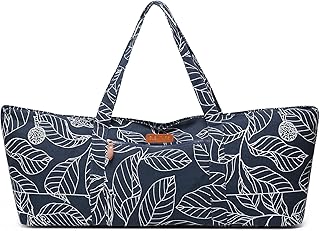
A wide tote opening is the practical answer to loading props: you drop blocks in from the top rather than posting them through a narrow gap. Hugger Mugger’s bags are well made, and the shape suits anyone who carries a bolster or a blanket as well as blocks. Wide openings are what totes do best. Bolsters fit here too.
Open totes offer less protection from rain than a zipped duffel, and the mat sits at an angle rather than fully enclosed. It is also bulkier to store empty. Buy it for ease of loading rather than for weather protection on a longer walk. Rain is the trade you accept with a tote. Zips add weather protection at a cost.
Yogiii Bag
The budget tube covers the basic job cheaply: a rolled mat, a small pocket and a shoulder strap. For someone whose studio provides blocks, or who only carries a mat and a towel, there is little reason to spend more than this on a bag. It covers a mat and a towel and nothing else. That suits studios which supply props.
It will not take blocks alongside the mat, the strap has no padding worth the name, and the fabric shows wear within a year of daily use. Treat it as a low-cost solution for a light load rather than something that will carry a full prop kit. Blocks will not fit alongside the mat. It is a mat bag rather than a kit bag.
Gaiam Tote
Wide mats are where most bags fail, and a tote sized for a 26 in (66 cm) mat plus props solves that specific problem. It also takes a longer mat than a standard tube bag will, which matters if you bought a 74 in (188 cm) mat for a taller practice. Wide mats are where most bags fail entirely, so check the internal width.
Totes are bulky when empty and offer minimal weather protection, and the open top means loose items can fall out on public transport. Check the stated internal length and width against your own mat, because “everything fits” is a description rather than a specification. Numbers on the listing beat adjectives every time.
Frequently Asked Questions
Four questions cover most of what people ask before buying a bag for a mat and a full set of props to carry to class. They are about capacity and fit rather than style, because a bag that will not close around the whole kit gets abandoned within a fortnight, however good it looks in the photographs.
Will two blocks fit in the best yoga bag for mat and blocks?
Almost never alongside a mat. Standard blocks are 9 x 6 x 4 in (23 x 15 x 10 cm) each, and a tube bag is built around the mat diameter alone. If you carry blocks, you need a duffel or tote shape rather than a cylinder. That is the single most common buying error. Choose the best yoga bag for mat and blocks by shape.
How do I know if my mat will fit?
Roll it, measure across it and measure its length. Compare both against the stated internal figures rather than the marketing description. Bags built for a 68 in (173 cm) mat will not take a 74 in (188 cm) one without bending the ends over time. Both figures matter, not just the diameter. Bent mat ends do not recover.
Do I need a padded shoulder strap?
Above roughly 8 lb (3.6 kg) of total load, yes. Two cork blocks plus a dense mat pass that figure easily. Below it, a plain webbing strap is perfectly fine. Strap width matters as much as padding, since narrow webbing digs into the shoulder whatever it is made from. Total load decides the width you need.
Can I wash a yoga bag?
Most fabric bags wash cold and air dry, though some have stiffening panels that do not survive a machine, so check the label first. Never store a damp mat inside a closed bag, since odour sets into both the mat and the lining within a few days. Air the mat before it goes into the bag. Odour is far easier to prevent.
See More:
Final Thoughts
The best yoga bag for mat and blocks is decided by internal dimensions rather than by looks. Measure your rolled mat, count your blocks, and buy a duffel or tote rather than a tube if props travel with you. Check both length and diameter on the listing before ordering. Then load it once and see what fits.
Write Your Review
No reviews yet. Be the first to share your experience!