
Compare fractional weight plates vs alternatives by deciding whether you need a smaller load change or another way to progress. Micro plates suit straight barbell increases. Heavier change plates, adjustable systems, and rep progression solve different problems, especially when your equipment has no plate sleeve.
Quick comparison of fractional weight plates vs alternatives
Choose fractional plates when a compatible bar needs a precise small increase. Choose conventional change plates when larger steps fit your training. For fixed dumbbells, use a supported add-on or another weight option. If your program permits changes in repetitions, you can also progress while keeping the load constant.
| Approach | Where it works best | What changes | Check before using it |
|---|---|---|---|
| Fractional plates | Compatible bars and some loadable handles | Small, direct increase in external mass | Bore, pair count, sleeve length, collar fit |
| Conventional change plates | Bars that progress comfortably in larger steps | Larger repeatable increases with fewer discs | Whether the next jump suits the lift |
| Approved clip-on or magnetic add-ons | Specific compatible dumbbells or equipment | Small mass added to equipment without a conventional sleeve | Exact compatibility, retention, balance, and permitted movements |
| Compatible loadable handles | Dumbbell users who want a wider choice of increments | Add or remove approved plates at the ends | Handle mass, sleeve room, collar engagement, and plate clearance |
| Selectorized adjustable dumbbells | Limited storage and many preconfigured loads | Move to the next designed weight setting | Exact list of selectable weights and model instructions |
| Additional repetitions at the same load | Programs that allow training within a rep range | More repetitions with the same external mass | Intended rep range, effort, and technique requirements |
| A planned change in tempo or exercise variation | Programs with a reason to alter the stimulus | Movement demands or execution change | Consistent tracking and program intent |
A small increase in mass is the most direct change when you are trying to progress at the same rep target on the same bar. An increase in reps changes the amount of work you perform with that mass. An exercise change can be useful, but it gives you a different movement to track. Compare each method against the result you intend to measure.
Compare the size of the step on your actual equipment
The practical difference between two loading options is how far each moves you from the current weight. Translate labels into the increase on the entire bar or on each dumbbell. Then check whether the step fits your planned exercise and whether it takes one pair, two pairs, or an entirely different tool to achieve it.
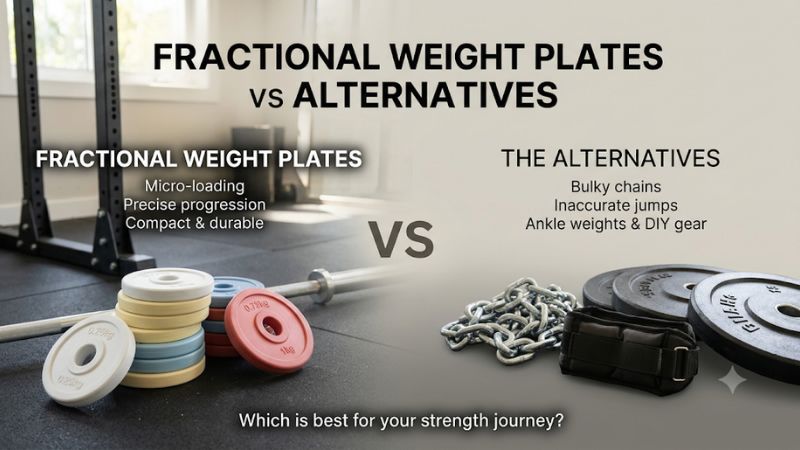
Fractional plates give a direct increase on a compatible bar
A pair of 0.25 lb plates adds 0.50 lb across a bar when you put one on each end. A pair of 0.50 lb plates adds 1 lb. The main advantage is that you can keep the bar, base weights, and movement the same while adjusting the external load by a small amount that is easy to record.
Consider a lifter keeping the same five-rep target on a familiar press. If the smallest normal jump is 5 lb, one pair of 0.50 lb discs creates a 1 lb step without changing the rest of the plan. The purchase makes sense when this problem recurs and the discs fit the sleeve and collars at the actual working load.
There is a trade-off in handling and accuracy. Several small discs can take up collar room, and small errors represent a larger percentage of lighter plates. Compare stated tolerance at the intended weight and keep both discs together. When a program calls for a 1 lb change, using an exact matching pair is generally easier to reproduce than improvising around the target.
Conventional change plates can be a better fit for larger increases
A pair of 1.25 lb discs gives a 2.50 lb jump, and a pair of 2.50 lb discs gives a 5 lb jump. Those increments can cover many lifts, warm-ups, and working sets. If a larger jump already fits your planned training, one common change pair can do the job with less handling than stacking smaller pieces.
For an 80 lb working load, a 2.50 lb increase is about 3.1%. At 200 lb, the same absolute increase is 1.25%. The relative size of a step changes with the lift and the starting load. Use your training plan and observed performance to judge whether the conventional pair already offers enough flexibility.
If you use a 2.50 lb jump repeatedly, compare a dedicated 1.25 lb disc on each end with a combination of 1 lb and 0.25 lb per side. Both add the same nominal mass. The dedicated pair uses fewer pieces, while the micro plates can serve several other loads. Compare actual stack thickness and delivered cost if you are deciding between them.
A consistent collar changes how precisely you can track the base
A change of equipment can add weight before you put a disc on the bar. If replacement collars each weigh 0.50 lb more than your previous collars, the assembled load rises by 1 lb. That arithmetic matters if the intended step is also 1 lb. Use collars for their approved retention function and account for their weight when relevant.
This is particularly important when you move between home and a commercial gym or use several bars with different starting weights. Record the bar, plates, and collars consistently when you need a close comparison. A lighter bar with the same labeled plate stack may produce a different training load even when the micro plates match.
If the priority is long-term consistency, dedicate a known pair of compatible collars to the bar you use for fine progression. This simplifies the baseline. Where equipment changes are unavoidable, recording the new total with the same method is more useful than treating the new setup as the old load plus only the added fractional plates.
Use equipment-specific options for dumbbell training
Barbell micro plates fit equipment with an appropriate sleeve and retaining system. Fixed dumbbells lack those sleeves, and adjustable models change weight in ways defined by their designs. Compare compatible add-ons, loadable handles, and built-in settings based on the intended lift, not just the small number printed on the accessory.
Approved add-ons can fill a gap on particular fixed dumbbells
A magnetic or clip-on accessory can add a small amount of weight to equipment it was designed to fit. Check the manufacturer’s guidance for shape, contact material, handle diameter or head fit, retention, and permitted movements. The load and feel can change depending on where the attachment sits relative to your hand.
For example, the Hex PlateMate is designed for suitable iron dumbbell ends and is sold as a pair of 1.25 lb attachments. If the approved arrangement uses one 1.25 lb add-on on each dumbbell, each dumbbell increases by 1.25 lb. Two pieces used on one compatible dumbbell would add 2.50 lb to that one implement. Follow the maker’s positioning and use directions.
Rubber, urethane, or other external parts can affect magnetic contact or prevent a suitable attachment. A clip-on can also interfere with finger space if the handle opening is short. Check fit before buying and avoid any arrangement that can shift, interfere with your grip, or depart from manufacturer instructions. Use compatible fixed loads or another progression method if attachment conditions are uncertain.
Loadable handles allow small changes with the right plates
A compatible pair of loadable handles can give you several weight settings using plates you already own. Compare bore and loadable sleeve length, collar engagement, and the outside diameter of any discs that will pass near your arm or thigh. The smallest increase requires compatible hardware at every end you intend to load.
Rogue lists 3.625 in of loadable sleeve length on its DB-10 and 6.75 in on its DB-15. The two products illustrate how different the available space can be. A thicker main plate and retaining collar can take substantial room on the shorter handle. Check the actual approved stack before choosing a fractional plate to add to it.
If you intend to add 0.50 lb to each of two symmetrical double-ended dumbbells, four 0.25 lb discs can give the change when used one per end in an approved layout. One mixed barbell kit usually supplies only two discs at that weight. Buy the proper count, and include the handles and collars when calculating the nominal total on each dumbbell.
Selectorized dumbbells trade custom steps for quicker setup
A selectorized set is useful when you want multiple working loads without storing several fixed pairs or loose plates. The actual selectable weights matter more than the advertised maximum. Read the specific progression table, including any built-in micro weights, and find the steps around the load you expect to use most.
If the model moves from 25 to 30 lb per dumbbell, the next jump is 5 lb per hand. A pair of loadable handles might allow a smaller increase with suitable equipment, while the selectorized pair makes routine adjustments more convenient. When two people train at once, consider how many handles and weight settings need to be available simultaneously.
Use add-ons only where the adjustable-dumbbell maker explicitly approves them for that model and arrangement. An accessory can affect how the weight seats or how the selector functions. When the step remains too large, keeping the current weight within a planned rep range may preserve the system’s intended operation and serve the training goal.
Advance the session when the weight can stay the same
An external load increase is one way to progress. Many programs also allow you to add a repetition, build toward the top of a rep range, or improve execution at a stable load. Use the progression method your program supports and keep the change you make clear in the log so you can compare sessions accurately.
Add repetitions within the planned range
If your program calls for sets of six to eight repetitions, moving from six to seven at the same load can be a progress marker. Keep the conditions comparable, including execution, rest, and the program’s effort target. When you reach the top of the intended range, consider the next available load and recheck the planned repetitions.
For example, a lifter using 70 lb can increase from three sets of six to three sets of seven over time if the program allows. That changes the number of repetitions at 70 lb. Adding a 1 lb pair total changes the mass at the same rep target. Both are measurable, and the better fit depends on what the workout asks you to improve.
This approach costs nothing and needs the same equipment. It is especially useful while waiting for a suitable micro pair or when a selectorized system has a large gap between settings. If a plan requires a specific increase at the same rep target, a verified fractional pair solves that equipment problem directly.
Use changes in tempo or pauses when they serve the program
A planned pause or slower lowering phase can change how an exercise feels while the external load stays the same. Choose it when the training plan calls for execution, control, or a distinct variant. Track the new movement conditions separately so you can interpret the result and repeat the setup later.
A paused bench press at 100 lb and a regular bench press at 100 lb use the same nominal load. The difference is how the repetition is performed. Improvement in one can be worth recording on its own. If your goal is to increase the regular press by 1 lb under the same conditions, micro plates provide the specific change you want.
Avoid changing multiple variables at once when the intent is an easy comparison. If you add a pause and change the load and rest time together, it becomes harder to interpret the next session. Choose a small change that suits the workout, write it clearly in the log, and apply it consistently.
Use a larger change only when the planned lift can support it
If you already perform the intended work comfortably at the current weight and the next ordinary step is appropriate, conventional plates may be sufficient. Compare the next weight with the scheduled rep range and effort. A small increase is useful when it fills a real gap, while some lifts can progress through larger available steps.
The needed increase can change from one exercise to another. One lifter may use fractional plates for a strict press and ordinary change plates for a deadlift. Keeping both options close at hand lets you adjust the right lift without committing to a single increment for the whole routine. Buy the additional pair only when a meaningful gap remains.
If you are unsure which step is appropriate, review the performance across several sessions and how consistently you can complete the planned work. Avoid buying a large assortment solely because the first heavier set felt difficult. A measured change in weight, a repeated session, or an allowed change in reps may each be available.
Compare costs and apply the right choice to your gym
The cheapest option depends on whether your equipment accepts the change and whether the next step solves a real problem. A single fractional pair can cost less than replacing a bar or adding a fixed dumbbell set. If your current plates already give appropriate steps, or the program permits more reps, you can keep the same setup.
A short Olympic bar with a crowded sleeve
Start with a thin compatible pair if the program requires a small load change and the collar can still engage fully. Compare the exact plate thickness and find the remaining room after your usual loading stack. If the sleeve cannot accept another disc in the correct arrangement, choose an approved alternative or use the current load within the plan.
For a single target increase, a pair can be a smaller purchase than a multi-size set. If the gap occurs at the heaviest end only, replacing a thick approved base plate with a suitable thinner configuration may also provide useful room. Compare the exact equipment and costs, and avoid changes that compromise the approved retention.
A fixed dumbbell set with a large jump between pairs
A compatible add-on may let you keep the familiar grip and move up by an intermediate amount. It needs documented fit and secure positioning for the exercise. Compare the delivered price of that option with adding one missing fixed pair or using the current weights at a higher rep count when your program allows.
For example, a hypothetical $40 verified add-on pair can cost less than an $80 intermediate dumbbell pair. The economics change if the add-ons suit only one movement or are incompatible with the head finish. The fixed pair may also be easier to switch to in circuits, while the add-on has value if it serves several compatible loads you already own.
A home setup that progresses across several lifts
One fractional set can cover small barbell changes while conventional plates handle greater jumps. A separate system might be better for dumbbells if they have no compatible sleeve. List your actual lifts and which equipment each uses. This shows whether one flexible purchase fills several gaps or whether targeted pairs suit the room better.
For people using pounds and kilograms at different gyms, keep a separate record of the equipment and intended step. A 0.50 kg increase is approximately 1.10 lb, close to but distinct from exactly 1.00 lb. Use the target unit from your plan and select equipment accordingly, especially if precise tracking is why you buy the extra plates.
Frequently asked questions
Compare the actual change you want to make before choosing hardware. A barbell increase, an add-on per dumbbell, and an extra repetition answer different needs. These questions help you keep the plan clear when the existing weight choices, sleeve fit, or the way the exercise is tracked affects your decision.
Is a 2.50 lb jump small enough for barbell training?
It can be, depending on the starting load, exercise, and intended repetitions. Two 1.25 lb plates give that increase on a balanced bar. If the jump consistently exceeds what your plan can accommodate, a smaller compatible pair can give a useful intermediate step. Compare it against how you perform on the actual lift.
Can I use household objects or loose washers to add small weights?
Use equipment designed and approved for the intended loading and retention arrangement. An improvised object can have unknown weight, a poorly fitting opening, or inadequate retention on the sleeve. Choose a compatible fractional plate or an allowed progression at the same load when the intended equipment is unavailable.
Do magnetic dumbbell weights fit every metal dumbbell?
Fit depends on the attachment design, head shape, contact material, surface condition, and placement. Check what the makers allow for the specific equipment and movement. A metal-looking end or a rubber-coated iron core does not by itself establish a suitable contact surface. Use a supported alternative when fit is uncertain.
Can rep progression replace fractional plates?
It can serve a different goal when your program allows a rep range at a fixed load. Adding a repetition changes what you do with the existing weight. Fractional plates are more direct when the next goal is a small increase in external mass at the same planned reps on compatible equipment.
Conclusion
Choose fractional plates for a verified smaller step on the same bar. Use conventional change plates for suitable larger jumps, an approved attachment or adjustable system for compatible dumbbells, and rep progression when the plan supports it. Match the choice to the equipment you own and the exact change you want to track.
More from Amazon
Programs that pair well with the guide above. Offers and eligibility are set by Amazon and may change.
Free shipping on eligible items, Prime Video and more. Eligible new members can start with a free trial.
Start a Prime free trialA Prime membership for ages 18-24 with a trial period. Eligibility is set by Amazon.
See Prime for Young AdultsAudiobooks and podcasts to listen to on the go. Eligible new members can start with a free trial.
Try Audible freeAd-free music streaming. Eligible new subscribers can start with a free trial.
Try Music Unlimited freeAs an Amazon Associate we earn from qualifying purchases.


Write Your Review
No reviews yet. Be the first to share your experience!