
When comparing a dumbbell storage tray vs alternatives, start with the weights you own and how you pick them up. A factory cradle supports adjustment, a tray defines a resting area, and a rack organizes multiple pairs. The right setup depends on load, head shape, available floor space, and how often you switch weights.
Quick comparison table
First decide whether you are replacing a required component or choosing where the equipment will live. A working adjustable dumbbell can need its original cradle regardless of whether that cradle sits on a floor, stand, or cart. With fixed weights, you have a wider choice of suitable storage geometry.
| Storage option | What it does best | Space and access | Main trade-off |
|---|---|---|---|
| Low tray or approved floor cradle | Keeps one or a few weights in defined positions | Low profile, with floor-level pickup | Limited capacity and sometimes a deep reach |
| Vertical A-frame or tower | Organizes several compatible fixed pairs | Uses height, with access from designated sides | Individual cradles must fit each dumbbell |
| Horizontal tiered rack | Holds numerous compatible fixed weights | Uses more wall length and offers a front approach | Takes more permanent floor space |
| Elevated adjustable stand | Raises approved selector bases or compatible adjustables | Comfortable access when correctly fitted | Model, weight, and mounting limits |
| Mounted storage shelf | Adds a row using an existing compatible frame | Needs room around the uprights and level above | Requires exact mounting compatibility |
| Suitable floor parking or protective mat | Provides a simple resting location for stable fixed weights | Minimal added equipment and floor-level handling | Limited organization and retention depend on shape and setup |
Compare storage using the loaded arrangement
The empty footprint is only one part of the comparison. A tray with two dumbbells can extend past its legs or edges. A rack puts more objects inside one storage area and needs a path to every pair. Measure the dimension that limits you first, whether it is height, wall length, or access from one side.
A short FitRx A-frame is listed at 14.6 × 12.6 × 20.9 in and holds four pairs within a 100 lb total limit. PowerBlock’s Small Compact Stand measures 16 × 14 × 25 in and also lists 100 lb total for supported models, but it serves one adjustable pair. Similar dimensions and ratings give you two very different storage setups.
For an adjustable example, two REP QuickDraw cradles side by side give a nominal footprint of 20.6 × 16.9 in before hand clearance or gaps. A compatible platform could raise those trays, which changes the pickup height and overall installation. The cradles still need to sit, align, and mount as intended.
Make the comparison at the highest weight you plan to store. A light selector setting can leave many plates behind in the base. The total stored equipment may be the same across settings even when the dumbbells you lift become lighter. Count all components the support carries.
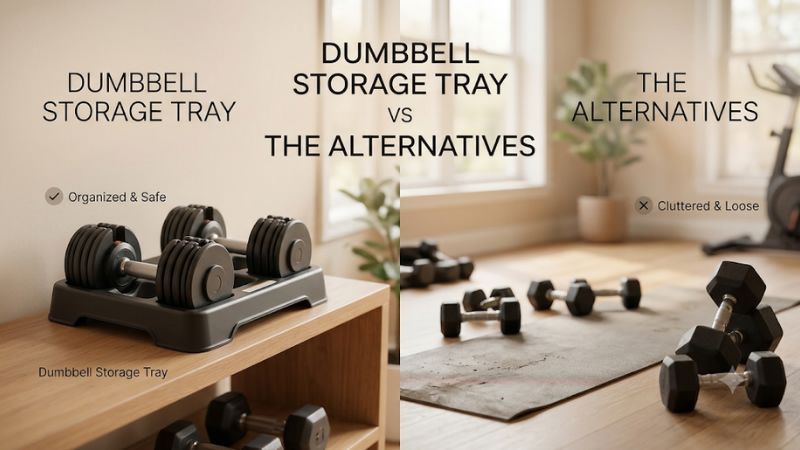
Dumbbell storage tray vs vertical stand
A low tray usually supports a few pieces close to the floor. A vertical stand stacks individual positions and makes better use of height when you own several fixed pairs. Choose by the number of compatible weights and whether you can reach every position with the other weights in place.
Choose a tray for one pair or a short collection
One stable fixed pair can sit in a purpose-built low tray in a spot that is easy to clear. This is useful beside a floor mat, under an open shelf with adequate clearance, or near a bench where a raised rack would crowd the room. If you use different loads, measure whether the tray can hold all of them without crowding their grips.
A tray also gives you more control over spacing when the design supports the equipment. Two weights can rest with a gap between them, whereas a stand fixes the location of each cradle. Check the inside dimensions and whether the lip or support shape serves the heads you’re storing.
A private home gym with one 25 lb pair rarely needs five separate cradle positions. Once you add four or five pairs that you reach for in the same session, a vertical stand can become easier to organize than spreading trays across the floor.
Choose vertical storage for several compatible fixed pairs
A compact A-frame keeps several pairs at separate heights with an assigned position for each weight. This can be useful when there is little wall length and the head shapes match the stand. Check the total capacity and each cradle’s fit before adding the largest pair.
Four pairs of 5, 10, 15, and 20 lb weigh 100 lb combined. Adding a 25 lb pair makes five pairs and brings the total to 150 lb. At that point the rack needs both five available positions and a load rating sufficient for the collection. The heads also need enough clearance to be removed without catching an adjacent pair.
Some vertical racks require access from both sides. Compare that approach path with the floor area of a low tray. A rack can save storage width and still need a more open location because its far side cannot sit against a wall.
Consider which weights you pick up most often
A tray places all weights at one height. A vertical rack places the various loads at different levels, usually with specific guidance for loading and placement. Think about the pair you use for most sets and how comfortably you can reach its assigned location.
If a heavy pair at the floor is hard to retrieve safely, an appropriate elevated station may make sense. If a very light pair is brought out once a week, floor-level storage can be enough. Compare the repeated handling rather than choosing solely by pair count or how neatly the rack looks when full.
Dumbbell storage tray vs horizontal rack
A horizontal rack puts more positions across a row or stacked shelves. It can suit a broader fixed-weight set and preserve a predictable approach from the front. A single tray can be simpler when you have little equipment and want to retain the rest of the wall space for a bench, mat, or attachment.
Choose a horizontal rack for wide collections and accessible rows
The REP three-tier horizontal rack is listed at 48 in long, 23.4 in deep, and 34.6 in high. REP recommends it for one of its 5–50 lb fixed sets and documents fit for its own round urethane models. A buyer with another brand should still verify its usable shelf length and the compatible head shape.
Look at the lower row while the top shelves are loaded. A well-placed rack leaves enough room to reach the grips and lift large heads clear of the upper equipment. Compare this motion with what happens on a small tray, especially for the pair you use when fatigued.
A horizontal rack is an easier fit in some rooms because it needs front access along a wall instead of two or three surrounding approaches. If you have a long open wall, it can store more weights without pushing as far into the working lane as its width alone suggests.
Use a saddle rack when round heads need defined support
A saddle rack has shaped positions for supported dumbbells. This can help when the heads are round and would roll on a plain surface. Titan’s saddle-rack description, for example, names round-head and hex dumbbells as intended for the shaped trays on its two-tier product.
Check the exact saddles before assuming they fit a mixed collection. A shape can be supported in principle while a particular dumbbell is too short, too wide, or too large for the adjacent spacing. Verify both where the dumbbell rests and how your fingers reach the grip.
For only one pair of round dumbbells, check whether an approved individual resting support would solve the problem without a full rack. Where the appropriate standalone product is unavailable, a compatible rack or another specified support gives you clearer information than a generic flat tray.
Count usable shelf width rather than the number of rows
A three-tier rack can hold quite different numbers of pairs depending on their head sizes. Calculate one row at a time. Identify the largest heads that go together, add enough room for pickup, and compare that with the manufacturer’s usable shelf dimensions.
A 5–50 lb fixed run totals 550 lb across ten pairs. A rack needs both the capacity and the room to fit those ten pairs in its intended configuration. The same number of positions occupied by heavier or larger pairs may exceed the space or weight allowed.
Dumbbell storage tray vs dedicated adjustable stand
For selector dumbbells, the actual question is often where to put the original cradle. Use the cradle where the mechanism requires it. A stand under it can raise the pickup point or fasten the base to a dedicated surface. It also adds frame dimensions, its own weight, and compatibility checks.
Keep original trays on a suitable floor when that works
Floor-level storage can be economical when the maker allows it, the surface is firm and level, and both dumbbells can be lifted straight from the bases. It avoids another equipment purchase and keeps the stored pair at a lower height. Verify the working clearances around both cradles.
For short workouts at moderate loads, the pickup height may already be convenient. If repeated changes become awkward or the cradle shifts during normal adjustment, inspect the surface, fit, and condition. A compatible stand can be useful if it addresses the cause and positions the bases as intended.
Place both trays outside normal walking routes. If you have to step around them to enter the room or get to the bench, a different position matters more than the height. The floor setup works when you can reach it directly and return the dumbbells without moving anything else.
Use an elevated stand when you need better docking access
A dedicated stand can place the cradles at a comfortable height and reduce how far you lower the dumbbells between sets. Certain models let you bolt the bases to support trays. REP’s adjustable stand, for example, provides specific tray versions and mounting provisions for its QuickDraw and REP x PÉPIN FAST Series cradles.
Check the approach and lift direction. A stand can support the base with enough rating and still be positioned too close to a shelf or bench to use the handles comfortably. Test both sides and find out whether you need to stand between the trays or in front of them.
Count cradle mass and the full supported pair when comparing stand ratings. Also check whether accessories or expansion plates will be stored on the stand. Follow the manufacturer’s rules for the supported version and for any supplied fasteners or caster locks.
Choose a compatible flat platform for supported designs
Some adjustable blocks can use a flat support surface instead of a molded external plate-alignment cradle. PowerBlock lists specific models for its Small Compact Stand. A compatible version can be raised on the top tray and adjusted according to the dumbbell instructions.
A matching upper weight limit is only one part of fit. PowerBlock’s own chart identifies models and series excluded from the Small Compact Stand. Check both the exact designation and the loaded stage. A larger expandable product needs a stand approved for the configuration it will reach.
If you move a stand between workouts, use the maker’s procedure. The option to fold a stand can help in a shared room, and the dumbbells need another suitable place to rest while it is unloaded and folded.
Dumbbell storage tray vs mounted shelves or floor parking
Mounted shelves take advantage of a frame you already have, while floor parking can avoid storage equipment altogether. Both options make sense under specific conditions. Check whether the intended layout leaves the exercise area open and what supports the weights when you’re done.
Add a mounted tray if you already have the right frame
A bolt-on shelf can add storage without buying another base. It can also put fixed weights close to the rest of the equipment you use. Check how the shelf mounts, whether the rack supports that configuration, and whether the tray projects into the area used for lifting or other attachments.
The main cost advantage comes from the existing frame. Buying a new frame for one tray can cost more and take more effort than a freestanding storage rack that fits the weights directly. Compare the full bill for uprights, feet, mounting hardware, and the tray.
A mounted tray also needs vertical pickup clearance. Check the distances to a crossmember, the shelf above, and nearby rack accessories. The best level is one you can reach and use comfortably with the equipment in its normal positions.
Use a protective floor area for stable fixed weights
One pair of fixed weights can often rest on a suitable floor surface outside the walking route. A compatible mat can protect the finish during controlled set-downs. A mat provides a contact surface and does not add the separate cradle position or roll restraint of a purpose-built tray.
This option is most practical with a stable resting shape and very few pieces. It also keeps the pickup at floor level. If the equipment spreads across the floor or gets moved several times a day, a tray or rack gives the pair a more predictable home.
Use equipment and floor manufacturer guidance to choose a material and location. If the weights have round heads, use suitable retention or approved supports. Keep the area clear when other people need to pass through it or share the workout space.
Compare the reset effort in a multipurpose room
Count what you move before and after using the room. A tray with two heavy fixed dumbbells can be left in a stable place or moved when unloaded. A tall rack loaded with every pair is a more permanent fixture. A foldable stand can tuck away when empty and needs another place for the weights.
If resetting the room is a daily task, map the role of the bench, mats, and storage together. It may be easier to move a light bench than to relocate a pair of loaded selector bases. Use the storage design that keeps the heaviest pieces where you can use them safely.
Choose by the equipment that is missing a suitable home
For a few fixed pairs, begin with low storage and add a rack when the inventory justifies it. For a selector pair, begin with the required adjustment base and decide whether it needs elevation. For equipment already used beside a rack, compare what a mounted tray would add to the existing station.
| Your situation | Best place to start | What could change the choice |
|---|---|---|
| One flat-sided fixed pair | Low approved tray or suitable floor parking | Need to raise the pickup height or clear the floor |
| Several matching light hex pairs | Vertical stand | Head size, per-position fit, or blocked side access |
| Ten fixed pairs with large heads | Compatible horizontal or saddle rack | Limited wall length or no clear front approach |
| Adjustable pair with both factory bases | Suitable floor placement or approved stand | Need for height, fastening, or easier selector access |
| One failed selector base | Exact approved replacement cradle | Warranty or official remedy |
| Empty bay on a compatible rack | Matching bolt-on tray | Hardware cost, interference, or blocked pickup path |
Frequently asked questions
The best choice changes as the collection or room changes. These questions address when a tray can reasonably give way to another storage type and what must be preserved when moving an adjustable setup to a new location.
Does a tray take less space than a vertical rack?
For one fixed pair, a low tray can be the smaller purchase and installation. For several pairs, a vertical rack groups more weights over the same area. Compare loaded width and retrieval access for the actual collection.
Can a mat replace a tray?
A suitable mat can protect a floor during normal placement of stable weights. If the tray provides retention, indexed positions, or plate alignment, use the equipment designed for those functions. Evaluate the specific job the tray performs first.
Is it worth buying an adjustable dumbbell stand?
Yes when the approved stand improves pickup height, maintains stable positioning, or secures the required cradles. A supported floor-level setup can be enough if you have easy access to both weights and the required controls.
Should I buy a horizontal rack for round dumbbells?
Choose a model that explicitly supports the exact type. Some horizontal racks and saddle racks accommodate certain round dumbbells. Check head shape, usable width, and the intended retention before loading an unfamiliar model.
Is a mounted tray cheaper than separate storage?
It can be if you already own the compatible framework and the required hardware. When starting without a frame, include its cost and working footprint. A standalone rack may cost less for the number of dumbbells you actually have.
Conclusion
Choose a low tray for a small group of compatible weights, a vertical rack for a short fixed collection, or a horizontal rack for greater row space and front access. Keep the approved cradle with any adjustable dumbbell that requires it, then add a stand if height helps. Use a mounted tray when the right frame is already available and the loaded row stays easy to reach.
More from Amazon
Programs that pair well with the guide above. Offers and eligibility are set by Amazon and may change.
Free shipping on eligible items, Prime Video and more. Eligible new members can start with a free trial.
Start a Prime free trialA Prime membership for ages 18-24 with a trial period. Eligibility is set by Amazon.
See Prime for Young AdultsAudiobooks and podcasts to listen to on the go. Eligible new members can start with a free trial.
Try Audible freeAd-free music streaming. Eligible new subscribers can start with a free trial.
Try Music Unlimited freeAs an Amazon Associate we earn from qualifying purchases.

Write Your Review
No reviews yet. Be the first to share your experience!