
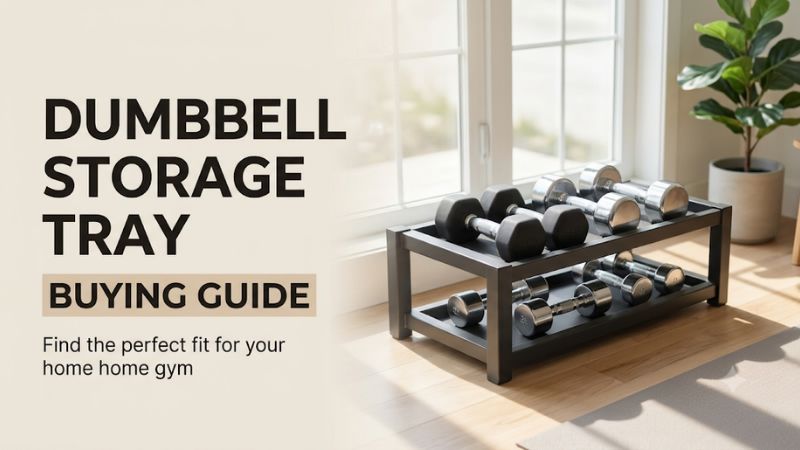
This dumbbell storage tray buying guide starts with what the tray needs to do. A fixed pair needs a supported resting place, while many adjustable dumbbells need a specific cradle to hold and align plates. Check the exact model, usable dimensions, and loaded weight before deciding where the tray should sit.
Identify the job the tray needs to do
Start with the equipment and the missing function. A fixed dumbbell needs a suitable resting surface and, depending on its shape, retention. A selector dumbbell can also need plate alignment and access to its controls. A tray that elevates an existing cradle has a third job and separate fit requirements.
| If you need to… | Look for… | Confirm before buying |
|---|---|---|
| Replace a cracked or missing adjustment base | Manufacturer-approved replacement cradle | Exact model, generation, and whether any other parts are affected |
| Raise a pair with working original cradles | A compatible stand or cart | How the cradles mount, the total rating, and pickup height |
| Store two or more fixed pairs | An approved tray, shelf, or saddle rack | Head shape, usable width and depth, and any per-position limits |
| Add a row onto an existing rack | A tray designed for the matching frame | Series, bay width, hardware, and installation limits |
| Organize spare plates or add-on weights | The specified holder for those parts | Inventory quantity, support rating, and access during weight changes |
Identify the model using its label or purchase record
For adjustable dumbbells, write down the exact model and generation. Weight capacity on its own is too broad. Two adjustable dumbbells that top out at 80 lb can use different channels, plate profiles, guides, and selector locks. The proper base is determined by the full model, not a similar photo.
Check the label on the handle, base, or underside where the manual indicates. If you have the order record, compare it with the label. A newer version can keep a similar sales name and change the dimensions or mechanism. Send the maker both identifiers when a replacement part page is unclear.
For fixed weights, note the brand and series, head type, and weights you plan to store. A matching set can still change dimensions as it gets heavier. The narrowest grip and the largest heads are the best place to start measuring.
Separate a defective base from a height problem
If your factory cradle works but floor-level pickup is inconvenient, an approved elevated stand may solve the problem. If the cradle itself is damaged, raising it leaves the original fault in place. Determine which part needs attention before pricing a replacement or a different support.
A cradle may look worn in cosmetic areas and still need a manufacturer assessment if the plate guides or locking surfaces are involved. If the mechanism behaves differently, the plates shift, or the dumbbell cannot seat properly, stop using the assembly and check the maker’s instructions.
Where a part is missing, confirm what the replacement includes. A listing could sell one complete base, one interior support, a set of rails, or hardware only. The needed part may be smaller than a full cradle, provided the manufacturer approves that repair for the condition of the unit.
Determine how much storage needs to be available at once
Two adjustable dumbbells usually need two secure positions. Five fixed pairs need ten positions, or enough approved shelf space for all ten weights. A tray shared between weights and spare plates also needs a plan for what happens when all equipment is put away simultaneously.
If you own one heavy single for rows and two light pairs for other work, the load distribution can differ from a standard set. Count the single where it will sit. Check whether the intended support permits that arrangement and whether the heavier object makes another dumbbell hard to reach.
Leave future expansion to specific pieces you expect to buy. If the next pair will be larger, measure or obtain its dimensions now. Choosing extra width can make sense when you can name the load. Buying a much larger storage system for uncertain growth adds cost and room requirements.
Measure the usable support surface
The relevant measurement is where the weight rests and how it leaves the tray. An outside dimension can include walls, headers, bolts, rolled edges, or hardware that occupies part of the opening. A small measurement error matters most when a cradle is meant to sit flat across its feet.
Measure inside width and depth for fixed dumbbells
For each fixed dumbbell, measure the widest head and the total length. Note how you plan to orient it. Two weights stored side by side can require space for both head profiles plus a hand gap. A tray wide enough for two objects to touch can still be awkward to use.
Consider an inside width of 18 in and two heads that use 7.5 in each across that width. You would have 3 in left in total for gaps and wall clearance. That is an illustration of the calculation. Your grip, head shape, and pickup direction determine whether the remaining space works.
Depth matters if the head protrudes front to back or needs to clear a retaining lip. Confirm that the weight is fully supported as directed. Use a saddle or other approved retention for round heads where the rack requires it. Avoid improvised wedges that move while you handle the weights.
Measure cradle feet and mounting points for adjustable units
Measure the outer limits of the cradle and the parts that actually touch the stand. The footprint can include feet, holes, projecting guides, and space for hardware beneath the base. A base may appear to fit across the top while one of its feet sits beyond the support.
If it bolts down, use the exact mounting pattern rather than relying on outside dimensions. The REP QuickDraw stand tray is listed at 9 × 21.4 in. The REP x PÉPIN version is 7.2 × 19.8 in. Both are made by REP, and each is sized and specified for its cradle.
Check the instructions for fastener type, orientation, and any required mounting hardware. Use the supplied or specified components. A smaller base that seems to sit on a larger tray still needs the correct fastening and supported contact before you use it.
Leave room for lifting above the support
Trace the path the dumbbell follows as you lift it. A fixed dumbbell may need to rise over a tray lip. A selector dumbbell can need to rise straight out of the base so the selected plates release clear of the ones left behind. Include this movement when placing a tray under a shelf.
Check both hands in their intended positions. On a dual station, one side might be easier to reach than the other. A split stand can give room to step in between the two trays. A narrow straight platform can still work if you can stand close enough and get a complete grip.
Place a bench in the normal working position and test the route with light practice objects before using the heaviest pair. Reaching over an obstruction can make a straightforward set-down awkward. A few inches of layout change sometimes solve the issue more easily than a different tray.
Calculate load and verify the support underneath
A tray rating applies under specific conditions. Check whether the load figure is for the tray, each side, or the complete assembly. Include the weight of cradles and accessories where the stand supports them. For mounted trays, the supporting frame and installation also impose requirements.
Add the weight of both dumbbells and the cradles
If a stand holds two 50 lb dumbbells, the dumbbells contribute 100 lb. If the design also uses two 5 lb cradles, the example load on the platform becomes 110 lb. Keep the weight of the stand itself separate when checking the floor, then add it to calculate the full stored weight.
The Snode AD80 is a useful documented example. Each cradle weighs 15.3 lb. At 80 lb per dumbbell, one fully loaded cradle and dumbbell total 95.3 lb. The pair totals 190.6 lb before any stand. Moving the equipment to a higher surface changes support requirements even though the dumbbells are the same.
If you use add-on weights, count the stored accessories supported by the stand. Follow separate limits for individual holders and any shelf areas. A small storage compartment can have a different intended load from the main dumbbell platforms.
Apply every relevant rack and shelf limit
A 600 lb manufacturer shelf rating can coexist with a narrower shape restriction or a lower limit for a particular configuration. Follow everything the maker specifies. The usable area can be filled by large heads while the total load is still far below the rating.
Evaluate frame compatibility in addition to shelf limits. A mounted shelf can depend on correct hardware, upright spacing, or foot extensions. Check the exact installation diagram, including how the overall frame is set up and whether nearby attachments leave the required clearance.
A published stand rating provides no structural rating for the floor underneath. If your collection is very heavy or the supporting surface is uncertain, confirm the location is appropriate. Use suitable, level flooring and make sure the feet and pads sit as directed.
Distinguish storage capacity from conditions during use
Static storage involves the load while it rests on the tray. Returning a weight abruptly introduces additional force. Use controlled set-downs and observe the equipment’s handling instructions. A hard landing can affect the stand, cradle guides, fasteners, or the floor even if the resting weight is within the listed limit.
Similarly, a stand that supports the weights while stationary may require unloading before folding or relocation. If it has casters, check whether the manufacturer authorizes movement when loaded and how the locks are used. Follow the stated procedure rather than relying on a generic rolling-cart rating.
Verify compatibility before buying a replacement or add-on
Order the smallest approved part that solves the problem. Check the exact variant, what the package contains, and any required hardware or frame. Then verify the price and support terms for the whole working pair, especially when the listing shows a loaded setup with accessories that are sold separately.
Match adjustable cradle parts to the exact product generation
A complete cradle and an individual support inside the cradle are different parts. If a replacement page describes an inner or outer support, verify that the rest of the base can be reused. Get the manufacturer’s instructions for replacing that component. Fit by appearance alone is insufficient for adjustment equipment.
Ask whether the part fits your maximum configuration as well as the initial weight. An expandable dumbbell can use different spacing when all the added plates are installed. Verify how the base or stand accommodates that configuration before buying it for a lighter current setting.
Keep the model and part number for future support. If an exact replacement is unavailable, ask the maker whether there is an approved alternative or service option. Avoid modifying a base to make a different dumbbell fit.
Match bolt-on trays to the mounting ecosystem
Compare the model series, width, upright format, hole size, and hardware needed for the installation. Two trays with similar advertised widths can attach differently. The original REP MSS and REP Modular Storage 2.0, for instance, are different generations and are not cross-compatible.
Check the space around the frame after the tray is mounted. Verify that rack attachments can still move, a barbell can still be loaded, and all intended pickup routes remain clear. A spare rack bay is valuable only when the tray leaves the surrounding equipment usable.
Review the allowed installation height and overall layout. Some manufacturers identify a recommended maximum height for a shelf. Follow that guidance and choose a level where you can retrieve the largest weights with control.
Check official remedies before paying for damaged parts
Identify whether an official safety notice applies before using or paying to repair a malfunctioning selector system. Recall remedies vary. The CPSC notice for ProForm Rapid Strike PAMSDB20 specified a replacement molded tray supplied through iFIT after affected owners stopped use.
Other notices can prescribe a different remedy, including a refund or replacement of the full unit. Check the exact model and applicable serial details. A damaged base or poor locking sequence is a reason to verify the supported resolution, including whether the original handle and plates were affected.
Frequently asked questions
These questions address measurements and buying assumptions that can change the order. Use the actual model, intended weight, and support configuration when applying each answer. A short specifications list can be enough if it identifies contact, capacity, and how the equipment is installed.
Does “tray dimensions” mean usable space?
It can describe either the outside or inside. Check the drawing or ask the seller. For a rimmed tray, the usable area can be smaller because of lips and hardware. For a cradle platform, confirm the footprint of the feet and every mounting point.
Can I use a different brand’s adjustable cradle?
Use only a cradle the manufacturer confirms for the exact model and generation. An apparent fit does not establish correct plate alignment or selector engagement. Buy from a source that identifies the applicable model and provides the required instructions.
Should I buy one base or replace both?
If only one needs replacement, ask whether an approved single replacement can be used alongside the intact base. Verify the reason for failure first. Buy the quantity the maker directs and compare prices on a per-cradle basis.
Can a tray hold both dumbbells and kettlebells?
Some rack trays explicitly support both in specified orientations. Check usable depth, weight distribution, mounting, and how each item rests. A shelf designed around particular dumbbell heads may be unsuitable for a bell if the maker does not approve that use.
Can I leave spare plates in the tray after lifting?
Keep unselected plates in the positions prescribed for the system. Store any separate add-on weights or loose plates in an approved location. Extra plates placed near the wrong guide can interfere with docking or adjustment.
Conclusion
Choose a dumbbell storage tray by identifying the model, measuring the actual contact area, and confirming the complete load. Replace a faulty adjustable base with the approved component, use a compatible stand if height is the issue, and verify the mounting ecosystem before adding a fixed-weight shelf. Make the purchase only after you know what the package includes and how both dumbbells will be reached.
More from Amazon
Programs that pair well with the guide above. Offers and eligibility are set by Amazon and may change.
Free shipping on eligible items, Prime Video and more. Eligible new members can start with a free trial.
Start a Prime free trialA Prime membership for ages 18-24 with a trial period. Eligibility is set by Amazon.
See Prime for Young AdultsAudiobooks and podcasts to listen to on the go. Eligible new members can start with a free trial.
Try Audible freeAd-free music streaming. Eligible new subscribers can start with a free trial.
Try Music Unlimited freeAs an Amazon Associate we earn from qualifying purchases.




Write Your Review
No reviews yet. Be the first to share your experience!