
Our Top Picks
 Klipsch Home Theater Speaker Bundle: 2 Pairs R-41M7.9 x 5.75 x 11.3 inches27.6 PoundsCheck on Amazon
 Sony SS-CS5M2 3-Way 3-Driver Hi-Res Compact Bookshelf Speakers8.7 x 7 x 13.2 inches1 poundsCheck on Amazon
The best home theater speakers depend on your room and priorities: choose a compact soundbar system for simple TV upgrades, a 5.1 package for affordable surround sound, or a larger 7.1.2/5.1.2 setup when you want convincing cinematic immersion.
Best Home Theater Speakers by Situation
| Situation | Best-fit configuration | Recommended type or example | Typical market range | Main trade-off |
|---|---|---|---|---|
| Small apartment or bedroom | 3.1 or compact wireless soundbar | Sonos Arc Ultra, Bose Smart Ultra Soundbar, or a compact 3.1 system | $400–$1,000 | Less precise rear and overhead imaging |
| Medium living room | 5.1 or 5.1.2 | AV receiver with bookshelf speakers, center speaker, subwoofer, and surrounds | $900–$2,000 | More cables and placement work |
| Large dedicated room | 7.1.2 or 7.2.4 | Separate speakers with an Atmos-capable receiver | $2,000–$6,000+ | Requires careful layout and more amplifier channels |
| Music and movies equally important | 5.1 with quality front speakers | KEF Q Series, ELAC Debut 2.0, or Klipsch Reference Premiere components | $1,200–$3,500 | May need a larger receiver and subwoofer |
What Configuration Should You Buy?
Soundbar systems: easiest installation
A soundbar is the most practical choice when you cannot run speaker cable or place speakers behind the seating position. Models such as the Sonos Arc Ultra and Bose Smart Ultra Soundbar use digital processing to create a wider soundstage, while optional wireless subwoofers add low-frequency impact. A package with a soundbar, subwoofer, and wireless surrounds is usually described as a 5.1-style system, although its surround precision depends heavily on the room and listening position.
Klipsch Home Theater Speaker Bundle: 2 Pairs R-41M Bookshelf Speakers + R-52C Center Channel Speaker (Black)
Picked as a relevant option in this category.
View on Amazon
Polk Audio T15 100 Watt Home Theater Bookshelf Speakers, Black, 1 Pair
Chosen because it specifies Black and 1 Pair.
View on AmazonSony SS-CS5M2 3-Way 3-Driver Hi-Res Compact Bookshelf Speakers (Pair)
Picked as a relevant option in this category.
View on Amazon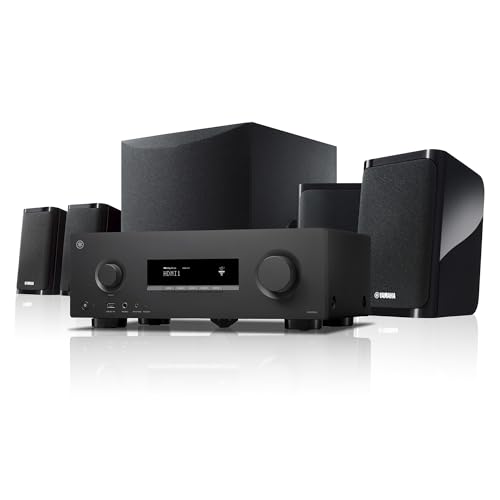
YAMAHA YHT-4970U 5.1-Channel Home Theater System - Dolby Atmos 4K120 8K AV Receiver, 5 Speakers and Powered Subwoofer - HDMI eARC, Bluetooth Wireless Streaming
Chosen because it specifies Dolby Atmos 4K120 8K AV Receiver and 5 Speakers and Powered Subwoofer.
View on AmazonSoundbars work particularly well in rooms under about 180 square feet, where listeners sit within roughly 8 to 10 feet of the television. They also simplify HDMI eARC, voice control, and streaming. Their limitations are physical: a slim enclosure cannot move as much air as separate left, center, and right speakers, and simulated height effects are less consistent when the ceiling is very high, angled, or heavily treated.
5.1: the sensible starting point
A conventional 5.1 system contains three front speakers, two surround speakers, and one subwoofer. It remains the best balance of price, clarity, and placement flexibility for many living rooms. The dedicated center speaker anchors dialogue to the screen, the left and right speakers handle music and front-stage effects, and the surrounds provide directional ambience.
For a medium room of approximately 150 to 300 square feet, bookshelf speakers are often sufficient. Floorstanding speakers can provide greater output and fuller music reproduction, but they occupy more space and do not eliminate the need for a subwoofer. A compact package such as the Klipsch Reference Theater Pack is easier to fit, while component systems based on KEF Q Series or ELAC Debut 2.0 speakers allow more gradual upgrades.
5.1.2 and 7.1.2: when height effects matter
The first number indicates ear-level channels, the second indicates subwoofers, and the final number indicates overhead or height channels. A 5.1.2 system has five ear-level speakers, one subwoofer, and two height channels. A 7.1.2 system adds two rear surround speakers.
Choose 5.1.2 when the sofa is close to the back wall or the room is medium-sized. Choose 7.1.2 when you have at least several feet behind the seating position for rear speakers. Dolby Atmos height modules that bounce sound from the ceiling are easiest to install, but actual in-ceiling or high-mounted speakers generally produce a more dependable overhead effect when installation is possible.
Room Size and Speaker Output
Room volume matters more than floor area alone. A 12-by-15-foot room with an 8-foot ceiling is about 1,440 cubic feet. That space does not require cinema-scale speakers, but a receiver with roughly 50 to 100 watts per channel into 8 ohms and a subwoofer with a 10-inch driver gives useful headroom without forcing the system to work at its limit.
For rooms above about 2,500 cubic feet, consider higher-sensitivity speakers, a more powerful receiver, or two subwoofers. Two smaller subwoofers can smooth bass across multiple seats better than one large subwoofer because room modes are distributed more evenly. Do not select speakers solely by their maximum wattage; sensitivity, impedance, listening distance, and amplifier quality are more useful matching factors.
Head-to-Head: Soundbar Package vs Separate Speakers
| Factor | Wireless soundbar package | Separate 5.1 speaker system |
|---|---|---|
| Typical setup time | 20–60 minutes | 2–5 hours, including cable routing and calibration |
| Common channel layouts | 3.1, 5.1, or simulated 5.1.2 | True 5.1, 5.1.2, 7.1.2, or larger |
| Subwoofer size | Typically 6.5–8 inches | Typically 8–15 inches |
| Best seating coverage | One main seating area | Multiple seats with better directional consistency |
| Upgrade flexibility | Usually limited to the manufacturer’s ecosystem | Receiver, speakers, subwoofer, and cables can be replaced separately |
| Connectivity | HDMI eARC, optical, Wi-Fi, Bluetooth, and app control vary by model | HDMI switching, eARC, optical, Bluetooth, Wi-Fi, and multiple source inputs |
Bass, Dialogue, and Connectivity
A subwoofer should handle the demanding lowest frequencies so the main speakers can concentrate on voices and effects. For most rooms, an 8-inch subwoofer is adequate for moderate listening, a 10-inch model is a versatile choice, and a 12-inch model is better for larger rooms or strong movie impact. Place it near the front wall initially, then adjust its position because corners increase output but can also make bass sound boomy.
Dialogue clarity comes from more than a bright treble setting. The center speaker should be aimed at ear level and positioned close to the screen. If it must sit inside a cabinet, leave space around the front and avoid blocking its grille. A three-channel soundbar can improve speech over many televisions, but a separate center speaker usually gives more control over dialogue volume and tonal balance.
HDMI eARC is preferable to optical because it supports modern surround formats and allows the television to pass audio from built-in streaming apps to the audio system. Check that the receiver supports the video features you use, such as 4K/120Hz, HDR10+, Dolby Vision, or gaming features. Wi-Fi is useful for multiroom audio and high-quality streaming; Bluetooth is convenient but usually offers less control and compression.
Setup Steps That Prevent Common Problems
- Measure before buying. Mark the television, sofa, side walls, and possible subwoofer positions. Leave approximately 2 to 3 feet behind a seating row if you want rear surround speakers.
- Place the front speakers symmetrically. Keep the left and right speakers the same distance from the main seat, with the tweeters near ear height. Angle them slightly toward the listening position.
- Position the center speaker correctly. Put it directly above or below the screen and aim it toward the listener rather than pointing it at the floor.
- Place surrounds to the sides or slightly behind. Mount them about 1 to 2 feet above seated ear level. Avoid placing both surrounds directly behind the sofa.
- Run room correction after placement. Systems such as Audyssey, Yamaha YPAO, and Denon calibration tools can correct timing and frequency balance, but they cannot repair badly placed speakers.
- Check bass integration manually. Try the subwoofer’s phase, crossover, and level settings after calibration. A common starting crossover is 80Hz for small and medium satellite speakers.
For a rough budget calculation, a $1,200 system used for two movies per week over three years provides about 312 viewing sessions, or approximately $3.85 per session before electricity and subscription costs. This is why a replaceable-speaker system can be better long-term value than a sealed package: the subwoofer or receiver can be upgraded without discarding every speaker.
Ownership, Durability, and Maintenance
Speaker cabinets generally last for many years when kept dry and ventilated. The parts most likely to wear first are subwoofer surrounds, grille fabric, wireless modules, and HDMI connections. Keep at least a few inches of ventilation around receivers, never cover a powered subwoofer’s amplifier panel, and use surge protection in areas with unstable power.
Dust speaker grilles with a soft brush or vacuum on low power from a short distance. Do not spray cleaner onto cones, tweeters, or grille fabric. Keep pets from chewing exposed cable, and secure loose speaker wire so it cannot touch neighboring terminals. If a receiver repeatedly shuts down, lower the volume and inspect for loose or shorted cable strands rather than continuing to operate it.
Final Buying Recommendation
Choose a soundbar package when minimal wiring and fast installation matter most. Choose a 5.1 system when you want the strongest balance of dialogue, surround accuracy, bass, and value. Choose 5.1.2 or 7.1.2 when your room allows proper speaker placement and you watch Atmos content often. Whichever route you take, prioritize a dedicated center speaker, HDMI eARC, a correctly sized subwoofer, and placement that matches the room instead of paying for more channels that cannot be positioned properly.










Write Your Review
No reviews yet. Be the first to share your experience!