
Our Top Picks
For most home botanical distillers, the best copper alembic still is a 5–10 L unit with a boiler made from roughly 0.8–1.0 mm copper, a removable dome, a well-supported vapor path, and a water-cooled condenser sized for steady output—not simply the largest still you can afford. Choose a smaller 1–3 L model for occasional, low-volume batches; for frequent work, prioritize thick copper, easy access for cleaning, dependable seals, and a condenser you can control.
“Best” depends on the plant material and how often you distill. Essential-oil yields can be small and vary widely by species, harvest, and preparation, so boiler capacity is not the same as expected oil output. The comparisons below describe useful specification targets by still type, rather than treating an unverified model listing as a recommendation.
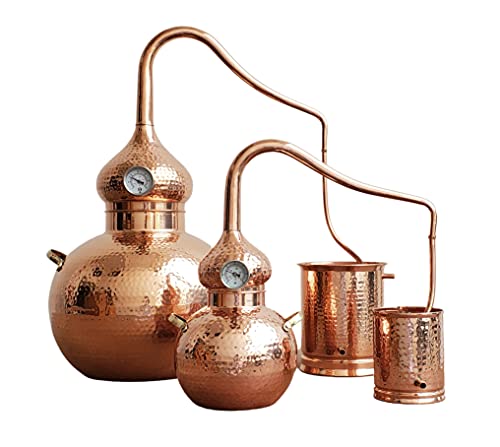
5 litres Pure Copper Alembic Still for Whiskey, Moonshine, Essential Oils by Copperholic
Chosen because it specifies Moonshine and Essential Oils by Copperholic.
View on Amazon5 Gallon Pure Copper Alembic Still for Whiskey, Moonshine, Essential Oils by Copperholic
Chosen because it specifies Moonshine and Essential Oils by Copperholic.
View on Amazon
2/3L Pure Copper Alembic Still Alcohol Distiller Home Brewing Alembic Still for Shiskey, Moonshine, Essential Oils (3L)
Chosen because it specifies Moonshine and Essential Oils (3L).
View on Amazon
Beautiful 5 Litre Copper Essential Oil Still Distillation Kit by NHR Organic Oils
Picked as a relevant option in this category.
View on AmazonBest copper alembic stills by situation
- Best for a first, occasional batch: A 1–3 L tabletop alembic. It takes little storage space and limits the cost of learning, but its small charge means more repeated runs for bulky herbs.
- Best all-rounder: A 5–10 L still with copper at least about 0.8 mm thick, a removable head, and a separate condenser vessel. It balances manageable batch size with room to work.
- Best for frequent small-scale production: A 10–20 L still with copper around 1.0 mm or thicker, reinforced handles, a wide opening, and a condenser with ample cooling capacity. Confirm that the filled unit can be safely moved and heated.
- Best for a tight budget: A smaller, simply constructed still with a sound boiler and replaceable food-contact seals. Avoid saving money by accepting unknown metals in the vapor path or a condenser that cannot maintain a continuous supply of cool water.
Specifications that matter in botanical distillation
| Still type | Boiler capacity | Useful copper target | Typical condenser arrangement | Best fit |
|---|---|---|---|---|
| Compact | 1–3 L | About 0.6–0.8 mm | Small coil or compact water jacket | Learning, small tests, limited storage |
| All-round | 5–10 L | About 0.8–1.0 mm | Separate coil or jacketed condenser with water connections | Regular household-scale batches |
| High-capacity | 10–20 L | About 1.0–1.2 mm | Larger surface area and adjustable cooling flow | Frequent runs and larger plant charges |
These are practical comparison ranges, not universal industry standards. Sellers may measure sheet thickness differently, and condenser performance depends on design, water temperature, and flow. Verify the actual specifications before buying.
Copper thickness and construction
Thicker copper is generally less prone to dents and distortion, especially around the boiler base, handles, and joints. A very thin pot may be lighter and less expensive, but repeated heating, moving, and cleaning can expose weak seams or leave it misshapen. Thickness alone does not prove quality: inspect how the seams are joined, whether the base sits flat, and whether handles are securely attached. Ask which parts are copper and which are other materials.
Capacity, charge size, and batch reality
Compare usable capacity, not just the advertised volume. The boiler needs room for water, plant material, and vapor movement; filling it to the brim is not a sensible operating plan. A 5 L boiler is therefore not a promise of a 5 L plant charge. Follow the maker’s fill limits, particularly for bulky or floating botanicals. If your source material is light and voluminous, the opening diameter and basket or plant-support arrangement may matter as much as nominal liters.
For a first purchase, think in terms of how much material you can reliably prepare and process in one session. A larger still can reduce the number of runs, but it also takes longer to heat, uses more water or fuel, and demands more storage and lifting capacity.
Condenser design, seals, and heat source
A condenser must remove heat quickly enough to turn vapor into liquid at a steady pace. A compact coil can suit a small unit, while a larger still benefits from a roomier coil or water jacket and clear inlet and outlet connections. Check whether cooling water is recirculated or supplied continuously, and whether the design lets you adjust its flow. A condenser that looks substantial but is awkward to flush or connect may become a nuisance in routine use.
Look for a secure, serviceable joint between the boiler and head. Food-contact silicone or another clearly identified, heat-suitable gasket is easier to replace than an improvised seal. The parts should fit without force, and the maker should state what materials contact vapor and condensate. Avoid unknown coatings, solder, or sealants in those surfaces.
Heating compatibility is a frequent source of disappointment. A copper boiler may not work directly on an induction hob; check the manufacturer’s instructions rather than assuming it will. A flat, stable base is useful on compatible electric or gas heat, while a purpose-built electric element may simplify temperature control. Any open-flame setup requires suitable clearance, ventilation, and compliance with local fire-safety rules.
Choose by budget, space, and frequency
| Your situation | A sensible choice | Trade-off to accept |
|---|---|---|
| New to distillation; limited budget | 1–3 L compact still with replaceable seals | Small charges and more runs for larger quantities |
| Some experience; occasional batches; moderate space | 5–10 L still with roughly 0.8–1.0 mm copper | Needs a dedicated storage spot and a suitable heat source |
| Frequent batches; room for setup and cleanup | 10–20 L still with a wide opening and higher-capacity condenser | More weight, water use, heat-up time, and handling effort |
| Unsure what botanicals or volumes you will process | Mid-size still with modular, accessible parts | May cost more initially than the simplest small unit |
Cleaning access and long-term ownership
A wide boiler opening and removable head make it easier to remove spent plant matter, rinse residue, and inspect seams. Narrow necks and fixed internal parts can trap fibers and make thorough cleaning frustrating. Before purchase, check whether the condenser can be drained and flushed, and whether gaskets, clamps, and water hoses are standard or proprietary.
In regular use, seals and hoses are common wear items; they may need replacement before the copper itself does. Thin sheet can dent, joints can loosen under rough handling, and mineral deposits can build up where hard water circulates. Rinse and dry the parts after use, clean according to the maker’s material guidance, and avoid abrasive pads or unapproved acids that can damage copper or its finish. Store components dry, with seals kept clean and uncompressed where practical.
Bottom line
The best copper alembic stills for essential oil extraction are sized around your real batch routine, not a theoretical maximum. For most buyers, a 5–10 L boiler, approximately 0.8–1.0 mm copper, a removable head, replaceable heat-suitable seals, and a condenser with controllable cooling make the strongest balance. Move smaller if space and experience are limited; move larger only when your plant supply, heat source, water setup, and cleaning routine can support it.
Distillation involves hot liquid, hot vapor, and heated equipment. Follow the manufacturer’s operating guidance, use stable heat-resistant surfaces, and do not leave a running still unattended. Essential oils are concentrated materials; this equipment overview is not medical advice or a recommendation to ingest or apply any distillate.



Write Your Review
No reviews yet. Be the first to share your experience!