
Our Top Picks
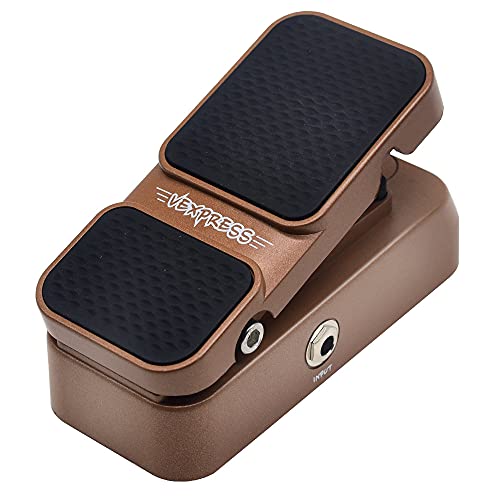 SONICAKE Passive Volume & Expression EXP Guitar Pedal5.85 x 2.58 x 2.4 inches0.4 PoundsCheck on Amazon
Best Expression Pedals: Quick Picks by Situation
The best expression pedal for most players is the Mission Engineering EP-1 for demanding guitar rigs, the Moog EP-3 for broad synth and effects compatibility, and the Dunlop DVP4 Volume (X) Mini when pedalboard space matters most.
- Best for guitar effects and amp control: Mission Engineering EP-1
- Best general-purpose choice: Moog EP-3
- Best compact pedal: Dunlop DVP4 Volume (X) Mini
- Best inexpensive keyboard option: M-Audio EX-P
- Best for a low-profile pedalboard: Nektar NX-P
- Best rugged full-size alternative: Boss FV-500H or FV-500L, depending on the connection required
An expression pedal is a passive controller, not normally a standalone effect. It sends a changing control voltage or resistance signal through a TRS cable to a compatible keyboard, MIDI controller, amplifier, or effects pedal. The important question is not simply how smooth the treadle feels: the pedal must match the receiving device’s wiring, expected resistance, polarity, and usable sweep.
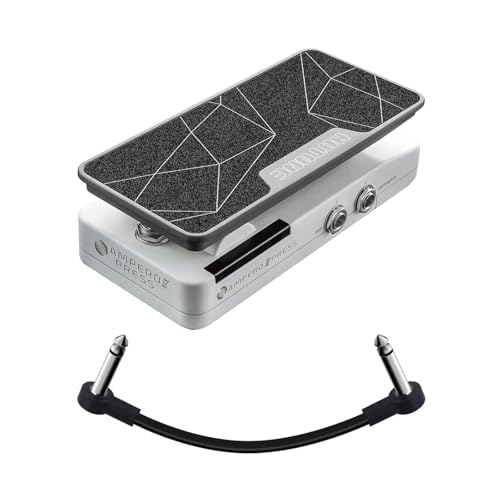
HOTONE 2 in 1 Passive Expression Footswitch EXP Pedal Ampero II Press(Included 1 PCS Additional 15 CM TRS Cable)
Picked as a relevant option in this category.
View on Amazon
Mantra Passive Dual Expression Pedal Klowra x Hotone
Picked as a relevant option in this category.
View on AmazonSONICAKE Passive Volume & Expression EXP Guitar Pedal, Mini Size - Vexpress
Chosen because it specifies Mini Size and Vexpress.
View on AmazonBest Expression Pedals Compared
| Pedal | Approx. dimensions | Approx. weight | Construction | Best use | Important compatibility note |
|---|---|---|---|---|---|
| Mission Engineering EP-1 | About 10.2 x 4.0 x 2.5 in | About 2.5 lb | Metal chassis, guitar-style treadle | Guitar processors, wah-style control, amplifier parameters | Uses a mission-style expression output; verify the target’s polarity and wiring |
| Moog EP-3 | About 10.6 x 3.4 x 2.4 in | About 2 lb | Metal housing with adjustable polarity switch | Synthesizers, keyboards, pedals, studio control | Polarity switch and minimum-output knob improve compatibility |
| Dunlop DVP4 Volume (X) Mini | About 6.0 x 3.5 x 2.5 in | About 1.7 lb | Compact metal enclosure | Small boards and portable effects setups | Its output mode and cable wiring must match the connected device |
| M-Audio EX-P | About 9.5 x 3.0 x 2.0 in | About 1 lb | Lightweight molded enclosure | Keyboards and entry-level MIDI controllers | Polarity switch supports common keyboard configurations |
| Nektar NX-P | About 7.0 x 2.8 x 2.3 in | About 1.3 lb | Compact plastic-and-metal construction | Portable MIDI keyboards and controllers | Polarity switch; confirm the controller’s required expression standard |
| Boss FV-500H / FV-500L | About 10.5 x 4.0 x 3.0 in | About 3.7 lb | Heavy-duty cast metal | Frequent touring and demanding stage use | H and L versions are designed for different signal-level applications; do not treat them as interchangeable |
Dimensions and weights are approximate manufacturer specifications and can vary slightly by production version. The table is most useful for board planning: a compact pedal may save several inches, while a heavier enclosure is usually less likely to move during repeated sweeps.
Head-to-Head: Sweep, Resistance, and Calibration
Mission Engineering EP-1 vs. Moog EP-3
The EP-1 feels closer to a traditional guitar wah. Its treadle geometry and resistance are well suited to gradual changes in delay mix, reverb level, filter cutoff, pitch, or amplifier gain. Guitarists who use a floor processor or an expression-ready amplifier often prefer this familiar, controlled movement.
The EP-3 is the more adaptable choice when several instruments are involved. Its polarity switch addresses one of the most common expression-pedal problems: a pedal that moves backward, remains at maximum, or produces no usable control. Its minimum-output control can also prevent a parameter from falling completely to zero at the heel position. That is useful for synth volume, filter cutoff, and effect depth, but it adds another setting to check during setup.
Choose the EP-1 when treadle feel and guitar-oriented performance are priorities. Choose the EP-3 when compatibility and calibration flexibility matter more than a specialized mechanical feel.
Full-size pedals vs. compact pedals
A full-size pedal generally offers a longer physical sweep. That gives your foot more distance to make a small, precise adjustment, which is valuable for filter resonance, pitch shifting, rotary-speaker speed, and ambient effect blends. The tradeoff is board space: a full-size pedal commonly uses 9 to 11 inches of length.
Compact models such as the DVP4 and NX-P are easier to fit beside a switcher or multiple footswitches. Their shorter treadle travel can feel more abrupt, especially when controlling a parameter across its entire range. They are excellent for occasional volume-like changes or portable keyboard setups, but players making continuous, delicate adjustments may prefer a longer sweep.
Compatibility: Polarity Is Only Part of the Problem
Expression outputs commonly use a 1/4-inch TRS cable, with the tip, ring, and sleeve carrying different parts of the control circuit. Unfortunately, manufacturers do not use one universal wiring convention. One device may expect the variable resistance between tip and sleeve; another may expect it between ring and sleeve. A pedal can therefore be electrically sound but incompatible with a particular instrument.
Before buying, check four specifications in the instrument or effect manual:
- Connector: Most expression inputs use 1/4-inch TRS, but some compact devices use another connector or require an adapter.
- Polarity or wiring: Look for statements such as “ring hot,” “tip hot,” or a required pedal model.
- Resistance range: Some devices are designed around a 10 kΩ expression pedal, while others work best with 25 kΩ or 50 kΩ designs.
- Calibration procedure: The device may require heel-down and toe-down positions to be stored in software or a menu.
A polarity switch can solve wiring orientation, but it cannot fix every resistance mismatch. Nor can a TRS-to-TS cable automatically convert an incompatible expression standard. If the manual specifies a particular pedal or resistance, follow that recommendation.
Decision Matrix: Which Pedal Fits Your Situation?
| Your situation | Best direction | Why |
|---|---|---|
| Under roughly $60 and mainly using a keyboard | M-Audio EX-P | Low cost, light weight, and a polarity switch cover common beginner setups |
| One pedal shared between synths and effects | Moog EP-3 | Adjustable polarity and minimum output make troubleshooting easier |
| Guitar processor used at every rehearsal or show | Mission Engineering EP-1 | Long, controlled treadle movement and robust metal construction |
| Less than 7 inches of board depth available | Dunlop DVP4 or Nektar NX-P | Compact footprint leaves room for additional footswitches |
| Frequent touring or heavy stage use | Boss FV-500 series | Heavy cast-metal enclosure resists movement and impact |
| Precise ambient, pitch, or filter control | Full-size pedal with adjustable resistance | Longer sweep and tunable treadle tension reduce accidental jumps |
Typical market pricing ranges from about $35–$60 for basic keyboard pedals, $60–$120 for versatile midrange models, and $130–$200 or more for specialized or heavy-duty pedals. A cheaper pedal is not necessarily a poor choice if its wiring matches your device; an expensive pedal cannot compensate for the wrong expression standard.
How to Set Up and Calibrate an Expression Pedal
- Turn the instrument or effects unit down. Expression connections are usually safe to make while powered off, and this avoids sudden parameter changes.
- Use a TRS cable unless the manual says otherwise. A stereo TRS cable has the separate conductors needed by most expression inputs.
- Set the pedal to heel-down. If the receiving device has a calibration menu, store the heel position first.
- Move fully to toe-down and store that position. Do not press beyond the natural mechanical stop.
- Test the direction. If toe-down produces less effect, change the pedal’s polarity switch or use the device’s reverse setting.
- Set the minimum-output control last. This determines how much of the parameter remains at heel-down; it is not a substitute for calibration.
A practical setup example: if you want a delay mix to move from 15% to 45%, first calibrate the complete physical range, then set the effect’s own minimum and maximum values to those targets. This preserves the pedal’s resolution instead of using only a small portion of its travel.
Durability and Ownership Realities
The parts most likely to wear are the treadle pivot, tension mechanism, cable, and the rubber or textured grip surface. A pedal that develops side-to-side play may still function, but its sweep can become inconsistent. Loose foot screws and worn cable strain relief are common before the electrical element itself fails.
- Keep dust and grit away from the pivot; use a dry brush rather than spraying lubricant into the enclosure.
- Do not leave the treadle pressed hard against its end stop inside a tightly packed case.
- Use hook-and-loop or a board bracket if the pedal slides during performance.
- Label cables when several expression pedals use different wiring standards.
- Never assume a volume pedal’s output is an expression output; passive audio volume circuits and expression circuits are different.
For most buyers, compatibility should be checked before resistance, footprint, or price. Once the pedal is electrically suitable, choose the longest sweep that fits your board, the resistance that feels controllable, and the strongest construction justified by how often you perform.
Final Recommendation
The best expression pedal is situation-dependent: the Mission Engineering EP-1 is the strongest guitar-focused choice, the Moog EP-3 is the safest all-rounder for mixed instruments and effects, and the Dunlop DVP4 is the practical compact option. Keyboard beginners can save money with the M-Audio EX-P, while touring players should prioritize the heavier Boss FV-500 design. Always verify polarity, resistance, connector type, and calibration requirements against the exact device before ordering.




Write Your Review
No reviews yet. Be the first to share your experience!