
Our Top Picks
The best CPU motherboard combo for most buyers in 2026 is the AMD Ryzen 5 7600 with a B650 motherboard: it offers strong gaming and everyday performance, DDR5 support, a useful AM5 upgrade path, and better platform value than pairing an expensive processor with a feature-heavy board you will not use.
Quick picks by budget and situation
| Use case | CPU | Recommended motherboard class | Memory target | Typical platform cost* | Why it makes sense |
|---|---|---|---|---|---|
| Lowest sensible new build | Ryzen 5 7600 | B650, preferably with BIOS flashback | 32GB DDR5-6000 | $300–$450 | Six cores, efficient performance, and AM5 upgrades |
| Value gaming | Ryzen 7 7800X3D | B650 or B650E | 32GB DDR5-6000 | $500–$700 | Large gaming gains without paying for workstation features |
| High-end gaming | Ryzen 7 9800X3D | B650E, X670E, X870, or X870E | 32GB–64GB DDR5-6000 | $700–$950 | Excellent gaming performance and a modern AM5 platform |
| Gaming plus heavy creation | Ryzen 9 9950X | X870 or X870E with strong VRM cooling | 64GB DDR5-6000 | $850–$1,150 | Sixteen cores for rendering, compiling, and productivity |
| Intel-focused productivity build | Core Ultra 7 265K | Z890 or B860 | 32GB–64GB DDR5 | $650–$950 | Modern LGA1851 platform and strong multicore capability |
| Reuse existing DDR4 parts | Ryzen 7 5700X3D | B550 | 32GB DDR4-3200 or DDR4-3600 | $250–$400 | Low-cost gaming refresh when you already own AM4 memory |
*General 2026 market ranges for CPU, motherboard, and the stated memory capacity. Prices vary by region, promotions, board size, and included features.

MICRO CENTER AMD 5500 Processor with ASUS TUF Gaming A520M Plus Motherboard
Picked as a relevant option in this category.
View on Amazon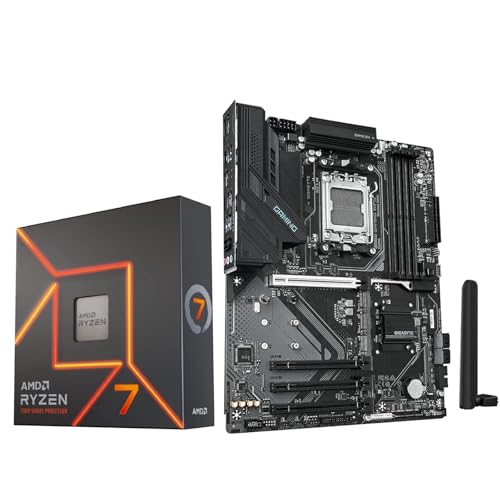
Micro Center AMD 7700X Processor with GIGABYTE B850 Gaming WiFi Motherboard
Picked as a relevant option in this category.
View on Amazon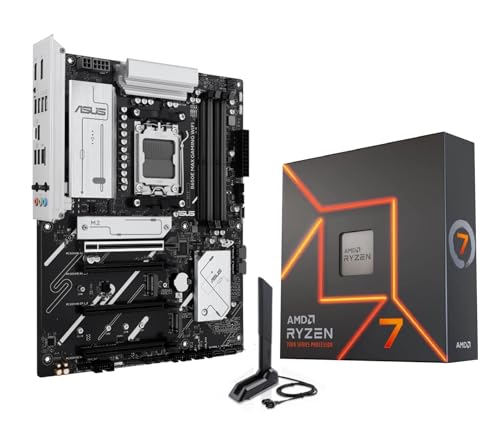
MICRO CENTER AMD 7700X Processor with ASUS B650E MAX Gaming WF Motherboard
Picked as a relevant option in this category.
View on Amazon
Micro Center CPU Motherboard Combo - Intel i9-14900K 14th Gen 24-Cores LGA 1700 Desktop Processor Bundle with TUF Gaming Z790-Plus WiFi Gaming Motherboard
Picked as a relevant option in this category.
View on AmazonBest overall: Ryzen 5 7600 and B650
The six-core, 12-thread Ryzen 5 7600 is the easiest recommendation for a balanced new PC. It uses the AM5 socket, supports DDR5, and is fast enough for high-refresh gaming, office work, photo editing, and ordinary streaming. A B650 board normally supplies the features that matter: one PCIe 4.0 graphics slot, at least one PCIe 4.0 M.2 slot, four or more SATA ports on many models, and USB connectivity suitable for a normal desktop.
Choose a board with two or three M.2 slots, Wi-Fi 6E or Wi-Fi 7 if wireless networking is important, and BIOS flashback if you want to simplify future CPU installation. Avoid paying extra for X670E or X870 merely to run a six-core processor. The main bottleneck in a gaming build is more likely to be the graphics card than this CPU, especially at 1440p.
Best gaming value: Ryzen 7 7800X3D and B650
The Ryzen 7 7800X3D remains a particularly strong pairing for a gaming-first system. Its eight cores and large 3D V-Cache can improve frame rates and, importantly, frame-time consistency in CPU-limited games. Pairing it with a mid-range B650 board is usually better value than buying a flagship motherboard with extra expansion hardware.
Use a capable tower air cooler or a quality 240 mm liquid cooler, depending on your case and noise preferences. A B650E board is worthwhile if you specifically want PCIe 5.0 for both the graphics slot and an M.2 slot. Otherwise, standard B650 is sufficient. Do not buy an X670E board expecting it to make the processor faster; chipset choice mainly changes connectivity and expansion.
Best high-end gaming: Ryzen 7 9800X3D
For a premium gaming PC, the Ryzen 7 9800X3D is a more logical choice than a 12- or 16-core processor when games are the priority. Its eight-core design leaves more of the budget available for the graphics card, which usually has a larger effect at high resolutions. Choose B650E, X670E, X870, or X870E based on storage and I/O needs rather than gaming performance alone.
X870 and X870E boards generally make more sense for new premium builds when you want newer USB connectivity, broad PCIe 5.0 support, or multiple fast NVMe drives. Confirm the exact lane layout: installing several M.2 drives can disable SATA ports or reduce the graphics slot from x16 to a lower link width on some boards.
Best for gaming and demanding work: Ryzen 9 9950X with X870
The 16-core Ryzen 9 9950X is aimed at buyers who render video, compile large projects, run virtual machines, or perform other sustained multicore tasks in addition to gaming. It does not require the most expensive motherboard, but it does deserve a board with a substantial VRM heatsink, adequate rear USB, and a reliable firmware support record.
For this class of CPU, choose X870 or X870E when you need multiple PCIe 5.0 devices, more high-speed USB, or several NVMe drives. A good B650 or B650E board can still work if its CPU power section is properly cooled. Spend part of the budget on a 280 mm or 360 mm liquid cooler, or a very large dual-tower air cooler, because sustained all-core workloads expose cooling limits quickly.
Where Intel fits: Core Ultra 7 265K and Z890 or B860
Intel’s Core Ultra 7 265K uses the LGA1851 socket and is a sensible alternative for mixed productivity builds. Z890 is the enthusiast chipset for CPU overclocking and more flexible lane and I/O arrangements. B860 is the value option when you want the processor at stock settings and do not need extensive expansion.
Check whether the motherboard uses DDR5; LGA1851 boards are generally DDR5 platforms, but memory speed listings and supported capacities differ. For a work-focused PC, 64GB is often more useful than chasing extremely high memory frequency. Also compare power limits, cooler requirements, Thunderbolt or USB4 support, and Wi-Fi versions rather than assuming a higher chipset number automatically means better real-world performance.
How socket and chipset compatibility actually works
- Socket first: AM5 CPUs require AM5 boards such as B650, B650E, X670E, X870, or X870E. Intel Core Ultra desktop processors use LGA1851 boards such as B860 or Z890.
- Chipset second: The chipset determines expansion, USB, storage, and overclocking features. It does not by itself make the CPU faster.
- BIOS support matters: A board may have the correct socket but need a firmware update for a newer processor. BIOS flashback is useful when the system will not boot with the installed CPU.
- RAM must match the board: AM5 builds use DDR5. Older B550 and X570 boards use DDR4. Do not attempt to install DDR4 in a DDR5 socket, even if the capacity is identical.
- Check physical fit: ATX boards need ATX cases; Micro-ATX boards fit most ATX cases but offer fewer expansion slots. Confirm cooler clearance around the socket and RAM.
RAM and upgrade-path decisions
For AM5, 32GB in two modules is the practical starting point for gaming, while 64GB is preferable for content creation, virtual machines, and heavy multitasking. DDR5-6000 is a commonly sensible target for Ryzen systems because it balances bandwidth, latency, and compatibility. Four populated slots can be harder to run at rated speeds, so buy a matched two-module kit if you expect 64GB or more.
AM5 is the stronger long-term choice for a new mainstream build because it has hosted several generations of Ryzen processors. That does not guarantee that every future CPU will work in every board; firmware, power delivery, and vendor support still matter. LGA1700 is attractive only when you already own compatible parts or find a complete platform at a substantial discount. A new AM4 build has the lowest upfront cost but little meaningful processor upgrade room beyond the Ryzen 7 5700X3D.
Common motherboard mistakes that create bottlenecks
- Buying a two-DIMM board for a system you expect to expand beyond 32GB.
- Choosing a board with only one M.2 slot, then discovering that the boot drive occupies it permanently.
- Ignoring VRM heatsinks when pairing a high-core-count CPU with long rendering workloads.
- Paying for PCIe 5.0 everywhere while using one graphics card and one PCIe 4.0 SSD.
- Forgetting that some M.2 slots share bandwidth with SATA ports or the graphics slot.
- Installing memory in the wrong slots. With two modules, the motherboard manual commonly specifies the second and fourth slots, but follow the board’s instructions.
A simple buying formula
Allocate the platform budget in this order: select the CPU for the workload, choose enough RAM for the next three years, then buy the least expensive motherboard that supplies the required socket, VRM quality, storage, networking, and ports. For example, a $220 processor plus a $170 B650 board and $100 of 32GB DDR5 memory produces a roughly $490 platform. Spending an extra $180 on an enthusiast board does not improve frame rates unless you actually need its additional slots, connectivity, or overclocking controls.
For most readers, choose Ryzen 5 7600 and B650 for value, Ryzen 7 7800X3D and B650 for gaming, Ryzen 7 9800X3D with B650E or X870 for premium gaming, and Ryzen 9 9950X with X870 for serious multicore work. Those pairings keep socket, chipset, RAM, cooling, and upgrade expectations aligned instead of paying for a mismatch.






Write Your Review
No reviews yet. Be the first to share your experience!