
Key takeaways
What's inside
Best gym flooring for garage training protects your concrete and equipment while cushioning dropped weights, and the right pick comes down to thickness. This best gym flooring for garage guide compares rubber, foam, tiles, and rolls by thickness, coverage, and installation so your garage floor survives heavy training for years.
As an Amazon Associate we earn from qualifying purchases at no extra cost to you. Product prices and availability are accurate as of the date shown and are subject to change.
By Chris Parker
🛒 Best Price Today on Amazon
Prime members get fast, free shipping on everything above, plus member-only deals. New members get a 30-day free trial — cancel anytime.
Start 30-Day Prime Free Trial →See Today’s Amazon DealsHow to Choose the Best Gym Flooring for Garage Use
Choosing the best gym flooring for garage use comes down to matching thickness to your training, picking the right material, buying enough to cover the space, and installing it properly. Get the thickness right the first time and the floor protects your slab, your equipment, and your joints for a decade or more.
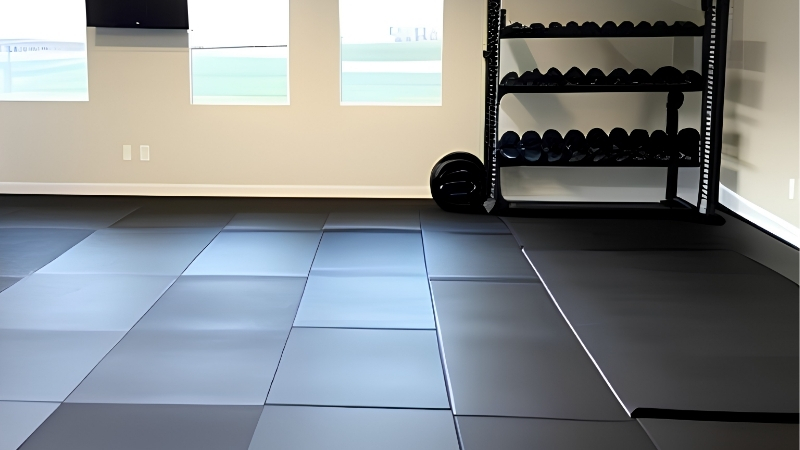
Match Thickness to Your Training
Thickness is the single most important spec. For heavy weightlifting with dropped weights, 3/4 in (19 mm) rubber is the industry standard, absorbing the impact of deadlifts and overhead drops without cracking concrete. Horse stall mats hit this thickness by default.
For general training, cardio, and floor work, 8 mm (about 0.31 in) rubber protects the slab well and cushions machines. Foam is only suitable for no-impact activities like yoga, since it compresses and is permanently damaged under heavy weights or equipment.
Rubber, Foam or Rolls
Each material trades off differently. Horse stall mats and rubber tiles give maximum durability for lifting, while rubber rolls deliver a seamless, commercial look that grows more cost-effective the larger your area, though they need adhesive and are essentially permanent.
Interlocking rubber tiles install without glue and relocate easily, but seams can separate under heavy drops. EVA foam is the cheapest at roughly one to two dollars per square foot and fine for light use, yet it collapses under a loaded barbell, so keep it away from your lifting zone.
Coverage and Measuring Your Space
Buy for the area you actually need to protect. Horse stall mats run about 4 by 6 ft (122 by 183 cm) each and weigh around 100 lb (45 kg), and a standard two-car garage of roughly 400 sq ft (37 sq m) takes several to cover fully.
If budget is tight, focus the thickest flooring under your rack, bench, and deadlift drop zone rather than covering everything. Always measure your floor area in square feet and the exact drop zone before ordering, since flooring is heavy and awkward to return.
Installation and Off-Gassing
Preparation makes or breaks the result. Clean and mop the subfloor first, because debris under the mats creates uneven spots and can damage the slab over time, then let new rubber acclimate and cut it with a sharp utility knife by scoring, flipping, and snapping.
New recycled rubber has a strong odor, so unroll mats outdoors in the sun for two to three days before bringing them in, which dramatically reduces the smell. In a ventilated garage, any remaining scent usually fades within a few weeks.
Top Picks for the Best Gym Flooring for Garage Gyms
These picks span budget foam to deadlift-proof rubber, so match the thickness to your lifts. Whichever best gym flooring for garage setup you choose, measure your space and drop zone before buying.
| Option | Thickness | Material | Best For | Tier |
|---|---|---|---|---|
| Horse Stall Mats | 3/4 in (19 mm) | Vulcanized rubber | Heavy lifting value | Budget |
| Interlocking Rubber Tiles | 8-20 mm | Rubber | Clean DIY look | Mid |
| Rubber Rolls | 8-12 mm | Rubber | Large coverage | Mid |
| 8mm Rubber Mats | 8 mm | Rubber | Cardio and general | Budget |
| Norsk Rubber-Tec Tiles | ~0.70 in | Foam + rubber top | Odor-free zones | Mid |
| EVA Foam Tiles | Varies | EVA foam | Light use budget | Budget |
| DIY Deadlift Platform | Layered | Plywood + rubber | Drop zone | DIY |
Horse Stall Mats – Best Heavy Lifting Value
Horse stall mats from farm supply stores are the best-value garage floor, with dense 3/4 in (19 mm) vulcanized rubber in 4 by 6 ft (122 by 183 cm) sheets that shrug off the heaviest deadlifts and last ten to twenty years. Six mats cover a full training area affordably.
Each mat weighs around 100 lb (45 kg), carries a strong initial rubber odor, and leaves slightly uneven seams. For pure durability per dollar under heavy lifting, though, nothing beats them.
Interlocking Rubber Tiles – Best Clean DIY Look
Interlocking rubber tiles offer a cleaner, finished look with jigsaw edges that lock together and install without adhesive, making them easy to lay and relocate. Heavy-duty versions hold tight even through hard lifting.
The seams can separate under repeated heavy drops, and they cost more per square foot than stall mats. For a polished, renter-friendly floor with strong protection, though, they are ideal.
Rubber Rolls – Best Large Coverage
Rubber rolls give a seamless, commercial-gym appearance and grow more cost-effective as coverage grows, eliminating the seam-separation weakness of tiles. They suit large, permanent, professional-looking spaces.
They require adhesive for proper installation, making them essentially permanent, and standard 8 to 12 mm thicknesses may need a stall mat added in the deadlift zone. For big dedicated gyms, though, they look and perform superbly.
8mm Rubber Mats – Best for Cardio and General
These 8 mm rubber mats protect the slab under racks, benches, dumbbells, and cardio machines, use the same material as commercial gyms, and provide enough cushioning for general training. They are a practical all-purpose layer.
At 8 mm they are too thin for repeated heavy overhead drops, so pair them with a stall mat in the drop zone. For everything short of max-effort lifting, though, they are excellent value.
Norsk Rubber-Tec Tiles – Best Odor-Free Zones
Norsk Rubber-Tec tiles use a high-density foam co-polymer with a rubber-blend top, installing without adhesive, staying odor-free unlike recycled rubber, and relocating easily. They protect subfloors under racks, benches, and dumbbell work.
They are built for general training zones rather than drop zones, so pair them with stall mats for barbell drops. For a clean, odor-free general area, though, they are a smart choice.
EVA Foam Tiles – Best Light Use Budget
EVA foam interlocking tiles are the cheapest option at roughly one to two dollars per square foot, offering comfort for yoga, stretching, and bodyweight work. They install in minutes and cushion joints on the floor.
Foam is low-density and will compress and be permanently damaged under heavy weights or equipment, so it is not for lifting. For a light-use or warm-up area on a tight budget, though, it works well.
DIY Deadlift Platform – Best Drop Zone
A do-it-yourself lifting platform sandwiches a sheet of plywood between layers of 3/4 in (19 mm) rubber, creating the ultimate force-distribution system for repeated Olympic and heavy drops. It shields the slab from the most extreme impacts.
It takes time to build and occupies a fixed footprint. For competitive powerlifters or Olympic lifters who drop heavy weights often, though, it is the best drop-zone protection.
Frequently Asked Questions
People choosing the best gym flooring for garage gyms usually ask about thickness, materials, and odor.
How thick should garage gym flooring be?
For heavy weightlifting with dropped weights, 3/4 in (19 mm) rubber is the standard, while 8 mm rubber suits general training and cardio. Thinner mats work for lighter weights and plyometrics, but heavy overhead drops need the full 3/4 in thickness.
Are horse stall mats good for a home gym?
Yes, they are the most popular budget choice for good reason. Dense 3/4 in (19 mm) rubber handles the heaviest lifts and lasts for years at a low cost per square foot. The main drawbacks are their weight, a strong initial odor, and uneven seams.
Rubber or foam flooring for a garage gym?
Rubber for anything involving weights, foam only for no-impact activities. EVA foam is cheap and comfortable for yoga or stretching but compresses and is ruined under a loaded barbell or heavy equipment, so keep it out of your lifting zone.
How do I reduce the rubber smell?
Let new mats off-gas outdoors in the sun for two to three days before bringing them inside, which dramatically cuts the odor. In a ventilated garage, any lingering smell usually fades within a few weeks of regular airflow.
See More:
- best barbell
- best barbell in the world
- best rowing machine for home
- best buy for treadmill
- treadmill at best buy
Final Thoughts
The best gym flooring for garage training starts with the right thickness, 3/4 in rubber or horse stall mats for heavy drops, 8 mm rubber for general work, and foam only for light use. Match the material to your lifts, measure your floor and drop zone before ordering, prep the subfloor, and off-gas new rubber so your garage gym is protected for years.
As an Amazon Associate we earn from qualifying purchases at no extra cost to you. Product prices and availability are accurate as of the date shown and are subject to change.







Write Your Review
No reviews yet. Be the first to share your experience!