
Our Top Picks
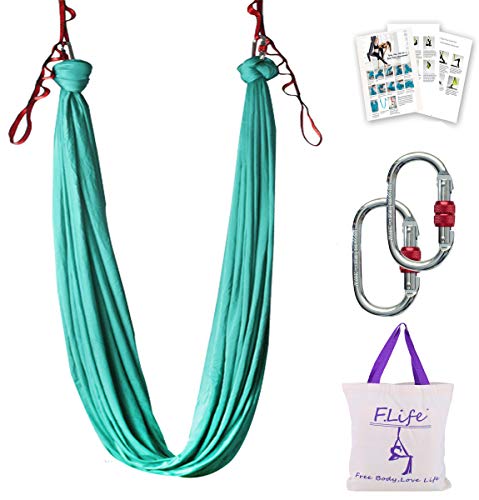 Aerial Yoga Hammock 5.5 Yards Premium Silk Fabric5.5 Yard196 x 110 x 0 inches3.79 poundsCheck on Amazon
The best aerial yoga hammocks for home practice are full-length nylon or polyester systems with a published breaking strength, a generous working load, rated suspension hardware, and a ceiling setup that can safely handle dynamic movement—not simply a colorful piece of fabric with carabiners.
Quick picks by home-practice situation
| Situation | Best choice | Look for | Typical market range |
|---|---|---|---|
| First-time user on a budget | Single-point hammock kit | 11–12 ft fabric, 1,000 lb or higher fabric strength, rated swivel and carabiner | $80–$160 |
| Regular practice and inversions | Double-point aerial yoga system | Two independent anchor points, 1,500 lb or higher working load, adjustable daisy chains | $150–$300 |
| Low ceiling or shared room | Shorter, adjustable hammock | 8–10 ft fabric, compact hardware, at least 3 ft clearance on every side | $100–$220 |
| Frequent or multi-user practice | Commercial-style rigging package | Documented hardware ratings, replaceable straps, professional installation | $250–$600 or more |
These are equipment categories rather than guarantees for every kit in a category. Always use the lowest rated component in the complete system as the practical limit, and follow the manufacturer’s stated working load rather than a fabric’s headline breaking strength.

Aum Active Aerial Yoga Hammock Swing, 4.5 Yards, Teal, with Hardware
Chosen because it specifies 4.5 Yards and Teal.
View on Amazon
ZELUS Aerial Yoga Swing Sling Strong Yoga Hammock Kit Set Trapeze Inversion Equipment Include 2 Extensions Straps and Ceiling Mounting Kit (Blue)
Picked as a relevant option in this category.
View on AmazonAerial Yoga Hammock 5.5 Yards Premium Silk Fabric Swing for Antigravity Inversion Include Daisy Chain,Carabiner and Pose Guide (Turquoise)
Chosen because it specifies Carabiner and Pose Guide (Turquoise).
View on Amazon
CO-Z Aerial Yoga Swing Hammock | Trapeze Set with Ceiling and Door Mounts, Hanging Straps, Hanging Kits | Silk Bodyfly Yoga Inversion Swing | Air Flying Swing for Aerial Exercise, Black
Chosen because it specifies Trapeze Set with Ceiling and Door Mounts and Hanging Straps.
View on AmazonWhat makes a hammock suitable for home use?
Fabric strength and construction
Aerial hammocks are commonly made from tightly woven nylon or polyester tricot fabric. Nylon is often soft and stretchy, while polyester generally resists moisture and ultraviolet exposure better. Neither material is automatically safer; weave quality, stitching, abrasion resistance, and the complete rigging system matter more than fiber name alone.
For a useful home setup, look for fabric at least 2.8–3.0 metres (9–10 ft) long and approximately 1.5–2.8 metres (5–9 ft) wide, depending on whether it is designed as a loop, sling, or open hammock. A wider fabric gives more support in seated poses, but it also needs more room to spread.
Do not confuse a fabric’s “tensile strength” with its safe user capacity. Tensile strength is usually measured on new material in a straight pull. A hammock can experience concentrated loads, shock loading, edge abrasion, and repeated folding. A product that publishes only a dramatic breaking-strength number but gives no working-load limit, inspection guidance, or hardware specifications deserves caution.
Weight ratings: static versus dynamic
Many home kits advertise capacities between 200 and 600 pounds (91–272 kg). The relevant figure should be a working load limit, not merely a breaking load. Dynamic movement, jumping into the fabric, fast inversions, or a sudden slip can multiply the force placed on the anchor.
For example, a 180-pound user does not necessarily produce only 180 pounds of force. If the body drops into the hammock or swings sharply, the peak load can be substantially higher. Choose a system with a clear margin and avoid bouncing unless the instructions specifically permit it. If more than one person may use the hammock, size the entire system for the combined load and the movement involved.
Suspension hardware: the part listings often under-explain
A complete system may include a hammock, daisy chains or webbing straps, carabiners, swivels, anchor plates, and bolts. Each part needs a compatible rating. A strong fabric attached to an unrated ceiling hook is not a strong system.
- Carabiners: Use locking carabiners intended for climbing, rescue, or aerial equipment. A decorative snap hook is not an adequate substitute.
- Swivels: A swivel can reduce twisting in a single-point setup, but it must be rated for the expected load and installed in the correct orientation.
- Daisy chains: These make height adjustment convenient. Keep the load on the manufacturer-approved loop and ensure the connector is fully locked.
- Webbing: Inspect for fraying, pulled stitches, cuts, chemical damage, and flattened areas. Webbing is a consumable component, not permanent hardware.
- Anchors: A ceiling eye, plate, or beam clamp should have a documented working load and should be appropriate for the structure—not just the hammock.
For a beginner, a kit with all components supplied and clearly rated is usually preferable to assembling miscellaneous hardware. However, “complete kit” does not mean it is suitable for every ceiling. The structural attachment remains your responsibility.
Ceiling requirements and installation space
The safest installation is into a confirmed structural beam, joist, or professionally installed support system. Drywall anchors, plaster anchors, and ordinary hollow-wall fasteners are not suitable for dynamic aerial loading. In concrete, masonry, or engineered ceilings, use the fastening method specified for that material and consider a qualified installer.
A single-point hammock usually needs less ceiling hardware but can rotate. A two-point system distributes the attachment points and can offer more control, although both anchors must be equally secure and correctly spaced. Follow the manufacturer’s spacing instructions; do not improvise by widening the points simply to fit a room.
Measure the usable area before buying. As a conservative starting point, allow about 3 feet (0.9 m) of unobstructed space on every side of the hammock. For swinging, lateral movement, or larger poses, 4–6 feet (1.2–1.8 m) of clearance is more practical. Remove ceiling fans, pendant lights, sharp shelving, glass, and furniture with hard edges.
Ceiling height affects the experience. Around 8 feet may accommodate gentle stretching with a short, adjustable setup. A 9–10-foot ceiling is more versatile. Higher ceilings may require longer suspension straps, which can increase swing and make installation more demanding. The hammock should not force you to touch the floor unexpectedly during an inversion, but it should also not be so high that mounting and dismounting require a dangerous jump.
Head-to-head: single-point versus two-point hammocks
| Feature | Single-point system | Two-point system |
|---|---|---|
| Installation | One structural anchor | Two structural anchors with accurate spacing |
| Movement | More rotation and free swing | More directional stability |
| Room flexibility | Usually easier in a small room | Needs a wider installation zone |
| Best for | Gentle stretching, supported poses, beginners | Regular aerial sequences and users wanting more control |
| Typical setup complexity | Lower, but still requires structural verification | Higher because both anchors must be reliable and aligned |
Worked cost-per-use calculation
Suppose a $180 hammock system is used three times per week for two years. That is approximately 312 sessions, making the equipment cost about $0.58 per session before replacement hardware or installation. If a $300 system lasts five years at the same frequency, the cost is about $0.38 per session.
This calculation favors the more expensive system only if it has better construction, replaceable components, and appropriate care. A cheaper hammock that stretches permanently, develops edge damage, or has unclear hardware ratings is not a bargain if it must be replaced quickly.
Durability, cleaning, and common mistakes
Wash fabric according to its instructions, usually with mild detergent and without bleach, fabric softener, or high heat. Let it dry completely before storage. Damp fabric left in a bag can develop odor or mildew and may weaken over time. Keep it away from pets, rough walls, grit, oils, and sunscreen residue.
Inspect the system before every session. Pay particular attention to stitching, folded edges, carabiner gates, webbing loops, swivels, and the area where fabric contacts hardware. Retire components after significant abrasion, chemical exposure, heat damage, torn stitching, or an unusually heavy fall. Never attempt to sew or knot a load-bearing repair unless the manufacturer or a qualified rigging professional approves it.
Common mistakes include using a doorway pull-up bar, attaching to a ceiling light box, loading an unrated eye bolt, leaving a carabiner unlocked, installing over furniture, and practicing advanced inversions without instruction. A short lesson with a qualified aerial-yoga teacher can help with mounting, dismounting, and choosing movements appropriate to your experience.
Bottom line
Choose the best aerial yoga hammock by verifying the whole system: fabric dimensions and construction, working-load rating, rated connectors, structural ceiling attachment, and adequate clearance. For most home users, a documented single- or two-point kit with adjustable suspension, roughly 9–12 feet of fabric, and at least 3 feet of empty space around the practice area is a sensible starting point. If the ceiling structure, installation method, or your intended movements are uncertain, pause before buying and consult a qualified installer or aerial instructor.
Write Your Review
No reviews yet. Be the first to share your experience!