
Our Top Picks
 ShaktiMat Acupressure Mat for Tension ReleaseLevel 230.71 x 16.93 x 1.18 inches1.7 poundsCheck on Amazon
 ProsourceFit Acupressure Mat and Pillow Set for Back/NeckLarge25 x 15.75 x 1 inches1.8 poundsCheck on Amazon
The best acupressure mats for at-home relaxation are the ones whose spike density, surface area, padding, and cover match your tolerance: beginners usually do better with a larger, thicker, lower-intensity mat, while experienced users may prefer firmer foam and denser spikes.
Quick picks by situation
| Situation | Best choice | Specifications to look for | Typical price range |
|---|---|---|---|
| First-time user | Gentle full-length mat | 65–75 cm long, 40–45 cm wide, 2–4 cm foam, about 3,000–5,000 points | $30–$70 |
| Frequent relaxation at home | Durable cotton-covered mat and pillow set | 70–80 cm long, removable cover, 3–5 cm foam, washable textile | $50–$120 |
| Experienced user seeking stronger pressure | High-density spike mat | 4,500–6,500 points, firmer foam, relatively thin cushioning | $45–$100 |
| Small apartment or travel | Foldable compact mat | 60–70 cm long, 30–40 cm wide, under 1.5 kg, rollable or foldable | $25–$65 |
| Very sensitive skin | Lower-density mat used over clothing | 2,000–4,000 points, softer cover, 3–5 cm foam | $30–$80 |
What separates the best acupressure mats?
Spike density and arrangement
Spike density is more useful than the raw number of plastic points alone. A mat may advertise thousands of points, but the points are usually grouped into circular rosettes. The important questions are how many rosettes cover the usable area, how closely they are spaced, and whether the tips are sharp or rounded.
ShaktiMat Acupressure Mat for Tension Release, Classic Level 2 Black
Chosen because it specifies Classic Level 2 Black.
View on Amazon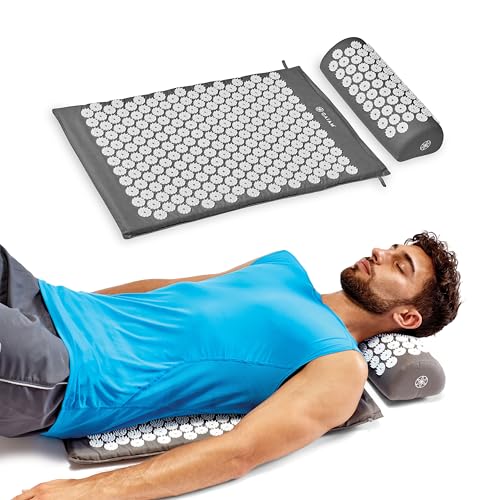
Gaiam Acupressure Mat & Pillow Set, Neck, Shoulder & Back
Chosen because it specifies Neck and Shoulder & Back.
View on AmazonProsourceFit Acupressure Mat and Pillow Set for Back/Neck Pain Relief and Muscle Relaxation, Large - Black/Black
Chosen because it specifies Large and Black/Black.
View on Amazon
UNMERA Acupressure Mat and Pillow Set,Natural Linen & Coconut Fiber Filling
Chosen because it specifies Natural Linen & Coconut Fiber Filling.
View on AmazonA lower-density mat generally leaves more space between contact points and can feel less intense at first. A high-density design distributes pressure across more points, which some experienced users find smoother, while others find the overall sensation stronger. Neither is automatically better. If you are new to acupressure mats, prioritize a forgiving surface and use it over a thin shirt before moving to bare skin.
Dimensions and body coverage
Most standard mats are roughly 65–75 cm long and 40–45 cm wide. That usually covers the upper back and part of the lower back when you lie down, but it does not cover the entire body. A longer mat, around 100–130 cm, can reach farther down the back and under the hips or legs, although it takes more storage space.
Width matters if you tend to shift position. A 30–35 cm travel mat may be adequate for a centered back, but a 40–45 cm mat is easier to use without repeatedly repositioning yourself. For shoulder-to-hip coverage, a conventional full-width mat is the safer choice.
Foam thickness and firmness
Foam determines how much your body sinks toward the spikes. A 2–3 cm layer tends to transmit pressure more directly and may suit experienced users. A 4–5 cm layer spreads body weight more gradually and is usually more comfortable for beginners, lighter users, and people who find hard floors unpleasant.
Thicker foam is not always gentler: soft foam can allow the body to sink deeply, increasing contact with the points. Firm, dense foam can feel more controlled, while thin foam placed directly on a hard floor can create a noticeably intense session. If you are unsure, choose medium-thickness foam and place the mat on a yoga mat, carpet, or bed rather than buying the most aggressively padded model.
Cover materials
Cotton and cotton-blend covers are common because they feel less slippery and can be more comfortable against clothing. Look for a zippered, removable cover that can be washed separately. Polyester covers often dry quickly and resist wrinkling, but they may feel warmer or less breathable.
The plastic spike discs are normally fixed to the cover or to a foam insert, so most mats are not machine-washable as a complete unit. A wipe-clean underside, reinforced seams, and a cover that can be removed without forcing the spike panels are more valuable than decorative stitching.
Head-to-head: gentle versus high-density mats
| Factor | Gentle, beginner-oriented mat | High-density, experienced-user mat |
|---|---|---|
| Approximate point count | 2,000–4,500 | 4,500–6,500 |
| Typical foam | 4–5 cm, medium or soft | 2–4 cm, medium or firm |
| Best starting position | Over a thin shirt, on a soft surface | Directly against skin or over light clothing |
| Advantages | More forgiving; easier to use for 10–20 minutes | More concentrated sensation; often feels stable during longer sessions |
| Trade-offs | May feel too mild after regular use | Can be uncomfortable if pressure, duration, or placement is excessive |
Decision matrix: which specification fits you?
| Your priority | Choose | Avoid |
|---|---|---|
| Lowest initial cost | Standard 65–70 cm mat with fixed cover and 3–4 cm foam | Oversized sets with unnecessary accessories |
| Daily or near-daily use | Removable washable cover, reinforced seams, dense foam | Thin fabric that bunches under your weight |
| Limited storage | Rollable model under 1.5 kg and no bulky pillow | Rigid mats with large attached bolsters |
| Strong sensation | Higher point density and firmer 2–3 cm foam | Very soft foam that lets you sink unpredictably |
| Easy entry for a sensitive user | Lower point density, thicker foam, and cotton cover | Sharp tips on a thin mat placed on bare flooring |
How to use an acupressure mat without overdoing it
- Prepare the surface. Start on a bed, carpet, or folded blanket. A hard floor increases pressure and can make a first session unnecessarily intense.
- Begin clothed. Wear a thin T-shirt and place the center of your back over the middle of the mat. Avoid placing your neck directly on the spikes until you understand how your body responds.
- Use a short session. Try 5–10 minutes initially. If the sensation settles into tolerable pressure rather than sharp pain, gradually work toward 15–20 minutes.
- Adjust position instead of forcing it. Move a few centimeters, add a thin towel, or use less body weight if one area feels excessively sharp.
- Inspect your skin afterward. Temporary redness or small pressure marks can occur. Stop if you experience persistent pain, unusual swelling, numbness, dizziness, or skin damage.
A pillow is useful for supporting the neck, but it also concentrates pressure into a smaller area. Beginners can place the pillow under the upper back or use a folded towel beneath the head instead of starting with direct neck contact.
Durability, cleaning, and ownership costs
The parts most likely to wear first are the cover seams, foam edges, and spike discs in the areas that receive repeated body weight. Rotating the mat end-for-end every few uses can reduce localized compression. Store it dry and loosely rolled; tightly folding it around the spike panels may crease the cover and weaken the foam.
For routine cleaning, wipe the plastic points and underside with a lightly damp cloth and mild soap, then allow the mat to dry completely. If the cover is removable, follow its care label and avoid high heat unless the manufacturer specifically permits it. Do not share a mat without cleaning it, particularly when it is used against bare skin.
Cost per use is modest if the mat survives regular use. For example, a $60 mat used three times per week for one year provides about 156 sessions, or approximately $0.38 per session before replacement costs. A washable cover and durable foam can matter more financially than saving $10 at purchase.
Important safety considerations
Acupressure mats are relaxation accessories, not a substitute for medical assessment or treatment. Avoid using one over open wounds, active skin irritation, or areas with reduced sensation. Ask a qualified healthcare professional before use if you are pregnant, have a bleeding disorder, take blood-thinning medication, have significant circulation or nerve problems, or are recovering from surgery. Stop and seek advice if a symptom is severe, new, or persistent.
Bottom line
For most first-time buyers, the best acupressure mat is a 65–75 cm model with a 40–45 cm width, 4–5 cm of medium foam, a removable textile cover, and moderate spike density. Choose a firmer, denser mat only after you know you enjoy the sensation. Prioritize fit, cleanability, and a comfortable starting setup over the highest advertised point count.
Write Your Review
No reviews yet. Be the first to share your experience!