
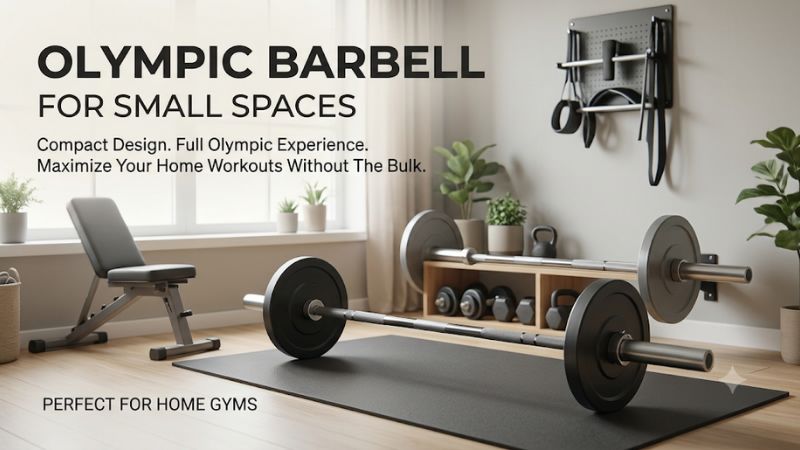
An Olympic barbell for small spaces needs room for the plates and your hands on both ends. Measure your rack’s J-cups, the path plates take onto each sleeve, and the ceiling above your lifts. Those three checks show whether you can keep a full-size bar, move to a 15 kg format, or shorten the sleeves further.
Start with the room you can train in
A full-size Olympic bar can work in a small gym when its ends face open space during use. A bedroom, garage, or basement only needs enough depth and width for the actual movement and loading paths. Measure the space with furniture, plate storage, the bench, and rack attachments where they normally sit.
A bar centered in a room still needs enough clear floor for you to stand where you load it. Imagine carrying your largest plate to the inside sleeve shoulder. Its path starts beyond the sleeve tip, continues across the sleeve, and finishes with room for your hands to release the plate. An obstacle anywhere along that path can make a usable-looking setup awkward.
Measure the bar’s full working width
Measure wall to wall at the height where the sleeves will sit with the bar on its hooks. Note any baseboard, shelf, or upright that intrudes at that height. Take a second measurement near the floor for deadlifts, where a storage bin or rack foot may block an end that was clear during bench presses.
If a 96-inch room holds an 86.75-inch bar exactly in the middle, it leaves about 4.63 inches on each side before accounting for plates, collars, or hands. A 79.13-inch bar gives about 8.44 inches on each side. A 72-inch bar gives 12 inches. These figures describe open distance from each tip to the wall. Protruding walls, a shifting bar, and the way you hold the plate can all reduce the room you can use.
Now take your largest plate or a cardboard cutout of it and simulate moving it over the location of the sleeve tip. Include the grip you use to carry it, especially if the plate lacks handles. The test reveals two different obstructions. A doorframe can block your wrist near the end of the bar, or a shelf can catch the top of the plate after your hand has already cleared the wall. Both matter.
Measure the real width of the J-cups
Use the outside edges of the contact surfaces on the installed J-cups. Different cup shapes can project beyond the uprights, so the “rack width” on a product page may be a different figure. Compare the cup span with the space between the inside shoulders of the sleeves on the exact bar you plan to buy.
Suppose the J-cups measure 49 inches across the outside contact edges. A bar with 52 inches between sleeve shoulders leaves 1.5 inches of theoretical clearance per side when centered. A 51.5-inch span leaves 1.25 inches each. If the bar drifts toward one side during a set, the gap on that side gets smaller. Fit depends on how the shaft lands on the support surface and how much movement the rack and bar permit.
Repeat the check for your safeties with the rack configured for the lifts you train. A bench may change where the bar approaches the rack and where you need to stand. A thin outline of a rack from a dimension drawing will miss those conflicts. If a particular bar maker calls a model rackable, use that as a clue to investigate the geometry of your own rack.
Trace the highest point of the movement
For overhead lifting, measure the height of the loaded bar and the space the plates need above it. Take the standing bar position and add the plate radius. Then check beams, lights, ceiling fans, and garage-door tracks over the path you actually use. A shorter bar mainly changes the room it takes side to side.
If the bar’s centerline reaches 84 inches overhead and the plate has an 8.86-inch radius, its rim reaches roughly 92.9 inches before allowing room for movement. A light fixture hanging at 92 inches can interfere even if the broad ceiling is 96 inches high. Use a broomstick and an unloaded mockup to check the path before moving actual weights into the area.
For squats and bench presses, the ceiling is often less limiting than the route between the bench, the hooks, and the plate storage. For an overhead lift in a basement, the plate size and height of the lifter can become the deciding factors before overall bar length. Plan around the lift that comes closest to the obstacle.
Account for floor position and household traffic
A bar can fit along the widest wall and still cross the only route to a door or a storage cupboard. Treat your gym as an active space first. Map where people enter, where they carry plates, and where the bar rests between sets. The best orientation lets someone load both sleeves without stepping across equipment.
An attached garage has another moving boundary. Measure with the car where it normally parks and the garage door in the position you use when lifting. Check for shelves, stairs, and floor transitions before choosing the rack location. If moving a vehicle is required for every workout, decide whether that commitment is realistic before spending to save a few inches of bar length.
In a multipurpose room, a diagram showing the bar, rack, bench, and plate storage can be as simple as four shapes on paper at a consistent scale. Keep the bench position for both pressing and storage visible. A bench that fits against the wall after training can be in the way while loading one sleeve. A gym layout succeeds when the room works in both states.
Compare Olympic barbell formats for small rooms
Overall length and the length of the shaft between shoulders change independently. Some 15 kg and compact rackable bars save space by shortening the sleeves while preserving much of the shaft span. That design can fit a conventional rack, but it reduces the room available for plates, collars, and future increases.
| Format | Example | Overall length | Loadable sleeve per side | When it makes sense |
|---|---|---|---|---|
| Full-size 20 kg | Rogue Ohio Bar E-Coat | 86.75 in | 16.40 in | You can load both ends and want room for thick bumpers |
| Shorter 15 kg multipurpose | Rogue Bella Bar 2.0 Black Zinc | 79.13 in | 13 in | You want a lighter start and can fit the planned plate stack |
| Compact rackable | Rogue C-70S | 72 in | 8.875 in | Room width is the constraint and a shorter stack still works |
| Short floor-use Olympic bar | Dimensions depend on model | Check exact listing | Check exact listing | Your program uses the floor and the rack is optional |
Keep a full-size bar if changing the layout solves the problem
A full-size bar leaves more sleeve room for thick bumpers and small change plates. If you only need a little clearance, try turning the rack or moving plate storage from the end of the bar to a spot along the wall. A layout change can preserve the grip, starting weight, and capacity you already use.
A rack turned 90 degrees may put the bar’s tips along the room’s longer axis. Check what that does to bench movement and the route to the rack. If the new orientation creates a longer clear aisle and both sides remain accessible, your existing bar can be the best equipment for the room. A full-size rack should still be anchored or configured according to its manufacturer’s directions after relocation.
If the remaining obstruction is a plate tree, try parking it forward of the platform or at the back of the rack when the manufacturer’s layout allows. That moves the storage footprint away from the path where your hand and plates travel. When the room has a narrow section at the entrance, consider how the bar gets inside, including the length of its shipping tube.
Move to a 15 kg bar when its other features suit you
A 15 kg multipurpose model can provide about seven to eight inches of overall length savings while retaining Olympic plate compatibility. The Bella Bar’s 79.13-inch length and 13-inch loadable sleeves illustrate that compromise. Its 25 mm shaft and lighter empty weight also change how the bar handles during training.
An extra 3.81 inches per end compared with the 86.75-inch Ohio can be enough to clear a wall-mounted shelf or garage cabinet. The switch also reduces empty weight by approximately 11 lb. If you practiced with a 20 kg bar for several years and want continuity, write down your expected working weights with the 15 kg base and see how your plate inventory handles those increments.
For lifts that start from the floor, the shorter end-to-end width can help in a cramped lane. For wide-grip work, test the actual grip position and the rack fit. For a bar with 13-inch sleeves, the biggest practical question is whether your upper range of bumper loads still fits. It is worth testing with the plate combination you plan to use a year from now.
Shorten the sleeves further when end clearance is the bottleneck
A compact rackable bar can hold onto the shaft width needed for J-cups by removing length at the ends. Rogue’s C-70S has a 72-inch overall length, 52 inches between sleeves, and 8.875 inches of loadable space per side. It saves room where the plates go, so the decision depends on plate thickness.
With a hypothetical collar that needs 1.5 inches of full engagement, the plate budget on one sleeve is 7.375 inches. Two hypothetical 3-inch bumpers and a 0.75-inch change plate use 6.75 inches, leaving 0.625 inches. Add a third 3-inch bumper and the stack grows beyond the available sleeve. Thinner plates or a longer-sleeve bar become the two practical ways forward.
Rogue specifies that the C-70S reaches 15 kg when its included collars are counted. If you use this example for logging or compare it with the empty weight of a regular 15 kg bar, keep the weight convention consistent. The compact bar saves more usable space than a slightly shorter general-purpose model, but it is a more consequential switch. Buy it after verifying what you can load.
Use a short floor bar if the rack serves a different purpose
Some home gyms need a bar only for floor pulls, rows, or similar exercises. For that use, a model with a shorter shaft span can be practical when you have verified plate fit, hand width, and the manufacturer’s intended use. The relevant clearance is how the bar and plates travel inside that floor area.
A short floor bar may have longer sleeves than a compact rackable design of the same overall length because its center shaft is shorter. That can give you extra plate capacity in exchange for grip and rack flexibility. If you might add squats or bench presses later, sketch the rack and check whether a second bar would then become necessary. A cheaper purchase today can become a specialized piece of gear in a setup that later needs a versatile main bar.
Plan plate loading and storage together
Plate storage affects how usable a small barbell station feels from one session to the next. Thick bumpers consume room on the sleeves, and broad plate trees can eat the open space around them. Design the plate system around where you train, how far you carry each plate, and how much space the heaviest stack needs.
Match plate thickness to your working loads
Build a real plate list for two sessions, one with a lighter technique load and one near the heaviest weight you expect to use. For each side, write the plates in order, add their measured thicknesses, and reserve the collar’s installed width. This simple check is especially valuable with compact bars and thick bumpers.
If you mostly bench and squat with controlled handling, thin compatible iron or steel plates can save sleeve space. If your training calls for repeated landings from weightlifting movements, use the bumper plates and surface specified for the equipment. A thinner plate solves a geometry problem. Its suitability for impact is a separate decision. Check the plates, bar, and training surface together.
Also check plate diameter for lifts that start from the floor. If you use a small-diameter iron plate as the main plate, the bar may sit lower. Full-diameter bumpers keep the starting height more consistent when you change between appropriate sizes in a compatible plate line. A compact room that requires thin iron for capacity may still benefit from one full-diameter pair for floor work.
Store the bar where it can be moved without contact
Horizontal storage keeps the bar easy to lift out if there is a clear path in front of it. Vertical storage can free wall width but requires enough ceiling height to lift the bar far enough to clear the holder and tip it into the room. Measure the removal path, including the hanger depth, before deciding.
If a storage tube needs several inches of upward travel to free the bottom sleeve, the required clearance exceeds overall bar length. Rotate the empty bar only where you have clearance from fixtures, mirrors, and people. Check the storage manufacturer’s mounting instructions and whether that product accepts the sleeve diameter and weight of your bar.
Place frequently used plates close to the loading position without turning the gap at the end of the bar into a storage lane. In a room shared with other activities, take loose plates off the floor after training and keep them on a rated stand or compatible rack attachment. Account for the stand’s width and how much space you need to pull the widest plate free.
Choose a floor plan that is ready on an ordinary day
A small home gym succeeds when it is easy to use on a normal weeknight. Before buying gear, walk through bringing the bench out, loading the first warm-up plates, changing to the largest plates, and putting the bar away. Repeat the walk with doors where they normally sit and anything on the floor that is hard to move.
If you have to carry plates past the sleeve tip, step across the bench, and twist between a wall and a rack, try a new position before shrinking every piece of equipment. A longer space that functions in one direction can handle a full-size bar. A short space with a wall at each end may require shorter sleeves or a different implement entirely. Time the reset process if you share the room and need to clear it every day.
Frequently asked questions
The last few inches matter differently for loading, gripping, and storage. Before making the purchase, confirm whether the rack and bar dimensions describe the same points. Then check that the bar can arrive, rotate into place, and come out of storage without crossing another person’s path during a lift.
Is a 7-foot bar usable in an 8-foot room?
It depends on the exact length. A common full-size 20 kg bar can be around 86.6 inches, leaving about 4.7 inches per tip in a bare 96-inch space when centered. Test the actual plate and collar movement in both end gaps. You may gain space by rotating the setup to use the longer dimension of the room.
If the walls are solid and the rack sits square across the 8-foot dimension, work from the loading motion and the space your hands need. A short bar can buy enough room to handle plates comfortably. Choose its exact shaft span and sleeves after checking those measurements.
Will every 6-foot Olympic bar fit a standard rack?
Rack fit depends on the bar’s shaft span between shoulders and the outside contact width of the installed J-cups. Some 6-foot bars retain a conventional rackable span by shortening the sleeves. Others use a shorter shaft. Request the dimension or a technical drawing if the listing gives the overall length alone.
In a rack with narrow or adjustable supports, follow the manufacturer’s intended setup and confirm that both the hooks and safeties support the shaft correctly. Two advertised overall lengths can match while the bars behave very differently in the same power rack.
Can I use 1-inch plates to make an Olympic setup smaller?
A 1-inch plate normally belongs on the matching standard-size bar format. An Olympic bar uses approximately 2-inch sleeves. You can save room within an Olympic setup by choosing thinner compatible plates, using a shorter rackable bar where appropriate, or moving to a plate storage system that clears the loading aisle.
If you own a full set of standard plates, compare the cost of keeping a matching straight bar against replacing the plates. Decide by the lifts and working loads you want to support, then check the rack compatibility for whichever format you choose.
Does a rubber mat make a small room suitable for weightlifting drops?
A mat adds a surface layer. Your usable drop area also depends on the floor underneath, the manufacturer’s instructions, available clearance, impact tolerance, and noise in nearby rooms. A tight upstairs room or a shared wall can change what training is practical even when you have an Olympic bar and bumpers.
Choose movements and lowering methods that work in the building you have. If a lift needs a dedicated landing zone and there is no room for one, adapt the program or use a space designed for it.
Conclusion
Keep a full-size bar if you can load both ends by changing the layout. A 15 kg bar is a useful middle step when the lighter weight and shorter sleeves suit your program. Choose a compact rackable bar only after confirming that your J-cups, safeties, heaviest plate stack, collars, and loading path all work together.
More from Amazon
Programs that pair well with the guide above. Offers and eligibility are set by Amazon and may change.
Free shipping on eligible items, Prime Video and more. Eligible new members can start with a free trial.
Start a Prime free trialA Prime membership for ages 18-24 with a trial period. Eligibility is set by Amazon.
See Prime for Young AdultsAudiobooks and podcasts to listen to on the go. Eligible new members can start with a free trial.
Try Audible freeAd-free music streaming. Eligible new subscribers can start with a free trial.
Try Music Unlimited freeAs an Amazon Associate we earn from qualifying purchases.

Write Your Review
No reviews yet. Be the first to share your experience!