
Key takeaways
What's inside
Best home workout equipment budget planning fails when people buy six cheap versions of the same movement. A working kit has to cover pushing, pulling, hinging, squatting and conditioning, and all of that can be done for roughly the price of a few months of gym membership if you buy the pieces in the right order.
As an Amazon Associate we earn from qualifying purchases at no extra cost to you. Product prices and availability are accurate as of the date shown and are subject to change.


As an Amazon Associate we earn from qualifying purchases at no extra cost to you. Product prices and availability are accurate as of the date shown and are subject to change.
By Chris Parker
🛒 Best Price Today on Amazon
Prime members get fast, free shipping on everything above, plus member-only deals. New members get a 30-day free trial — cancel anytime.
How to Build the Best Home Workout Equipment Budget Setup
The best home workout equipment budget is not the smallest one, it is the one with no wasted overlap. Three rules do most of the work: buy by movement pattern, check the total storage volume before the total price, and understand exactly where the cheap tier gives way so the failure is not a surprise.
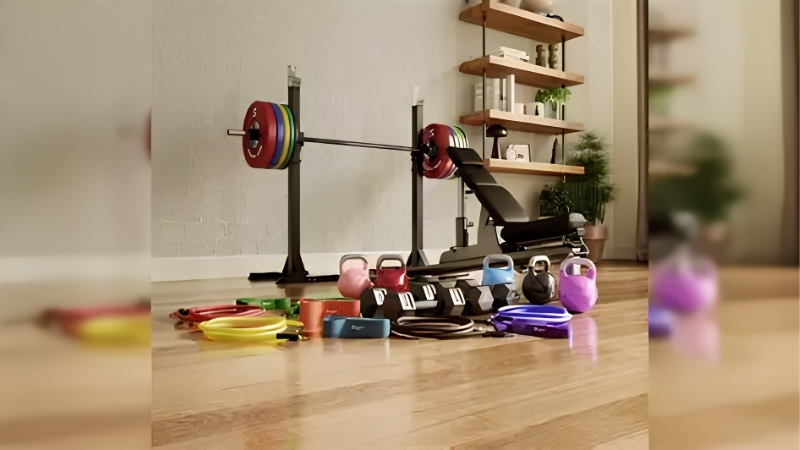
Cover the Movement Patterns, Not the Muscle List
Five patterns cover almost everything a general trainee needs: a horizontal push, a vertical pull, a hip hinge, a knee-dominant leg movement and something for conditioning. Buy one tool per pattern before you buy a second tool for any of them, because a second pair of bands adds nothing a first pair could not do.
That framing changes the shopping list. A pull-up bar is not optional decoration, it is the only affordable way to load a vertical pull at home. A kettlebell covers the hinge. Bands cover pressing and rowing. Adjustable dumbbells cover the leg work that bands struggle to load properly once you get stronger.
Total Footprint and Where It All Lives
Footprint is the constraint that decides whether the best home workout equipment budget survives contact with a real flat. A band set, a jump rope and a doorway bar together occupy less than a shoebox. A pair of adjustable spinlock dumbbells with plates takes roughly 2 x 1.5 ft (61 x 46 cm) of floor and does not move easily.
Interlocking foam tiles are the item people forget to measure. A standard pack covers about 24 sq ft (2.2 sq m), which is a 6 x 4 ft (183 x 122 cm) area, and that has to sit somewhere permanently or be lifted every session. Measure the real floor area of your training space before ordering anything bulky.
Where the Price Floor Actually Bites
Home training stopped being a stopgap years ago, and the equipment market followed: cast iron, decent latex and usable adjustable dumbbells are all available at prices that would have bought very little a decade ago. That shift is real, and it is why a genuinely usable kit now fits a modest budget.
What arrived alongside it was a large volume of gear that photographs better than it performs. Thin latex layers in band sets, plastic clips where carabiners should be, hollow vinyl kettlebells with rough handle castings, and foam tiles that dent permanently under iron. None of it is dangerous; all of it shortens replacement cycles.
The reliable filter for the best home workout equipment budget is to spend where the load path runs and economise everywhere else. Bands, cast iron and the pull-up bar mount deserve the money. Mats, ropes and storage racks do not. A budget spent that way tends to last years, while an evenly spread one tends to be replaced piece by piece.
Top Picks: 6 Budget Buys That Cover Every Pattern
These six items together form a complete beginner kit at the lower end of the market, with no two covering the same job. The best home workout equipment budget stretches furthest when each purchase adds a pattern you could not train before, so the table lists what each one actually unlocks.
| Item | Pattern It Covers | Tier | Storage Footprint | Main Limit |
|---|---|---|---|---|
| Whatafit Resistance Band Set | Push, row, curl, press | Budget | Small bag | Clips are the weak point |
| Yes4All Spinlock Dumbbells | Legs, press, row | Budget to mid | Approx. 2 x 1.5 ft (61 x 46 cm) | Slow plate changes |
| Amazon Basics Kettlebell | Hip hinge, swings, carries | Budget | Under a desk | Fixed weight |
| ProsourceFit Pull-Up Bar | Vertical pull | Budget | Hangs or stores flat | Needs door trim |
| ProsourceFit Puzzle Mat Tiles | Floor work, noise control | Budget | Approx. 24 sq ft (2.2 sq m) | Dents under iron |
| WOD Nation Speed Rope | Conditioning | Budget | Needs ceiling clearance |
Whatafit Resistance Bands Set
The cheapest way to make pressing and rowing loadable at home. A typical set stacks five tube bands to somewhere near 150 lb (68 kg) of combined resistance and includes handles, ankle straps and a door anchor, which between them cover chest press, rows, curls, overhead press and lateral work.
Stacked resistance figures are quoted near maximum stretch, so the load in the working range is lower than the headline suggests. The plastic clips are the component that fails, usually before the latex does. Inspect them regularly, never stretch a band towards your face, and replace the set rather than a single band.
Yes4All Adjustable Spinlock Dumbbells
Cast iron plates on a threaded bar with screw collars, sold in sets from around 40 lb (18 kg) upwards. It is the cheapest route to genuinely progressive loading for squats, lunges, presses and rows, and additional plates can be bought separately later on rather than replacing the whole set.
Changing weight is slow, which makes supersets tedious, and the collars work loose if you do not tighten them properly. The bar is longer than a fixed dumbbell, so tight positions feel awkward. Do not drop them: spinlock threads are the first thing to deform and a bent bar is not repairable.
Amazon Basics Cast Iron Kettlebell
One kettlebell covers the hip hinge, which is the pattern most home setups miss entirely. Cast iron in a single piece with a wide handle is all that is required for swings, goblet squats, carries and Turkish get-ups, and one sensibly chosen weight will stay useful for a long time.
It is fixed weight, so progression means buying another one, and cast iron on a hard floor is loud and damaging. Handle finish varies between production runs and occasionally needs a light sanding to stop it tearing calluses. Put it down on a mat, and never let it drop from overhead.
ProsourceFit Multi-Grip Lite Pull-Up Bar
The vertical pull is the hardest pattern to cover cheaply, and a doorway bar solves it for very little money. This one is listed at 300 lb (136 kg), fits openings of roughly 24-32 in (61-81 cm), and offers wide, neutral and close grips so hand position can be varied across the week.
It hooks over the door casing, so a flush modern frame will not work and a soft painted trim will mark unless you pad the contact points. Foam grips compress within a season. Treat the rating as a static one: no kipping, no swinging, and no dropping off the bar onto a hard floor.
ProsourceFit Extra Thick Puzzle Exercise Mat
Interlocking EVA tiles around 0.5 in (13 mm) thick, covering roughly 24 sq ft (2.2 sq m) per pack. In a flat this is the item that makes everything else acceptable to the people below you, dampening the impact from a jump rope and protecting the floor when a kettlebell is set down.
EVA is not the same as rubber. Heavy cast iron dents it permanently, edges curl if the tiles are lifted repeatedly, and the surface gets slippery under sweat. For light dumbbells, floor work and rope, it is more than adequate; for regularly dropping serious weight, you need rubber instead.
WOD Nation Speed Jump Rope
Conditioning with the smallest footprint of anything you can buy. An adjustable coated cable on ball-bearing handles costs very little, packs into a pocket, and gives a genuine cardiovascular session in ten minutes without a treadmill taking up half a room or drawing serious electricity.
You need roughly 12 in (30 cm) of clearance above your reach, which rules out low ceilings, and rope on concrete or rough tile abrades the coating quickly. It is also high impact, so on a suspended upstairs floor it is easily the loudest thing in this kit even with tiles underneath.
Frequently Asked Questions
Questions about the best home workout equipment budget usually come down to sequencing and sufficiency: what to buy first, whether bands alone are enough, and how much floor protection is really needed. These four answers cover the decisions that most often stall a first equipment purchase.
What is the minimum for a usable home gym?
A band set, a doorway pull-up bar and one kettlebell cover every major pattern and cost less than a couple of months of most gym memberships. Everything after that is refinement rather than necessity. Add adjustable dumbbells when band resistance stops challenging your legs, which usually happens within a few months.
Are resistance bands enough on their own?
For upper body pressing and rowing, they go a long way. For legs they run out quickly, because the strongest muscle group in the body outpaces band tension long before it outpaces iron. Bands also load the movement unevenly, being lightest where you are weakest. Treat them as a foundation, not a complete answer.
Do I need floor protection?
If you own cast iron, yes. Even a controlled set-down marks timber and can crack tile, and impact noise travels through suspended floors far more than people expect. EVA tiles handle dumbbells and floor work. If you plan to drop weight regularly, budget for rubber matting instead of foam from the start.
What should I buy first?
Buy the pattern you currently cannot train. Most people can already do push-ups, squats and lunges with no equipment at all, so the vertical pull is the honest first gap, which makes the pull-up bar the highest-value opening purchase. Bands come second, and iron comes when bodyweight stops being difficult.
See More:
- Best home pull-up bar
- Best at home pull up bar
- Best in house pull up bar
- Best rated ab roller
- Best rated ankle weights
Final Thoughts
The best home workout equipment budget is the one where every item unlocks a pattern the others cannot reach. Start with a doorway pull-up bar and a band set, add one kettlebell for the hinge, then move to adjustable dumbbells when your legs outgrow band tension. Measure the floor area first.





Write Your Review
No reviews yet. Be the first to share your experience!