
Key takeaways
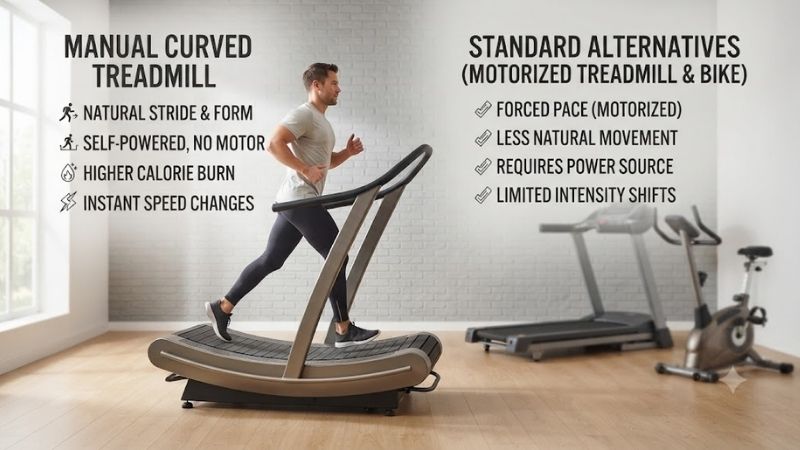
- Curved Deck Geometry: The running surface features a concave contour with an entry arc curve of roughly 10 to 18 degrees. Gravity acts on the runner’s mass: stepping forward onto the downward curve creates a gravitational down-force that drives the track backward beneath the foot.
- Independent Slatted Track: Rather than a continuous PVC or rubber belt sliding over a stationary phenolic deck, curved treadmills utilize individual vulcanized rubber or aluminum-reinforced polyurethane slats. Each slat attaches to dual roller bearings traveling along low-friction guide rails.
- Zero-Friction Bearing Arrays: Premium curved runners house 60 to 144 sealed radial ball bearings. This allows the track to glide smoothly with minimal mechanical drag. Adjusting running speed requires no buttons; increasing cadence or shifting foot strike forward along the upward curve accelerates the belt, while moving toward the center contour decelerates it.
Choosing between a manual curved treadmill and alternative cardio machines comes down to mechanical drive styles, joint deceleration demands, and long-term maintenance overhead. Curved treadmills rely entirely on user inertia and gravity across an arched slatted belt, eliminating drive motors and electrical requirements while increasing metabolic demand and posterior chain recruitment. Evaluating curved treadmills against motorized treadmills, dual-action air bikes, indoor rowers, and upright ski ergs reveals which tool best matches your athletic conditioning goals, acoustic tolerance, and floor space.
Quick Comparison Table
| Machine / Method | Drive Mechanism | Impact & Kinetic Profile | Power Requirement | Operating Footprint (L x W) | Primary Muscle Emphasis | Maintenance Demands |
| Manual Curved Treadmill | User-propelled slatted track on precision ball bearings | Low to Moderate (speed-dependent overground simulation) | Cordless (Zero electricity; battery console only) | 68–77 in x 31–36 in | Glutes, Hamstrings, Calves, Core | Low (No motor/deck waxing; periodic belt tracking) |
| Motorized Flat Treadmill | Continuous-duty electric drive motor (2.5–4.0 CHP) | Moderate to High (Belt pulls foot; deceleration shock) | Standard 120V / 15A or 20A grounded outlet | 70–82 in x 34–38 in | Quadriceps, Calves, Plantar Flexors | High (Motor brushes, deck lubrication, belt tensioning) |
| Dual-Action Air Bike | User-driven perimeter fan impeller with wind resistance | Zero impact (Closed-chain upper/lower push-pull) | Cordless (Battery-operated console) | 48–55 in x 24–27 in | Quadriceps, Hamstrings, Deltoids, Lats, Core | Low to Moderate (Chain/belt tensioning, pivot inspection) |
| Indoor Rower (Air Ergometer) | User-driven coiled damper flywheel with chain/cord return | Zero impact (Seated horizontal drive and recovery) | Cordless (Flywheel-generated power / battery backup) | 84–96 in x 24 in | Lats, Rhomboids, Erector Spinae, Glutes, Quads | Low (Chain oiling, slide rail wiping, dust vacuuming) |
| Ski Ergometer (Wall/Stand) | User-driven dual-cable flywheel system with air damper | Zero impact (Closed-chain standing flexion/extension) | Cordless (Flywheel generator / battery console) | 24 in x 19 in (Wall) or 50 in x 24 in (Floor Stand) | Lats, Triceps, Anterior Core, Hip Extensors | Low (Drive cord inspection, flywheel cage cleaning) |
Mechanical Architecture and Operating Principles
Curved Non-Motorized Treadmills: Gravity-Assisted Bearing Dynamics
Curved non-motorized treadmills (NMTs) eliminate electric drive motors, circuit boards, and elevation gearboxes. Instead, their mechanics depend on three integrated systems:
- Curved Deck Geometry: The running surface features a concave contour with an entry arc curve of roughly 10 to 18 degrees. Gravity acts on the runner’s mass: stepping forward onto the downward curve creates a gravitational down-force that drives the track backward beneath the foot.
- Independent Slatted Track: Rather than a continuous PVC or rubber belt sliding over a stationary phenolic deck, curved treadmills utilize individual vulcanized rubber or aluminum-reinforced polyurethane slats. Each slat attaches to dual roller bearings traveling along low-friction guide rails.
- Zero-Friction Bearing Arrays: Premium curved runners house 60 to 144 sealed radial ball bearings. This allows the track to glide smoothly with minimal mechanical drag. Adjusting running speed requires no buttons; increasing cadence or shifting foot strike forward along the upward curve accelerates the belt, while moving toward the center contour decelerates it.
Alternative Machine Mechanics
- Motorized Flat Treadmills: Rely on an alternating current (AC) or direct current (DC) motor spinning a front drive roller via a rubber poly-V drive belt. The motorized belt pulls the runner’s leg underneath their hips. This creates continuous friction between the belt backing and the flat walking deck, demanding regular silicone fluid lubrication to avoid motor control board overheating.
- Dual-Action Air Bikes: Utilize a large steel or high-density polymer fan wheel. As the user pedals and manipulates the dual-action handlebars, the blades displace ambient air. Air resistance scales exponentially to user cadence according to fluid dynamic principles; doubling pedal speed quadruples aerodynamic drag.
- Indoor Air Rowers: Employ an enclosed fan impeller connected to a stainless steel drive chain or high-tenacity synthetic cord. A spiraling damper controls airflow entering the flywheel cage, altering the drag factor. The return mechanism relies on an internal shock cord that pulls the handle back during the recovery stroke.
- Ski Ergometers: Mirror air rower mechanics in a vertical plane. Users pull down on two lightweight drive cords that rotate a perimeter-damped fan impeller. Resistance remains purely responsive: pulling with greater downward force and speed generates immediate mechanical braking resistance without mechanical wear parts.
Mechanical Architecture and Operating Principles
Biomechanical and Physiological Differences
Energy Expenditure and Metabolic Demand
A distinctive difference between manual curved treadmills and alternatives is the internal metabolic work required to generate locomotion:
- Curved Treadmill Metabolic Demands: Because no drive motor pulls the belt, the user must propel their entire mass while overcoming the resting rotational inertia of the slatted belt. Peer-reviewed sports science literature indicates that curved manual treadmills induce 25% to 32% higher oxygen uptake ($VO_2$), elevated heart rate responses (approximately 16% higher), and increased relative energy expenditure at equivalent running speeds compared to flat motorized units.
- Motorized Treadmills: The motorized belt assists rearward foot travel, lowering the mechanical effort needed to complete hip extension. This allows sustained steady-state aerobic conditioning at lower relative metabolic costs for a given pace.
- Air Bikes, Rowers, and Ski Ergs: These alternatives offer scalable metabolic output through non-impact air resistance. However, because they distribute work across the upper and lower body or allow seated recovery phases (as seen in rowing), they provide distinct systemic cardiovascular conditioning without loading foot arches, ankles, or lower leg soft tissue.
Joint Impact and Stride Biomechanics
- Locomotion on Curved Decks: The curved slope encourages users to land directly beneath their center of mass on the midfoot or forefoot rather than landing on the heel out in front (overstriding). Overstriding creates a high braking force that spikes vertical ground reaction forces. Striking the mid-curve shifts mechanics toward active hip extension and ankle stiffness, substantially reducing deceleration shock on knees and hips.
- Flat Motorized Locomotion: A horizontal belt moving at a fixed velocity can foster lazy stride mechanics, heel striking, and repetitive passive loading on the patellofemoral joint and lumbar spine, particularly as fatigue accumulates during long runs.
- Closed-Chain Alternatives (Air Bike, Rower, Ski Erg): Air bikes and indoor rowers eliminate ground impact completely. Foot plates remain anchored, preventing eccentric shock to knees and ankles. The ski erg provides standing hip hinge mechanics without foot-strike deceleration, making it exceptionally well-suited for athletes rehabilitating lower-leg stress fractures, plantar fasciitis, or Achilles tendinopathy.
Spatial Dimensions, Weight, and Flooring Clearances
Evaluating usable floor space, ceiling height, and floor loading capacities is essential before moving high-mass equipment into spare bedrooms, basements, or garage gyms.
Total Operating Dimensions and Stride Profiles
- Manual Curved Treadmills: Measure between 68 and 77 inches in total length and 31 to 36 inches in width. The usable slatted surface is typically 17 to 19 inches wide and 60 inches long. Because the user does not kick out behind the frame, operating length matches the physical length, but the high handrails demand lateral elbow room.
- Motorized Treadmills: Range from 70 to 82 inches long and 34 to 38 inches wide. Belt decks span 20 to 22 inches in width and 60 inches in length. Folding motorized frames pivot upright to free floor space; curved treadmills are rigid, non-folding structures that command their footprint permanently.
- Air Bikes: Require a compact footprint of 48 to 55 inches in length and 24 to 27 inches in width. Handle travel sweeps forward and backward, requiring an additional 6 inches of clearance front and rear.
- Indoor Rowers: Have the longest horizontal footprint among home cardio equipment, extending 84 to 96 inches. However, air rowers measure only 24 inches wide and can be stood upright vertically between workouts, storing within an area under 4 square feet.
- Ski Ergometers: When wall-mounted, a ski erg occupies an ultra-compact footprint of 19 inches wide by 24 inches deep. When set on a freestanding base platform with transport wheels, it requires a 50-inch by 24-inch floor space.
Ceiling Clearance Calculations
To confirm safe ceiling clearance for standing or running equipment, apply the standard headroom calculation:
$$\text{Minimum Ceiling Height} = \text{User Height} + \text{Deck Step-Up Height} + \text{Dynamic Head Bounce / Safety Margin}$$
- Curved Treadmill Overhead Calculations: Curved treadmill bases sit higher than flat running decks to accommodate the lower loop of the slatted track. Deck step-up heights range from 14 to 17 inches at the center and up to 18 to 20 inches at the front and rear curves. A 6-foot runner (72 inches) on a 15-inch curved deck requires a dynamic head clearance of 87 inches. Adding an 8-inch safety margin to absorb running bounce requires a minimum ceiling height of 95 to 96 inches (8 feet).
- Motorized Treadmills: Base deck step-up heights span 7 to 9 inches for non-incline use, requiring an 8-foot ceiling. Incline trainers that lift users 15 to 18 inches off the subfloor require 9-foot ceilings.
- Air Bikes and Rowers: Athletes remain seated during exercise, keeping vertical height requirements around 5 to 6 feet. They fit safely in basements with low ductwork or dropped ceilings (84 inches or lower).
- Ski Ergometers: The top of the ski erg frame stands at 85 inches (roughly 7 feet, 1 inch). A standing user with full overhead arm reach requires an absolute minimum ceiling clearance of 86 to 88 inches.
Equipment Mass and Floor Point Loading
- Curved Treadmills: Weigh between 260 and 380 lb due to heavy gauge structural steel frames, solid aluminum pulleys, and steel bearing tracks. This mass is distributed over four small leveling feet, creating substantial static and dynamic point loads on wood-joist subfloors.
- Motorized Treadmills: Weigh between 220 and 330 lb. The distribution of weight is concentrated heavily at the front motor pan.
- Air Bikes and Rowers: Air bikes weigh 110 to 140 lb, while air rowers weigh roughly 57 to 65 lb. Both can be safely positioned on any residential floor without reinforcing joists or risking subfloor deflection.
Electrical Needs, Acoustic Profiles, and Maintenance Overhead
Operational disruptions—ranging from blown circuit breakers to motor whining and floor vibrations—dictate how comfortably cardio equipment integrates into home environments.
Power Demands and Placement Freedom
- Manual Curved Treadmills: Require zero electrical wall power. The internal friction-free generator or a pair of standard AA batteries powers the LCD tracking console. This allows placement in garage gyms, outdoor patios, or basement corners completely free of extension cords or dedicated wall outlets.
- Motorized Flat Treadmills: Demand an isolated, grounded 120V 15-amp or dedicated 20-amp electrical circuit. Drawing power on shared household circuits frequently trips breakers when the drive motor spikes current under heavy foot strikes. Electrical reliance restricts machine placement to walls near grounded outlets.
- Air Bikes, Rowers, and Ski Ergs: Self-contained platforms powered by batteries or small internal flywheel alternators. They offer full placement flexibility throughout the home.
Acoustic Footprints and Structural Vibration
- Curved Treadmills: Produce no motor noise, but the rolling contact of 60+ steel bearings and slatted rubber segments generates an acoustic level between 68 and 74 dB during fast running. The real impact is low-frequency floor vibration: sprinting on a curved treadmill transfers kinetic force through the floor joists, which will transmit noise into adjacent or downstairs rooms unless placed on ground-level concrete with thick rubber gym tiles (minimum 3/8-inch thickness).
- Motorized Treadmills: Emit continuous mechanical motor whine alongside foot-strike clatter, operating between 62 and 72 dB. Motor insulation suppresses high-frequency noise, but belt slapping remains audible.
- Air Bikes: Operate between 72 and 82 dB at high pedal cadences. The open fan displaces air rapidly, producing a loud wind rush that can overpower conversation and television audio in shared living areas.
- Air Rowers and Ski Ergs: Produce smooth, whooshing air currents between 65 and 75 dB. They generate zero floor-thudding vibration, making them far quieter across second-floor residential installations than running machinery.
Long-Term Maintenance and Reliability
- Curved Treadmill Maintenance: Curved units require minimal preventive maintenance. The slatted track rides on sealed bearings that do not require silicone lubrication, deck waxing, or recurring centering adjustments. Routine care is limited to wiping dust from guide tracks and checking belt tension bolts annually.
- Motorized Treadmill Maintenance: Requires extensive upkeep. Unwaxed decks demand silicone oil application every 100 to 150 hours of use to prevent thermal burnout of the drive motor and controller board. Belts stretch and track off-center, requiring tension adjustments with Allen wrenches. Motor covers must be removed semi-annually to vacuum pet hair and debris.
- Alternative Machine Maintenance: Air bikes require occasional drive chain lubrication or poly-V belt tension checks. Rowers require weekly wiping of the monorail and oiling of the nickel-plated steel chain every 40 to 50 hours of use. Ski ergs require periodic checks on the high-strength drive cords for surface fraying.
Practical Conditioning Scenarios
Scenario 1: True Sprint Conditioning and High-Intensity Interval Training (HIIT)
- The Challenge: Performing 10-second all-out maximal sprints followed by 20-second active rest intervals inside a residential garage.
- Equipment Assessment: Motorized treadmills are poorly suited for short interval work because motors take 5 to 10 seconds to ramp up to top speed and another 5 seconds to decelerate safely. Air bikes allow instant speed changes, but they lack running-specific stride adaptation.
- The Recommendation: The manual curved treadmill is the superior tool here. Because the runner’s feet dictate track speed instantly, you can accelerate to a maximal sprint within three strides and stop immediately by stepping off or easing cadence, offering unconstrained sprint mechanics without safety shut-off clips.
Scenario 2: Compact Apartment or Second-Floor Installation
- The Challenge: Designing an effective cardio space on an upper floor with low ceiling clearance and sensitive noise limits.
- Equipment Assessment: A curved treadmill or motorized treadmill transmits heavy kinetic vibration through subfloors, and their high step-up decks leave minimal headroom under 8-foot ceilings.
- The Recommendation: Select an air rower or magnetic exercise bike. An air rower provides comprehensive cardiovascular work without floor-thump vibration and tilts vertically against a closet wall when finished, preserving valuable living space.
Scenario 3: Joint-Friendly Aerobic Base Building (Zone 2 Cardio)
- The Challenge: Logging 45 to 60 minutes of low-intensity steady-state (LISS) aerobic work while managing knee cartilage wear or lower back pain.
- Equipment Assessment: A curved treadmill demands continuous focus and active engagement to maintain belt speed; its higher metabolic demand can push heart rates out of Zone 2 into Zone 3 easily.
- The Recommendation: Use a dual-action air bike or indoor rower. Both machines eliminate ground reaction force, allowing consistent cadence and steady-state cardiovascular conditioning without stressing lower-limb joints or risking balance fatigue.
Scenario 4: Specific Trail Running and Outdoor Race Preparation
- The Challenge: Preparing for competitive 5K to marathon distances or trail running during winter or inclement weather.
- Equipment Assessment: Rowing machines and air bikes build systemic work capacity but lack the bone-loading and tendon-stiffening benefits required for running durability.
- The Recommendation: Pair a manual curved treadmill with outdoor running, or choose a commercial-grade motorized treadmill. The curved treadmill conditions posterior chain muscles, reinforces midfoot landings, and builds cadence efficiency, while a motorized treadmill allows exact pace-setting for distance-specific tempo training.
Advantages and Disadvantages
Manual Curved Treadmills
Advantages
- Increased Caloric Burn: Higher mechanical resistance demands up to 30% more energy expenditure at equivalent speeds compared to motorized units.
- Reinforces Proper Running Form: Concave geometry promotes forefoot/midfoot striking directly beneath the body, discouraging joint-damaging overstriding.
- Instantaneous Velocity Control: Accelerates and stops naturally with the runner’s stride; no electronic buttons or motor acceleration lag.
- Cordless Placement Freedom: Zero electrical consumption allows placement anywhere without cord routing or tripped breakers.
- Low Maintenance Overhead: Sealed bearing tracks eliminate deck lubrication, motor electronics failures, and continuous belt tracking.
Disadvantages
- High Initial Financial Cost: Commercial slatted designs and bearing arrays make curved runners significantly more expensive than standard motorized treadmills.
- Substantial Step-Up Height: High base decks (14 to 18 inches) demand generous 8.5-foot to 9-foot ceilings for tall athletes.
- Heavy, Rigid Footprint: Typically weighing 300+ lb with no folding capability, curved units are difficult to relocate once positioned.
- Pacing Difficulty for Beginners: Lacks an automated speed governor; maintaining a slow, steady walking pace requires active balance and rhythm.
Alternative Cardio Equipment
Advantages
- Complete Impact Elimination: Air bikes, rowers, and ski ergs provide closed-chain motion that shields joints from ground reaction trauma.
- Full-Body Kinetic Recruitment: Ergometers recruit upper body, core, and lower body musculature, spreading cardiovascular effort evenly.
- Budget-Friendly Accessibility: Commercial-standard rowers and air bikes cost a fraction of the price of an entry-level curved manual treadmill.
- Low Overhead Clearances: Seated platforms fit safely beneath restricted 7-foot basement joists and dropped ceilings.
- Vertical Storage Capabilities: Equipment like the Concept2 Rower folds or stands vertically to occupy under 4 square feet of floor space.
Disadvantages
- Lacks Running Locomotion Specificity: Non-impact seated machines do not prepare bones, tendons, or foot arches for real-world running and walking forces.
- High Air Displacement Noise: Air bikes generate considerable aerodynamic wind noise that can dominate residential rooms.
- Technique-Sensitive Movement: Indoor rowing demands strict hip hinge mechanics; poor execution under fatigue can compromise the lower back.
- Quadriceps Dominance: Standard pedaling on upright bikes places heavy strain on the anterior chain, neglecting the hamstrings and posterior chain.
Who Should Choose Which Machine?
Choose a Manual Curved Treadmill If:
- You want to run indoors while maintaining natural overground mechanics, forefoot striking, and strong posterior chain engagement.
- You frequently train with high-intensity intervals, sprint repeats, or CrossFit-style conditioning circuits where motorized speed adjustments are too slow.
- You have a ground-floor garage or basement with ceilings measuring at least 8.5 to 9 feet.
- You want a durable running machine free of electric cords, sensitive circuit boards, and recurring deck waxing.
Choose a Motorized Flat Treadmill If:
- Your primary training consists of steady-state distance running, marathon preparation, or consistent walking at exact target speeds.
- You need automated speed and incline controls to lock in pace without having to consciously regulate cadence against a curved deck.
- You require a folding cardio platform that can tuck away vertically to preserve usable floor space.
Choose a Dual-Action Air Bike If:
- You need maximum cardiovascular conditioning with zero impact on lower-body joints.
- You want an integrated upper-body push/pull workout alongside lower-body pedal power.
- You are outfitting a compact space with standard or low ceiling heights.
- You want an intense conditioning tool with minimal maintenance and simple mechanics.
Choose an Indoor Rower If:
- You want full-body cardiovascular training that targets your back, lats, glutes, and core.
- You need a long machine that can be stored upright in a closet or room corner between workouts.
- You must keep floor-transmitted vibration to an absolute minimum in an apartment or second-floor home gym.
Choose a Ski Ergometer If:
- You are managing foot, ankle, or knee injuries that prevent running or heavy seated pedaling.
- You want to develop posterior core bracing, hip hinge power, and upper-body endurance.
- You want a wall-mounted cardio platform that takes up virtually zero floor space.
Frequently Asked Questions
Can beginners walk comfortably on a curved manual treadmill?
Yes, but it requires a brief adjustment period. Because there is no motor regulating belt speed, beginners must find the neutral dead-center of the curve to keep a steady walking cadence. Stepping too far forward accelerates the track, while stepping toward the rear slows it down. Holding the handrails lightly during the first few sessions helps users settle into a natural walking rhythm.
Do curved treadmills burn more calories than motorized treadmills?
Yes. Independent physiological studies demonstrate that walking or running on a manual curved treadmill increases caloric expenditure by 20% to 30% compared to a flat motorized treadmill at matching speeds. Because the user must physically pull the slatted track backward using their own muscular force against gravity and bearing friction, the body recruits more motor units in the hamstrings and glutes, raising systemic metabolic demand.
Are curved manual treadmills bad for people with knee issues?
Curved treadmills are generally easier on the knees than flat motorized treadmills. The curved running surface promotes a midfoot or forefoot strike pattern directly underneath the user’s center of gravity, significantly reducing the heel-striking braking forces that transmit shock into the patellofemoral joint. However, because curved treadmills place higher demands on ankle dorsiflexion and the Achilles tendon, users with tight calf complexes or plantar fascia irritation should ease into steep-curve training gradually.
How much ceiling height is required for a curved treadmill?
As a baseline rule, calculate your height, add 15 to 17 inches for the curved deck base, and include an additional 8 to 10 inches for dynamic running head bounce. A 6-foot-tall runner (72 inches) will need a minimum ceiling clearance of 95 to 97 inches—making standard 8-foot (96-inch) ceilings tight and 9-foot (108-inch) ceilings ideal for running and sprinting.
Why are manual curved treadmills more expensive than regular treadmills?
Manual curved treadmills use heavy structural steel frames, dozens of sealed precision ball bearings, and interlocking vulcanized rubber or aluminum-slat belts designed to commercial durability standards. Unlike budget motorized treadmills that use lightweight stamped metal, thin single-ply PVC belts, and small DC motors, curved treadmills are engineered to withstand decades of commercial use with minimal mechanical wear, resulting in higher initial manufacturing and freight costs.
Conclusion
Deciding between a manual curved treadmill and alternative cardio equipment hinges on balancing training specificity, joint impact, and spatial constraints. Curved treadmills deliver unmatched athletic running conditioning, instant sprint response, and durable, cordless operation, but their high cost, substantial weight, and vertical ceiling clearance demands require careful planning. If ceiling height is restricted below 8 feet or budget and floor vibration are primary concerns, air rowers, dual-action bikes, or ski ergs offer joint-friendly conditioning without running impact. For runners seeking natural movement patterns, posterior chain development, and zero-maintenance durability, a curved treadmill remains an exceptional long-term investment.


Write Your Review
No reviews yet. Be the first to share your experience!