
Key takeaways
- Continuous Duty Horsepower (CHP): Walking uphill creates a continuous braking force against the belt rather than the intermittent contact cycle seen during flat running. A motor rated below 3.0 CHP will experience substantial thermal stress under prolonged, steep-incline walking sessions. Machines designed for steep grades typically employ 3.5 to 4.25 CHP DC or AC drive motors paired with active heat-dissipation fans.
- Elevation Hardware: Standard incline mechanisms use a single linear lift actuator capable of exerting 500 to 900 lb of lift thrust. Heavy-duty incline trainers typically upgrade to reinforced dual-actuator lift systems or heavy-gauge steel pivoting rack assemblies to preserve frame rigidity above 20% incline.
- Deck and Roller Sizing: Steep inclines increase downward shear forces across the belt deck interface. Thicker decks (typically 1 inch thick, phenolic-waxed) and larger commercial-grade rollers (2.25 inches to 2.5 inches in diameter) reduce surface friction, decrease motor strain, and mitigate belt slippage under foot strike.
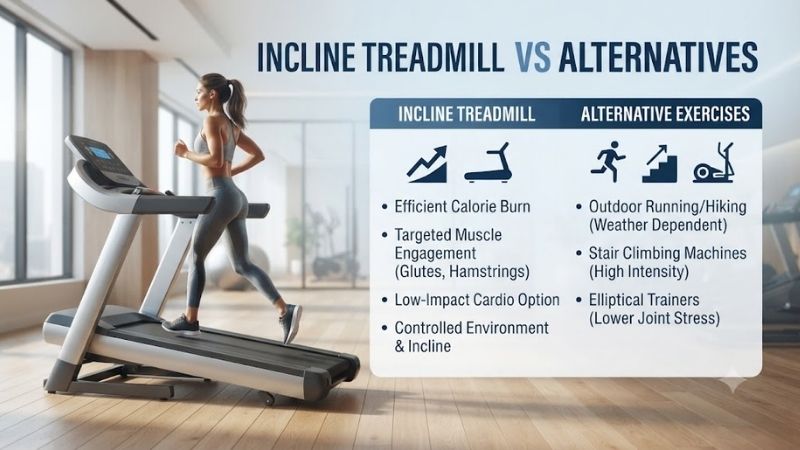
Choosing between an incline treadmill and alternative cardio machines comes down to mechanical demands, joint impact, and available physical space. Steep incline walking elevates cardiovascular strain and posterior chain recruitment without running-level joint impact, yet it demands substantial ceiling clearance and motor power. Evaluating alternatives like stair climbers, ellipticals, stationary bikes, rowers, and rucking reveals which equipment best matches your training goals and home gym constraints.
Quick Comparison Table
| Machine / Method | Primary Movement Pattern | Joint Impact Level | Ceiling Clearance Demand | Footprint (L x W) | Target Muscle Emphasis |
| Incline Treadmill | Uphill locomotion (striding/power-walking) | Low to Moderate (speed-dependent) | Very High (User Height + Deck Height + Max Rise + 6 in) | 70–82 in x 33–40 in | Glutes, Hamstrings, Calves, Tibialis |
| Stair Climber (Rotating) | Continuous vertical stepping | Low | High to Extreme (User Height + Step Height + 12 in) | 50–60 in x 30–35 in | Glutes, Quadriceps, Calves |
| Elliptical / Arc Trainer | Closed-chain elliptical glide | Very Low (Non-impact) | Moderate to High (User Height + Pedal Elevation) | 65–80 in x 28–34 in | Quadriceps, Glutes, Hamstrings, Upper Body |
| Stationary Bike (Upright/Spin) | Closed-chain rotational pedaling | Zero impact | Minimal (Standard 8 ft ceiling sufficient) | 45–55 in x 20–25 in | Quadriceps, Hamstrings, Calves |
| Indoor Rower (Ergometer) | Horizontal concentric drive and recovery | Zero impact | Minimal (Horizontal movement only) | 84–96 in x 24 in | Lats, Upper Back, Core, Glutes, Quadriceps |
| Rucking (Weighted Walking) | Natural overground locomotion under external load | Moderate (Weight-dependent) | None (Standard room height) | Negligible (Wearable backpack) | Traps, Core, Glutes, Hamstrings, Foot Arches |
Equipment Specifications and Structural Mechanics
Incline Treadmills: Motor Dynamics and Elevation Geometry
Standard motorized treadmills feature an incline range spanning from 0% to a typical ceiling of 10% to 15%. Dedicated incline trainers expand this range significantly, with consumer units achieving up to 30% to 40% positive grade, alongside modest decline capability ranging from -3% to -6%.
Operating at an elevated angle alters the mechanical load profile placed on the equipment:
- Continuous Duty Horsepower (CHP): Walking uphill creates a continuous braking force against the belt rather than the intermittent contact cycle seen during flat running. A motor rated below 3.0 CHP will experience substantial thermal stress under prolonged, steep-incline walking sessions. Machines designed for steep grades typically employ 3.5 to 4.25 CHP DC or AC drive motors paired with active heat-dissipation fans.
- Elevation Hardware: Standard incline mechanisms use a single linear lift actuator capable of exerting 500 to 900 lb of lift thrust. Heavy-duty incline trainers typically upgrade to reinforced dual-actuator lift systems or heavy-gauge steel pivoting rack assemblies to preserve frame rigidity above 20% incline.
- Deck and Roller Sizing: Steep inclines increase downward shear forces across the belt deck interface. Thicker decks (typically 1 inch thick, phenolic-waxed) and larger commercial-grade rollers (2.25 inches to 2.5 inches in diameter) reduce surface friction, decrease motor strain, and mitigate belt slippage under foot strike.
Alternative Machine Mechanisms
- Rotating Stair Climbers: Consumer stepmills employ a revolving staircase system driven by an eddy-current magnetic brake, alternator, or mechanical step-lock mechanism. Users continuously overcome gravity to lift their own body weight against step heights ranging from 6 to 8 inches. The absence of a continuous motor pulling the feet back means the mechanical load depends entirely on the user’s vertical displacement.
- Ellipticals and Cross-Trainers: These machines use front-drive, center-drive, or rear-drive flywheels attached to foot pedals that move along an oval track. Resistance is generated almost exclusively via eddy-current magnetic brakes positioned beside a weighted perimeter flywheel. Because feet remain glued to the pedals throughout the stroke, ground reaction forces remain negligible.
- Stationary Bikes: Upright, dual-action air, and indoor cycle platforms rely on perimeter-weighted flywheels or fan impellers. Mechanical contact resistance utilizes felt or leather pads pressing against a steel perimeter, whereas magnetic systems move neodymium rare-earth magnets closer to or further from an aluminum flywheel to modify resistance silently without friction wear.
- Indoor Rowers: Air-resistance rowing machines employ an impeller flywheel that scales exponentially with user effort: pulling harder encounters more air resistance. Water rowers use revolving paddles submerged in a fluid tank to simulate dynamic drag, while magnetic rowers provide consistent, quiet mechanical tension irrespective of stroke velocity.
- Rucking Setup: Rucking substitutes stationary machinery with an ergonomic weight-bearing backpack or dedicated ruck plate carrier. Cast-iron weight blocks (typically 10 to 45 lb) sit elevated between the shoulder blades, transferring mechanical resistance through the skeletal frame during flat or hill walking outdoors or on standard treadmills.
Mechanical and Biomechanical Differences
Ground Reaction Forces and Joint Shear Stress
Ground reaction force (GRF) during flat outdoor or flat treadmill running typically measures 2.0 to 3.0 times total body weight per foot strike. This kinetic energy transfers through the calcaneus, plantar fascia, Achilles tendon, patellofemoral joint, and lumbar spine.
- Incline Treadmill Impact: Walking at an incline of 10% to 15% drops joint impact drastically by converting horizontal velocity into vertical displacement. Foot impact velocity decreases, reducing vertical ground reaction forces to approximately 1.0 to 1.3 times body weight. However, ankle dorsiflexion demands scale directly with incline angle. At gradients above 15%, the ankle joint operates near its terminal dorsiflexion threshold, increasing passive tensile load across the Achilles tendon and plantar fascia.
- Stair Climber Biomechanics: Stepping upwards requires zero foot impact, as the foot plants softly onto an ascending step before knee and hip extension begin. Patellofemoral compressive forces increase as the knee flexes past 60 degrees during each step initiation, making this machine challenging for users with patellar tendinopathy or severe cartilage loss beneath the kneecap.
- Ellipticals and Bikes (Closed Kinetic Chain): Ellipticals and stationary bikes fully eliminate impact shock because the feet never break contact with the driving surface. The pedal path dictates the movement arc, which shields foot and ankle complexes from deceleration trauma. Bikes virtually eliminate eccentric muscular actions, mitigating muscle soreness and tendon shock.
- Rower Biomechanics: The rowing stroke divides into the catch, drive, finish, and recovery. It is entirely non-impact, but it exposes the lumbar spine to flexion under load if hip hinge mobility or thoracic extension degrades during the catch phase.
Muscle Activation and Kinetic Chain Recruitment
- Incline Walking: As treadmill deck inclination increases beyond 6%, EMG activity increases in the gluteus maximus, biceps femoris, semitendinosus, and gastrocnemius-soleus complex. Walking uphill shifts muscular recruitment away from the quadriceps-dominant pattern of flat running toward a posterior-chain-dominant extension profile.
- Stair Climbing: Continuous climbing places heightened mechanical tension on the quadriceps during initial step extension, accompanied by high activation of the gluteus maximus to complete hip extension against gravity.
- Elliptical Trainers: Ellipticals activate the quadriceps and glutes moderately, with minimal calf engagement compared to incline walking. Dual-action upper-body linkages introduce modest anterior deltoid, triceps, rhomboid, and latissimus engagement, distributing cardiac workload across upper and lower extremities.
- Stationary Cycling: Focuses almost exclusively on lower-body musculature. Upright and road configurations drive peak quad activation from 12 o’clock to 5 o’clock in the pedal stroke, followed by hamstring and calf recruitment to clear the bottom dead center.
- Rowing: Engages roughly 85% of total skeletal musculature across every full cycle. The leg drive provides the majority of power output (quadriceps and glutes), transitioned through the torso (erector spinae and rectus abdominis) and completed by the upper back (rhomboids, rear deltoids, and latissimus dorsi).
Ceiling Height, Footprint, and Spatial Demands
Physical footprint and vertical ceiling clearance represent make-or-break variables when choosing between an incline treadmill and alternative options for low-ceiling basements, spare bedrooms, and residential garages.
Total Operating Height Calculation
A standard residential ceiling stands between 96 inches (8 feet) and 108 inches (9 feet). Many basement home gyms feature dropped ductwork, plumbing, or structural joists lowering clearance to 84 to 90 inches.
To calculate safe operating clearance for an incline treadmill:
$$\text{Minimum Ceiling Height} = \text{User Height} + \text{Deck Step-Up Height} + (\text{Running Surface Length} \times \sin(\theta)) + \text{Safety Buffer (6 in)}$$
Where $\theta$ represents the deck incline angle.
Dedicated incline trainers with steep 40% capability can raise the front of the walking platform 15 to 18 inches off the ground. A 6-foot-tall user (72 inches) stepping onto a machine with an 11-inch base deck and an 18-inch maximum lift will stand 101 inches tall at peak elevation. Factoring in a necessary 6-inch head-clearance safety margin demands a minimum ceiling height of 107 inches (roughly 9 feet). Failing to plan for this leaves the machine physically unusable at maximum incline settings.
In contrast:
- Stair Climbers: Rotating stair climbers demand ceiling heights comparable to or higher than incline trainers. Step heights place the user 14 to 22 inches above the subfloor during active climbing, requiring a minimum 8.5-foot to 9-foot ceiling.
- Ellipticals: Elliptical pedal paths feature a maximum pedal elevation of roughly 10 to 15 inches. An 8-foot ceiling safely accommodates users up to 6 feet tall on most models.
- Bikes and Rowers: Require almost zero overhead vertical clearance beyond standing height. An athlete on an indoor cycle or rowing machine requires only 5 to 6 feet of vertical space, rendering them the safest choices for basements with low-hanging ductwork.
Floor Load, Machine Mass, and Footprint
- Incline Treadmills: Premium incline trainers are massive, non-folding machines weighing between 275 and 450 lb. They claim a standard footprint of 70 to 82 inches in length by 33 to 40 inches in width. Due to their heavy internal frame reinforcement and dual-motor architecture, most incline trainers cannot fold upright for storage.
- Rotating Stair Climbers: While compact in length (50 to 58 inches), stair climbers are wide and exceptionally heavy, typically weighing between 250 and 400 lb. Their concentrated mass rests on a compact footprint, applying higher point loads to residential subflooring than elongated treadmills.
- Ellipticals: Feature elongated footprints (65 to 84 inches long), with weights spanning 150 to 250 lb. Folding elliptical frames exist, but standard rear-drive elliptical platforms remain fixed.
- Stationary Bikes: Most spatial-efficient choice, taking up a mere 45 to 55 inches of length and 20 to 24 inches of width, weighing between 80 and 140 lb. Most can be wheeled easily on front-mounted transport rollers.
- Rowing Machines: Claim the longest single operational footprint (84 to 96 inches in length), though they measure only 20 to 24 inches in width. Air rowers like the Concept2 weigh a manageable 57 lb and split or fold vertically to occupy a stored footprint of under 4 square feet.
Maintenance, Acoustic Output, and Mechanical Durability
Acoustic noise and mechanical maintenance dictate how comfortably cardio equipment integrates into multi-use living environments, second-floor spaces, and residential basements.
Mechanical Noise Profiles
- Incline Treadmills: Generate continuous mechanical motor whir alongside periodic foot-strike impact. Walking on an incline creates significantly less foot-thud than outdoor flat running, but the continuous interaction between the belt, drive deck, and high-torque motor creates sound levels around 60 to 70 dB. Second-floor installations transmit low-frequency vibration through joists unless isolated with high-density vulcanized rubber mats (minimum 3/8-inch thickness).
- Stair Climbers: Drive chains, gearboxes, and step links emit periodic mechanical clicking and whirring sounds. They generate zero floor-thudding impact, making them quieter in terms of floor-transmitted vibration than running treadmills.
- Ellipticals and Magnetic Bikes: The quietest machines available. Magnetic resistance creates zero friction noise, keeping sound emissions within a 45 to 55 dB range. Users can easily exercise in living spaces without disturbing adjacent bedrooms.
- Air Rowers: Produce wind-buffeting sound that scales directly with stroke velocity. While smooth and free of structural vibration, an air rower operates between 65 and 75 dB, making it louder in living areas than a magnetic spin bike or elliptical.
Routine Maintenance Requirements
- Belt Lubrication and Tracking: Incline treadmills require continuous maintenance. Operating at steep inclines increases deck surface friction. Non-waxed treadmill decks demand manual silicone fluid lubrication every 3 to 6 months (or every 130 to 150 miles). Belts must be checked regularly for tension and centering to avoid fraying against side rails. Motor compartments require vacuuming twice per year to clear accumulated ambient dust and dog hair.
- Drive Chains and Linkages: Stair climbers rely on internal chains or toothed drive belts that need quarterly tension checks and semi-annual lubrication to prevent binding.
- Rowers: Air rowers demand periodic chain wiping with oil (e.g., 20W motor oil or mineral oil) and vacuuming of the flywheel mesh housing to clear dust build-up.
- Magnetic Bikes and Ellipticals: Require the least regular maintenance. With sealed-bearing pivots, enclosed magnetic resistance units, and poly-V drive belts, these systems operate reliably for years with simple external hardware tightening.
Practical Use-Case Scenarios
Scenario 1: Low Ceilings or Compact Footprint
- The Constraint: A 7-foot (84-inch) basement ceiling or an apartment spare bedroom under 100 square feet.
- The Assessment: Incline treadmills (especially models capable of 20%+ incline) and rotating stair climbers are eliminated immediately due to overhead safety hazards.
- The Solution: Choose a high-end stationary bike (magnetic drive) or an indoor rower. A rower provides full-body engagement and can be stored vertically between workouts, while a stationary bike takes up just 10 square feet of floor space and safely accommodates an athlete of any height within an 84-inch ceiling.
Scenario 2: Joint Preservation and Low-Impact Cardiovascular Training
- The Constraint: An athlete managing chronic knee arthritis, lumbar disc degeneration, or recurring patellofemoral pain syndrome.
- The Assessment: High-impact flat running is off the table. Incline treadmills provide a viable solution up to an 8% to 12% grade, but extreme inclines (above 15%) place intense tensile stretch on the Achilles tendon and demand deep hip flexion. Stair climbers strain knees through deep repetitive flexion.
- The Solution: Choose an elliptical trainer or an indoor magnetic exercise bike. The fixed pedal path on an elliptical eliminates heel strike impact entirely while allowing upright spinal posture. Bikes limit joint shear forces completely, allowing pain-free zone 2 cardiovascular volume.
Scenario 3: Mountaineering, Hiking, and Trail Conditioning
- The Constraint: Training specifically for vertical mountaineering, mountain hunting, or steep trail running without local access to outdoor topographical elevation.
- The Assessment: Ellipticals, rowers, and flat exercise bikes fail to replicate the exact biomechanical demands of uphill locomotion and natural foot ground contact under load.
- The Solution: An incline trainer capable of 30% to 40% grade or outdoor rucking paired with an incline treadmill. The machine develops specific concentric calf and glute stamina while conditioning feet and ankles to withstand sustained uphill locomotion.
Scenario 4: Maximum Upper-Body and Core Integration
- The Constraint: A user seeking a standalone cardiovascular machine that avoids lower-body-only training patterns.
- The Assessment: Incline treadmills, stair climbers, and exercise bikes rely almost entirely on the lower-body kinetic chain; arm movement on a treadmill is passive and unresisted.
- The Solution: Choose an indoor rowing machine or an air bike (fan bike with moving arms). A rower activates the latissimus dorsi, rhomboids, trapezius, and posterior core throughout each stroke, spreading the training stimulus evenly over 85% of bodily musculature.
Advantages and Disadvantages
Incline Treadmills
Advantages
- High Cardiovascular Output at Low Speed: Steep incline walking dramatically elevates heart rate and oxygen consumption without requiring running speeds, sparing knees from high ground reaction forces.
- Postural and Posterior Chain Recruitment: Emphasizes glutes, hamstrings, and calves through natural, unguided locomotion.
- Movement Specificity: Walking uphill directly translates to overground athletic tasks, outdoor hiking, and everyday biomechanics.
- Flexible Utility: Can be used for standard flat walking, light jogging, or maximum-grade mountaineering simulations on a single platform.
Disadvantages
- Demands High Ceiling Clearance: High deck rise requires 9-foot ceilings to use steep incline settings safely.
- Bulky, Non-Folding Frames: Incline trainers with reinforced multi-actuator systems are exceptionally heavy and rarely fold up for storage.
- High Motor and Mechanical Strain: The combination of heavy incline friction and low belt speeds strains motors, requiring high CHP ratings and regular deck lubrication.
- Achilles and Plantar Tension: Gradients exceeding 15% force sustained ankle dorsiflexion, which can aggravate tight Achilles tendons or plantar fasciitis.
Alternative Cardio Equipment
Advantages
- Lower Ceiling Demands: Stationary bikes, rowers, and basic ellipticals fit easily into standard 8-foot (or lower) ceiling heights.
- Negligible Impact and Shear Stress: Ellipticals and magnetic exercise bikes maintain closed-chain foot contact, minimizing ground reaction stress to near zero.
- Full-Body Muscle Engagement: Rowers and dual-action air bikes combine upper-body pulling and pushing mechanics with lower-body drive.
- Minimal Floor Footprint: Spin bikes and vertically stored rowers preserve usable floor space in multi-purpose rooms.
- Low Maintenance: Magnetic spin bikes operate for years without deck waxing, motor cleaning, or belt tracking adjustments.
Disadvantages
- Non-Specific Movement Patterns: Pedaling a bike or gliding along an elliptical track does not fully replicate the biomechanical, load-bearing patterns of running or climbing natural terrain.
- Stair Climbers Require Massive Vertical Clearance: Revolving stepmills present the same (or greater) ceiling height problems as incline trainers.
- Quadriceps Dominance: Standard upright cycling isolates the quads, failing to engage the hamstrings, glutes, and posterior chain as actively as steep incline walking.
- Technique Dependence: Rowing machines demand strict hip hinging and spinal stability; poor mechanics can trigger lumbar disc or thoracic spine fatigue.
Who Should Choose Which Machine?
Choose an Incline Treadmill If:
- You have minimum ceiling heights of 8.5 to 9 feet across your workout area.
- Your goal is hiking preparation, mountaineering conditioning, or building posterior-chain stamina through real walking locomotion.
- You want high cardiovascular output and calorie burn without subjecting joints to the pounding impact of flat outdoor running.
- You have a dedicated, permanent footprint that does not require moving or folding the machine away after use.
Choose a Stationary Bike If:
- You need to train within an 84-inch to 96-inch basement ceiling.
- Floor space is tightly constrained, requiring a machine footprint under 12 square feet.
- You are recovering from foot, ankle, or lower-leg impact injuries and need completely zero-impact cardio.
- You need a quiet, low-maintenance setup for early-morning or late-night workouts in shared living quarters.
Choose an Indoor Rower If:
- You want full-body cardiovascular training that engages your back, lats, and core alongside your legs.
- You need a commercial-grade machine that can be stored vertically to take up under 4 square feet of floor space.
- Your ceiling height is restricted, but you have at least 8 feet of flat floor length to roll the machine out during workouts.
Choose a Rotating Stair Climber If:
- You have at least 9 feet of vertical clearance and a reinforced subfloor.
- You prioritize glute and quad endurance and want a pure body-weight-against-gravity stepping challenge.
- You want a compact length footprint (under 60 inches) and do not need to run or walk on flat surfaces.
Choose an Elliptical Trainer If:
- You experience patellar tendinitis or joint pain on bikes or stairs and need a smooth, weight-bearing, non-impact glide.
- You want a stable platform that offers dual-action upper-body push/pull handles to distribute cardio workload away from your lower legs.
Frequently Asked Questions
Can an incline treadmill burn as many calories as running?
Walking at an incline of 12% to 15% at 3.0 to 4.0 miles per hour matches the metabolic demand and cardiovascular heart-rate response of jogging on flat ground at 5.5 to 6.5 miles per hour. Elevating the grade forces lower-body musculature to lift your body mass vertically against gravity with every stride. This lets you match running-intensity cardiovascular conditioning while eliminating the joint impact forces that accompany flat running.
How much ceiling clearance do I need for an incline treadmill?
For traditional treadmills with a 10% to 15% incline, add your height plus 16 inches to determine safe minimum ceiling height. For dedicated incline trainers that rise to 30% or 40%, calculate: user height + base deck step-up (10 to 12 inches) + maximum vertical deck travel (15 to 18 inches) + 6 inches of safety buffer. A 6-foot user on a 40% incline trainer needs a minimum ceiling height of 105 to 108 inches (8.75 to 9 feet) to operate the unit safely at full incline.
Is walking at a high incline bad for the lower back?
Walking at high inclines can strain the lower back if the user lacks adequate hip extension, calf flexibility, or core bracing. At inclines above 12%, tight hip flexors or weak glutes can pull the pelvis into an anterior tilt, causing hyperlordosis (excessive arching) in the lumbar spine. Holding onto the handrails and leaning backward exacerbates this strain. To protect the lumbar spine, lean slightly forward from the ankles, hinge forward at the hips, maintain a neutral spine, and choose an incline angle that lets you walk smoothly without gripping the handrails.
Why do incline trainers cost more than standard treadmills?
Incline trainers require heavy structural engineering beyond standard residential treadmills. Elevating a user at a 30% to 40% angle under continuous load requires dual linear lift actuators, high-tensile steel frame plates, high-torque drive motors (3.5+ CHP) with specialized low-RPM cooling fans, and reinforced, thicker decks. These commercial-grade materials and structural requirements drive manufacturing and freight costs well above entry-level flat-folding treadmills.
Is an elliptical better than an incline treadmill for bad knees?
An elliptical is generally safer for individuals dealing with acute patellar tendinitis, meniscus irritation, or cartilage loss. The elliptical’s closed-chain movement keeps the feet in continuous contact with floating pedals, completely eliminating ground impact force and limiting knee shear. While incline treadmill walking drastically reduces impact compared to running, it still requires repetitive unguided foot strikes, which can stress compromised joints if your gait breaks down.
Conclusion
Choosing between an incline treadmill and alternative cardio equipment hinges on balancing joint needs, mechanical movement goals, and physical room clearances. Incline treadmills deliver natural, functional uphill locomotion that fires up the glutes, calves, and cardiovascular system without running-level joint impact. However, their tall footprint, heavy non-folding frames, and high ceiling clearance demands require careful pre-purchase planning. If vertical ceiling space is restricted below 8.5 feet, an indoor rower or magnetic exercise bike offers an effective, low-impact conditioning stimulus without overhead hazards. For spacious workout areas, users preparing for outdoor hiking, mountaineering, or joint-friendly, high-calorie conditioning will find an incline trainer well worth the investment.
Write Your Review
No reviews yet. Be the first to share your experience!