
Compare urethane dumbbells vs alternatives by looking at how the weights rest, grip, and fit your routine. Urethane pairs suit frequent lifting and quick changes between fixed weights. Rubber hex offers flat resting faces, neoprene suits light work, and adjustables cover more loads from a smaller footprint.
Quick comparison of urethane dumbbells vs alternatives
Start with the load range you use every week, the number of weights you need ready at once, and the room available for storage. Fixed urethane competes with other fixed weights on grip and head construction. Adjustable dumbbells change the choice by combining several working loads in one body.
| Option | Best for | What changes in use | Practical trade-off |
|---|---|---|---|
| Fixed urethane | Frequent lifting and a particular grip or head profile | Pick up another pair when changing loads | Multiple weights need compatible storage, and round variants can roll |
| Rubber hex | General home lifting and easy floor placement | Flat heads provide a defined resting face | Head bulk, grip, and coating vary by model |
| Round rubber | Round fixed heads at a competitive price | Similar storage geometry to round urethane when dimensions match | Needs round-head restraint and model-specific fit checks |
| Bare cast-iron hex | Cost-conscious fixed pairs on a suitable surface | Exposed iron or painted heads make harder direct contact | Floor protection and coating condition matter |
| Neoprene-coated dumbbells | Light accessory movements or compact light pairs | The coating may extend across the grip | Limited useful load range for many heavier lifts |
| Selectorized adjustable dumbbells | Many loads in one compact pair | Change weight using the model’s selector and docking procedure | Grip clearance and changeover time depend on the mechanism |
| Plate-loaded adjustable dumbbells | Deliberate load changes and access to compatible plates | Add plates and secure the lock or collars | Plate diameter, sleeve length, and spare-plate storage affect use |
There are two decisions in this table. One is material and geometry, which determines how the dumbbell fits in your hand and where it can rest. The other is whether to keep a separate pair at every load. Handle the storage and loading decision first when floor space or workout transitions have the biggest effect on your routine.
Compare real dimensions at the same load
Comparing two catalog labels at 25 lb holds the intended load constant. It leaves head diameter, end-to-end length, handle opening, and the shape of the resting face free to vary. Use the exact versions you plan to order, since a different weight in the same line can change more than the amount of mass.
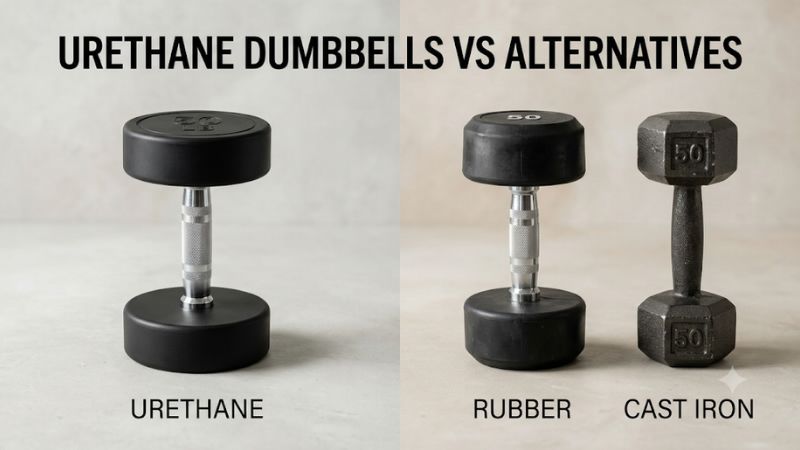
Urethane round and rubber hex can trade length for width
Titan lists its 25 lb round urethane dumbbell at 10.2 in long with a 6 in head diameter and 32 mm handle. Its 25 lb rubber hex is listed at 12 in long, 5.25 in wide, and 34 mm at the grip. The round urethane example is shorter along the shaft and wider across the head’s published dimension.
This comparison shows why descriptions such as compact need a direction. A shorter bell can be easier to move around a bench, a thigh, or the opposite dumbbell in a close press. A wider head can take more space across a shelf or require a different cradle. Compare how you intend to orient the bells before choosing one from a single dimension.
The two models also change shape and grip diameter. Any difference you feel while lifting could come from the shape, the shaft geometry, or how the texture contacts your hand. To focus on the coating, compare two round models with similar grip and head dimensions. Check the seller’s coating and care information for each.
A faceted urethane head can keep a similar resting behavior
Urethane can be round, faceted, or hexagonal. A 12-sided head like XMARK’s or a covered Hampton Dura-Bell hex head gives the buyer a flat resting option in a urethane product. Where both heads have facets, the loaded rack position and handle differences can matter more than the broad product category.
A true hex head has six broad faces. A 12-sided head has more faces and a different geometry between them. The actual flat width, head profile, and surface determine how a bell settles. Test the intended resting orientation on a firm level surface. A faceted design still needs an appropriate parking place where a foot, door, or moving bench will not push it.
If your current rubber hex pair fits a rack neatly, measure the shoulder and widest area of any replacement. Some saddles cup a circular outer rim. Others support flat faces or specific shaft lengths. An upgrade in covering can still require a storage change when the new dimensions or support points differ.
An adjustable pair solves a different space problem
PowerBlock lists the home Pro 50 at 13 by 7 by 7.25 in and up to 50 lb per handle. Its selector and internal weights provide several settings inside that frame. One such pair can take less storage than a collection of fixed pairs, while an individual weight may have a larger profile than a fixed bell.
A 25 lb fixed bell does not need docking access. An adjustable model needs whatever space its instructions require for the stack, stand, or mechanism. Measure the full setup, including the reach to change settings on both sides. A compact unit pushed behind a bench can save shelf space while still being inconvenient to adjust.
Also compare the working length and clearance at the lightest settings you use. Some mechanisms keep a consistent outer body, while others get shorter as plates are removed. A fixed or compact lighter dumbbell may feel more natural if your main use involves curls and compact wrist positions. Try or measure the motion that is least forgiving of the handle and frame.
Compare alternatives for specific training needs
The coating comparison matters when you buy two products that otherwise fit the same job. A change to an adjustable system or neoprene set can change the work the equipment can do. Match each alternative to an exercise, the people using it, and how that weight will be handled between repetitions and sets.
Rubber hex suits quick placement and general home strength
Rubber hex pairs make sense when your routine uses familiar pressing, rowing, lunge, or hinge loads and you want a shape that rests predictably on the floor. They are often less expensive at comparable weights. The price difference should be checked alongside the exact handle, head dimensions, and storage.
If you alternate two fixed loads, both rubber hex and fixed urethane pairs give instant access to the next one. A commercial round urethane line can be appealing if you need a specific handle or heavily favor a round profile on the thighs at bench setup. If a hex already fits your grip and rack, the extra price needs a use you will notice.
Rubber heads can cushion normal set-downs, just as urethane heads change the contact with the floor. Noise through floors depends on the weight, the way it is lowered, and the floor assembly. Treat subjective odor and sound claims as model-specific. For a shared home, test controlled placement on appropriate protection before paying more for a coating change.
Round rubber is the closest design comparison when dimensions match
A round rubber model can give a familiar flat end face and straight handle with the same storage category as round urethane. Compare the two at the intended weight, including the handle diameter and the size of the heads. This removes some of the obvious geometry differences in a urethane-versus-hex comparison.
A retail listing may use the phrase rubber-coated with limited information about the core. Check whether the listing specifies the head attachment, available increments, and warranty terms for the actual environment. Match the round bells to the rack at the contact point and verify both can be removed with enough hand clearance.
Paying more for urethane can be reasonable for a high-use setup if the chosen model offers a documented feature or helps you maintain a consistent collection. If the round rubber model fits the same rack and training patterns, compare how easy it is to replace a single or buy the next pair and put the price difference in that context.
Bare iron provides fixed loads with a simpler contact surface
Bare or painted cast-iron hex dumbbells offer a solid fixed load with flat resting faces and less cushioning at contact. They can make sense in a garage with suitable floor protection or where a local used pair is inexpensive. Check the condition of each head and handle before assuming the price difference makes it worthwhile.
An iron head contacts the floor directly or through a thin finish, so protect the surface where you rest it and lower it under control. A nominally similar urethane pair still exerts the same gravitational force at the same actual mass. The difference is how the shape and covering distribute and cushion contact at the moment of placement.
Inspect used iron for severe corrosion, sharp edges, or damage at the handle and head. Inspect used urethane for damaged covering or play at the joint. With both categories, an honest used comparison requires seeing the actual pair or having meaningful return terms. A sound pair with worn markings can serve well when you can still verify each labeled load.
Neoprene suits light loads and a covered grip
Many neoprene dumbbells use a coating that extends over the grip, which changes texture and how the handle feels in the hand. They are useful when your weights are light and you value a simple compact pair for accessories or warm-ups. Verify the available sizes before buying a whole progression for strength training.
For a 5 lb raise or a controlled light circuit, a covered grip and a convenient place to put the pair may matter more than precise steel knurling. For a 35 lb row, the comparison changes because many neoprene lines target lighter loads. Look for a model that supplies the weight you need and measure the grip on that exact size.
You can use both materials in one setup. One light neoprene pair for accessories and a midweight urethane or rubber pair for pressing can cost less and occupy fewer slots than a single-material collection with every intermediate weight. Check how each pair rests independently and put each load where you can retrieve it easily.
Adjustable dumbbells change how you switch weights
Selectorized pairs suit a home gym that routinely uses several weight settings but rarely needs them ready simultaneously. Plate-loaded pairs can work for someone who already has compatible plates or who changes weights between longer blocks. A fixed urethane pair stays ready for an immediate change of load.
If you alternate a 15 lb press with 35 lb rows, two fixed pairs let both loads remain available. A selectorized pair requires returning the handles to the correct docking or alignment position and setting the new weight. Some systems can change quickly when the stand is nearby. The value depends on how often a session repeats that switch and whether one handle or both require adjustment.
Plate-loaded systems add time for handling plates and checking the securing hardware. Check the actual loaded length and plate diameter. Ironmaster, for example, lists its Quick-Lock 75 lb dumbbell at 9 in long when loaded to 20 lb and 14.5 in at 75 lb. One model can therefore require substantially different working clearance at opposite ends of your routine.
Use real ownership costs to make the choice
Compare the equipment you will use, the storage it needs, and your likely next purchases. A few fixed pairs and a simple storage position create one budget. Ten fixed pairs and a larger rack create another. Comparable purchase totals are useful only when both setups cover your actual weights and training pattern.
Run a break-even example with rack and shipping
Imagine that your three useful fixed pairs cost $110, $170, and $270 before tax. A $120 rack raises that hypothetical setup to $670 before delivery charges. An adjustable pair at $550 has a lower initial equipment total if it supplies the needed weights and you already have suitable storage for it.
For just two of those three fixed pairs, the starting total becomes $280 without a rack, or $400 with the same $120 rack. Depending on which pair you need and what storage you already own, the comparison reverses. Reuse this calculation with the shipping quote and the selected weights in your own cart.
A comprehensive fixed 5–50 lb set in 5 lb increments contains 20 bells weighing 550 lb. A selectorized pair with two 50 lb maximum loads keeps far less lifting mass in the room. Its stand and changing access still need to fit. Concurrent training matters, since fixed pairs provide more handles when two people need different loads at the same time.
Choose for a heavy lifter, a beginner, or a shared room
A heavy lifter may prioritize a particular straight shaft and buy two or three fixed pairs that cover top working sets. A beginner can get more use from a modest pair and manageable increments. In a shared room, a combination of one or two fixed pairs and an adjustable may make the schedule easier.
For a heavy fixed purchase, verify that the exact pair has a handle diameter you can use and rack contact you can trust. If you are buying the first set for a beginner, consider where a 2.5 lb progression is available and whether a lighter covered grip is useful. A broad assortment is valuable if those loads will get used, and storage can remain simple when the exercises only require a few.
In a multipurpose room, consider a small fixed pair for quick accessories and a selectorized pair for the heavier compound lifts. That approach keeps the frequently repeated light load ready while reducing duplicate storage, provided you can change the adjustable settings without blocking the training area or a walkway.
Decide what you will actually notice during a session
Choose your most frequent lift and your most awkward setup. Ask how the grip fits across both, where you put the dumbbells down, and whether you will have to change weight several times. Those observations often answer the buying question more directly than a general claim about commercial construction.
Someone with a crowded bench area may prefer a particular shorter urethane pair after checking both width and clearance. Another person may prefer a less expensive hex pair because it has a defined resting position on a suitable floor. With a physically similar round rubber pair, price and replacement availability may decide the purchase.
One mixed setup can give different needs their own solution. Use urethane where its exact handle, size, or weight range matters. Keep a low-cost rubber pair for a load you use infrequently, or a light covered pair for accessories if that feels more comfortable. Each piece should be useful at a weight you can name, with a safe place to store it.
Frequently asked questions
Equipment labels can make the differences look broader than they are. Compare the actual weights, shape, and usable handle at the load you will train with. Then decide whether your routine benefits most from ready-to-lift fixed pairs, finer increments, lower total cost, or a storage arrangement that saves room.
Do urethane dumbbells feel heavier than rubber ones at the same weight?
Equal actual masses create the same gravitational force. A thicker grip, wider head, or difference in balance can make a movement feel different because of your hand position and available clearance. Check both units on an appropriate scale when the discrepancy feels substantial and you can compare them under the same conditions.
Do urethane heads protect the floor better than rubber hex heads?
That depends on the specific coating, head shape, floor protection, and how the bell lands. Both materials change surface contact while the full dumbbell still carries enough mass to damage unsuitable flooring. Compare manufacturer instructions and use a compatible protector for ordinary controlled set-downs.
When is it worth replacing an existing rubber hex set with urethane?
Consider replacement when a particular grip, head length, load increment, or storage arrangement materially improves your routine. Compare the delivered cost of the specific replacement pairs and any rack change. Buying just one new pair can resolve a handle or geometry issue in a regular lift without replacing every weight.
Can one adjustable pair cover a whole fixed-dumbbell routine?
It can if its actual settings, maximum load, and handle geometry fit all the lifts you perform and you have time to change weights. Compare the minimum setting and each step near your working loads. A fixed pair is still useful when two people need equipment at once or a circuit needs two loads ready simultaneously.
Conclusion
Choose fixed urethane when its grip, head geometry, or heavy-pair availability solves a real training need. Choose rubber hex for general strength work and flat resting faces, neoprene for useful light loads, or adjustable dumbbells for several settings in one pair. Compare the complete setup around a typical workout.
More from Amazon
Programs that pair well with the guide above. Offers and eligibility are set by Amazon and may change.
Free shipping on eligible items, Prime Video and more. Eligible new members can start with a free trial.
Start a Prime free trialA Prime membership for ages 18-24 with a trial period. Eligibility is set by Amazon.
See Prime for Young AdultsAudiobooks and podcasts to listen to on the go. Eligible new members can start with a free trial.
Try Audible freeAd-free music streaming. Eligible new subscribers can start with a free trial.
Try Music Unlimited freeAs an Amazon Associate we earn from qualifying purchases.


Write Your Review
No reviews yet. Be the first to share your experience!