
Compare rubber hex dumbbells vs alternatives by counting how many loads you need and how often you switch. Fixed hex pairs are ready to lift on demand. Selectorized and plate-loaded options pack more loads into less space, while kettlebells and bands can change the grip, balance, or direction of resistance during a lift.
Quick comparison of rubber hex dumbbells vs alternatives
Choose rubber hex dumbbells if you use a few predictable loads or frequently switch between pairs. Choose a compact adjustable system if you need multiple increments with limited storage. Bare iron, urethane, kettlebells, and bands make sense when their contact surface, handle geometry, or resistance profile fits the job.
| Option | Load changes | Best fit | Advantage over rubber hex | Trade-off |
|---|---|---|---|---|
| Fixed rubber hex dumbbells | Pick up another bell | Quick transitions and common pressing and rowing loads | Baseline | Each added load takes more storage |
| Selectorized adjustable dumbbells | Dock and change a pin or dial as directed | Multiple load settings in a small room | Many settings in two units | Changes depend on a compatible mechanism and docking space |
| Plate-loaded dumbbells | Add or remove plates and secure the ends | Shared plates or adjustable training with longer rest | Can expand around the right plates and handles | Changes take handling, and plates may project past the grip |
| Bare cast-iron hex dumbbells | Pick up another bell | Low-cost fixed weights over a suitable surface | Avoid paying for a rubber shell if it adds little value | Harder direct contact and a fixed-weight footprint |
| Urethane-coated fixed dumbbells | Pick up another bell | Frequent training where the exact shape and finish justify the price | Different coating and head profiles, including round designs | A broad collection still needs storage |
| Kettlebells | Pick up another bell | Swings, cleans, and front-rack patterns | Offset load and a handle window designed for those lifts | Different balance and grip during conventional dumbbell work |
| Resistance bands | Change band, starting length, or setup | Portable training and variable tension | Easy to pack and can pull from different directions | Resistance depends on stretch and anchoring |
A useful distinction is load selection versus simultaneous access. Two adjustable units can cover many settings, but a household training together may need four handles in use. A circuit with two fixed pairs can go from a light movement to a heavier one without touching a mechanism. Both arrangements can cover the same listed weights under different conditions.
Compare verified specifications at the exact model level
These examples show how differences in geometry and adjustment can affect an exercise. Their measurements belong to the specific product and configuration, so apply the same checks to the model you are considering. Catalog figures are especially useful for comparing the declared load, the handle opening, and the bench or rack clearance.
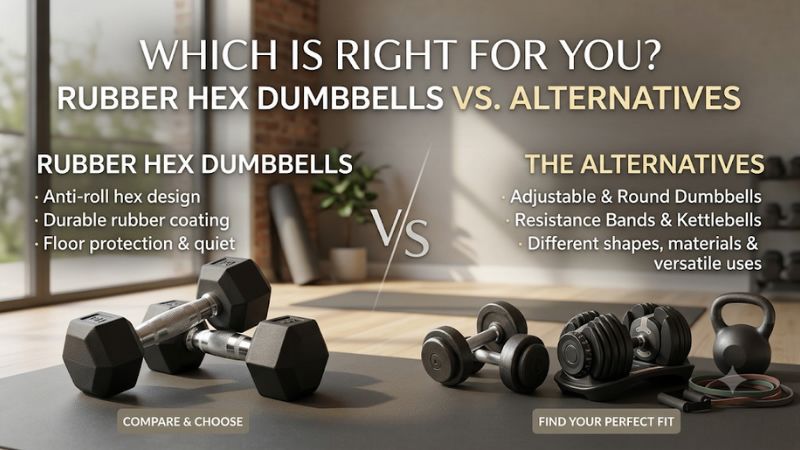
A fixed pair and a selectorized pair answer different space problems
Titan lists its 25 lb rubber hex model at 12 in long and 5.25 in wide, with a 34 mm handle. PowerBlock’s Pro 50 uses a magnetic selector pin and 2.5 lb internal micro weights alongside 5 lb plates. The home model has a published maximum of 50 lb per dumbbell and a frame about 13 by 7 in.
At 25 lb, those design choices can feel different around the forearm and where the weight passes your body. The Titan leaves a traditional open shaft between two heads. The PowerBlock places your hand inside a frame, so compare wrist movement and grip changes during curls and presses with the space you have. It also needs access to both units for adjustments.
The major storage benefit of the adjustable pair comes from the other loads it replaces. If you only use one 25 lb pair, the extra frame and adjustment options may add little convenience. If you regularly use several settings from 10 to 50 lb, the same pair can occupy less space than separate fixed pairs at every useful load.
Plate-loaded length changes with the configuration
Ironmaster lists the Quick-Lock 75 lb model at 9 in long when loaded to 20 lb and 14.5 in long at 75 lb, with a 6.7 in square profile across the ends. It uses removable plates and locking screws. A buyer can use those published dimensions to check both a smaller working load and the heaviest planned configuration.
Traditional plate-loaded handles can have projecting threaded ends or sleeves. Even at a modest weight, the hardware can influence thigh contact during a press setup or how close the bells can pass each other. Plate diameter also matters. A weight that reaches the intended value with larger plates may move differently from a shorter load with smaller plates.
Check the permitted plates and locking hardware, the required engagement for collars or screws, and whether advertising counts the handles in a capacity figure. When comparing per-hand loads, add the mass of the handle, securing parts where applicable, and plates. Use the manufacturer’s range and load charts for the exact model.
Coating and balance are separate differences
Rogue lists its urethane dumbbells with a 6 in straight chrome handle and solid steel heads overmolded with urethane. Its powder-coated 12 kg kettlebell has a flat base and a 1.4 in handle diameter. These details affect the available grip positions and the location of the mass relative to your arm.
A weighted head on each side of a straight grip tends to balance around the hand. A kettlebell’s mass hangs below the handle at rest. During front-rack or overhead positions, its body can contact a different part of the forearm. Moving the same nominal load with either tool requires attention to those geometry changes.
A coating changes what touches your storage surface and can affect odor or finish preferences. Comparative claims about sound, coating life, or drop resistance require comparable test conditions. Use a documented coating and shape to decide how the tool fits, and check manufacturer instructions before inferring impact behavior from the finish alone.
Compare how the equipment works during a session
The useful performance questions are the time and space needed to change loads, where your wrist and forearm can move, and how the weight contacts the floor. Similar weight labels can lead to different experiences when you shift quickly, train close to furniture, or share equipment with another person.
Fixed rubber hex versus selectorized adjustables
Fixed pairs work well for short rests or circuits because another load can be set out in advance. A selectorized pair gives that variety without requiring a rack of different handles. It works best when you can return the dumbbells to their dock or aligned stacks and confirm the selected plates before each set.
If your session alternates a 15 lb floor press with a 35 lb row, two fixed pairs make both loads available at once. With one adjustable pair you may be able to change both bells quickly, but the workflow depends on the mechanism and the place where you park it. For a one-arm row, you can change just one handle. Before the next press, return it to the original setting and check that both dumbbells match.
Read the instructions on how each selected plate should be captured. Consider the path back to the base at the end of a demanding set and whether the setup has room for both hands. If the change point is behind your bench or on the floor below a shelf, the storage saving may come with slower transitions.
Fixed rubber hex versus plate-loaded dumbbells
Plate-loaded dumbbells are a good match for a home gym that already owns compatible plates or favors deliberate changes between movements. The important comparison includes the parts you already have, plates of both required sizes, and what you need to assemble two handles at an equal load with balanced ends.
For example, if you want two handles to progress by 5 lb per dumbbell, you generally need a way to add 2.5 lb to each end of each dumbbell to maintain balance, subject to that design’s instructions. That is four 2.5 lb plates across the pair. A single spare plate does not create the same symmetric increase.
Think about where you will set loose plates during the workout. A tidy rack for one adjustable pair can become a small cluster of plates, collars, and handles once you are at an intermediate weight. If the routine changes loads only a few times, the savings in storage or equipment cost may justify the process.
Rubber hex versus bare cast-iron hex or urethane
Bare cast-iron hex dumbbells keep a roll-resistant shape when placed on a flat face. They can make financial sense on an appropriate gym surface, especially if you can inspect a used pair locally. Rubber covers the contact faces and cushions ordinary set-downs. Both are heavy enough to damage unsuitable flooring.
For urethane, compare the exact head geometry and intended use. A round urethane dumbbell can roll on an unrestrained surface even when its coating is appealing. A tray or saddle rack designed for it can solve the storage issue. A compact model may allow more clearance between the two bells in presses, but measure the head and handle to confirm that for the model at your working weight.
If cost is the focus, compare all-in prices for the handful of useful weights and any additional storage. If floor contact is the focus, check the protection and how you lower the bells. A premium coating still leaves the full mass of the bell acting on the floor. Handle and head shape can be a more concrete reason to pay more.
Rubber hex versus kettlebells for dynamic work
Choose a kettlebell when your program centers on swings, cleans, or rack positions that use its handle window and offset mass. A dumbbell works well for many presses, rows, and split squats. A kettlebell changes the grip orientation and where the load sits, which can be useful or unnecessary depending on the movement.
Compare a one-arm dumbbell press with a kettlebell press at a similar nominal load. The dumbbell’s heads sit to either side of the hand. The kettlebell’s body may sit against the forearm, and the handle window affects hand insertion. Try the grip and clearance at a comfortable load before transferring your expected working weight.
A pair of kettlebells can serve symmetrical work when both match. A mixed setup also works well. Someone with two dumbbell pairs could add one kettlebell for swings and carries rather than replacing an entire pressing or rowing setup. The incremental purchase makes sense when the new implement does a job those weights handle less conveniently.
Rubber hex versus resistance bands for portability
A dumbbell has a fixed mass, while the torque it creates around a joint changes through a lift as leverage changes. A typical elastic band develops more tension as it stretches. The anchor and direction of pull determine where that tension adds resistance, so band labels and dumbbell pounds describe different things.
A band row can feel light at the start and harder as you pull farther from the anchor. A dumbbell row relies on gravity pulling the weight down throughout the movement, with demand changing as the arm and torso position change. If you prefer consistent setup, record the specific band, grip, and starting distance. The band color alone is a limited way to track the exercise.
Bands fit travel and rooms where there is little room to keep iron. Inspect bands and attachments for damage, and use an anchor designed for the direction and forces involved. Keep the path clear if a band slips or an attachment fails. A portable option still needs a stable setup for repeated work.
Choose based on your own routine
Write down the loads used in one week, how many people lift at once, and how often the same session changes weights. Include the space for a bench, a storage or docking position, and a clear set-down area. Then compare the useful working setups and total purchase costs using those observations.
Limited space and many different weights
A selectorized pair makes sense when you frequently use several loads and want two handles to cover most of the range. Check the body size and actual increments near your lightest and heaviest exercises. Include the dock or stand in the layout, and verify the weight ratings and movement clearance.
If your room has space for one fixed pair beside the adjustable set, you can keep your most-used weight immediately available. A light fixed pair could cover quick accessories while the adjustables remain set up for presses or rows. That decision uses one extra shelf position and may remove several switches each week.
A shared space or fast circuits
A few fixed pairs make simultaneous use and rapid transitions easier when each person has the needed weight. For example, two compatible pairs may cover a circuit with alternating moderate presses and heavier hinges. Choose the weights with the greatest overlap across exercises and people before building a whole rack.
A 5–50 lb fixed collection in 5 lb increments gives ten pairs at 550 lb total. An adjustable pair with a 50 lb maximum weighs much less in combined lifting hardware at that setting, though its stand and mechanisms still need space and ratings. Compare the number of loads you actually need alongside the number you need available at once.
Price sensitivity and a useful starting load
Compare the all-in price of two exact fixed pairs with the cost of an adjustable pair that covers those loads. If the fixed pairs meet your near-term needs, the up-front purchase can be smaller. If you expect to add many increments, run the calculation again with those specific weights and a rack that can hold them.
For example, three hypothetical fixed pairs at $55, $75, and $100 cost $230 before tax and shipping. A $65 rack would raise the starting cost to $295. At a hypothetical $350 for an adjustable pair with suitable increments, the gap is $55. Delivery, additional weights, and whether the rack is needed can swing that decision. Use figures from your own configured carts.
Frequently asked questions
Once you have narrowed the comparison, simple checks can answer most remaining questions. Focus on the exercise you would be least willing to change and the weight range you use most. Then compare the storage and handling that each option demands in your room.
Can adjustable dumbbells replace all fixed dumbbells?
They can cover many of the same exercises if the actual increments, handle geometry, weight ceilings, and setup fit. Check whether you need two loads available at once, whether the model can be held as your routine requires, and whether any exercise use is restricted by the manufacturer.
Do rubber hex dumbbells provide different resistance from iron dumbbells at the same weight?
The same actual mass creates the same gravitational force. Head size and balance can still change clearance, grip, and how the load feels through an exercise. Different units may vary within their manufacturing tolerances, so check measured weight only with an appropriate scale.
Is having rubber heads enough to protect tile or wood?
Use floor protection approved for the surface and the load and set the bells down under control. Rubber changes the contact between the bell and floor, while tile can chip and wood or its finish can still mark under weight or impact. Check the flooring maker’s guidance before leaving rubber or a mat in contact with a finished floor.
Does a kettlebell make sense if I already own a pair of hex dumbbells?
Yes, if you will use the offset load and handle window for movements such as swings or kettlebell front-rack work. Keep the equipment that already suits your rows and presses and add a kettlebell that fills the gap. Check its handle diameter, opening, and intended weight against how you will grip it.
Conclusion
Choose rubber hex for a few fixed loads or quick changes between sets. Choose selectorized adjustables for many loads in a small space, or use plate-loaded handles if your plates fit and you have time to swap them. Add a kettlebell or bands when the grip, balance, or resistance suits a specific exercise in your routine.
More from Amazon
Programs that pair well with the guide above. Offers and eligibility are set by Amazon and may change.
Free shipping on eligible items, Prime Video and more. Eligible new members can start with a free trial.
Start a Prime free trialA Prime membership for ages 18-24 with a trial period. Eligibility is set by Amazon.
See Prime for Young AdultsAudiobooks and podcasts to listen to on the go. Eligible new members can start with a free trial.
Try Audible freeAd-free music streaming. Eligible new subscribers can start with a free trial.
Try Music Unlimited freeAs an Amazon Associate we earn from qualifying purchases.
Write Your Review
No reviews yet. Be the first to share your experience!