
Choosing a trap bar vs alternatives starts with the movement you want to train. The trap bar places neutral handles at your sides and loads from the floor. Straight bars, dumbbells, kettlebells, and machines change where you hold the weight, how much resistance you can add, and how much space the exercise takes.
Trap bar vs alternatives at a glance
Choose a trap bar when you want a plate-loaded, neutral-grip floor pull or carry. A straight bar is the right fit when the conventional deadlift, squat, or bench is the exercise you want to practice. Dumbbells and kettlebells offer independent or single-hand loading, while machines supply a different line of resistance or support.
| Tool | Where the load is held or applied | Best use | Main equipment trade-off |
|---|---|---|---|
| Trap bar | Neutral handles to each side of a shared frame | Neutral-grip deadlifts, shrugs, and carries | Frame depth, handle spread, and sleeve fit need checking |
| Straight Olympic bar | Straight shaft in front of the body for deadlifts | Conventional and sumo deadlifts, plus many rack exercises | Requires space to load both ends and a rack for certain movements |
| Dumbbells or farmer’s handles | One independent implement in each hand | Carries, unilateral work, and compact training | Increment size and total load depend on the equipment |
| Kettlebell | One or two offset handles and weights | Compact hinges, carries, and swings | Working range depends on the bell weights available |
| Belt squat or leg press | Load attached at the belt or moved through a footplate | Lower-body work with minimal hand involvement | Distinct movement path, machine space, and cost |
| Low cable station | Resistance along the cable’s pull | Cable hinges, rows, and accessory work | Force and travel depend on layout and pulley ratio |
Pick the tool according to what you need to preserve. A powerlifter preparing for a conventional deadlift wants repeated exposure to the straight bar. Someone outfitting a garage for general training might prefer a trap bar for deadlifts and dumbbells for pressing. Someone primarily training carries can be better served by independent handles. All three choices use resistance, with different ways of setting it up and progressing it.
How a trap bar and a straight bar change the deadlift
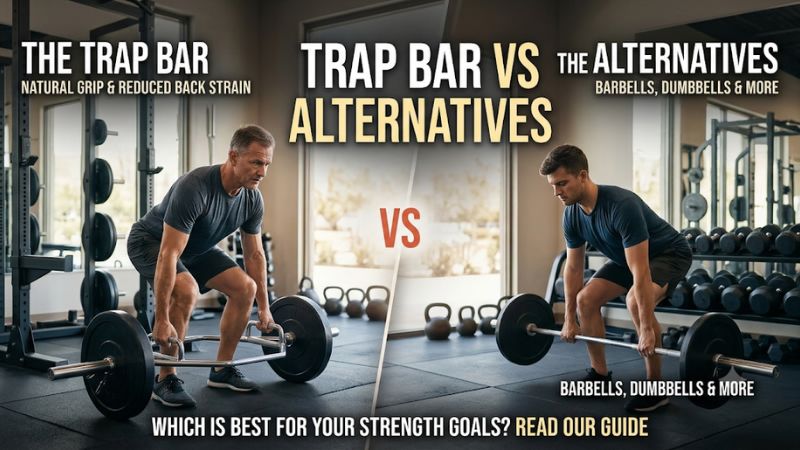
A straight-bar deadlift starts with the shaft in front of your legs. A trap bar gives you two handles at your sides, usually with your palms facing inward. That arrangement changes where your hands start, where the sleeves sit relative to you, and how you can position your hips and knees for the first pull.
Compare bar position and movement specificity
For conventional or sumo deadlifting, the straight shaft stays in front of the body and moves up along a path you control. With a trap bar, you stand between the handles and the plates sit out to the sides. The grip and shape can change the way you set up and the room you have to move your knees.
If your goal is a conventional straight-bar deadlift, practice that lift for the setup, grip, and bar path you will use. If you want a general floor pull, compare the positions you can repeat with either piece. A low-handle trap bar and a high-handle trap bar can create distinct movements even when both use the same plates. Logging the exercise precisely matters more than settling on a universal ranking.
Consider the rest of your program too. A straight bar is used for traditional bench presses, squats, and Olympic lifts when the equipment is appropriate. A trap bar can extend your options for pulling and carrying without being part of that broader straight-bar system. If one bar has to serve a whole home gym, check how many of your actual lifts each tool supports.
Read the biomechanics evidence in its training context
A study led by Paul Swinton compared straight and hexagonal bar deadlifts in 19 male powerlifters at a range of loads below their maximum. In that group, the hex bar changed joint demands, with a higher peak moment at the knee and lower peak moments at the hip, ankle, and lumbar region during the tested lifts.
The same study reported higher peak force, velocity, and power in the hex-bar conditions it tested. These results describe the study’s lifters, equipment, and loading method. They help explain why the exercises can feel different. A person choosing between two home gym bars should still consider grip height, frame fit, the intended movement, and the load they can control.
Use those findings to frame a practical question. If you want to keep a conventional deadlift, equipment specificity has a clear benefit. If you want a general hinge and can practice with both tools, compare which variant fits your range of motion and program. One laboratory comparison cannot establish an injury advantage or predict how an individual’s response will change over time.
Compare high handles with an elevated straight bar
High handles provide a higher start within the trap bar design. A straight bar resting on approved blocks or rack safeties can also start higher. Both change the range below the hands, but the grip orientation and the bar’s horizontal position relative to the body remain different. Compare them as distinct exercises.
For example, if the obstacle in your program is reaching the floor with a controlled setup, an elevated version of the straight-bar pull may serve your training with equipment already in the gym. If your goal includes a neutral grip with the load held around you, the trap bar provides a different shape and feel. Use supports and loading positions specified for the equipment.
When you compare the weight you can lift, record the actual hand height, the bar’s empty weight, and the plates. A high-handle set can have a shorter range than both a conventional pull and a low-handle trap-bar set. You can progress any of them by keeping the setup consistent across sessions.
Compare trap bars with dumbbells and kettlebells
Dumbbells and kettlebells offer extra freedom to choose the path of each hand. That can be valuable in a compact gym or for asymmetric work. The trap bar ties the hands to a common frame and allows small increases through the same plate collection. The best option depends on your preferred exercises and target loads.
Trap bar vs adjustable dumbbells for hinges and carries
Two dumbbells allow a neutral grip and let the weights hang in positions you control separately. That setup works for dumbbell hinges, carries, presses, and rows in less stored space than a trap bar. Use a pair whose weight, size, and locking design meet the loads and movements you want to train.
For a floor pull, the initial height of the grip depends on dumbbell head size or the supports permitted by that model. The same weight can sit much lower than a trap bar with full-size bumpers. If you are trying to reproduce the same range, check the hand height rather than matching the weight alone. For a standing hinge, the independent position may be useful even if you never start the lift on the floor.
The progression differs as well. A pair of adjustable dumbbells that jumps 5 lb per side raises the combined load by 10 lb. Adding two 1.25 lb plates to a trap bar raises the total by 2.5 lb. Those examples depend on your equipment. If you need fine progressions at heavier loads, the shared plate system may make them easier to organize. If your greatest constraint is storage and you can train within the dumbbells’ range, they can cover a full lower-body accessory routine.
Trap bar vs farmer’s handles for loaded carries
A trap bar connects both hands, with the frame moving around the lifter as a single implement. Farmer’s handles give each side its own frame and allow the implements to move separately as you walk. That difference affects the way the weights respond to a step, the available path for your legs, and how you set them down.
For a carry done in a narrow hallway or between fixtures, compare the full loaded width and turning room. Independent handles may fit through a route better. Their plates can also swing or shift separately, so draw the actual walking path and check side clearance. A trap bar can suit a simple straight carry when the whole frame clears the path and you can set it down at each end.
If carries are accessory work and you already own a suitable trap bar for deadlifts, the shared implement saves another equipment purchase. If carries are a major event or frequent performance test, choose the tool whose handling matches your purpose. Check the design and grip diameter before assuming two farmer’s handles will feel like a trap bar at the same load.
Trap bar vs kettlebells for compact lower-body work
Kettlebells are convenient when you want a weight that fits on a shelf or under a low stand. Their offset handle and body give you useful options for swings, carries, goblet squats, and hinges. A trap bar is easier to load incrementally for heavy bilateral pulls where both hands share a single frame.
A single bell can sit between your feet for an elevated-handle floor pull, depending on its shape and your stance. Two bells can be held independently, and the width of the bell bases needs room. Compare the motion you plan to do. A full kettlebell swing uses clearance around the path of the weight, and a stationary trap-bar deadlift uses a broad loaded rectangle near the floor.
Progressing with fixed kettlebells may mean buying another heavy bell or reorganizing the program around the weights available. An adjustable kettlebell can add steps within its limits. A trap bar lets you reuse the usual plate inventory from a compatible straight bar. If your setup consists of one kettlebell tucked away in a living room, the convenience may outweigh the extra loading range of a bar you cannot bring out regularly.
Compare a trap bar with machines and cables
Equipment can remove the grip as a major variable or change the direction in which resistance acts. That is useful if the session is aimed at a particular lower-body pattern. Compare the task directly. A belt squat, a leg press, and a low cable may each serve a different part of a strength program.
Trap bar vs belt squat or leg press
A belt squat loads through a belt near the hips. A leg press applies resistance through a platform, with body support determined by the machine. A trap-bar pull asks you to hold the handles while you move the entire implement. These differences change setup, grip demands, and the exercise you can record from week to week.
For example, a lifter with a leg press already available can use it for lower-body work without buying a new bar or managing a loaded grip. The leg press does not reproduce a standing floor pull. If you want to train lifting a neutral-grip load off the floor, select the trap bar or another implement that preserves that task. If the goal is lower-body work without gripping a heavy implement, the machine may fit better.
Compare the complete commitment. A purpose-built machine may occupy more permanent floor space and have a different delivery and assembly cost. A belt squat attachment may fit an existing rack but still need dedicated parts and compatible mounting. Choose from what you already use and the specific exercise you want to add.
Trap bar vs low cable for repeatable resistance
A low cable station can apply resistance along the line from the pulley to the handle. A trap bar carries gravity-driven resistance through the frame. A cable can be convenient for setting up rows, accessory hinges, and some unilateral movements. Its geometry and available travel determine how close a movement is to a floor pull.
To compare loading, check the station’s pulley ratio and whether the number printed on the stack refers to total stack weight or a documented resistance at the handle. A station with a nominal 2:1 ratio can deliver roughly half the selected stack weight at one handle under the ideal simplified ratio, and actual feel can be affected by friction, setup, and model-specific design. Plan the movement by that actual setup.
The trap bar makes total load easy to log once the assembled bar weight is known. A cable makes small changes quick when the same machine and attachment are available each week. Decide whether you want a lift that begins with plates resting on the floor or an accessory movement whose cable stays under tension along a different path.
Choose from four realistic home gym scenarios
List your current exercises, the working loads you expect, and the area you can dedicate to equipment. Compare from that inventory. A new implement can fill one gap without replacing the tools already working well. A buyer building a gym from scratch should also price the equipment needed for the first usable session.
You already own a straight bar and Olympic plates
A trap bar can add a neutral-grip floor pull without duplicating the main plate purchase. Check actual sleeve diameter and collar fit so the shared system works. Consider where the trap bar goes during straight-bar sessions, including room to turn and carry its frame out of the way.
Your straight bar can still cover the conventional deadlift and rack lifts. Add a trap bar when you can name the useful new movement, grip, or start height. If you only want a higher straight-bar start and have appropriate supports, try pricing the existing setup first. Compare the real cost of the next exercise against an entire second bar.
You train in a shared apartment room
A pair of dumbbells or an adjustable kettlebell can serve more training with less stored space if you do unilateral work, hinges, and carries. Check how much area the movement itself needs, especially on a carry route. If you prefer a floor pull with a trap bar, start by measuring both sleeve ends and the frame’s route into storage.
A compact trap bar can work if you use short enough stacks and have a compatible surface. Its empty weight and frame depth affect how convenient it is to move at the end of each session. If the space must reset quickly every day, equipment you can handle and store by yourself can matter more than the mechanical advantages of a heavier setup.
You are creating one station for several people
Compare the lowest starting weight and the range in preferred grip widths across the people who will use it. A heavy modular trap bar with narrow or wide adjustable grips can suit the strongest exercises and still start above another person’s expected range. An inexpensive light trap bar or independent dumbbells may be useful alongside it.
If the station will serve just one bar, start with the broadest set of compatible sessions. Evaluate each person’s bottom position with the right floor height. Then check the highest plate stack and lowest usable load. This gives a practical reason to choose a dual-height design, a set of different grips, or a different implement.
Heavy carries are your main objective
Choose a trap bar if a shared frame matches how you want to carry and its loaded width clears the lane. Choose independent farmer’s handles if that is the pattern you want to practice. If you are starting with modest loads in a small room, dumbbells can deliver a carry routine without a new bar or a stack of plates.
Map the actual route and check both ends. Decide where you can lower the load and turn without passing a narrow obstacle with the full frame swung sideways. A timed static hold or a short route can stay inside a small floor plan. The key comparison is whether the equipment fits the carry, including how you take it up and put it down.
Frequently asked questions
Before changing tools, decide how you will record the new movement. A nominal weight can represent one plate stack, two independent loads, or a pulley system. Tracking handle height, implement weight, setup, and range of motion makes progress easier to interpret across days and when you add a new exercise.
Can a trap bar replace a straight bar for deadlifts?
It can serve as the main general pulling exercise if its setup suits your program. For practice of the conventional or sumo straight-bar deadlift, keep a straight bar in the plan. Record each variation on its own line so a change in implement or handle height is visible.
Is a trap bar the same as a farmer’s carry setup?
Both can provide loaded carries with neutral grips. A trap bar connects the two sides through one frame. Farmer’s handles move independently, changing the handling, the available walking line, and how each weight settles when you put it down. Use whichever format matches your objective and available space.
Can a dumbbell hinge progress as steadily as a trap-bar deadlift?
Progression depends on the available dumbbell increments and each hand’s load ceiling. Some sets allow small steps, while others have wider jumps. A trap bar using compatible small plates can be convenient for fine loading. Compare the smallest increase you can make on both setups and how close you are to the highest useful load.
Which choice needs the least permanent space?
Dumbbells and kettlebells usually offer a compact place to start if their load range and exercises are enough for you. A trap bar needs room around the frame and on both sleeve ends when in use, plus a storage route. A machine may need a fixed station, though some attachments share space with equipment you already own.
Conclusion
Choose a trap bar for neutral-grip floor pulls or carries with one plate-loaded frame. Use a straight bar for conventional lift practice, independent weights for compact or unilateral work, and a machine or cable when its resistance path serves a specific exercise. Compare the setup you will use every week before buying.
More from Amazon
Programs that pair well with the guide above. Offers and eligibility are set by Amazon and may change.
Free shipping on eligible items, Prime Video and more. Eligible new members can start with a free trial.
Start a Prime free trialA Prime membership for ages 18-24 with a trial period. Eligibility is set by Amazon.
See Prime for Young AdultsAudiobooks and podcasts to listen to on the go. Eligible new members can start with a free trial.
Try Audible freeAd-free music streaming. Eligible new subscribers can start with a free trial.
Try Music Unlimited freeAs an Amazon Associate we earn from qualifying purchases.
Write Your Review
No reviews yet. Be the first to share your experience!