
When comparing loadable dumbbell handles vs alternatives, look at what you already own, how often you change weights, and how your lifts start and finish. Manual handles suit people with compatible plates. Fixed dumbbells, selectors, kettlebells, and barbells solve different loading, space, and handling problems.
Quick comparison table
A loadable handle is one kind of adjustable dumbbell. It changes weight by adding plates and securing them with collars or a related fastening system. Compare that process with how the alternatives select weight, store unused mass, and help you set up the exercises that matter most to you.
| Equipment | How you change load | Best fit | Main compromise |
|---|---|---|---|
| Loadable dumbbell handles | Put compatible plates on both ends and secure the collars | Reusing existing plates and building custom increments | Four ends to manage across a pair, plus plate storage |
| Fixed dumbbells | Pick up a different pair | Fast changes and two or three familiar working loads | Each additional load needs its own dumbbells |
| Selector adjustable dumbbells | Use a dial, pin, or switch at supported settings | Frequent changes over a broad range on one pair | Preset increments and model-specific parts |
| Proprietary plate-loaded dumbbells | Add compatible plates and fasten them with the system’s hardware | Heavy manual loading with parts designed as one system | Regular barbell plates generally do not carry over |
| Kettlebells | Pick another bell or use its approved selector or plate system | Swings, cleans, rack positions, and certain carries | Different hand position and load distribution |
| Barbell and plates | Add compatible plates and secure both sides | Heavy bilateral lifts with smaller total-weight steps | Larger working footprint and lift-specific support equipment |
Compare the same routine before comparing costs
The price of a manual handle describes only part of the setup. Count the plates and collars required to build two matching weights. Compare that with fixed pairs at the same useful loads or a selector that actually includes those settings. Include the storage and support each option needs.
Suppose you want 20, 30, and 40 lb per hand. Fixed equipment gives you three ready-to-use pairs and 180 lb of total fixed dumbbell weight in storage. A bare pair of loadable handles can reach several settings with the same compatible inventory. It also takes plate changes between exercises. If you use all three loads in a single circuit, that difference occurs repeatedly every time you train.
A selector can simplify the changes, but check the actual list of settings and whether the minimum and maximum cover every use case. If 20, 30, and 40 lb work and the pair replaces other weights as well, it is a sensible comparator. If your regular work uses only 30 lb and you have no other role for the equipment, a fixed pair offers a much simpler setup.
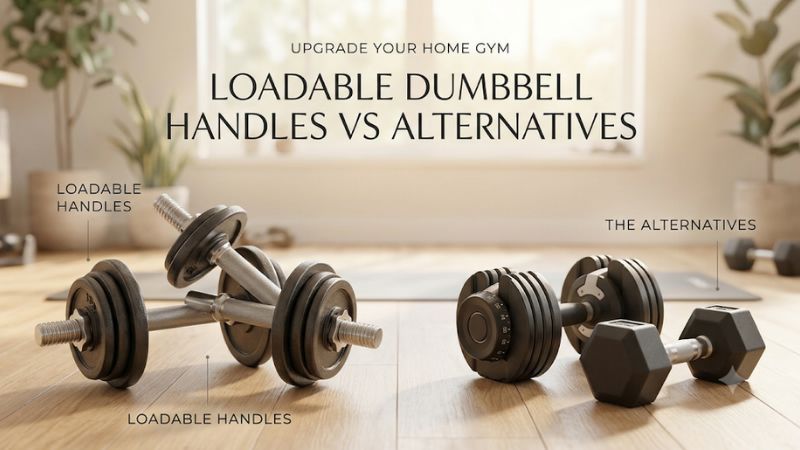
Loadable dumbbell handles vs fixed dumbbells
Both give you a familiar independent load in each hand. Their practical differences show up before and after each set. Fixed dumbbells at your chosen weight are always ready, while loadable handles share plates across settings. Compare where you need speed, what weights you repeat, and what you can store.
Fixed pairs suit short routines and quick transitions
A fixed dumbbell keeps the same dimensions and labeled load every time you pick it up. If your workout rotates between three known weights, lay out those pairs and start. There are no collars to remove or stack recipes to remember. Separate pairs also allow two people to use different loads simultaneously.
For example, a household might regularly use 10 lb for accessories, 20 lb for presses, and 35 lb for rows. If it has room for three pairs, fixed equipment offers an easy transition between the exercises. If that household expects to add many intermediate loads, storing each new pair may become inconvenient.
Rubber hex pairs can help when a flat side matters for set-downs. Verify the maker’s intended use if you plan to put body weight on them. For ordinary lifts, evaluate grip diameter and end dimensions at the actual weight. Fixed dumbbells can have larger heads as the weight increases, so compare the geometry at more than one load.
Manual handles make sense when your plates do double duty
Loadable handles are appealing if your barbell plates can build the intended dumbbell loads. They can give you a custom progression without buying a dedicated pair for each weight. This is particularly useful if you need occasional heavier options or want smaller steps using compatible change plates.
The benefit depends on how many pieces you own. One matched pair of a plate size can build the ends of one dumbbell. Using that same size on both loaded dumbbells at the same time generally takes four discs. If you also use your barbell in the same session, check whether the plates are free for the dumbbells at that point.
The more you change weights, the more often you handle four collars and the plates they secure. Many lifters find this manageable for straight sets. A session built around short circuits can make the same recurring work a reason to choose fixed pairs or selectors instead.
Short fixed heads can improve close working positions
A loadable frame keeps its length even with light plates. A fixed model generally needs only enough head and handle to provide its designated mass. Depending on the exact construction, it can therefore fit more easily into close pressing, curls beside the hips, or exercise positions with a short gap.
Plate diameter compounds the effect. An Olympic handle with big discs can take up more room around the hand than its total length suggests. Before deciding on a loadable system, compare the actual assembled outline with a fixed dumbbell at the same weight. If one common exercise is the only problem, a single fixed pair may solve it while you keep the loadables for everything else.
Loadable dumbbell handles vs selector and proprietary systems
Selector and proprietary dumbbells solve different inconveniences of regular plate-loaded handles. A selector can speed up changes, while a dedicated manual system can place the mass closer to a dumbbell-shaped head. Each relies on a specific inventory of plates, hardware, or docking equipment.
Selector dumbbells suit frequent changes
With a selector system, you may change both working loads by docking the dumbbells and operating the pins, handles, or switches. This can be valuable if a short-rest superset moves between different weights. With manual handles, the same transition may involve releasing four collars, moving multiple plates, and securing both assemblies.
Check the complete selector sequence. Some adjustables offer small changes only where add-on weights or a separate setting operation is supported. For example, REP QuickDraw is available in capacities through 60 lb per dumbbell, with included 2.5 lb micro plates and distinct procedures for their use. Decide whether the setting you need is practical at your workout pace.
You also inherit the storage and maintenance requirements of the selector. If the model docks in a cradle, you need a stable place for both cradles and enough room to lift and return each loaded dumbbell. A compact storage claim remains useful only when the complete working station fits.
Proprietary manual sets offer a different plate geometry
A system such as Ironmaster Quick-Lock uses matching compact plates and locking screws. Its 75 lb configuration is listed at 14.5 in long at the top supplied weight. For comparison, Titan’s Olympic model is 20 in long before you choose plates. A dedicated system can therefore offer a shorter build for certain heavy uses, depending on the products and configurations.
The trade-off is that the maker’s compatible plates and screws form their own inventory. If you already own several sets of Olympic plates, that hardware does little toward the purchase. Price any expansion hardware and storage alongside the base kit. You might still choose it if compact handling at heavier weights matters more than plate sharing.
Both designs require hands-on changes. Their actual adjustment time will depend on the planned plate sequence, storage, extra hardware, and how often the weight changes. Compare the work required to move between two settings you use frequently, rather than relying on a mechanism label alone.
Use a hybrid when one recurring change slows everything down
A basic light fixed pair can stay at 5 or 10 lb while your loadable handles remain assembled at a heavier weight. This is useful when a workout alternates light and heavy exercises and manual plate changes would delay every round. It also solves an empty-handle minimum that is too high for light accessories.
If the one problem is a heavy lift, a dedicated heavier fixed single can cover some unilateral exercises, such as a one-arm row. A heavy two-hand press needs matching weights on both sides. Compare the cost and footprint of that specific addition with replacing the whole set.
Loadable dumbbell handles vs kettlebells and barbells
Kettlebells and barbells become more compelling when the intended exercises call for their shapes. A kettlebell places mass below the handle. A barbell keeps both hands on one implement. These changes affect how you prepare for each lift, where the weight sits, and which movement positions feel natural.
Kettlebells suit work that depends on a bell-shaped load
A kettlebell’s handle window and offset mass make it useful for movements such as swings, cleans, and rack-position work with a model designed for them. A plate-loaded dumbbell places mass on both sides of a short handle. The hand and forearm interact with that load in a different way.
If you primarily train bilateral presses and independent curls, dumbbells may fit your program more directly. For frequent swings, choose a bell that supports the movement under the maker’s instructions. Consider handle width, the grip required, and the available room for the bell’s path. Avoid relying on a plate stack that was chosen for quiet, controlled rows to serve a substantially different motion.
An adjustable kettlebell can replace multiple fixed bells for a range of loads, with its own mechanism and settings. If you need only one bell for a specific recurring movement, a fixed bell can be simpler. Compare the usable loads and setup requirements for the exercise itself.
Barbells suit heavy combined loading and small total jumps
A barbell lets both hands work on a shared load. With compatible 2.5 lb plates on both ends, the total rises by 5 lb. On a matched pair of loadable dumbbells, one of those plates per sleeve raises each dumbbell by 5 lb, or 10 lb combined. Smaller change plates can give the dumbbell setup finer increases.
Barbells can suit heavy bilateral presses, squats, and pulls. The equipment changes with the lift. A barbell press or squat may require a suitable rack and safeties. A floor pull needs room at both ends of the bar to load the plates and a compatible lifting surface. Compare actual working setups rather than just the dimensions of a bare bar or handle.
Loadable dumbbells offer independent grips and can work in a shorter floor area for many unilateral exercises. If you already have a barbell station, handles can add variety using compatible plates. If you only have space for one type of equipment, base the choice on whether bilateral barbell work or independent dumbbell exercises define the program.
Choose the setup that supports your training week
The useful comparison is how often your routine asks for each advantage. Count changes between different loads, check whether other equipment needs the same plates simultaneously, and walk through the most constrained lift. This usually exposes the difference between an affordable purchase and an easy-to-use setup.
Choose manual handles when you have plates and train in blocks
If you already have plates ready and use one load for several sets before moving to another exercise, manual handles offer economical access to a broad range. Buy for the plate standard you own, then check four-way plate availability and working clearance. A suitable handle pair can add dumbbell training without requiring a separate rack of weights.
When a plate is needed on two implements at once, you may need another pair or change the workout order. Calculate the cost of any missing small plates and compatible collars. These are part of the system that need to be included for the savings to be real.
Choose selectors or fixed pairs when transitions dominate
If you change weights several times during a circuit, selectors reduce repeated plate handling when the actual settings fit. Fixed pairs can be even more convenient when the program needs only a small number of known loads and you have somewhere for each pair to rest between sets.
If two people train at the same time, decide whether they both need matching pairs at different weights. A single selector pair will often be shared sequentially. Several fixed pairs or a small fixed pair plus one selector can handle simultaneous work with fewer interruptions.
Choose equipment around the strongest movement preference
A dedicated barbell setup is worth evaluating if the core program uses heavy bilateral lifts and the room supports the necessary hardware. A kettlebell can be the better first purchase for someone who mainly practices bell-specific lifts. Each choice changes the available exercises as well as the space and cost.
For general home strength work that uses independent arm paths, shared plates make loadable handles attractive. Pick a short assembled shape when clearance matters, and use a longer sleeve only when it fits a real plate stack. Add a fixed pair or another implement when a recurring movement benefits from it.
Frequently asked questions
These questions resolve common overlaps in the comparison. Use the answers for the loads and exercises in your own plan. Even products in the same equipment category can differ in weight steps, how they secure resistance, and the space they need while being used.
Are loadable handles cheaper than adjustable dumbbells?
They can be if you already own suitable plates and collars. When starting from scratch, include matched plates for all four ends plus storage. A complete selector pair may be better value if it covers every weight you use and makes many adjustment steps easier.
Are loadable handles better than fixed dumbbells for heavy rows?
They can offer higher customizable loads using your existing plate inventory. A fixed dumbbell may be easier to grip, set down, and store for a single known load. Compare plate diameter, handle length, and your ability to safely start and finish the row.
Are screw-lock dumbbells the same as standard threaded handles?
Both can require manual plate changes. A conventional threaded handle uses compatible loose plates and matching threaded collars. Some proprietary systems use specific plate shapes and locking screws. Confirm what transfers between systems before treating the two purchases as equivalent.
Can adjustable dumbbells replace a barbell?
They can cover many presses, rows, and lower-body exercises, depending on the available load and geometry. A barbell offers a different grip relationship, loading range, and setup for heavy bilateral movements. Which exercises are central to your program determines how much the equipment can overlap.
What should I buy if I need two or three loads and have no plates?
Price fixed pairs at those exact loads first, then compare a selector that can cover them and other settings you expect to need. Loadable handles become more attractive if you want a broader range, compatible plates for another implement, or a particular progression the other options miss.
Conclusion
Choose loadable dumbbell handles when compatible plates are already available, you want custom weights, and manual changes fit your pace. Fixed pairs suit a short list of working loads, selector dumbbells suit frequent changes, and dedicated plate-loaded systems can offer a more compact heavy build. Choose kettlebells or a barbell when their specific lifts matter enough to shape the room and the routine.
More from Amazon
Programs that pair well with the guide above. Offers and eligibility are set by Amazon and may change.
Free shipping on eligible items, Prime Video and more. Eligible new members can start with a free trial.
Start a Prime free trialA Prime membership for ages 18-24 with a trial period. Eligibility is set by Amazon.
See Prime for Young AdultsAudiobooks and podcasts to listen to on the go. Eligible new members can start with a free trial.
Try Audible freeAd-free music streaming. Eligible new subscribers can start with a free trial.
Try Music Unlimited freeAs an Amazon Associate we earn from qualifying purchases.
Write Your Review
No reviews yet. Be the first to share your experience!