
Our Top Picks
 BlenderBottle Classic V2 Plastic Shaker Bottle 28 oz28 Ounces3.81 x 3.81 x 8.94 inches0.4 PoundsCheck on Amazon
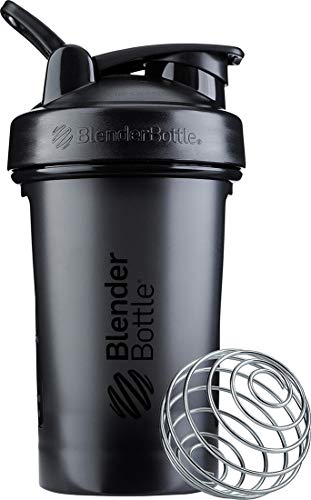 BlenderBottle Classic V2 Plastic Shaker Bottle 20 oz20 oz3.81 x 3.81 x 6.91 inches0.1 PoundsCheck on Amazon
 BlenderBottle Classic V2 Plastic Shaker Bottle 28oz Grey&Black/Black28 Ounces3.81 x 3.81 x 8.94 inches0.4 poundsCheck on Amazon
The best protein shaker bottle for most people is a Tritan plastic bottle with a ball-whisk and flip-cap lid, like the long-running BlenderBottle Classic style, because it clears thick whey without a motor, survives dishwasher cycles without clouding as fast as cheaper plastics, and costs little enough to replace every year or two before odor becomes a real problem. But that answer changes depending on what you’re mixing, how rough you are on gear, and whether you mind hand-washing. Here’s how the three main materials and three mixing systems actually stack up.
Capacity on the Label vs. What You Can Actually Use
Printed capacity and usable capacity are rarely the same number. Most shakers list total volume to the rim, but you lose 60-120 ml to the agitator ball, the fill-line markings, and the headspace you need to actually shake liquid without it spraying out the spout. A “700 ml” bottle with a ball whisk often maxes out around 500-550 ml of usable liquid once you add a scoop of powder and leave shaking room.
BlenderBottle Classic V2 Plastic Shaker Bottle 28 oz Clear/Black
Picked as a relevant option in this category.
View on Amazon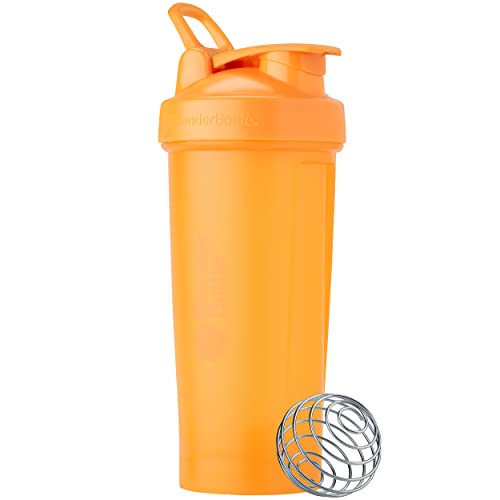
BlenderBottle Classic V2 Plastic Shaker Bottle 28 oz Mango
Picked as a relevant option in this category.
View on AmazonBlenderBottle Classic V2 Plastic Shaker Bottle 20 oz Black
Picked as a relevant option in this category.
View on AmazonBlenderBottle Classic V2 Plastic Shaker Bottle 28oz Grey&Black/Black 2-Pack
Picked as a relevant option in this category.
View on Amazon| Bottle type | Labeled capacity | Realistic usable fill | Mixing hardware |
|---|---|---|---|
| Tritan plastic, ball whisk | 700 ml | 500-550 ml | Stainless ball whisk |
| Tritan plastic, agitator disc | 600 ml | 480-520 ml | Mesh/disc agitator |
| Stainless steel, double-wall | 590 ml | 450-480 ml | Ball whisk (narrower bore) |
| Glass, single-wall | 650 ml | 520-550 ml | Ball whisk or none |
| Motorized mixer bottle | 500-600 ml | 400-480 ml | Battery-driven spinning blade |
Stainless steel loses the most usable volume because insulated walls add thickness without adding to the printed capacity, and the narrower drinking bore limits how high you can safely fill before it sloshes out when shaken. Glass bottles are deceptively roomy since there’s no insulation layer eating into the interior.
Mixing Hardware: Which One Actually Breaks Up Clumps
A stainless ball whisk is the simplest and most reliable option. It’s a wire cage with a loose metal ball inside; shaking slams the ball through the powder and it works on everything from whey to collagen to pre-workout. It’s also the easiest part to lose at the bottom of a gym bag and the first thing to start smelling if it’s not rinsed immediately.
Agitator discs (flat mesh or ridged plastic discs instead of a ball) move more water volume per shake but struggle with dense, clumpy powders like mass gainers or oat-based blends. They’re quieter, which matters if you’re mixing at a desk.
Motorized mixer bottles spin a small blade at the push of a button and genuinely do produce the smoothest texture, especially for gritty plant proteins. The tradeoff is real: a rechargeable battery that degrades after 300-500 charge cycles (roughly 1-2 years of daily use), a motor base that can’t go in the dishwasher, and a price point 3-4x higher than a basic ball-whisk bottle.
Leak Testing After Life in a Gym Bag
Lid design matters more than material once a bottle starts getting tossed around with shoes and weight-lifting straps. Flip-cap lids with a single silicone gasket are the most common failure point: after repeated impacts, the hinge loosens and the gasket seats slightly off-center, which is when you start finding a damp gym bag.
- Screw-top lids with a wide thread: most leak-resistant over time since there’s more sealing surface, but slower to open one-handed.
- Flip-cap with single gasket: convenient, but the gasket is a wear part — expect to replace it or the whole lid within 1-2 years of daily gym-bag use.
- Flip-cap with double-seal (gasket plus inner plug): noticeably better leak resistance under impact, common on mid-range and premium Tritan bottles.
- Stainless steel screw lids: seal well but the metal-on-metal or metal-on-silicone threads can develop a faint metallic smell faster than plastic threads if not dried fully.
Glass bottles are usually the exception that proves the rule: they’re almost always sold with a protective silicone sleeve, and the lid is typically a simple screw-top, which tests well for leaks but makes the bottle heavier and more fragile if it’s ever dropped without the sleeve on.
What 30 Dishwasher Cycles Does to Each Material
This is where most people’s shakers actually fail, long before the plastic cracks. Odor retention, not breakage, is the real end-of-life signal.
| Material | Condition after ~30 cycles | Odor risk | Visual wear |
|---|---|---|---|
| Tritan plastic (BPA-free copolyester) | Holds up well, minor surface haze | Low to moderate — threads and lid seams need manual attention | Slight clouding, scratches from the ball whisk |
| Cheap generic plastic (PP/PETG blends) | Visible clouding, surface micro-scratching | High — scratches trap residue | Noticeably duller, may warp near hot elements |
| Stainless steel | Excellent, no clouding | Low if dried fully; metallic odor if left damp | Minimal, may dull slightly |
| Glass | No clouding or scratching | Lowest of all materials | None, unless chipped |
Tritan is the practical winner for daily dishwasher use. It resists the micro-scratching that traps protein residue and bacteria far better than the thin, cheap polypropylene found in bundled or no-name shakers. Stainless steel and glass both outperform plastic on pure odor resistance, but stainless needs full air-drying (upside down, lid off) after every wash or it develops a metallic smell inside the threads. Glass has no odor retention problem at all, but it’s the only material here that will shatter if dropped on a tile locker-room floor.
The part that fails first on almost every bottle, regardless of material, is the lid gasket or seal, not the bottle body. Plan to replace the lid (many brands sell replacement lids separately) every 1-2 years rather than the whole bottle.
Matching the Bottle to Your Situation
| Your situation | Best pick | Why |
|---|---|---|
| Daily gym-bag use, budget-conscious | Tritan, ball whisk, double-seal flip lid | Best durability-to-cost ratio, light weight, dishwasher-safe |
| Mixing thick or gritty powders (mass gainers, plant protein) | Motorized mixer bottle | Only option that fully breaks up dense clumps without pre-mixing in water |
| Want it to double as a hot/cold drink bottle | Stainless steel, screw lid | Insulation and durability, but hand-dry threads after every wash |
| Sensitive to plastic taste or smell | Glass with silicone sleeve | Zero odor retention, but needs the sleeve for drop protection |
| Travels a lot, wants minimal leak risk | Tritan or glass with screw-top lid | Wide-thread screw lids outperform flip caps under repeated impact |
Buying and Care Notes
General market prices run roughly $8-15 for basic Tritan ball-whisk bottles, $15-25 for double-seal or insulated stainless options, $20-35 for glass with a protective sleeve, and $35-60 for motorized mixer bottles. Across all materials, rinse the bottle and whisk within an hour of use rather than letting it sit in a bag, air-dry upside down with the lid off, and replace the lid or gasket as soon as you notice a smell that survives a wash — that’s the component actually holding the odor, not usually the bottle itself. If you’re monitoring protein intake alongside other dietary changes, a registered dietitian can help you figure out serving sizes and timing that fit your goals.










Write Your Review
No reviews yet. Be the first to share your experience!