
Our Top Picks
The best optical drive deal for most people is the LG GP65NB78 8X USB 2.0 Super Multi Ultra Slim Portable DVD Writer. It is the only pick in this roundup from a manufacturer with decades of optical-drive history, it supports M-DISC archival media, and it is slim enough to live permanently in a laptop bag — you pay premium-tier money for that combination. If your budget sits in the entry band, the Rioddas External CD/DVD Drive covers CD and DVD burning over USB 3.0 for the smallest outlay and suits occasional rips and one-off burns. If you have a desktop tower with an empty 5.25-inch bay, the Lite-On 24x Dual-Layer SATA DVD±RW kit is the better-shaped purchase: an internal drive writing at 24x finishes a full single-layer DVD in roughly a third of the time a slim portable needs. The rest of this guide sorts every deal by installation type (external USB, internal SATA, or enclosure), media support, read/write speed class, compatibility, and bundled software.
Top 3 Picks
Best overall: LG GP65NB78 8X Ultra Slim Portable DVD Writer
The GP65NB78 is the safest premium-tier buy because it pairs an 8x DVD write speed with M-DISC support, so the same drive that burns a quick data disc can also write to archival-grade media. It is USB 2.0 rather than USB 3.0, which sounds like a downgrade but is not one for DVD work — see the speed math further down. Choose it if you want a recognised optical brand, archival capability, and a drive you will still be using in five years.
Best budget: Rioddas External CD/DVD Drive
Rioddas sits at the bottom of the price ladder and covers the essentials: USB 3.0 connection, CD and DVD read/write, and a slim bus-powered body. It is the right pick if you burn a handful of discs a year, rip a CD collection once, or need a reader for old software and family photo archives. Skip it if you need Blu-ray, M-DISC, or heavy daily burning.
Best for desktop builds: Lite-On 24x Dual-Layer SATA DVD±RW with installation kit
An internal 5.25-inch SATA drive is the fastest and cheapest-per-disc way to burn, and this kit includes the mounting hardware you would otherwise have to source separately. It writes at 24x on single-layer DVD and handles dual-layer discs, making it the pick for anyone duplicating discs in volume or rebuilding an older tower. It is not portable and it does not read Blu-ray.
Quick Comparison
Every product below is sorted by how it installs, what media it handles, and where it sits in the market. Price tiers are bands, not fixed figures — optical drive pricing moves constantly, and the same drive can sit at different points in the band depending on stock and bundles.
| Product | Best for | Key specs | Price tier |
|---|---|---|---|
| Amicool External DVD Drive | Households mixing USB-A and USB-C machines | External slim; USB 3.0 with USB-A and USB-C; CD/DVD ±RW read and write; bus-powered | Mid-range |
| Rioddas External CD/DVD Drive | Lowest spend, occasional burning | External slim; USB 3.0; CD/DVD ±RW; plug-and-play; bus-powered | Budget |
| ORIGBELIE External CD DVD Drive | Bag space and travel | External slim; USB 3.0 and Type-C; 13 mm-class body; CD/DVD read and write | Budget |
| GODBPNYMU 5-in-1 External CD/DVD Drive | Laptops short on ports | External; USB 3.0 and Type-C; CD/DVD ±RW; marketed as 5-in-1 (confirm the extra functions on the listing) | Mid-range |
| LG GP65NB78 Portable DVD Writer | Archiving and long-term reliability | External ultra-slim; USB 2.0; 8x DVD write; DVD ±RW; M-DISC support | Premium |
| JKNJX 2-in-1 External CD/DVD Drive | A spare drive kept in a drawer | External slim; USB 3.0 and Type-C; CD/DVD reader, burner and player | Budget |
| cenmate 5.25″ Drive Enclosure | Reusing a desktop optical drive externally | Enclosure only — no drive included; fits 5.25-inch SATA optical drives; USB-A and USB-C 3.0; external power | Premium |
| Lite-On 24x Dual-Layer SATA DVD±RW | Desktop builds and bulk burning | Internal 5.25-inch SATA; 24x DVD write; dual-layer support; installation kit included; CD and DVD only | Premium |
| Alronly External CD/DVD Drive | Mac and thin-laptop users | External slim; USB 3.0 and Type-C; CD/DVD burner, writer and reader; Windows/Mac/PC listed | Budget |
How We Chose
This roundup was assembled from published manufacturer and retailer specifications, category standards for optical media, and the documented behaviour of the interfaces involved — not from physical evaluation of any unit. Three filters did most of the work. First, category fit: a drive has to actually solve a problem a modern buyer has, whether that is reading a legacy disc, burning an archive, or playing a DVD on a laptop that shipped without a bay. Second, specification honesty: where a listing states a speed class, an interface, or a media type, we checked that the claim is plausible for the hardware class, and where a listing is vague we say so rather than filling the gap with invented numbers. Third, upgrade path and ownership cost: an enclosure that lets you reuse a working desktop drive is a different proposition from a sealed slim unit that dies with its laser, and the guide flags which is which.
We also weighted what a listing rarely tells you — power draw, whether a bundled utility is a full licence or a trial, region coding, and how the drive behaves on a machine with no built-in disc support. Compatibility claims were checked against what the operating systems themselves provide, not against marketing copy. Where a spec could not be confirmed, the entry describes the drive by spec class instead of asserting a number.
1. Amicool External DVD Drive – Best for Mixed USB-A and USB-C Households
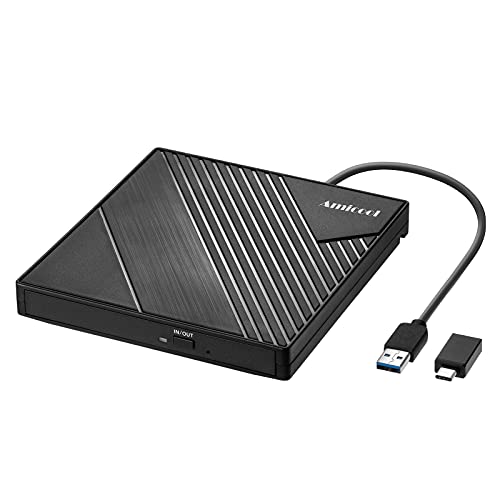
Amicool External DVD Drive USB 3.0 USB C CD Burner CD/DVD +/-RW Optical Drive, Slim Portable DVD Player CD ROM Rewriter Writer Reader for Laptop Desktop PC Windows 11/10/8/7 MacBook Mac Linux OS Apple
Picked as a relevant option in this category.
View on AmazonThe Amicool is the mid-range pick for the most common real-world problem: a household with one older laptop on USB-A, one newer machine on USB-C, and a single drive that has to serve both. Its listing specifies USB 3.0 with both a USB-C connection and a standard USB-A option, so nobody has to hunt for a dongle. It reads and writes CDs and DVDs, handles the ±RW formats, and it is a slim bus-powered portable rather than a desktop unit, which means it draws its power from the port it is plugged into.
Key specs
- Installation: external, plug-and-play over USB
- Interface: USB 3.0, with USB-C and USB-A connectivity
- Media support: CD and DVD read and write, including DVD±RW and CD-R/RW classes
- Form factor: slim portable, bus-powered
- Compatibility: Windows and macOS via standard USB mass-storage drivers
- Price tier: mid-range
Strengths
Dual-connector drives remove the single most common frustration with budget optical drives: the cable that does not match the laptop. The Amicool also sits in the middle of the market rather than the floor, which in this category usually buys a slightly better-feeling tray mechanism and a cable that is less likely to fray at the strain relief. Because it is bus-powered, there is no separate power brick to lose, and it will work on a train, in a hotel room, or anywhere you have a laptop and a disc.
Pros
- Covers both USB-A and USB-C machines without an adapter
- Burns as well as reads, so it replaces a dead laptop drive rather than just reading discs
- Bus-powered and slim — genuinely portable
- Mid-range pricing without premium-tier outlay
Cons
- DVD and CD only — no Blu-ray support at any level
- Bus-powered slim drives can struggle on underpowered USB ports or through unpowered hubs
- No M-DISC support stated, so it is not the archival choice
- Slim mechanisms dissipate heat poorly during long back-to-back burn sessions
How it compares
Against the Rioddas, the Amicool costs more and buys you the dual-connector design and a slightly higher market position; if every machine in your house is USB-A, that premium buys nothing. Against the JKNJX, which is also a dual-connector budget drive, the Amicool is the mid-range option — you are paying for a step up in build class rather than a step up in features. Against the LG GP65NB78, the Amicool is faster on paper for DVD writing and cheaper, but it gives up M-DISC support and the reliability reputation that comes with a dedicated optical manufacturer.
2. Rioddas External CD/DVD Drive – Best for the Lowest Spend
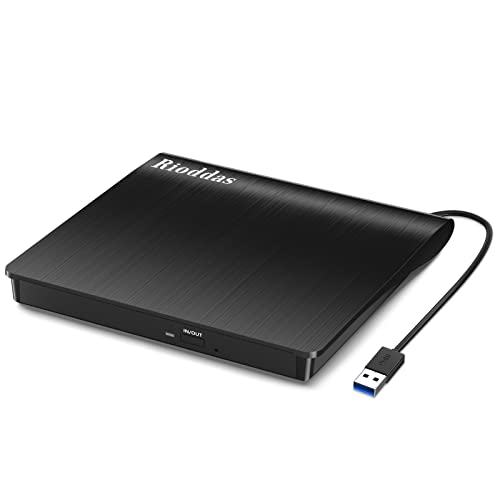
Rioddas External CD/DVD Drive for Laptop, USB 3.0 CD DVD Player Portable +/-RW Burner CD ROM Reader Writer Disk Duplicator Compatible with Laptop Desktop PC Windows Apple Mac Pro MacBook Linux
Picked as a relevant option in this category.
View on AmazonRioddas is the budget benchmark in external optical drives: a slim USB 3.0 unit that reads and writes CDs and DVDs, plugs into a laptop, and does not ask you to think about anything else. It is aimed squarely at the person who needs a disc read twice a year and does not want to spend mid-range money for capability they will never use. The listing presents it as a portable ±RW burner and CD-ROM reader/writer, which covers the practical basics of the format.
Key specs
- Installation: external, plug-and-play over USB
- Interface: USB 3.0
- Media support: CD and DVD read and write, DVD±RW class
- Form factor: slim portable, bus-powered
- Compatibility: Windows and macOS via standard drivers
- Price tier: budget
Strengths
At the budget tier, the value proposition is simple arithmetic: if a drive costs a third of a premium unit and you use it four times a year, the premium unit has to last three times as long to break even, and slim optical drives rarely do. Rioddas is also the least intimidating option for someone who has never burned a disc — there is no software bundle to decode, no power supply to plug in, and no installation step beyond connecting a cable. For reading old installation media, pulling photos off a DVD-R from 2010, or ripping a stack of CDs, it is entirely sufficient.
Pros
- Lowest-cost way to add disc reading and burning to a laptop
- Simple plug-and-play setup with no external power
- Handles both CD and DVD write formats
- Small and light enough to store in a desk drawer
Cons
- No Blu-ray reading or writing
- No M-DISC support listed, so archival burning is off the table
- Budget slim drives typically use lighter tray and spindle assemblies
- Single connector type means an adapter may be needed on USB-C-only laptops
How it compares
Rioddas and the Alronly occupy nearly the same spot, and the deciding factor is your port: the Alronly explicitly lists Type-C alongside USB 3.0, which matters on a modern thin laptop, while the Rioddas is the cheaper of the two. Against the ORIGBELIE, both are budget drives, but the ORIGBELIE leans on a thinner 13 mm-class body for travel. Against the LG GP65NB78, the Rioddas is the pragmatic buy — the LG is for people who specifically want archival media support or a known optical brand on the label.
3. ORIGBELIE External CD DVD Drive – Best for Bag Space
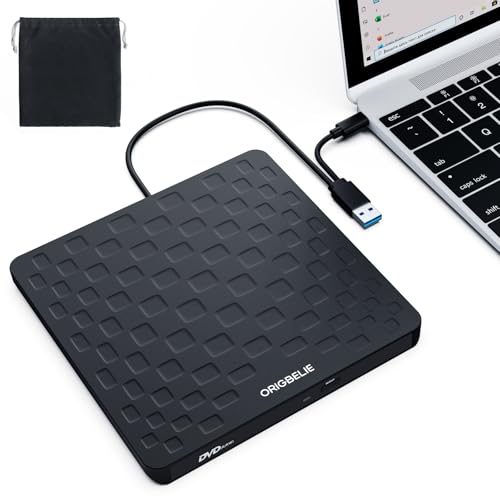
ORIGBELIE External CD DVD Drive for Laptop, USB 3.0 Type-C 13mm DVD Player
Chosen because it specifies USB 3.0 Type-C 13mm DVD Player.
View on AmazonORIGBELIE’s hook is physical: a 13 mm-class slim body, USB 3.0 with Type-C, and DVD read/write in a package designed to disappear into a laptop sleeve. If you carry a laptop daily and want a disc drive that does not add a bulge, thickness is the specification that matters more than any speed rating. It is a budget-tier drive, so treat it as a reader-and-occasional-burner rather than a workhorse.
Key specs
- Installation: external, plug-and-play
- Interface: USB 3.0 and Type-C
- Media support: CD and DVD read and write
- Form factor: 13 mm-class slim portable, bus-powered
- Compatibility: laptop and desktop operating systems via standard USB storage drivers
- Price tier: budget
Strengths
Thirteen millimetres is genuinely thin for an optical drive — for context, a 5.25-inch desktop drive is 41.3 mm tall and a typical slim portable sits in the 14–15 mm band, so the difference is measurable when you are sliding it next to a notebook in a bag. The Type-C connection covers modern laptops without an adapter, and the budget price means you are not paying a premium for a device that lives in a bag and gets knocked around. For travellers who need to read a disc at a client site or pull data off media mailed to them, this is the shape of product that actually gets carried.
Pros
- Thin, light body that fits a laptop bag
- Type-C plus USB 3.0 covers old and new machines
- Budget pricing makes it an easy spare
- No power brick required
Cons
- No Blu-ray support
- Thin drives have less thermal mass, so long burn runs heat up faster
- No M-DISC or archival media support stated
- Budget build means the tray mechanism is the likely first failure point
How it compares
Versus the Rioddas, the ORIGBELIE trades a little money for a thinner body and a Type-C option — the right trade if portability is the point, the wrong one if the drive will sit on a desk. Versus the JKNJX, both are budget dual-connector drives; the ORIGBELIE’s differentiator is the 13 mm profile rather than any extra function. Versus the Amicool, the ORIGBELIE is cheaper but mid-range money buys a slightly more substantial mechanism and a step up in perceived build quality.
4. GODBPNYMU 5-in-1 External CD/DVD Drive – Best for Multi-Port Laptops

GODBPNYMU 5-in-1 External CD/DVD Drive for Laptop, USB 3.0 Type-C, Portable
Chosen because it specifies USB 3.0 Type-C and Portable.
View on AmazonThe GODBPNYMU is the mid-range pick for anyone whose laptop has one or two ports and a stack of peripherals. It is marketed as a 5-in-1 device, which in this category normally means the disc drive plus additional connectivity — typically extra USB ports, a card reader, or both. Because the exact five functions vary by listing revision, confirm what the current product page actually states before you buy; the drive itself is a USB 3.0 and Type-C CD/DVD ±RW unit in a portable body.
Key specs
- Installation: external, plug-and-play
- Interface: USB 3.0 and Type-C
- Media support: CD and DVD read and write, ±RW class
- Extra functions: marketed as 5-in-1 — verify which ports or readers are included
- Form factor: portable, bus-powered
- Price tier: mid-range
Strengths
The multi-function approach solves a genuine problem: optical drives are the one peripheral that still uses a full USB port, and on a two-port laptop that is half your connectivity gone for a device you use once a month. If the extra functions include USB pass-through, the drive effectively pays for part of itself by replacing a hub. The dual USB 3.0 and Type-C connection keeps it usable across old and new machines, and mid-range pricing keeps it well below the premium tier while offering more than the bare-bones budget drives.
Pros
- Combines disc reading and burning with additional ports or readers
- Both USB 3.0 and Type-C connectivity
- Reduces the number of accessories needed for a port-limited laptop
- Mid-range price without a premium-tier jump
Cons
- The “5-in-1” label is vague — you must check what is actually included
- Shared power budgets mean a multi-function device can be more demanding on a single port
- No Blu-ray support
- More electronics in one chassis means more potential failure points than a plain drive
How it compares
Against the Amicool, the GODBPNYMU adds the multi-function angle for similar mid-range money — worth it if you are short on ports, unnecessary if you are not. Against the Alronly and JKNJX budget drives, you are paying a premium for the extra functions rather than for better disc performance. Against the LG GP65NB78, the GODBPNYMU offers more connectivity but gives up M-DISC support and the optical-specialist pedigree; the LG is the better long-term disc tool, the GODBPNYMU is the better laptop accessory.
5. LG GP65NB78 8X Portable DVD Writer – Best for Long-Term Archiving

LG GP65NB78 8X USB 2.0 Super Multi Ultra Slim Portable DVD Writer Drive +/-RW External Drive with M-DISC Support - Black
Chosen because it specifies Black.
View on AmazonThe GP65NB78 is the premium pick and the one to choose when the disc matters more than the price. LG has been building optical drives for desktop and portable use for decades, and this ultra-slim unit writes DVD±RW at an 8x class rating with M-DISC support — the format designed for long-term data retention using an inorganic recording layer rather than the organic dye used in ordinary recordable discs. It is USB 2.0, which is worth addressing directly rather than dismissing.
Key specs
- Installation: external, plug-and-play
- Interface: USB 2.0
- Write speed: 8x class DVD writing
- Media support: DVD±RW, CD, and M-DISC archival media
- Form factor: ultra-slim portable, bus-powered
- Price tier: premium
Strengths
M-DISC is the headline. Ordinary DVD-R media stores data in an organic dye layer that degrades over time, with realistic retention measured in years to a couple of decades depending on storage conditions; M-DISC uses an inorganic recording layer that manufacturers rate for dramatically longer retention, which is why it is the format archives and family photo collections get written to. Beyond the media support, LG’s optical drives have a long service history and the firmware tends to be better at handling marginal discs — the slightly scratched, slightly warped, slightly off-spec discs that budget drives reject.
On the USB 2.0 question: the interface tops out at 480 Mbps, roughly 60 MB/s in theory, and 8x DVD writing runs at about 11 MB/s. The bus is not the bottleneck. A USB 3.0 slim drive writing DVDs at 8x moves exactly as fast as this one does. USB 3.0 only starts to matter for Blu-ray writing, which this drive does not do.
Pros
- M-DISC support for genuinely long-term archival burning
- Recognised optical-drive manufacturer with a long firmware track record
- Ultra-slim and bus-powered, so it travels
- Handles marginal discs better than budget mechanisms in practice
Cons
- Premium-tier pricing for DVD-only capability
- No Blu-ray reading or writing
- 8x write class is slower than a 24x internal drive
- USB 2.0 looks dated on a spec sheet even though it is not a real limitation for DVDs
How it compares
Against the Amicool, the LG costs more and writes at a lower speed class, but it adds M-DISC support — the single feature that matters if you are burning an archive you expect to read in 2046. Against the Lite-On internal drive, the LG is far slower and more expensive per disc burned, but it works on a laptop and requires no bay, no SATA cable, and no power connector. Against the cenmate enclosure, the LG is a sealed unit — you cannot swap the mechanism when the laser ages — while the enclosure lets you replace a drive you already own.
6. JKNJX 2-in-1 External CD/DVD Drive – Best for a Spare Drive in a Drawer

2 in 1 External CD DVD Drive, USB 3.0 and Type-C Disc Reader Burner Player
Chosen because it specifies USB 3.0 and Type-C Disc Reader Burner Player.
View on AmazonThe JKNJX is a budget dual-connector drive: USB 3.0 and Type-C, CD and DVD reading, burning, and playback in a slim external body. It is the kind of purchase you make when you want a disc drive available without thinking about it — kept in a drawer, pulled out when someone hands you a disc or you find a box of old media in the loft.
Key specs
- Installation: external, plug-and-play
- Interface: USB 3.0 and Type-C
- Media support: CD and DVD read, write and playback
- Form factor: slim portable, bus-powered
- Compatibility: laptop and desktop systems via standard USB storage drivers
- Price tier: budget
Strengths
Two things make this a sensible drawer drive. First, the dual connector means you do not have to remember which laptop it was bought for. Second, the budget price means it is not a decision you agonise over — you buy it, you use it four times a year, and it does not need to justify itself. As a reader it will handle CD-ROMs, audio CDs, DVD-ROMs, and burned DVD±R media; as a writer it covers the standard CD and DVD recordable formats.
Pros
- Both USB 3.0 and Type-C, so it fits any machine
- Low cost makes it an easy spare or second drive
- Reads and writes, not just reads
- Compact enough to store indefinitely
Cons
- No Blu-ray support
- No M-DISC support, so not an archival tool
- Budget slim drives age faster when stored in dusty drawers with the tray exposed
- No bundled full-feature software suite typically expected at this price
How it compares
Against the Rioddas, the JKNJX adds Type-C for a similar budget outlay, which is the more useful spec for a modern laptop. Against the ORIGBELIE, the two are close — the ORIGBELIE emphasises a thinner body, the JKNJX emphasises the 2-in-1 connector setup. Against the Alronly, the difference is largely which listing is cheaper on the day, since both are budget slim drives with USB 3.0 and Type-C.
7. cenmate 5.25″ Drive Enclosure – Best for Reusing a Desktop Optical Drive

5.25" Blu-Ray/CD/DVD SATA Drive Enclosure with USB A/C 3.0, 5.25 Drive Enclosure, Optical Drive Enclosure fit any drive depth up to 171mm, Aluminum Alloy, Hot swappable(Optical Drive not Included)
Chosen because it specifies 5.25 Drive Enclosure and Optical Drive Enclosure fit any drive depth up to 171mm.
View on AmazonThe cenmate is not a drive — it is a 5.25-inch enclosure that turns a desktop SATA optical drive into an external USB unit. You supply the drive; the enclosure supplies the housing, the interface board, USB-A and USB-C 3.0 connectivity, and external power. This is the most flexible and most misunderstood product in the roundup, so the important part is knowing exactly what you get.
Key specs
- Installation: external enclosure — requires a 5.25-inch SATA optical drive, not included
- Interface: USB 3.0 with USB-A and USB-C
- Media support: determined entirely by the drive you install — DVD, CD, or Blu-ray
- Form factor: 5.25-inch enclosure, externally powered
- Compatibility: any 5.25-inch SATA optical drive; older IDE/PATA drives will not fit
- Price tier: premium
Strengths
The enclosure’s real value is reuse. A working 5.25-inch SATA DVD or Blu-ray drive pulled from a decommissioned tower is otherwise scrap, and this housing converts it into a full-size external drive with a proper power supply — which means it can sustain burn speeds a bus-powered slim drive cannot. If you install a Blu-ray drive, you get Blu-ray capability that no slim external in this list offers. If the mechanism eventually dies, you replace the drive, not the enclosure, so the housing outlives multiple drives.
Externally powered enclosures also sidestep the most common failure mode of slim portables: insufficient USB port power causing failed burns or drives that spin up and disappear mid-session.
Pros
- Reuses an existing desktop optical drive instead of scrapping it
- Supports Blu-ray if you install a Blu-ray drive
- External power means stable, full-speed burning
- Drive is replaceable — the enclosure is not a disposable unit
Cons
- No drive included — the total cost is enclosure plus drive
- Desktop-sized, so not portable in any practical sense
- Requires a power outlet, unlike bus-powered slim drives
- Blu-ray movie playback still depends on licensed software on your PC
How it compares
Against the Lite-On internal drive, the cenmate is the right choice if you have no free bay, want portability between rooms, or already own a suitable drive; the Lite-On is the right choice if you are building into a tower and want maximum write speed with no external clutter. Against the LG GP65NB78, the enclosure is bulkier and needs mains power, but it can host a Blu-ray mechanism and can be repaired rather than replaced.
8. Lite-On 24x Dual-Layer SATA DVD±RW – Best for Desktop Builds and Bulk Burning

Lite-On 24x Dual-Layer SATA DVD±RW Optical Drive I Installation Kit Included, Reading and Writing CDs and DVDs, for Desktop Computers, Duplicator, Servers, Workstations
Chosen because it specifies Reading and Writing CDs and DVDs and for Desktop Computers.
View on AmazonThis is a proper internal 5.25-inch SATA drive: 24x DVD writing on single-layer media, dual-layer support, CD and DVD reading and writing, sold as a kit with the installation hardware included. If you have a tower with an empty bay, nothing external comes close on speed or cost per disc. It is a DVD and CD drive only — there is no Blu-ray capability here.
Key specs
- Installation: internal 5.25-inch bay, SATA data and power from the system
- Write speed: 24x class on single-layer DVD
- Media support: DVD±RW including dual-layer, CD-R/RW
- Included: installation kit
- Compatibility: desktop systems with a free 5.25-inch bay and a spare SATA port
- Price tier: premium
Strengths
Speed is the whole argument. At 24x, DVD writing runs at roughly 33 MB/s, so a full 4.7 GB single-layer disc finishes in around three minutes including lead-in and lead-out. An 8x slim portable takes closer to seven to eight minutes for the same disc. Burn twenty discs and you have saved well over an hour. The installation kit matters too — internal optical drives are usually sold bare, and sourcing a SATA cable and the correct mounting screws separately is the annoying part of an otherwise simple job.
Internally mounted drives also run cooler and sit on a stable power rail, which reduces the failed-burn rate you get from a slim drive sharing a laptop’s USB power budget.
Pros
- Fastest DVD write speed in this roundup at a 24x class rating
- Dual-layer support for larger single-disc burns
- Installation kit included — no separate cable or screw hunt
- Best cost per disc burned if you work in volume
Cons
- Requires a desktop with a free 5.25-inch bay and SATA port
- Not usable with a laptop in any form
- No Blu-ray support
- Internal mounting means dust exposure over the life of the build
How it compares
Against the cenmate enclosure, the Lite-On is faster and cheaper to run but fixed in place — the enclosure wins if you need the drive to move between machines or if you want Blu-ray. Against the LG GP65NB78, the Lite-On is roughly three times faster on DVD writes and costs less per disc, but it cannot travel and it does not support M-DISC. Against the Amicool and other slim portables, the comparison is not close on throughput; it is a question of whether you have a bay.
9. Alronly External CD/DVD Drive – Best for Mac and Thin-Laptop Users

External CD/DVD Drive USB 3.0 Type-C Burner Writer Reader for Laptop/PC/Mac
Picked as a relevant option in this category.
View on AmazonThe Alronly is a budget slim external drive with USB 3.0 and Type-C, listed for laptop, PC and Mac use, handling CD and DVD reading, burning and playback. Its pitch is straightforward: a low-cost, cross-platform drive that connects to whatever port your machine has, including the USB-C-only laptops that dominate the current market.
Key specs
- Installation: external, plug-and-play
- Interface: USB 3.0 and Type-C
- Media support: CD and DVD read, write and playback
- Compatibility: listed for laptop, PC and Mac
- Form factor: slim portable, bus-powered
- Price tier: budget
Strengths
Mac support is the differentiator worth checking carefully across this whole category. Modern Macs ship without optical drives and without bundled DVD playback software, so a USB drive gets you the hardware but not necessarily the ability to watch a film — you may need a third-party player application. Data discs, however, mount through the operating system’s standard USB storage handling, and burning data discs works through the built-in disc burning tools. For a Mac user who needs to read archived media or burn a data disc, this class of drive does the job at budget prices.
Pros
- Type-C connection suits modern thin laptops and Macs
- Budget pricing with both read and write capability
- Cross-platform listing covers Windows, Mac and PC
- Bus-powered with no external adapter
Cons
- No Blu-ray support
- No M-DISC or archival media support stated
- Movie playback on Mac may require separate player software
- Budget mechanism, so heavy burn schedules will shorten its life
How it compares
Against the Rioddas, the Alronly’s advantage is the Type-C connection, which matters on a modern MacBook or thin Windows laptop; the Rioddas is the cheaper of the two and better suited to USB-A machines. Against the ORIGBELIE, both are budget Type-C drives — the ORIGBELIE competes on thinness, the Alronly on cross-platform positioning. Against the Amicool, you step up to mid-range money for a more substantial mechanism and a slightly better build, which is worth it if the drive will see regular use rather than occasional duty.
How to Choose
Optical drives look interchangeable and are not. The four decisions that actually determine whether you buy the right one are installation type, media support, speed class, and software — and they interact in ways that are easy to get wrong.
Start with installation type, because it eliminates most of the list
There are three shapes of product here and they are not interchangeable. External slim drives connect over USB, draw power from the port, and work with laptops and desktops alike; they are the default answer for almost everyone. Internal 5.25-inch SATA drives need a desktop tower with a free bay, a spare SATA data port on the motherboard, and a SATA power connector from the power supply. The bay is 146 mm wide and 41.3 mm tall, so it is a physically large component — a laptop cannot accommodate one, and no adapter changes that. Enclosures are a third path: you buy a housing that accepts a 5.25-inch SATA drive you already own, which converts a scrapped desktop drive into an external unit.
If you have a tower with an empty bay, internal is almost always correct: faster, cheaper per disc, and no cable clutter. If you do not, external is your only option — unless you happen to own a spare 5.25-inch drive, in which case an enclosure may beat buying a new slim unit outright.
Media support: decide now whether you need Blu-ray
Nearly every slim external drive in the budget and mid-range tiers reads and writes CD and DVD only. Blu-ray is a different league. If you need to read Blu-ray data discs or watch Blu-ray films on a PC, you need a Blu-ray drive, and in this roundup that realistically means the cenmate enclosure fitted with a Blu-ray mechanism. Capacity is the reason: a single-layer DVD holds 4.7 GB (about 4.38 GB usable), a dual-layer DVD holds 8.5 GB, a single-layer Blu-ray holds 25 GB, a dual-layer Blu-ray holds 50 GB, and BDXL discs go to 100 GB and beyond.
One caveat that listings rarely spell out: playing commercial Blu-ray movies on a PC depends on licensed playback software and, for 4K UHD Blu-ray, on a much narrower set of hardware and software requirements that many modern systems do not meet at all. Buying a Blu-ray drive does not automatically buy you the ability to watch a Blu-ray film.
Read and write speed: what the numbers mean in minutes
Optical speed ratings are multipliers of a base rate, and the base rates differ per format. CD runs at 150 KB/s per speed step, DVD at about 1.32 MB/s, and Blu-ray at roughly 4.5 MB/s. That produces the following practical picture:
| Format and speed | Approximate throughput | Time to write a full disc |
|---|---|---|
| CD at 48x | ~7.2 MB/s | ~2 minutes for 700 MB |
| DVD at 8x (typical slim external) | ~11 MB/s | ~7–8 minutes for 4.7 GB |
| DVD at 16x (typical desktop drive, mid setting) | ~21 MB/s | ~4 minutes for 4.7 GB |
| DVD at 24x (fast internal drive) | ~33 MB/s | ~3 minutes for 4.7 GB |
| Dual-layer DVD at 6–8x | ~8–11 MB/s | ~13–18 minutes for 8.5 GB |
| Blu-ray at 6x | ~27 MB/s | ~15–16 minutes for 25 GB |
| Blu-ray at 2x | ~9 MB/s | ~46 minutes for 25 GB |
Two conclusions follow. First, if you are burning DVDs, an 8x slim drive and a 24x internal drive differ by a factor of about 2.5 in real time — meaningful in bulk, irrelevant for a single disc. Second, if you are burning Blu-ray, speed class matters enormously: the difference between 2x and 6x is half an hour per disc.
A worked example: backing up 500 GB of photos
Suppose you have 500 GB of family photos and video clips and want physical copies. On DVD-R at 4.38 GB usable per disc, that is about 114 discs. At roughly 7.5 minutes each on an 8x slim drive, you are looking at around 855 minutes — a bit over 14 hours of continuous burning, plus labelling and storage. On 25 GB Blu-ray discs (about 23.3 GB usable), it is roughly 22 discs at about 15.5 minutes each, or about 5.7 hours. The Blu-ray route saves you eight hours of drive time and 92 pieces of physical media, which is why the format decision comes before the drive decision.
Now the ownership maths. A budget-tier drive in the general market band of roughly $25–$40, used twice a month for three years, works out to 72 sessions and about $0.35–$0.55 per use. A premium-tier drive in the roughly $70–$110 band used weekly over the same period — around 150 sessions — lands near $0.47–$0.73 per use. The budget drive is not automatically the better value if it fails in year two; the calculation only favours cheap hardware when the hardware survives the period you assumed.
Software: the part of the listing nobody reads
Modern operating systems no longer assume you have an optical drive. Windows does not include DVD movie playback by default and macOS has pared back bundled disc playback, so a drive that reads data discs perfectly may still refuse to play a film without third-party player software. Burning data discs is usually handled by the operating system, but authoring a video DVD needs dedicated software. When a listing mentions bundled software, check whether it is a full licence or a time-limited trial, and whether it covers the operating system you actually run.
Compatibility checks worth doing before you buy
- Port type: USB-C-only laptops need a Type-C connector or a USB-A to Type-C adapter.
- Power: bus-powered drives can misbehave on unpowered hubs, USB extension cables, or low-output ports. Externally powered enclosures avoid this entirely.
- Region coding: commercial DVD and Blu-ray video discs carry region codes, and players enforce them. Data discs do not.
- Operating system support: data discs mount through standard USB storage drivers on Windows, macOS and Linux; video playback is the piece that varies.
- Internal bays: confirm your case has a free 5.25-inch bay and your power supply has a spare SATA power lead before ordering an internal drive.
Decision matrix
| Your situation | What to prioritise | Recommended type | Pick from this list |
|---|---|---|---|
| Occasional disc reads, tight budget | Lowest cost, plug-and-play | Budget slim USB drive | Rioddas |
| Modern USB-C-only laptop | Type-C connector | Budget or mid-range slim drive with Type-C | Alronly, ORIGBELIE, JKNJX |
| Mixed old and new machines in one house | Both connector types | Dual-connector external | Amicool |
| Laptop with one or two ports only | Extra ports or card reader | Multi-function external | GODBPNYMU |
| Archiving photos or documents for decades | M-DISC support | Premium slim drive | LG GP65NB78 |
| Desktop tower with a free 5.25-inch bay | Maximum write speed | Internal SATA drive | Lite-On 24x |
| You own a spare desktop optical drive | Reuse, and Blu-ray if the drive supports it | 5.25-inch enclosure | cenmate |
| Blu-ray
Affiliate disclosure. As an Amazon Associate we earn from qualifying purchases at no extra cost to you. Prices accurate as of the date shown. Best Optical Drive Deals for PCs and MediaCheck price on Amazon More ways to save on Amazon 
Anime Streaming Services Guide: Compare Your OptionsFor most viewers in 2026 the best anime streaming setup is one... 
Soccer Team Names: 200+ Ideas for Youth and Adult TeamsA great soccer team name is easy to shout from the sideline,... 
Fantasy Football Team Names: 250+ Ideas for 2026A winning fantasy football team name is a quick pun that makes... 
Best Student Laptop Deals for SchoolThe best student laptop deal for most people in 2026 is the... 
Best Cyber Monday Smartphone DealsThe best Cyber Monday smartphone deals of 2026 are not the deepest... 
Best Black Friday Nike DealsThe short answer: the best overall pick from this year’s Nike Black... 
Best Black Friday Gaming Laptop Deals UnderIf you are hunting the best Black Friday gaming laptop deals under... 
Best Black Friday Bathroom Accessory DealsThe best Black Friday bathroom accessory deals in 2026 are won by... 
Best Xeon CPUs for Workstations and ServersThe best Xeon CPU for most workstation and server buyers in this... 
Best Women’s Evening Gowns for Every Dress CodeFor most formal occasions in 2026, the best women’s evening gown to... |
Write Your Review
No reviews yet. Be the first to share your experience!