
Our Top Picks
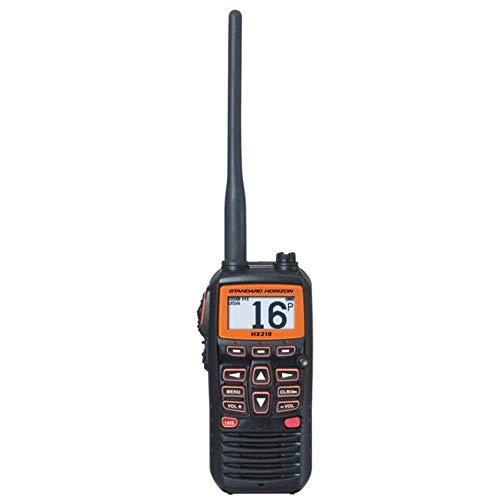 Standard Horizon HX210 6W Floating Handheld Marine VHFMedium1.57 x 2.36 x 5.2 inches1 PoundsCheck on Amazon
 Cobra BlueBound 350 VHF Handheld Marine RadioSmall2.05 x 2.6 x 10.04 inches0.59 poundsCheck on Amazon
The best marine radios for most boaters are a DSC-and-GPS-equipped fixed-mount VHF for routine cruising, or a waterproof handheld VHF when portability, backup capability, and simple installation matter more than maximum range.
Best marine radios by boating situation
| Boating situation | Best radio type | Useful target specification | Why it fits |
|---|---|---|---|
| Small boat, kayak, tender, or occasional use | Handheld VHF | 5–6 W transmit power, IPX7 or IPX8, built-in GPS, DSC | No permanent wiring; can travel with the operator and serve as an emergency backup |
| Day trips and coastal cruising | Fixed-mount VHF | 25 W high power, 1 W low power, DSC, GPS or NMEA connectivity | Better range, louder audio, and dependable operation from the boat battery |
| Offshore or remote cruising | Fixed-mount VHF plus handheld backup | 25 W fixed radio, waterproof 5–6 W handheld, separate antennas | Preserves communications if the main electrical system or antenna fails |
| Boat with more than one helm station | Modular or dual-station fixed VHF | Remote microphone support and intercom capability | Lets the operator communicate from the cockpit without duplicating the radio |
| Lowest installation cost | Handheld VHF | USB or cradle charging, replaceable or long-life battery | Avoids antenna, power, flush-mount, and NMEA installation work |
Fixed-mount versus handheld marine radios
Fixed-mount VHF radios
A fixed radio is the stronger primary choice for a powerboat, sailboat, or frequently used fishing boat. Its 25-watt high-power setting can provide substantially more range than a handheld’s typical 5 or 6 watts, although antenna height and installation often matter more than the wattage printed on the box. A properly mounted antenna high above the water can outperform a higher-powered radio connected to a poorly located antenna.

Uniden UM385BK 25 Watt Fixed Mount Marine VHF Radio, Waterproof, Noaa Weather Alert, All USA/Intl/Canadian Marine Channels
Chosen because it specifies Waterproof and Noaa Weather Alert.
View on Amazon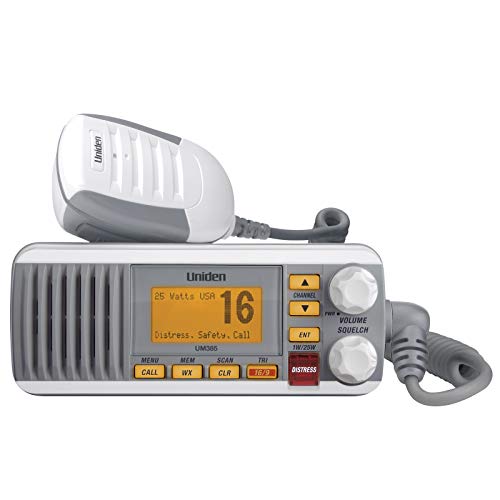
Uniden UM385 25 Watt Fixed Mount Marine Vhf Radio, Waterproof IPX4 with Triple Watch, Dsc, Emergency/Noaa Weather Alert, All Usa/International/Canadian Marine Channels, Memory Channel Scan, White
Chosen because it specifies Waterproof IPX4 with Triple Watch and Dsc.
View on AmazonStandard Horizon HX210 6W Floating Handheld Marine VHF Transceiver [HX210]
Picked as a relevant option in this category.
View on AmazonCobra BlueBound 350 VHF Handheld Marine Radio - White, 6-Watt, Floats
Chosen because it specifies White and 6-Watt.
View on AmazonFixed units also tend to have larger speakers, clearer controls, a more visible display, and reliable power from the boat’s electrical system. Examples include the Garmin VHF 115, Standard Horizon GX1400 and GX2400, Icom IC-M330, and Raymarine Ray63. Availability and exact package contents vary by region, so confirm that the model supports the channels and regulations used where you boat.
The trade-off is installation. You need a fused 12-volt connection, an appropriate marine VHF antenna and coax, a mounting location protected from spray, and often a GPS or chartplotter connection. A fixed radio is not useful if its antenna connector, power wiring, or fuse is neglected.
Handheld VHF radios
Handhelds are easier to buy, carry, and deploy. They are especially useful on small craft, tenders, kayaks, and boats where drilling or routing cable is impractical. They also remain valuable as a backup if the boat battery, fixed radio, or masthead antenna becomes unusable.
Good examples include the Standard Horizon HX890, Icom IC-M73, Icom IC-M94D, and Cobra MR HH600. Depending on the model, you may get DSC, an integrated GPS receiver, a dedicated distress button, a strobe, weather reception, and a charging cradle. The Icom M73 prioritizes long battery life and high audio output, while the Standard Horizon HX890 and Icom M94D add navigation-oriented features such as GPS and DSC support.
Handheld range is limited by the short antenna and the user’s position above the water. The advertised 5 or 6 watts does not eliminate that limitation. Keep the radio upright, hold it in the open rather than inside a cabin, and fully charge it before every trip.
Feature comparison: what the numbers mean
| Representative model | Format | Transmit power | Water resistance | Navigation and safety features | Ownership consideration |
|---|---|---|---|---|---|
| Garmin VHF 115 | Fixed mount | 25 W / 1 W | IPX7 class protection | DSC; GPS and network connectivity depend on installation | Requires antenna, 12 V wiring, and mounting space |
| Standard Horizon GX2400 | Fixed mount | 25 W / 1 W | Water-resistant marine construction | DSC, GPS capability, AIS receiver on supported versions | Feature-rich choice for boats with compatible navigation electronics |
| Standard Horizon HX890 | Handheld | 6 W / 1 W | IPX8-rated waterproof design | Built-in GPS, DSC, distress key, navigation functions | Rechargeable battery needs regular charging and replacement eventually |
| Icom IC-M73 | Handheld | 6 W / 1 W | IPX8-rated waterproof design | DSC and GPS are not its primary selling features; verify the exact variant | Large battery and loud audio suit long days on the water |
| Icom IC-M94D | Handheld | 6 W / 1 W | IPX8-rated waterproof design | Built-in GPS, DSC, and AIS receive capability | More expensive, but reduces the need for separate navigation information |
IPX7 generally means protection during temporary immersion, commonly up to 1 meter for 30 minutes under the test condition. IPX8 indicates a higher level of manufacturer-defined immersion protection, but the exact depth and duration still depend on the product. Neither rating means saltwater can be ignored. Rinse salt from the case and charging contacts with fresh water, then let the radio dry before charging.
DSC and GPS: features worth paying for
Digital Selective Calling, or DSC, allows a compatible radio to transmit a formatted distress alert rather than relying only on a voice call. When the radio has a valid GPS position and a registered Maritime Mobile Service Identity, the alert can include the vessel’s identity and location. This is one of the most useful safety upgrades over a basic voice-only VHF.
DSC is only helpful when it is configured correctly. Register for an MMSI through the appropriate national authority, enter it carefully, and connect the radio to GPS if the unit does not have its own receiver. Do not enter a made-up number to get past setup; many radios cannot easily change the MMSI after it is saved.
Built-in GPS is particularly useful in a handheld because it keeps the radio’s distress position available even when the boat’s chartplotter is off. On a fixed radio, an NMEA 0183 or network connection to the chartplotter may be perfectly adequate, but confirm connector compatibility before buying cables.
Audio clarity and transmit power
A clear 2- to 5-watt speaker is more useful than a nominally powerful radio whose speaker is masked by engine noise. Look for a front-facing speaker, a stated audio output around 700 mW or higher, a large volume knob, and a separate squelch control. Some handhelds advertise unusually loud audio, which is useful in wind and spray, but can consume more battery at high volume.
Use 1 watt when communicating with a nearby marina, bridge, or boat. Use 25 watts on a fixed set, or 5–6 watts on a handheld, when distance or conditions require it and local rules permit. High power is not a substitute for correct channel selection, a clear line of sight, or a properly installed antenna.
Installation requirements for a fixed radio
-
Choose the location. Keep the display visible and the microphone reachable while steering. Leave room behind the panel for connectors and cable bends.
-
Install the antenna first in your plan. Use a marine VHF antenna designed for the radio, with sound coax and weatherproof connections. Avoid sharp bends and unnecessary adapters.
-
Run fused power wiring. Follow the manufacturer’s wire-size and fuse recommendations. Connect directly to a suitable distribution panel or battery circuit rather than using a loose accessory socket.
-
Connect GPS and other equipment. Verify the wiring standard, especially when connecting older NMEA 0183 equipment to newer networked electronics.
-
Program and inspect. Enter the MMSI, test the display and microphone, inspect the antenna connection, and perform a radio check through an approved service rather than repeatedly transmitting unnecessary calls on working channels.
Durability and ownership costs
The parts most likely to wear first are handheld battery packs, rubber port covers, microphone seals, charging contacts, and antenna connectors. A rechargeable battery that once lasted 15 to 20 hours may eventually provide only a fraction of that runtime. If the radio is essential, budget for a replacement battery or a second charged pack rather than waiting for the original to fail.
After saltwater exposure, rinse the exterior with fresh water, wipe the contacts, and dry the radio with the charging cover open. Do not charge a visibly wet unit. Store handhelds partly charged during extended off-season storage according to the battery maker’s instructions, and check them every few months.
Typical market pricing is roughly $120–$300 for a basic handheld, $250–$500 for a GPS/DSC handheld with advanced features, and $180–$600 for a fixed-mount VHF before adding an antenna, coax, mounting hardware, and professional installation. A fixed setup can therefore cost considerably more than the radio itself.
Final buying recommendation
Choose a fixed-mount 25-watt VHF with DSC and GPS connectivity if your boat has a permanent 12-volt system and you regularly travel beyond sheltered waters. Choose a waterproof 5–6-watt handheld with built-in GPS and DSC if you need portability, operate a small craft, or want an emergency backup. For offshore trips, the strongest setup is both: a properly installed fixed radio as the primary communicator and a charged, waterproof handheld stored where it can be reached quickly.










Write Your Review
No reviews yet. Be the first to share your experience!