
Our Top Picks
Best Hunting Blinds for Concealment and Comfort
The best hunting blinds depend on where you hunt: choose a lightweight pop-up for mobile setups, a hub-style blind for fast deployment and two-person comfort, a tower or elevated blind for long-term concealment, and a box blind when weather protection matters more than portability.
Quick comparison: which blind fits your hunt?
| Blind type | Typical setup time | Packed size | Typical weight | Interior space | Best use |
|---|---|---|---|---|---|
| Lightweight ground pop-up | 2–5 minutes | 30–36 in. long | 8–14 lb | One adult | Run-and-gun whitetail or turkey hunting |
| Two-person hub blind | 3–8 minutes | 34–42 in. long | 12–22 lb | 55–75 sq. ft. | Archery and firearm hunts with a partner |
| Large multi-person hub blind | 5–10 minutes | 38–48 in. long | 18–35 lb | 75–100 sq. ft. | Families, guides, or three hunters |
| Elevated box blind | Several hours to install | Usually transported in panels | 150–500+ lb | 12–32 sq. ft. | Repeated use on one property |
These figures are practical buying ranges rather than universal specifications. Actual dimensions vary by model, frame construction, fabric, windows, and included accessories. A large blind can offer more usable room, but its packed length and weight become important if you must carry it through brush or over uneven ground.

TIDEWE Hunting Ground Blind, See Through, 270° View, 2-3 Person
Chosen because it specifies See Through and 270° View.
View on Amazon
FUNHORUN Hunting Blind with Floor Mat, 360 See Through Ground Blind, Pop Up
Chosen because it specifies 360 See Through Ground Blind and Pop Up.
View on Amazon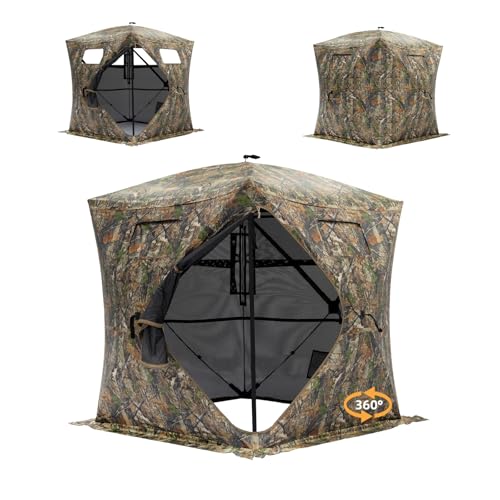
JOMAILIEEL 360 See Through Ground Blinds for Deer and Turkey, Pop Up Deer Blind with Diamond-Shaped Door, Mud Flap, Portable Carry Bag and Quiet-Fast Setup
Chosen because it specifies Pop Up Deer Blind with Diamond-Shaped Door and Mud Flap.
View on Amazon
PHYSKE 270/360 Degree Hunting Blind, See Through Pop‑Up Ground Deer Blind
Chosen because it specifies See Through Pop‑Up Ground Deer Blind.
View on AmazonBest overall choice for most hunters: a two-person hub blind
A two-person hub blind is the most balanced option for many whitetail and turkey hunters. Its umbrella-like hub frame opens quickly, the footprint is large enough for two chairs, and the fabric usually provides better concealment than a minimalist one-person shelter. Models from brands such as Ameristep, Barronett Blinds, RedHead, and Primos are common examples of this category.
Look for an interior around 60 to 75 square feet, a peak height near 70 inches, and enough vertical wall space to position a firearm or bow without pressing against the fabric. A blind that technically fits two people may feel cramped once you add backpacks, shooting sticks, bow limbs, or a camera.
For archery, prioritize silent window covers and generous horizontal openings. For firearms, adjustable mesh and firearm-height windows are more useful than a very wide panoramic opening. Dark interiors also help prevent movement from being outlined when the exterior windows are open.
Best for mobile setups: a lightweight one-person blind
If your hunting strategy changes locations frequently, weight and packed size matter more than maximum comfort. A one-person pop-up weighing 8 to 14 pounds can be carried with other equipment, while a 25-pound blind may become a burden after a long walk.
The trade-off is limited movement. A compact blind often has room for one low chair or stool, but little space for a bow case, pack, or shooting tripod. It can also have a narrower field of view. That is not necessarily a disadvantage: smaller window openings can improve concealment when you are sitting close to a trail or feeding area.
Choose a model with a carry bag that has compression straps and a durable bottom panel. A bag that is 36 inches long may fit in a vehicle easily but still be awkward to carry through tight timber. Before buying, measure the distance from your parking area to likely setup locations and consider whether you will carry the blind alone.
Best for visibility: panoramic hub designs
Panoramic blinds, including designs such as the Primos Double Bull SurroundView, are intended to provide a wide field of view while keeping the hunter inside a dark, concealed interior. They are useful when game can approach from several directions or when two hunters need to monitor a broad opening.
Visibility is only valuable if the window system can be controlled quietly. Examine whether the mesh can remain in place while the lower fabric opens, whether the window covers roll upward or sideways, and whether exposed hook-and-loop closures can make noise. A wide window also increases the chance that movement will be visible, so the blind should have a dark interior and good shadowing.
For bowhunting, check the angle between the seat and each window. A broad window may look impressive, but a vertical support bar can block the exact shooting lane you need. Sit in the blind with your bow or unloaded firearm and simulate drawing, shouldering, and turning before settling on a design.
Best for bad weather: elevated or semi-permanent blinds
For repeated use through rain, snow, and wind, a rigid or elevated box blind offers more dependable protection than fabric. Solid walls reduce drafts, a roof sheds precipitation, and enclosed windows make it easier to wait comfortably during a long sit. The disadvantages are cost, transport difficulty, installation time, and reduced flexibility.
Fabric blinds can still handle poor weather if they have waterproof or water-resistant treatment, taped or covered seams, a sloped roof, and strong tie-down points. “Waterproof” fabric does not make the entire blind stormproof. Water can enter through open windows, stitching, zippers, and the floor seam.
In windy areas, use all anchor points, add stakes suited to the soil, and attach the blind to brush or natural cover when permitted. A blind that survives a calm afternoon may fail overnight if it is left assembled without proper anchoring.
Decision matrix: match the blind to your situation
| Your situation | Recommended choice | What to prioritize | What to avoid |
|---|---|---|---|
| New hunter with a limited budget | Basic two-person hub blind | Simple frame, replaceable stakes, quiet windows | Oversized specialty features you will rarely use |
| Frequent relocation between properties | One-person lightweight pop-up | Under 14 lb, compact carry bag, fast setup | Large panoramic models over 25 lb |
| Two archery hunters | Two-person hub blind with tall windows | Silent covers, 70-inch-plus peak, broad shooting lanes | Low roof and narrow vertical openings |
| Three hunters or a family group | Large hub blind or rigid blind | At least 75 sq. ft., multiple shooting positions | Nominal “three-person” blinds with little gear room |
| Permanent location with frequent sits | Elevated or box blind | Weather sealing, comfortable seats, stable windows | Lightweight fabric not designed for extended deployment |
Setup and concealment: details that matter more than camouflage
Camouflage helps, but placement and movement usually determine whether a blind disappears. Set up several days before hunting when possible so animals can become accustomed to its shape. Brush the outline with natural vegetation without covering windows, vents, or structural joints.
- Choose the background first. Place the blind against brush, timber, or a shadow line rather than in the middle of an open field.
- Face away from the rising or setting sun. Direct light through an open window can expose movement and make the interior bright.
- Check shooting lanes while seated. A lane that looks clear while standing may be blocked by a window frame when you are seated.
- Stake every corner and hub. Tension reduces flapping, which can alert animals and wear the fabric.
- Practice window operation before hunting. Locate pulls by touch so you do not search for them during a shot opportunity.
Keep the blind far enough from the expected travel route that animals do not have to pass directly beside it. Follow local rules regarding placement, bait, public land structures, and how long a blind may remain unattended.
Durability and ownership realities
The first parts to wear are commonly window closures, zipper pulls, hub joints, stake loops, and the bottom edge of the fabric. Repeated folding while the blind is wet can encourage mildew and may weaken coatings. Allow the blind to dry completely before storing it, then pack it loosely enough that sharp frame sections do not create permanent creases.
Clean fabric with mild soap, cool water, and a soft brush. Avoid bleach, strong solvents, and aggressive pressure washing because they can damage water-repellent treatments and camouflage printing. Inspect poles and hubs at the end of each season, and replace bent stakes before the next high-wind setup.
Do not leave a pop-up blind unattended for long periods unless the manufacturer permits extended deployment. Ultraviolet light can fade fabric, and wind can gradually enlarge stake holes even when the blind appears intact.
Final recommendation
For most hunters, a two-person hub blind with a dark interior, quiet adjustable windows, a 60–75-square-foot footprint, and a weight below roughly 22 pounds is the strongest all-around choice. Pick a lighter one-person blind when mobility is the priority, a panoramic design when visibility drives the hunt, and a rigid elevated blind when the location is permanent and weather protection justifies the installation effort.









Write Your Review
No reviews yet. Be the first to share your experience!