
Our Top Picks
 MFASCO Waterproof Marine First Aid Kit for Boating10.5 x 8.5 x 4.75 inches4.25 PoundsCheck on Amazon
The best marine first aid kits for boating are a waterproof offshore kit for remote or multi-day trips, a compact day-trip kit for small crews, and a larger organized kit when you need supplies for six or more people or several days away from shore.
Quick picks by boating situation
| Boating situation | Best kit type | Useful capacity target | Why it fits |
|---|---|---|---|
| Short lake or harbor trips | Compact waterproof day kit | 1–4 people, up to 24 hours | Small enough to stay accessible without taking valuable storage space |
| Frequent coastal day trips | Mid-size waterproof boating kit | 4–6 people, 1–3 days | Better wound-care depth and more backup dressings |
| Offshore, fishing, or overnight trips | Large marine or expedition kit | 6–10 people, 3–7 days | More bandages, trauma dressings, blister care, tools, and replacement supplies |
| Remote cruising or charter work | Large kit plus separate backup pack | 10 or more people or more than 7 days | Reduces the risk of exhausting one kit or losing access to it |
What makes a marine first aid kit different?
A boating kit must tolerate salt spray, condensation, wet hands, and storage in a locker that may be opened repeatedly. A fabric pouch with a water-resistant zipper can work inside a dry cabin, but it is not equivalent to a sealed hard case or a roll-top dry bag.
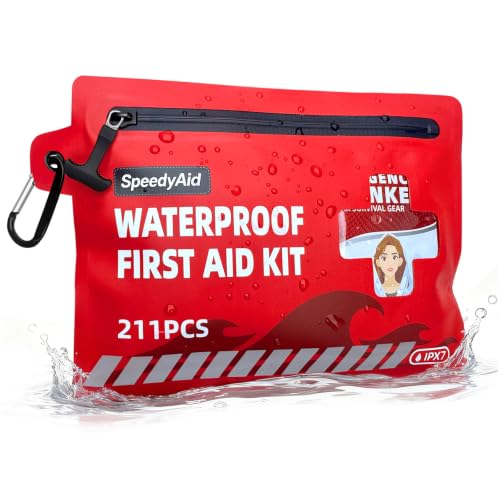
211 PCS Waterproof First Aid Kit, Emergency Supplies for Hiking & Boating
Chosen because it specifies Emergency Supplies for Hiking & Boating.
View on Amazon
WELL-STRONG Waterproof First Aid Kit Roll Top Boat Emergency Kit with Waterproof Contents for Fishing Kayaking Boating Swimming Camping Rafting Beach Red
Picked as a relevant option in this category.
View on AmazonMFASCO Waterproof Marine First Aid Kit for Boating & Camping
Picked as a relevant option in this category.
View on AmazonLook for a case made from molded plastic, welded coated fabric, or another material that can be wiped clean. A gasketed hard case offers the strongest protection against splashes and crushing. A dry bag is lighter and easier to pack into irregular spaces, but its seal depends on correctly rolling and closing the top. “Water-resistant” is not the same as submersible; check the manufacturer’s stated protection level rather than assuming any waterproof-looking case is suitable for deck storage.
The case should also be recognizable in poor light. A bright color, large first-aid marking, and an internal layout with labeled pouches can save more time than adding another type of adhesive bandage.
Best marine first aid kit types compared
Compact waterproof day-trip kits
Choose this format for one to four people boating near shore, especially when another source of help is readily available. A practical target is 40–80 individual wound-care items, two or more medium dressings, several pairs of gloves, antiseptic wipes, tweezers, scissors, tape, and a basic emergency blanket.
The main advantage is access. A kit that fits beside the helm or in a cockpit locker is more useful than a larger kit buried beneath spare lines. The compromise is limited redundancy: a small kit may run short after one substantial cut, several blisters, or multiple minor injuries on the same trip.
Mid-size coastal kits
This is the best all-round choice for many recreational boaters. It should serve four to six people for a long day or a few nights, with multiple sizes of sterile dressings, elastic or conforming bandages, triangular bandages, wound-closure strips, eye-wash or eye-care supplies, cold-pack capability, and a useful selection of protective gloves.
A mid-size kit is also easier to maintain than an expedition box. You can see what has been used, replace expired items, and keep a duplicate of frequently consumed supplies in a small grab pouch.
Large offshore and expedition kits
Large kits are appropriate when rescue may take longer, the crew is larger, or the boat operates far from medical facilities. Adventure Medical Kits’ Marine 450 and Marine 1000 are examples of marine-oriented kits designed around progressively larger crew and trip requirements. Product contents and packaging can change, so verify the current inventory and stated capacity before buying.
Large kits generally provide more trauma dressings, wound irrigation supplies, closure materials, burn-care items, blister treatment, splints or triangular bandages, and medication compartments. They are not a substitute for crew training or professional medical advice, and their extra contents only help if someone on board knows how to use them.
Contents that matter most on a boat
- Wound care: Include adhesive strips in several sizes, sterile gauze, non-adherent dressings, conforming bandages, medical tape, and wound-closure strips.
- Bleeding control: Look for several pairs of nitrile gloves, absorbent trauma dressings, pressure bandages, and a durable pair of shears. Follow current professional training when selecting any advanced bleeding-control item.
- Eye care: Salt, fish hooks, grit, and fuel-related splashes make eye protection and sterile rinsing supplies useful. Eye injuries warrant prompt professional assessment.
- Burn care: Include sterile non-stick dressings and burn-specific dressings or gel where appropriate. Avoid relying on a tiny single-use packet for a crew-sized kit.
- Sprains and fractures: Triangular bandages, elastic wraps, and moldable or padded splint materials add versatility without requiring a rigid full-length splint.
- Tools: Tweezers, scissors, a marker, safety pins, a thermometer, and a small flashlight can be more useful than duplicate novelty items.
- Barrier and hygiene items: Hand sanitizer, cleansing wipes, waste bags, and a CPR face shield help reduce contamination during care.
- Medication section: If a kit includes medicines, check active ingredients, age restrictions, allergies, storage conditions, and local regulations. Keep personal prescriptions separate and clearly labeled.
Waterproofing, size, and capacity: the practical trade-off
| Case format | Approximate external size | Typical empty weight | Best storage location | Main limitation |
|---|---|---|---|---|
| Small zip pouch | 20 × 14 × 7 cm | 0.25–0.5 kg | Helm drawer or day bag | Usually splash-resistant rather than fully sealed |
| Medium dry bag | 28 × 20 × 12 cm | 0.5–1.0 kg | Cockpit locker or cabin shelf | Contents can become disorganized without internal pouches |
| Gasketed hard case | 32 × 24 × 15 cm | 1.0–2.0 kg | Protected locker or cabin bulkhead | Uses more space and may be awkward in a small boat |
| Large expedition case or bag | 40 × 30 × 18 cm or larger | 2.0–4.0 kg | Dedicated medical locker | Can be left behind if the crew stores it too deeply |
These are useful planning ranges, not a specification for a particular brand. Measure the actual locker opening, not just its internal volume. A case that fits inside a compartment may still be impossible to remove when other equipment is packed around it.
How much capacity do you need?
Use a simple planning calculation: start with one wound-care set per person for each day, then add a 50% reserve for common consumables. For six people on a three-day trip, that is 18 baseline person-days. Adding half again gives 27 person-days of bandages, dressings, gloves, and cleaning supplies. You do not need 27 complete trauma kits; use the figure to judge whether a small kit is clearly undersized.
For a six-person overnight trip, a reasonable minimum might include 24–36 adhesive dressings, at least six medium sterile dressings, two or more larger trauma dressings, 12 pairs of gloves, several gauze rolls, two triangular bandages, multiple meters of medical tape, and spare cleansing supplies. Increase those quantities if fishing hooks, sharp tools, children, or rough deck work are part of the itinerary.
Buying checklist for 2026
- Confirm the case is genuinely waterproof or sealed to the level your storage location requires.
- Choose a size that remains accessible when the boat is fully loaded.
- Prioritize wound-care depth over an inflated item count made up of tiny duplicates.
- Check whether sterile items have clear expiration dates and whether replacements are easy to source.
- Prefer labeled compartments or color-coded pouches so a crewmember can find supplies quickly.
- Keep a contents list inside the lid and a second copy in the boat’s safety paperwork.
- Do not assume included medicines suit every crewmember or jurisdiction.
- Pair the kit with a communication device, flotation equipment, and appropriate first-aid training.
Maintenance mistakes that shorten a kit’s life
Saltwater damage often begins with the zipper, scissors, metal tweezers, or snap fasteners rather than the case fabric. After a wet trip, wipe the exterior with fresh water, dry it fully, and inspect metal tools for corrosion. Do not seal damp contents inside a supposedly waterproof case; trapped moisture can damage dressings and encourage odor or mold.
Review the kit after every trip, even when nothing appears to have been used. Count gloves, tape, dressings, and wipes, because these are the items most often removed without being recorded. Replace crushed sterile packaging, opened antiseptic products, expired medicines, and any item contaminated by water or fuel.
Store the kit away from prolonged heat and direct sunlight. Heat can degrade adhesives, medicines, elastic wraps, and some plastic packaging. A second small “rapid access” pouch containing gloves, gauze, tape, and a dressing can be kept near the helm while the main kit remains protected in the cabin.
Final recommendation
For most recreational boaters, a well-organized mid-size waterproof kit is the strongest balance of protection, capacity, and accessibility. Select a compact kit only when trips are short and close to help. Choose a large marine or expedition kit when the crew is bigger, trips last several days, or evacuation could be delayed. Whatever size you buy, waterproof storage, fresh consumables, clear organization, and crew familiarity matter more than a long item count printed on the package.








Write Your Review
No reviews yet. Be the first to share your experience!