
Our Top Picks
The best leg compression massagers for home recovery are Hyperice Normatec 3 Legs for adjustable, established performance; Therabody RecoveryAir JetBoots for cordless convenience; and a lower-cost sequential air-compression system for shoppers who mainly want occasional calf and leg relief without premium pricing.
Quick picks by situation
- Best all-around choice: Hyperice Normatec 3 Legs. Its five overlapping compression zones, seven intensity levels, and separately adjustable programs make it a strong fit for frequent users who want detailed control.
- Best for minimum setup: Therabody RecoveryAir JetBoots. The pump is built into the boots, so there are no external air hoses or a separate control unit to store.
- Best for a tighter budget: a wired four- or five-chamber compression system. These usually sacrifice portability and fabric refinement but can provide useful sequential inflation at a substantially lower market price.
- Best for tall users: a system with dedicated tall sleeves or extension options. A high maximum circumference does not guarantee enough length; check both measurements before buying.
What separates the best leg compression massagers
These devices use air-filled chambers that inflate and deflate in sequence, usually moving from the foot upward. The meaningful differences are not just the number of pressure levels. Fit, chamber coverage, control layout, noise, battery design, and storage determine whether a system becomes a useful routine or an awkward piece of equipment.

FIT KING Leg Compression Massager with Heat for Circulation and Pain Relief
Picked as a relevant option in this category.
View on Amazon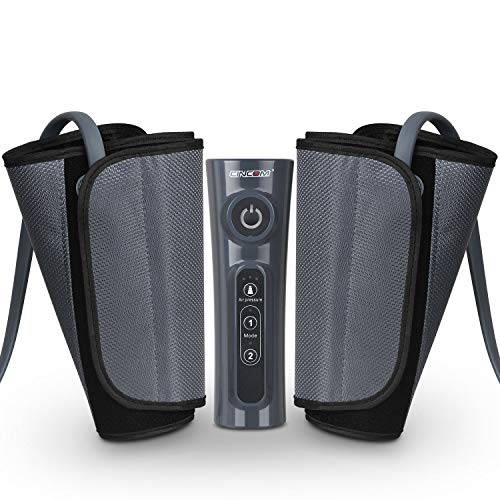
CINCOM Leg Massager for Circulation and Pain Relief FSA - HSA
Chosen because it specifies HSA.
View on Amazon
QUINEAR Leg Recovery Compression System for Athlete Post Workout, Professional Sequential Device for Massage Therapy, Foot and Leg Recovery Boots, Improve Circulation Reduce Muscle Soreness (Medium)
Chosen because it specifies Professional Sequential Device for Massage Therapy and Foot and Leg Recovery Boots.
View on Amazon
CINCOM Leg Massager with Heat and Air Compression FSA - HSA
Chosen because it specifies HSA.
View on AmazonLeg length and circumference fit
Measure both legs while standing or sitting naturally. Record the distance from the heel or sole to the highest point the sleeve should cover, then measure circumference around the ankle, calf, and thigh. Compare those numbers with the manufacturer’s sleeve chart rather than relying on a generic “one size fits most” label.
Length matters because a sleeve that ends below the upper thigh leaves part of the leg untreated. Circumference matters because an excessively loose chamber may inflate without distributing pressure evenly, while an overly tight sleeve can feel uncomfortable before the program begins. If you are between sizes, look for adjustable fasteners or an extension piece—not merely a larger maximum circumference.
Compression zones and pressure settings
Four chambers can provide useful foot-to-thigh sequencing. Five or more zones generally create a smoother transition along a full-length leg, particularly for users who dislike abrupt changes in pressure. More zones do not automatically mean better results, but they give the manufacturer more control over the inflation pattern.
Pressure is commonly expressed in mmHg. Consumer systems often offer roughly 20–100 mmHg, although the available range and preset names vary. A greater maximum is not a reason to use the highest setting. Start at a comfortable low or medium level and increase only if the manual allows it and the sensation remains comfortable.
| System type or example | Zones | Pressure control | Power and runtime | Storage footprint | Typical 2026 market range |
|---|---|---|---|---|---|
| Hyperice Normatec 3 Legs | 5 overlapping zones per leg | 7 intensity levels; zone and program controls depend on mode | Rechargeable control unit; approximately 3 hours of typical battery use | Two long sleeves plus a separate control unit; plan for about 0.5 cubic metre of shelf or bag space | About $700–$900 |
| Therabody RecoveryAir JetBoots | Sequential full-leg air chambers | Multiple preset pressure levels; cordless controls integrated into the boots | Built-in rechargeable batteries; commonly rated for several sessions per charge | Compact compared with hose-based systems, but boots remain bulky when folded | About $700–$900 |
| Entry-level wired four-zone system | 4 zones per leg | Usually 3–6 levels, often controlled by one shared pump | Wall-powered; no battery maintenance | Two sleeves, hoses, and a pump; roughly 0.2–0.4 cubic metre in a drawer or storage bin | About $100–$250 |
| Premium wired five- or six-zone system | 5–6 zones per leg | Several preset programs and a broad adjustable range | Wall-powered or optional battery, depending on model | Largest setup because of long sleeves, tubing, and controller | About $300–$700 |
Specifications and prices can change by package, region, and sleeve size. Treat the table as a shopping framework and verify the current manual for the exact configuration.
Head-to-head: Normatec 3 Legs versus RecoveryAir JetBoots
Choose Normatec 3 when control matters most
Normatec 3 Legs is the more suitable choice for someone who uses compression several times per week and wants to adjust the experience over time. Its five-zone layout and seven intensity settings offer more fine-grained control than basic systems. The trade-off is a separate control unit, air connections, and more pieces to pack away.
Its sleeves are also more likely to suit shoppers who want a traditional, serviceable configuration: the pump can remain on a table while the user sits nearby. Measure carefully, especially if you have unusually long legs or a large thigh circumference, because the standard and tall options are not interchangeable.
Choose RecoveryAir JetBoots when setup friction is the problem
RecoveryAir JetBoots place the pumping hardware in the boots, which removes external hoses and makes the system easier to move between rooms. That is valuable in a small apartment, shared living space, or home where equipment cannot stay assembled.
The integrated design also changes the weight distribution. Each boot can feel heavier than a simple sleeve, and charging becomes part of ownership. Check charging time, battery warranty, and whether the boots can be used while connected to power before treating them as a travel solution.
Decision matrix for real homes
| Your situation | Best direction | Why | Watch out for |
|---|---|---|---|
| Budget under $250; use once or twice weekly | Four-zone wired system | Lowest cost per session and no battery to replace | Less precise pressure control and more basic materials |
| Daily or near-daily use | Normatec 3 or another premium five-zone system | Better adjustability and a more refined fit system can justify the cost | Do not skip cleaning and zipper or hook-and-loop care |
| Small room or shared home | RecoveryAir JetBoots or another hose-free design | Fewer loose parts and faster setup | Boots still need a substantial storage bag or shelf |
| Tall legs or broad thighs | Tall sleeves with published measurements | Length and upper-leg coverage are easier to verify | Do not select by ankle circumference alone |
| First-time user who dislikes strong pressure | System with at least four low-to-medium settings | Allows gradual familiarization | More settings cannot compensate for a poor sleeve fit |
A simple cost-per-use calculation
Suppose a $180 wired system lasts three years and you use it twice each week. That is approximately 312 sessions, or about $0.58 per session before electricity and replacement parts: $180 divided by 312.
A $800 premium system used five times per week for three years would provide about 780 sessions, or approximately $1.03 per session. The premium system is not automatically the better value; its higher price makes sense only if its fit, portability, controls, or durability lead you to use it substantially more often.
Storage, cleaning, and durability realities
Measure the storage location before buying. Full-length sleeves do not fold as small as clothing because their air channels and closures need to avoid sharp creases. A practical setup may require a 60–90 cm-wide shelf for the folded sleeves, plus room for a pump, charger, and hoses. Hose-based systems are easier to repair or replace piece by piece, while cordless boots reduce clutter but concentrate more electronics in the garment.
- What wears first: zippers, hook-and-loop fasteners, hose connectors, and the fabric around the ankle and knee bends.
- Clean correctly: wipe the inner lining with a lightly damp cloth and mild soap, then air-dry fully. Do not machine-wash or immerse powered boots unless the manual specifically permits it.
- Protect the chambers: store sleeves loosely folded, never sharply compressed under heavy equipment.
- Prevent odor: wear clean, dry clothing underneath and allow the sleeves to dry between sessions.
- Avoid common mistakes: do not connect hoses with the pump running, force a zipper over an incorrectly positioned leg, or operate a cordless unit with a nearly empty battery if the manual warns that performance may drop.
Safety and final buying advice
Use these products only as directed. Stop if you experience pain, numbness, unusual swelling, skin discoloration, or persistent tingling. People with circulation disorders, a history of blood clots, unexplained one-sided swelling, significant heart or kidney conditions, or recent surgery should ask a qualified healthcare professional before using pneumatic compression.
For most shoppers, the decision comes down to three checks: does the sleeve cover your actual leg length, can its pressure range accommodate a comfortable starting level, and can you store it without leaving it permanently in the way? If all three answers are yes, choose Normatec 3 Legs for control, RecoveryAir JetBoots for cordless convenience, or a well-sized four-zone wired system for economical occasional use.
Write Your Review
No reviews yet. Be the first to share your experience!