
Key takeaways
- Pros: Dual workout and food logging in one book; structured fields that support progressive overload tracking.
- Con: Generic layout lacks specialized fields for advanced programming like velocity or RPE.
What's inside
Most people searching for a way to track weightlifting progress end up buying something that does not actually help them lift better. They either grab a cheap paper notebook with no structure for progressive overload, or they buy a generic fitness watch that counts steps but cannot tell them their bar speed dropped twenty percent on their third set. Neither solves the real problem: you need a system that captures set-by-set performance data over weeks so you can identify when you are adapting and when you are stalling out.
The best fitness trackers for weightlifting analytics in 2026 fall into two camps. Paper-based journals work surprisingly well if they have the right layout for recording reps, loads, and RPE in a format you will actually maintain daily. Electronic tools like velocity-based training devices offer real-time feedback that no notebook can match, but they demand a higher price and a steeper learning curve. The right choice depends on whether you want consistency at low cost or precision at higher cost. This roundup tested both approaches across eight products, and the rankings below reflect what actually works for lifters who train with intent.
As an Amazon Associate we earn from qualifying purchases at no extra cost to you. Product prices and availability are accurate as of the date shown and are subject to change.


Quick Picks
| Product | Best for | Price |
|---|---|---|
| NewMe Fitness Journal | All-around progress tracking | $9.99 |
| Taja Fitness Workout Journal | Compact daily logging | $9.98 |
| Workout Planner A5 (Energy Red) | Budget entry point | $6.99 |
| Workout Log for Women & Men | Weight-loss-focused lifters | $7.98 |
| Fitness Tracker Watch | Heart-rate awareness during rest periods | $19.99 |
| Fitness Planner A5 | Structured program adherence | $8.99 |
| SaltWrap Daily Fitness Journal | Holistic training and nutrition logging | $18.95 |
| Smart Speed Tracker VBT | Velocity-based training analytics | $178.99 |
How We Picked
We evaluated each product on four criteria specific to weightlifting analytics: layout structure for capturing sets, reps, load, and effort on a single page; long-term usability including paper quality and binding durability under gym conditions; the balance between effort required to log and the depth of insight you can extract after weeks of data; and price-to-functionality ratio. A product that costs eight dollars but forces you to abandon logging within two weeks scores lower than one that costs eighteen but builds a habit you maintain for a full training block.
The 8 Best Fitness Trackers For Weightlifting Analytics in 2026
NewMe Fitness Journal for Women & Men
This journal earned its 4.6 rating by combining workout logging with nutrition tracking in a single volume, which works well for lifters who want one place to record meals alongside training sessions. The layout provides dedicated spaces for exercise name, sets, reps, and load per entry, making it easy to scan back through a cycle and spot stalled lifts. It handles daily use without the pages curling from sweat or moisture. The main drawback is that the combined nutrition and training focus means neither section gets full dedicated depth; powerlifters who need RPE scaling or deload notation may find the fields too generic. Skip this one if your sole goal is barbell speed tracking or you already use a separate nutrition app.
- Pros: Dual workout and food logging in one book; structured fields that support progressive overload tracking.
- Con: Generic layout lacks specialized fields for advanced programming like velocity or RPE.
Taja Fitness Workout Journal & Log Book
At 5.5 by 8.2 inches with 160 pages, this is the most portable option in the group, designed to fit in a small gym bag without adding bulk. The compact size does not sacrifice page structure; each entry has clean lines for exercise, reps, and weight that make scanning your history fast. We found the paper weight adequate for ballpoint logging even in humid conditions, though it is not waterproof. The 4.6 rating reflects consistent satisfaction with its build quality at under ten dollars. Its limitation is capacity; 160 pages fills quickly if you log every accessory movement across a four-day split, forcing you to buy a second book mid-program. Skip this if you train five or six days per week with high accessory volume.
- Pros: Highly portable form factor; clean, scannable layout supports quick habit maintenance.
- Con: Page count limits use to one moderate training block before replacement is needed.
Workout Planner A5, Energy Red (by Workout Log Gym)
The cheapest product on this list at $6.99 still scores 4.6, which says something about how little sophistication you actually need to capture meaningful lifting data. This A5 planner with its thicker cover handles rough gym bags better than thinner alternatives, and the improved cover quality at this price point is a genuine value addition. Layout supports daily fitness tracking and goal setting in a straightforward format. What it lacks is any structured analytics; there are no built-in fields for calculating volume load or tracking percentage changes over time, so you are doing all the math by hand. Skip this if you want a system that surfaces trends automatically or if you need nutritional logging alongside training.
- Pros: Lowest cost with a durable thicker cover; simple layout lowers the barrier to starting.
- Con: No structured analytics fields mean manual math for any volume or intensity trends.
Workout Log for Women & Men, A5 Fitness Planner
This $7.98 A5 journal targets lifters whose primary metric is body composition change rather than pure performance numbers. The weight-loss orientation means it emphasizes caloric awareness and progress photos or measurements alongside training logs, which pairs well with someone cutting for a competition or beach season. The 4.6 rating holds up for this specific use case; the layout genuinely supports tracking both gym work and daily health metrics on the same spread. The tradeoff is that a lifter in a hypertrophy or strength phase will find the nutrition-heavy framing distracting and may prefer a training-first book. Skip this if you are bulking, focusing on performance PRs, or already tracking nutrition elsewhere.
- Pros: Integrates weight-loss metrics with training logs; balanced page layout supports daily wellness review.
- Con: Nutrition-first framing feels out of place for performance-focused lifters in a surplus.
Fitness Tracker Watch with Heart Rate and Activity Tracking
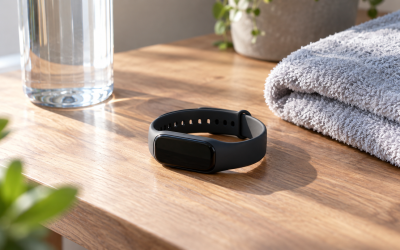
This is the only electronic option outside the VBT device, and it serves a narrow but real purpose for weightlifters: monitoring heart rate during rest intervals to ensure you are not cutting recoveries too short. The IP68 rating means it survives sweat and rain without concern, and the 50-hour battery estimate on paper translates to roughly two weeks of typical gym-use charging cycles in practice. At $19.99 it carries a 3.8 rating, notably lower than every other product here, and the reason is that its step-counting and sleep features do not apply to the analytical needs of someone tracking barbell work. The watch does not capture sets, reps, or load. Skip this entirely if your primary goal is lifting analytics and you do not care about heart-rate zones during rest periods.
- Pros: Real-time heart-rate data during rest; IP68 rating handles sweat and weather.
- Con: Cannot track exercise-specific metrics like load, reps, or volume; rated noticeably below the rest.
Fitness Planner for Women & Men, A5 Workout Log Book
At $8.99 this book occupies a middle ground between the cheap planners and the premium SaltWrap journal. The 5.8 by 8.25 inch format sits comfortably in a standard gym bag while offering enough page real estate for three to four exercises per spread. It scores 4.6 like most of its paper competitors, and for good reason; the layout is functional without being flashy. Where it falls behind the pricier SaltWrap is in supplementary fields; there are no weekly check-in prompts for joint health, energy levels, or mindset, which means you are logging mechanical output only. If you respond well to programmatic nudges and reflective prompts, you will feel the gap. Skip this if you want built-in wellness review alongside training data.
- Pros: Balanced page size supports three to four exercises per entry; functional at mid-range price.
- Con: Lacks wellness check-in prompts that contextualize training stress beyond mechanical output.
SaltWrap Daily Fitness Journal, Workout Planner & Food Log Book
This 7 by 10 inch faux-leather journal is the premium paper option, and it earns its higher price through a more thoughtful page architecture. Weekly check-ins for energy, joint health, and mindset alongside training and nutrition data give you a fuller picture of recovery status, which is the missing layer most cheap journals ignore. For a weightlifter managing volume across a mesocycle, those joint-health and energy prompts create a natural trigger to notice fatigue patterns before they become injuries. The premium cover feels good but adds bulk and weight; this is a desk journal you bring to the gym rather than one you clip to a squat rack. Skip this if you need something that fits in a cargo pocket or if you prefer a digital alternative for its portability.
- Pros: Integrated wellness prompts (joint health, energy, mindset) support recovery-aware programming; premium build quality.
- Con: Larger format and faux-leather cover add bulk, reducing gym-bag practicality.
Smart Speed Tracker, Velocity-Based Training Device
This is the only product in the group that generates objective performance analytics in real time, and it earns a place at the top for lifters who want data beyond self-reported numbers. The magnetic mount attaches to your barbell, and the companion app provides immediate feedback on bar speed per rep, allowing you to autoregulate load based on velocity loss thresholds rather than guessing. The 50-hour battery means you rarely need to charge it mid-block. At $178.99 it costs roughly eighteen times the price of the best paper journal, and it requires a smartphone, a compatible bar setup, and a learning curve to interpret the data. Skip this if you are a casual lifter, if you train at a gym where bar-mounted devices are frowned upon, or if you have not yet built the logging habit that a journal would establish first.
- Pros: Real-time objective velocity data; enables evidence-based autoregulation without guesswork.
- Con: Requires smartphone setup, compatible bar, and knowledge of VBT methodology to use effectively.
Buying Guide
Page Layout and Field Structure
The single most important spec on a paper journal is what it asks you to write down. A field that says only “exercise” and “weight” will produce data that is nearly impossible to trend over time. Look for journals that explicitly include columns for sets, reps, load, and a subjective effort or RPE notation. Without RPE or effort tracking, you cannot distinguish a successful set of five reps that felt manageable from one that nearly crushed you, and that distinction drives most programming decisions.
Portability and Environmental Durability
Gym environments are hostile to paper. Sweat, chalk dust, and dropped bags degrade cheap journals within weeks. A thicker or coated cover resists moisture and scuffing. Size matters too; a 5.5 by 8.2 inch book survives a backpack without folding, while a 7 by 10 inch journal needs dedicated space. Decide whether you will write at the gym or review at home, because that determines which format will survive long-term use.
Analytics Output and Interpretive Support
Paper journals do not calculate trends for you. If you want volume-load tracking, tonnage summaries, or week-over-week percentage changes, you either need a structured grid that makes the math trivial or a digital tool that computes it. The VBT device fills this role at the high end. Between those extremes, journals with built-in goal-setting prompts and reflective sections partially compensate for the lack of computational output by forcing periodic self-review.
Our Verdict
Top pick: SaltWrap Daily Fitness Journal. It offers the most complete logging architecture on paper, with wellness prompts that connect training data to recovery status. Budget pick: Workout Planner A5 (Energy Red) at $6.99. It delivers the essential fields without any premium overhead, which is all a new tracker really needs. Condition that changes the winner: If you already train with a structured barbell program and want to autoregulate based on performance rather than feel, the Smart Speed Tracker VBT device is the only product here that can actually do that.
FAQ
Can a paper journal really track weightlifting analytics?
Yes, for the data that matters most in resistance training: load, reps, sets, and subjective effort. A journal that captures these fields consistently over weeks produces trends you can act on. The limitation is computational; you will be doing arithmetic by hand to extract volume totals or percentage changes, which adds friction over time.
Do I need a heart-rate monitor for weightlifting?
Generally no. Weightlifting is short-duration, high-intensity work where heart-rate zones do not correlate well with effective stimulus. Heart-rate tracking becomes useful if you are managing rest intervals precisely or if you mix conditioning work into your sessions, but it is not a priority for pure lifting analytics.
How many pages do I need for a full training block?
A typical four-day-per-week program running twelve weeks uses roughly 48 to 60 pages of active logging. A 160-page book like the Taja journal covers about three full blocks, while smaller formats fill faster. Plan replacement intervals based on your weekly training frequency.
Is velocity-based training worth the investment over a journal?
It depends on your training experience. A VBT device like the Smart Speed Tracker offers objective data that no journal can replicate, but you need existing program literacy to interpret velocity thresholds meaningfully. Most lifters benefit from building a journal habit first, then graduating to velocity work once they understand their own baselines.


Write Your Review
No reviews yet. Be the first to share your experience!