
Our Top Picks
 PETLIBRO Automatic Dog Feeder with Camera5L-with Camera & Slow Feed Bowl12.99 x 7.48 x 13.78 inches3.8 poundsCheck on Amazon
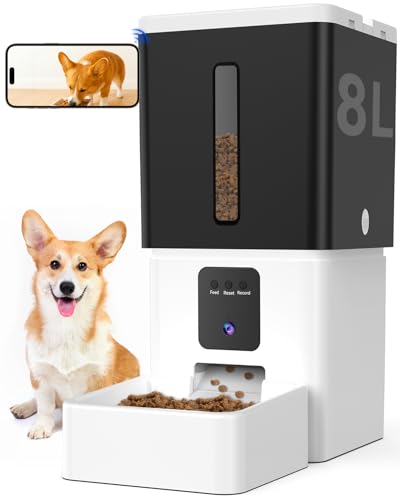 UTCG Automatic Dog Feeder with Camera: 8L/33 Cups8L for Medium Dogs7 x 5 x 9 inches5.3 PoundsCheck on Amazon
The best automatic dog feeders with cameras for most homes are the PETLIBRO Granary Smart Camera Feeder for balanced features, the PETKIT YumShare Solo with Camera for a polished app and compact design, and a WOPET camera-equipped feeder when a larger hopper matters more than advanced monitoring.
A camera is useful only if the feeder also dispenses consistently, stays connected, and can be cleaned without becoming a chore. The right choice depends on your dog’s meal size, how long you are away, whether you need two-way audio, and how much wet or oily food residue the design can tolerate.
PETLIBRO Automatic Dog Feeder with Camera, Auto Cat Food Dispenser Slow Feeders Dogs Bowl, 1080P HD Video with Night Vision, 5G WiFi with 2-Way Audio, Stainless Steel Slow Food Tray for Small Dogs
Chosen because it specifies Auto Cat Food Dispenser Slow Feeders Dogs Bowl and 1080P HD Video with Night Vision.
View on Amazon
Yakry Automatic Dog Feeder with Camera - 8L/33 Cups Smart Dog Feeder
Chosen because it specifies 8L/33 Cups Smart Dog Feeder.
View on AmazonUTCG Automatic Dog Feeder with Camera: 8L/33 Cups 5G WiFi
Picked as a relevant option in this category.
View on Amazon
Faroro Automatic Cat Feeder with Camera, 1080P HD Video with Night Vision, 5G WiFi Automatic Dog Feeder with APP Control, 2-Way Audio, Blockage Sensor for Cats or Small Dogs, 4L (Black)
Chosen because it specifies 1080P HD Video with Night Vision and 5G WiFi Automatic Dog Feeder with APP Control.
View on AmazonQuick comparison: the leading camera feeders
| Feeder | Hopper capacity | Camera and audio | Portion control | Connectivity | Cleaning considerations |
|---|---|---|---|---|---|
| PETLIBRO Granary Smart Camera Feeder | About 5 L | 1080p video, wide-angle view, night vision, two-way audio | Small programmable increments; verify output with your food | Wi-Fi app control; model-dependent 2.4 GHz or dual-band support | Removable food-contact parts; dry thoroughly before refilling |
| PETKIT YumShare Solo with Camera | About 3 L | 1080p camera, night vision, two-way audio on camera-equipped versions | Programmable scheduled servings; portion size varies by kibble | PETKIT app and Wi-Fi | Narrower internal areas require a small brush and regular wiping |
| WOPET camera-equipped smart feeder | About 6 L on larger models | Typically 1080p video, night vision, microphone and speaker | Programmable portions, commonly divided into multiple small servings | Wi-Fi app; check the exact model’s network requirements | Large hopper is convenient, but chute and impeller still need frequent cleaning |
| Camera feeder with a stainless-steel bowl | Usually 3–5 L | Often 1080p, but viewing angle varies widely | Usually timed portions rather than weight-based dispensing | May use a proprietary app or basic Wi-Fi setup | Best option for a dishwasher-safe bowl; inspect the chute for hidden buildup |
These figures are useful for narrowing the field, not for assuming identical performance between model generations. Manufacturers sometimes change camera fields of view, app compatibility, and included bowls while retaining a similar product name. Check the current specification sheet before buying.
Best overall: PETLIBRO Granary Smart Camera Feeder
The PETLIBRO Granary is the strongest all-round choice when you want a sizable hopper, a useful camera, scheduled feeding, and remote interaction in one unit. Its roughly 5-liter capacity is enough for several days for many small or medium dogs, although the actual duration depends on calorie needs and kibble density.
Its camera is most valuable for confirming whether food was dispensed and whether your dog actually approached the bowl. Two-way audio can help you call your dog to a meal, but it should not be treated as a substitute for supervision: some dogs ignore the speaker, while others become excited or anxious when they hear a voice without seeing a person.
Where it falls short
Like most auger-style feeders, it measures volume rather than calories or weight. Different kibble shapes can produce noticeably different serving sizes. The camera also sees a defined area, not the entire room, so placement matters. Put the bowl in the camera’s lower field of view rather than directly under a tall hopper that blocks it.
Best for a compact setup: PETKIT YumShare Solo with Camera
The PETKIT YumShare Solo is a good fit for an apartment, a small dog, or an owner who prefers a smaller appliance and a more integrated app experience. Its approximately 3-liter hopper occupies less space than many large feeders, but it will require more frequent refilling for a larger dog.
The camera is suited to checking mealtime behavior and the bowl area. App-based schedules can be helpful for dividing a daily ration into several meals, which is often more practical than relying on one or two large releases. Before committing, confirm that the exact version includes two-way audio; product names and regional configurations can differ.
Who should skip it?
Choose a larger hopper if your dog eats several cups of food daily or if you routinely travel for more than a few days. A compact feeder is not automatically easier to clean: tight corners around the dispensing mechanism can hold dust and oil from kibble.
Best for longer refill intervals: a large WOPET camera feeder
WOPET’s larger camera-equipped feeders appeal to owners who prioritize capacity. Models around 6 liters can reduce refill frequency, making them practical for a household with a larger dog or multiple scheduled meals. Capacity alone does not make a feeder suitable for two dogs, however. One dog may guard the bowl, consume both portions, or obstruct the camera.
WOPET models commonly provide scheduled dispensing, video monitoring, night vision, and two-way communication. The important buying check is the exact app and Wi-Fi requirement. Some units are intended for 2.4 GHz networks, while newer models may support broader connectivity. A feeder that cannot remain connected to your home network loses much of its remote-control value.
How to choose by situation
| Your situation | Best direction | Why |
|---|---|---|
| Small dog, limited counter or floor space | PETKIT YumShare Solo with Camera | Smaller hopper and footprint; refill more often |
| Most owners wanting balanced features | PETLIBRO Granary Smart Camera Feeder | Good capacity, video, audio, and schedule flexibility |
| Large dog or infrequent refilling | Large WOPET camera feeder | Approximately 6-liter capacity on larger versions |
| Unreliable home Wi-Fi | Feeder with local controls and a backup schedule | Basic feeding should continue even if the app is unavailable |
| Dog prone to eating too quickly | Feeder with small serving increments or a compatible slow-feed bowl | Several small releases may be more useful than a single large one |
Portion accuracy: the specification most buyers overlook
“One portion” is not a universal unit. It is usually a timed motor cycle or a volume increment. Kibble that is small, round, and dense may deliver more calories per cycle than large, irregular pieces. Dust and crumbs can also reduce the effective capacity of the chute.
Calibrate the feeder before relying on it:
- Fill the hopper with the food your dog normally eats.
- Program one serving and collect it in a bowl or measuring container.
- Repeat the release at least five times.
- Measure the total amount and divide by five to find the average serving.
- Adjust the schedule to match your veterinarian-approved daily amount.
For example, if five test releases weigh 140 grams altogether, the average release is 28 grams. A 112-gram daily ration would require four of those average releases, divided across the meals you choose. Recheck after changing food, because kibble dimensions can change the result.
App reliability and camera quality
A sharp 1080p image is useful only when the feeder is positioned correctly. Place it near a wall outlet, keep the lens away from direct sunlight, and angle it toward the bowl rather than the dog’s back. Night vision helps in a dim room, but reflective bowls and nearby windows can create glare.
Before purchasing, look for an app that supports multiple caregivers, feeding-history notifications, and a schedule that remains stored on the device. A brief Wi-Fi outage should not cancel the next meal. If the manufacturer requires a cloud account, understand that remote video and notifications may depend on the company’s servers and app maintenance.
Cleaning, durability, and ownership realities
Dry kibble does not mean maintenance-free. Oil from food can coat the chute, hopper base, and impeller. The parts most likely to cause trouble are the motor-driven dispensing mechanism, the silicone seals, the bowl coating, and the power cable. A dog that paws or nudges the unit may also loosen the bowl or move the camera out of position.
- Remove crumbs from the chute at least weekly when feeding daily.
- Wash the bowl frequently, especially if it is plastic or holds oily food.
- Keep the motor housing and power connection dry.
- Do not refill on top of old food indefinitely; empty and inspect the hopper.
- Use a backup plan for power or internet failures if a missed meal would be serious.
- Secure the feeder against a wall if your dog can tip or drag it.
Most automatic feeders are designed for dry food or, at most, semi-moist food compatible with the manufacturer’s instructions. They are not a safe substitute for refrigerated storage of wet food unless the specific model includes an appropriate cooling system.
Bottom line
Choose the PETLIBRO Granary for the best balance of capacity, camera monitoring, and remote feeding. Choose the PETKIT YumShare Solo when compact size and a refined app matter more than refill intervals. Choose a large WOPET camera feeder when capacity is the priority. Whichever model you select, calibrate portions, test the schedule while you are home, and treat the camera as a monitoring aid rather than proof that your dog is safe without human backup.










Write Your Review
No reviews yet. Be the first to share your experience!