
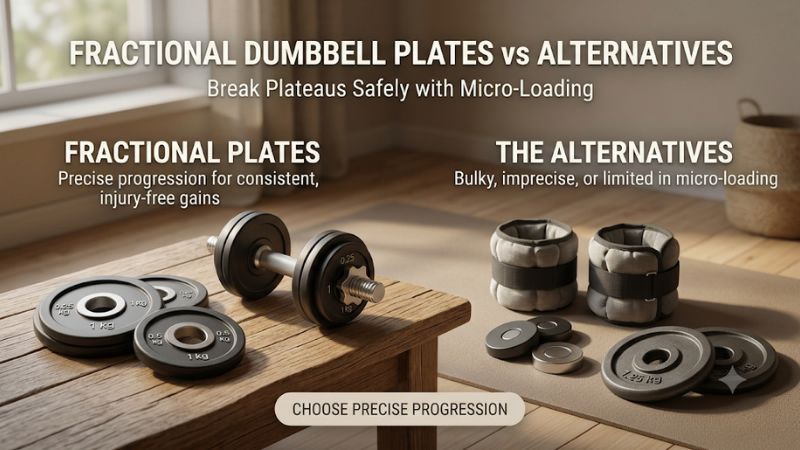
Comparing fractional dumbbell plates vs alternatives comes down to the limitation you hit most often. Add-on plates can split a large gap on equipment you already own. An extra fixed pair, a smaller dial step, or a change in your rep range may solve the same training problem with simpler setup between sets.
Fractional dumbbell plates vs alternatives at a glance
Start with the job you need done. If a handful of dumbbells already cover nearly all your workouts, a matched add-on can fill a gap. If you need several additional weights or change loads repeatedly in a session, a different system may save more time and effort over the course of a week.
| Option | What it changes | Best fit | Main trade-off |
|---|---|---|---|
| Fractional plates | Weight on the existing dumbbell | A compatible setup with missing intermediate loads | Installation, fit, and clearance |
| Additional fixed pair | Adds one complete working weight | One recurring midpoint with fast changeovers | Additional storage for a full pair |
| Adjustable dumbbells with finer steps | Replaces several fixed weights with one system | Multiple gaps or a broad weight range | Purchase cost and model-specific increments |
| Built-in or approved internal adders | Adds weight inside a supported handle | Existing adjustable systems with that feature | Available increments depend on the model |
| Wrist weights | Adds resistance at the wrist | An exercise where wrist loading suits the movement | Changes where the load acts |
| Rep progression | Raises reps at a given load before moving up | A temporary gap and flexible programming | No intermediate dumbbell weight |
Use the working weight as the basis for comparison
Use the weight of one dumbbell to calculate the gap. A move from 15 to 20 pounds is a 5-pound increase per hand, or about 33 percent. A move from 45 to 50 pounds is also 5 pounds per hand, but about 11 percent. Equal steps can have very different effects across exercises and training weights.
Introduce the same kind of comparison when you evaluate an alternative. A pair of 17.5-pound fixed dumbbells and a supported 2.5-pound add-on applied to each 15-pound dumbbell can produce the same total mass per hand. The difference comes from storage, geometry, and the attachment you handle every session. Wrist weights, by contrast, produce resistance at a different point even if their weight corresponds to the same numeric increase.
Track where the current change starts to interfere. If you can complete most sets at the lighter load and are ready to try the next, a progression change may cover a short period. If you use the same midpoint across several exercises and workouts, owning a repeatable configuration can make more practical sense. The number of working weights you need helps split those cases.
When fractional dumbbell plates have the advantage
Fractional plates are most useful when the current dumbbell fits your grip, training space, and exercise selection, and the available loads are the main constraint. A suitable accessory can preserve the rest of that setup and give you different intermediate loads across the dumbbells it is designed to fit.
Use sleeve plates when the existing handles work well
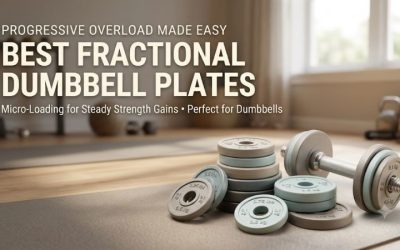
Loadable dumbbells are relatively easy to evaluate. You need compatible center openings, space for the plates, and properly seated collars. A 0.25-pound plate on each end adds 0.5 pound per dumbbell. That can be useful when your available plates make jumps of several pounds at a time.
The price and storage cost scale with the number of plates, rather than with the weight of a full replacement pair. A set of four 0.25-pound plates can add half a pound to two dumbbells at 15, 25, or 35 pounds, assuming the sleeves retain enough room in each configuration. If you already train with the handles, their familiar grip and base stack stay in use.
The costs are loading time and space on the handle. A short sleeve may become crowded at heavier settings. Plates with an outside diameter larger than the ones on the dumbbell can change how it clears your arm, bench, or leg. If the adders would require changing your main plates or collars just to fit, compare the cost and handling time of the complete update with a fixed pair or another adjustable system.
Use a supported add-on when several fixed loads have gaps
A grip clip or a compatible end attachment can create new weights across several existing fixed dumbbells. The advantage is strongest when one accessory serves more than one pair. Check each handle or end shape individually and use the exact mounting pattern and movement limits specified for the accessory.
Suppose you own compatible 15-, 20-, and 25-pound dumbbells and can add 2.5 pounds to each in an approved configuration. The same kit may give you three new working weights at 17.5, 22.5, and 27.5 pounds. A single new fixed pair would cover one of those weights. If you train from that whole range during the week, the accessory can add more options without another row of dumbbells.
The calculation changes when handle or head shapes vary across the set. A grip clip that only fits the 20-pound dumbbells will create one new weight. Compare it with the cost, storage, and setup of a 22.5-pound pair. On magnetic end attachments, check the maker’s required mounting surface and minimum supported weight for every model you plan to use. The weight printed on the dumbbell is only part of the fit.
If you rely on the adder for a particular lift, check that the movement is within the maker’s instructions. An attachment that works during controlled curls may have restrictions on fast swings or on how you can place the dumbbell down. Those limits matter as much as price when a full setup has to serve several exercises.
When a fixed pair or adjustable system is a better fit
A dedicated pair is the fastest way to reach one frequently used load, while a finer-step adjustable system can provide several new working weights. The choice depends on the number of missing settings, how often you change between them, and how much usable space your existing rack or stand leaves.
Buy a fixed midpoint for a weight you use often
A fixed pair makes sense when most of the inconvenience comes from one load you reach for repeatedly. If 22.5 pounds is a working weight for several lifts, having that pair on the rack saves the time spent moving plates or resetting a dial every time the two other pairs come back into use.
Compare it with the cost of a compatible kit on both hands. A cheap two-piece adder pack might equip one dumbbell only, while the cost of two packs could come close to a used or sale-priced fixed pair available nearby. A fixed dumbbell also gives you a consistent shape without new projections around the grip or heads. Check that the specific intermediate weight is available in the line you want.
The larger cost is space. An additional fixed pair needs two rack positions and is heavier to move than a few small accessories. If the whole gym has space for three fixed pairs, one midpoint can displace a load you still use. That layout favors compatible adders when they open multiple weights and store in a shallow tray. A roomy garage with an existing open rack slot can favor the fixed pair.
For paired movements, compare the shape of the new midpoint with the weights above and below it. A shorter fixed dumbbell or a thicker handle can change the feel despite an even numerical increase. If your progression depends on consistent positioning, check the dimensions alongside the purchase price.
Choose smaller built-in steps if several gaps recur
A finer-step adjustable system is worth comparing when you are short on several working weights and already plan to buy a wider range. Check the actual sequence of settings, including the lower range you use for lighter lifts. Some systems use smaller steps in one range and larger steps in another.
Write down the settings you want across a typical week. If you need 12.5, 17.5, 22.5, and 27.5 pounds, verify that the new pair can reach each one at the relevant settings. A model advertised with a small minimum increment may only offer it for some loads or through a specific approved internal accessory. Price the complete equipment you need to use that sequence.
Adjustable handles can cut down on the number of fixed pairs you store, though the cradle still has to fit where you train. Compare the grip length, handle diameter, loaded width, base size, and available seating clearance with your present dumbbells. Faster changes can make a particular model more useful if you alternate exercises. For straight sets where you rarely change the load, the difference in changeover time may be minor.
Replacing a whole set also means deciding what to do with the existing weights. If they are comfortable, fit the room, and already cover most of your needs, the price of a new adjustable system buys much more than an intermediate setting. That large purchase works best when the extra range, smaller steps, or storage savings each solve a recurring issue.
Use built-in adders when your current model supports them
Some adjustable dumbbells have internal weight positions that already produce smaller steps. Certain PowerBlock systems, for example, use 2.5-pound micro weights in the handle. Verify the compatibility and placement for the exact model before ordering replacement pieces or relying on a particular combination.
An existing internal adder changes weight without extending the outer shape of the dumbbell. That can keep both hands and the cradle clear while preserving normal storage. Its main limitation is the sequence the manufacturer built into the device. If one internal weight gives you the step you need, use the approved layout. If it still leaves a wide gap at the loads you normally lift, evaluate the next available solutions.
Some products with very similar names use different adders. Confirm the model identifier on the dumbbell and compare it with the official accessory description. A replacement pair can cover one position on each handle when the manual specifies that use, or it may cover a different configuration. Work from the manufacturer’s explanation instead of assuming that a package pair always supplies two complete handles.
If you bought the dumbbells used, check what is already installed before adding anything. Two handles with the same selector setting can have different actual weights if one has an internal adder and the other does not. Identifying the existing pieces first also tells you whether you need a replacement or whether your system already does the job.
When fractional dumbbell plates vs alternatives changes the exercise
Some alternatives help you progress without producing the same loading arrangement as a heavier dumbbell. Rep progression changes the amount of work you do at a set weight. Wrist weights and bands change where or how resistance acts. Compare them as training choices and keep the dumbbell load separate in your log.
Use rep progression to bridge a temporary gap
A familiar approach is to pick a rep range, then gradually build reps at the current working weight before taking a heavier setting. For example, you might work within eight to twelve reps and increase the load when you consistently reach the upper end with the range of motion and control you want.
Take someone using 20-pound dumbbells for three sets of ten and who struggles to complete the intended reps at 25. If the exercise is flexible, building from ten toward twelve reps at 20 can provide room to progress without an equipment change. On a later attempt, that person can compare the same exercise under similar conditions at 25 and decide whether the heavier weight now suits the intended range.
The trade-off is that you are progressing reps at the same load until you move up. A user who needs a specific load for an established plan or who repeatedly drops below the chosen rep range at the next setting may still benefit from a half-pound or 2.5-pound step. Use the result of the heavier attempt to decide whether the gap is temporary.
When changing reps, try to keep the exercise itself consistent. More reps through a shortened range are not directly comparable with full-range reps logged earlier. Similarly, adding rest changes the conditions of the set. Keep the change you are measuring clear and treat it as one way to train until the next available working weight fits.
Use wrist weights when loading the wrist suits the movement
A wrist weight adds mass nearer the wrist and moves slightly differently from a plate centered on the dumbbell or added to both heads. The movement can feel different even when the increase in total weight is the same. This option suits an exercise that benefits from wrist loading and a product designed for that use.
Consider a lifter who wants to keep holding a 10-pound dumbbell and adds a 1-pound cuff. The cuff is a pound of additional mass, yet some of that mass sits closer to the joint than it would on a dumbbell. Its effect on the movement depends on the position of the wrist and arm. Keep the original dumbbell weight and cuff weight as separate entries in your log.
The option can be useful when you have little room to store extra dumbbells and want some adjustable wrist loading for several activities. If you care about the exact feel of a heavier dumbbell, a supported plate or a dedicated dumbbell weight keeps the extra mass on the equipment. Wear the cuffs as directed. Select a purpose-built attachment for a dumbbell handle if that is where you want the load.
Use bands or a cable system when you want a different load profile
A resistance band changes tension as it stretches. A cable’s resistance and direction depend on the machine and exercise setup. Either can be practical when you have access to the equipment and want to train the same broad movement, with a different resistance profile from a free weight moving against gravity.
A compatible cable stack may offer smaller selectable changes across a wide range of exercises. Follow its parts and loading instructions if you want to use an approved stack adder. The number on the stack can differ from the effective resistance at the handle because of pulley geometry. Compare cable workouts on the same machine and attachment rather than treating the stack marking as a direct dumbbell equivalent.
Bands can travel easily and take little storage space. Their feel changes with starting length, anchor position, and tension across the movement. If consistent progression matters, repeat the same setup and record which band and anchor you used. This makes bands a useful alternative for training when you want compact equipment. A fractional plate remains the more direct choice when the only desired change is the weight of a particular dumbbell.
Choose based on the gap you hit most often
One missing weight, several recurring gaps, and a short-term plateau lead to different purchases. List the current loads you use each week and mark where you frequently need an intermediate setting. Compare what each option would cost and where it would go before you devote space to more equipment.
Compare the full cost per useful setting
A compatible four-piece kit can produce several intermediate weights on existing dumbbells. One fixed pair buys one exact weight. An adjustable system can replace many weights, but the settings you already own add little value by themselves. Compare what each option adds to your actual routine.
For example, an add-on that creates 17.5, 22.5, and 27.5 pounds across three compatible fixed pairs solves three gaps. A single fixed pair can outperform it on convenience if all of your main sets are at 22.5. A finer-step adjustable system is worth pricing if you need those loads plus several others or if you also want to replace the rack.
Add shipping, storage, and any required collars or hardware to the cost calculation. When two choices are close in price, consider the number of times you will swap the configuration in a session. A product that costs a little more but speeds up an exercise you repeat several times per workout can be an appropriate choice. If you only install it before a set once a week, the extra cost may serve you less.
Conclusion
Use fractional plates when you want smaller jumps on dumbbells you already like and can confirm the attachment fits. Buy a fixed pair if you repeatedly use one missing weight. Consider finer built-in settings for several gaps and rep progression for a temporary one. Compare each option against the load you actually use.
More from Amazon
Programs that pair well with the guide above. Offers and eligibility are set by Amazon and may change.
Free shipping on eligible items, Prime Video and more. Eligible new members can start with a free trial.
Start a Prime free trialA Prime membership for ages 18-24 with a trial period. Eligibility is set by Amazon.
See Prime for Young AdultsAudiobooks and podcasts to listen to on the go. Eligible new members can start with a free trial.
Try Audible freeAd-free music streaming. Eligible new subscribers can start with a free trial.
Try Music Unlimited freeAs an Amazon Associate we earn from qualifying purchases.
Write Your Review
No reviews yet. Be the first to share your experience!