
Comparing barbell collars vs alternatives starts with the bar you plan to load. Lever clamps and spring clips suit compatible smooth sleeves, while threaded handles need matching spinlocks. Axle collars, weighted competition collars, and integrated systems each address a different fit, loading, or training requirement.
Barbell collars vs alternatives at a glance
For a smooth Olympic sleeve, the practical choice is usually between compatible spring and lever collars. A threaded bar, a specialty axle, or a selectorized implement needs the retention system its maker specifies. Compare the lock, loading process, and available sleeve before paying for a feature your equipment cannot use.
| Option | Where it makes sense | What changes |
|---|---|---|
| Olympic lever collar | Compatible smooth Olympic sleeves and regular plate changes | Fast closure with a lever and sometimes a separate latch |
| Spring clip | Compatible sleeve and basic strength training | Squeeze handles and slide on from the end |
| Open-sided collar | A compatible sleeve with limited access beyond the tip | Attaches from the side and needs radial access |
| Adjustable screw collar | Several sleeves within the stated fit range | Tightens with a knob and may take longer to adjust |
| Threaded spinlock | Matching threaded bar or dumbbell handles | Turns along the threads and seats against the stack |
| Dedicated axle collar | A specialty sleeve with its specified outside diameter | Sized for a sleeve such as 1.9 inches |
| Weighted competition collar | Event-specific load and equipment practice | Collar mass is part of the prescribed total |
| Fixed or selectorized equipment | A system designed around its own retention | A different equipment and weight-change workflow |
The useful comparison starts with options approved for the same bar. When the alternatives require another sleeve or a complete equipment change, include the plate collection, storage footprint, and exercises you can perform. Those differences often have a larger effect than the price of any pair of collars.
Compare barbell collars vs alternatives on smooth sleeves
A lever clamp may be the default for a busy home rack, and a spring pair can meet the same basic retention need when it fits and suits the intended use. An open-sided body changes the approach to the sleeve. An adjustable screw model can cover several verified sizes. The room and loading routine determine what matters most.
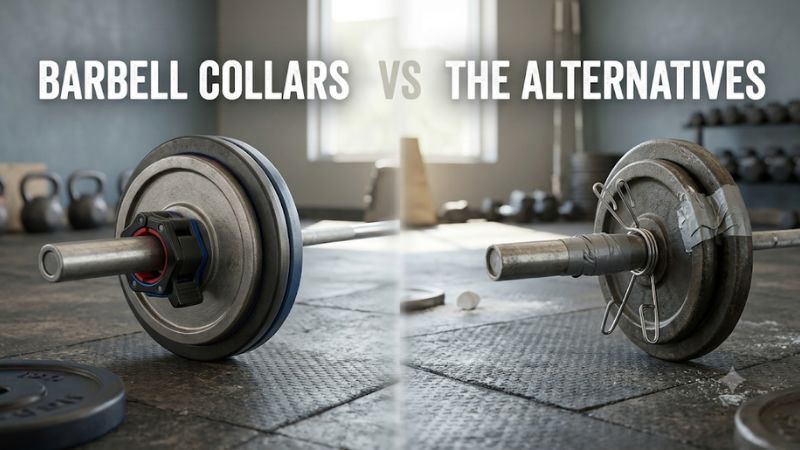
Lever clamps versus spring clips for ordinary home lifting
Lever clamps close around the sleeve after you position them. Spring clips require squeezing the handles during placement and releasing them to grip. Both styles exist for Olympic sleeves. Compare the exact size, contact area, and intended use first. Then consider which motion is easier with your hands and layout.
For three sets at one working weight, a well-fitting spring clip may be all you need. A shared bench with alternating warm-ups and work sets asks for more release cycles. In that setting, it can be worth paying for a lever that both lifters operate comfortably. Look at how your grip lines up under the bar and beside the largest plate.
A spring pair still needs space beyond the tip and enough room for the handles to come together. A closed lever collar also slides over the end and may need space for a large lever swing. Test both before calling either the more compact design. The relevant space includes the area around the sleeve and the bar’s plate-loading route.
Open-sided collars versus closed rings when tip access is tight
A closed collar moves over the end of the sleeve before sliding up against the plates. An open-sided collar can be placed beside the plates from an accessible direction around the sleeve. This distinction matters beside a wall, inside a storage corner, or near a fixture that makes working directly beyond the bar tip difficult.
Eleiko’s Öppen illustrates the trade-off. Its design allows side-on placement and includes a lever and integrated magnets. The body still needs enough clearance around the sleeve and space for your hand. This can solve the final collar change while leaving a separate need to slide the weight plates onto the bar from the end.
Choose an open-sided design when its different entry path addresses your actual restriction and the maker confirms compatibility. If your room controls how much engagement space remains beside a thick plate, compare axial width first. A narrow closed ring can be the better choice when available sleeve, rather than end access, is the deciding factor.
Adjustable screw collars versus fixed-size lever clamps
An adjustable screw collar can suit several sleeves if their diameters are within its specified fit range. A fixed-size lever clamp is often simpler when you use one standard bar. Compare the correct mounting position, the time required to operate each system, and how you will check that the collar is secured before lifting.
Rogue’s Proloc 1 illustrates why the exact range matters. It is listed for sleeves from 1.937 to 2.007 inches. That can cover different bars within the range, while a 1.9-inch axle lies below its lower limit. The ability to turn a knob is a feature inside the documented range, not permission to extend it.
If you change weights often on one bar, a dedicated lever can be more convenient. If you use multiple approved sleeve sizes and perform fewer changes, an adjustable screw pair can save the cost and storage of separate sets. It must still fit the available axial room on the shortest sleeve in your setup.
Magnetic collars versus an ordinary clamp and a storage tray
Magnetic designs add a place to park the collar on compatible steel. An ordinary lever or spring pair can live in a small tray near the rack. Both approaches keep collars off the floor between plate changes. Compare where the pair goes, how far you reach, and whether it stays clear of the equipment moving around you.
For a crowded station with a usable steel upright next to each sleeve, magnets can make plate changes easier to repeat. For a low garage rack with accessories covering its usable faces, a small tray might be easier to reach. The magnet is a workflow feature. Verify the mechanical sleeve fit and closure whichever storage route you choose.
Count the step that matters most. If you regularly hand a pair to another lifter or remove collars for several quick warm-ups, a parking point can justify a higher price. If you change plates only once or twice, the width and feel of the lock may be better places to spend the same money.
Compare collar systems that depend on the equipment
Some alternatives only work on their matching bar or handle. A spinlock needs the appropriate threads. A specialty axle may take a smaller outside diameter. Competition collars add prescribed mass. Fixed-weight and selectorized equipment change how you add resistance entirely. Use the implement and movement to set the comparison.
Threaded spinlocks versus smooth-sleeve clamps
A spinlock threads onto a matching sleeve and turns until it seats as the manufacturer directs. A spring or lever collar for a smooth Olympic sleeve uses a different interface. Compare thread fit, usable length, and change speed on the threaded bar you own rather than judging options by whether the plate looks similar.
A pair of standard threaded dumbbell handles can work well if you own matching plates and keep the load constant for several sets. It may be slower if two people change both dumbbells repeatedly. If weight-change speed drives the purchase, compare the complete threaded setup with a purpose-designed adjustable dumbbell system and include its usable increments and full weight range.
When replacing a threaded collar, match the original model or an approved equivalent. Diameter alone does not confirm thread pitch and seating. If the new collar binds or does not seat correctly, verify the part before use. Changing to a smooth sleeve is an equipment purchase as well as a change to the locking method.
Axle collars versus standard Olympic collars
Some axle and specialty bars use a sleeve with a 1.9-inch outside diameter. Standard 50 mm collars are sized for a different mounting surface. Measure the sleeve or read the bar’s exact specification and compare it with the collar maker’s fit statement. Olympic-bore plates alone cannot tell you which collar will hold.
A dedicated axle collar such as the OSO Axle 2.0 is useful when the bar matches the stated 1.9-inch requirement. Another specialty bar may use a genuinely full-size sleeve, in which case a standard Olympic collar can be appropriate. The brand name or visual thickness of the shaft does not settle the question.
If you train with both types, decide whether to buy separate pairs or use a documented adjustable option that covers each measured sleeve. Separate pairs can be easier to identify during loading. An adjustable model only simplifies the setup when it includes both actual sleeve sizes and remains suitable for the intended movements.
Competition collars versus lightweight training collars
A weighted competition collar is used for more than everyday retention. In IWF weightlifting, the collars are 2.5 kg each and contribute 5 kg to the total. A lightweight training collar can still have a defined mass. The Eleiko Öppen adds 0.50 kg per pair, so changing between those examples changes the lift by 4.5 kg.
Suppose a 15 kg bar has a 20 kg plate on each side. The bar and plates total 55 kg. With the 0.50 kg pair, the assembly weighs 55.5 kg. With a 5 kg competition pair it weighs 60 kg. If you intend to practice exactly at 60 kg, choose a plate combination and collar system that reach the stated total.
Choose weighted collars when event-style loading, handling, or requirements matter. A lighter pair can be more manageable for routine changes and can preserve a lower training start. If you use both, keep their masses in your training log and check that the intended plates and collars fit together on the available sleeves.
Fixed-weight equipment versus a bar that needs collars
A fixed-weight barbell or dumbbell keeps its stated load on the equipment permanently. It can be convenient for a small list of exercises and repeatable loads. To increase from one fixed weight to another, you need a second implement. That decision changes storage and the cost of progression more than changing the style of collar.
A single Olympic bar, plates, and correctly fitted collars can cover many loads on one shaft. That helps if you are regularly changing the weight of squats, rows, or presses. A fixed bar can be convenient for a specific accessory movement where one load stays the same. Compare how many weights you need and how often you will change them.
Where no rack is available, consider whether a fixed bar serves the lift you want to track or whether adjustable dumbbells suit more of the routine. The fixed format avoids a separate plate change at the end of the bar, while putting the cost and storage burden into distinct pieces of equipment.
Selectorized adjustable dumbbells versus loadable handles
A selectorized dumbbell retains the selected weights through its own mechanism. A loadable handle uses physical plates and matching collars. Compare maximum weight, adjustment increments, length under load, storage space, and permitted use. The faster option depends on the design and can be valuable during paired exercises.
The case for a selector grows when two lifters regularly change weights or use multiple loads in a short interval. A loadable handle can be a better fit for someone who already owns the correct plates and adds weight in small amounts. Check how much of the sleeve remains when the handle is loaded and whether the collar is appropriate for its use.
The same nominal plate size on a bar and handle is only one compatibility check. Consider the actual sleeve diameter and length, plus the approved lock for the handle’s movements and orientation. A selectorized model should be operated, verified, and used according to its own manufacturer’s instructions.
Choose the option that resolves your training constraint
The point of comparing collar alternatives is to identify the step you need to change. Sometimes you want a quicker release, sometimes your bar uses a different sleeve, and sometimes the room makes plate loading difficult. Use one normal training session to decide which feature would have the greatest practical effect.
You want faster plate changes on one rack
Test what takes the most time during a typical session. If the delay is operating the spring clips, try a compatible lever collar. If you regularly walk away to retrieve both collars, compare magnetic parking with a basic tray. If the plate must travel around furniture, solve that route first and then choose the locking action.
Use a real warm-up sequence to compare the choices. Take the bar through two or three changes with the equipment in its normal positions. Check how long you spend finding the collar, how easily your hand reaches the lock, and whether you can verify its engagement each time. A different design is worthwhile if those changes become easier.
For a rack shared by multiple people, use a pair that everyone can operate on both sides of the room. An intuitive opening action can matter more than the type of frame. If you add a second storage location, make sure it does not interfere with the bench, hooks, safeties, or plate motion.
You need more room near the end of a compact sleeve
Measure the space beyond the complete plate stack and compare it with the collar’s installed axial width. A lever with a different opening direction can help once it fits fully. A side-loading collar solves a clearance problem beyond the tip. An unusually thick stack may require a narrower collar or a different approved plate mix.
Imagine that plates on one sleeve leave 1.65 inches of usable space. A documented 1.5-inch collar fits the calculation. A 1.875-inch body needs another 0.225 inch of sleeve. If the narrower model can be operated and fully engaged, the geometry favors it. If the wall blocks the loading path, geometry around the tip remains a separate issue.
If both a wider collar and a thicker plate stack are important to you, consider longer sleeves on the bar you use. That may require more space in the room, particularly if it changes overall bar length. Compare the cost and footprint of that change with a smaller collar or one thinner pair of compatible plates.
You use multiple bars with different sleeve sizes
List every sleeve you need to fit, including the main bar, an axle, a curl bar, and any loadable handles. Write down its mounting diameter, available width, and approved type of collar. Then compare a dedicated pair for each size with an adjustable option that explicitly covers all the measured mounting areas.
If you use similar implements in one session, color or label their storage positions by verified size. A spare pair only helps if you can use it safely on the equipment that needs it. Keep the aisle or plate path clear so you can retrieve the right pair without moving a loaded bar or crossing a working station.
When the equipment has integrated or threaded hardware, consider buying the maker’s replacement before switching to a different format. If the frustration is the whole weight-change process, a different implement may solve it. Compare the replacement cost with the exercises and weight range the new equipment would cover.
You are preparing for a meet or tracking small increases
Check how the event accounts for collars and which equipment it specifies. Match the total barbell load in your training log, including collars where relevant. Use an accurate pair weight when the smallest planned increase is the same order of magnitude as the weight difference between your training and competition locks.
For example, if you switch from a lightweight pair to a 0.50 kg pair and add a small change plate at the same time, the true progression combines both differences. Record the old and new full totals. This lets you tell whether you reached the target weight even though the plates alone did not express the entire change.
If you need a familiar loading routine for competition day, use the event format during the sessions where that familiarity matters. A simpler pair can still serve frequent changes at home. Keep the correct competition and training pieces identified and give each setup the sleeve space its combination of plates and collars requires.
Conclusion
Choose compatible spring or lever collars for ordinary Olympic sleeves, an open-sided design for difficult end access, and a dedicated axle collar or spinlock when the bar requires it. Weighted collars make sense for event-specific loading. Fixed or selectorized equipment is worth comparing when your real goal is changing how the entire workout handles resistance.
More from Amazon
Programs that pair well with the guide above. Offers and eligibility are set by Amazon and may change.
Free shipping on eligible items, Prime Video and more. Eligible new members can start with a free trial.
Start a Prime free trialA Prime membership for ages 18-24 with a trial period. Eligibility is set by Amazon.
See Prime for Young AdultsAudiobooks and podcasts to listen to on the go. Eligible new members can start with a free trial.
Try Audible freeAd-free music streaming. Eligible new subscribers can start with a free trial.
Try Music Unlimited freeAs an Amazon Associate we earn from qualifying purchases.

Write Your Review
No reviews yet. Be the first to share your experience!