
The right neoprene dumbbells for small spaces fit where you store them and where you train. One matched pair can live on a low shelf, while three or more pairs may be easier to reach from a compact stand. Choose your working weights first, then measure the loaded footprint, hand clearance, and route to your mat.
Start with the minimum equipment your routine needs
Fixed dumbbells earn their space one pair at a time. List the movements you perform at home and estimate the weights you use most often. This tells you whether to buy one pair, several pairs with a stand, or a case that holds a small range and disappears when the room returns to everyday use.
| Training pattern | Sensible starting format | What to measure |
|---|---|---|
| One or two accessory movements at the same load | One matched pair | Flat resting area, handle access, and room to pick up both weights |
| Three distinct loads in regular circuits | Three-pair open rack | Floor depth, hand clearance, and distance from the mat |
| Three light pairs used in a multipurpose room | Carrying case or low storage bin that supports the load | Closed length, opening clearance, and total loaded weight |
| Several people using different loads | Small open rack or rated shelf with separated pairs | Capacity, access to each level, and room for two users |
| Light accessories and occasional heavier work | One or two neoprene pairs alongside a suitable heavier option | Total equipment footprint and room to handle the heaviest weight |
Sort weights by exercise before buying a bundle
A fixed set occupies the same amount of storage when some of its weights are rarely used. A person who uses 5 lb for raises and 10 lb for presses may need only two matched pairs. A person who changes between three loads in one short session can benefit from a stand with every pair visible.
Write down the exercise, load per hand, and whether it uses one or two dumbbells. A one-arm row can use one heavier dumbbell. A paired floor press calls for matching weights. If your exercise list asks for just one heavier single and two lighter pairs, a complete range of matched weights may take more room than the equipment you actually need.
Check whether a projected future load merits space today. A 15 lb pair can have a clear role if you are already using 12 lb regularly. If most of your work is at 2 or 3 lb and you have no exercise planned for heavier weights, start with the loads that fit your current program and preserve room for a purposeful addition.
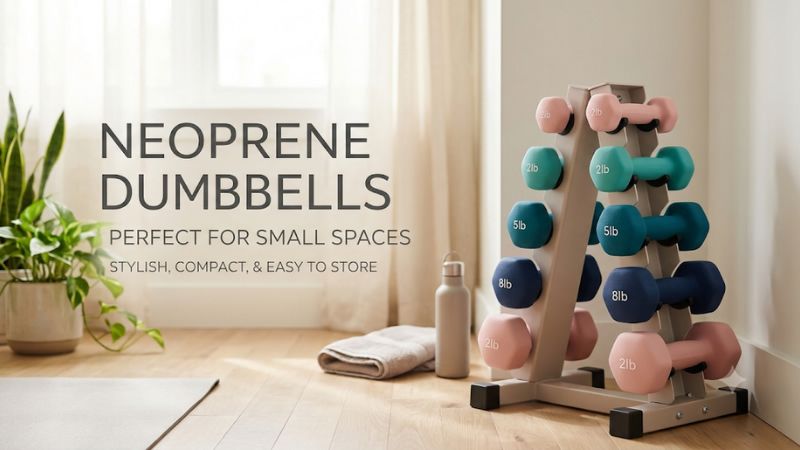
Use the selected weight to estimate the dumbbell’s real size
A range listed from 3 to 15 lb can hide a noticeable change in head dimensions and handle thickness. Gaiam, for example, publishes 6.75 × 2.525 in for its 3 lb dumbbell and 9.29 × 4.76 in for its 15 lb version. The larger pair takes more space on a shelf and in a close grip.
Packing the dumbbells tightly on a shelf might save a few inches. The useful layout also leaves room for fingers around the handle and creates a clear route for taking the weight out. If you can only remove one pair after shifting two others, the storage footprint is technically small and inconvenient through an ordinary week.
If you’re ordering from a product page with several weights, verify that the dimensions refer to the selected one. For a bundle, check whether the number measures the assembled stand or the delivery box. Shipping dimensions describe how the product arrives. Use assembled dimensions and the loaded shape for room planning.
Pick a storage format that works at the start and end of a workout
The difference between a rack and a case is how you access the weights. An open rack makes each load available during a session. A case hides the set between sessions but needs a place to open. A shelf works for a couple of pairs when it supports the weight and leaves room to pick them up comfortably.
Use open low storage for pairs you reach for often
For one or two pairs, a stable low shelf or suitable tray can be enough. Set each dumbbell on a flat side with the grip accessible. Measure the usable depth after allowing for shelf lips, doors, and any other item that might block the hand as you reach to the back.
Check the furniture’s rating and the distribution of the load. A 12 lb pair puts 24 lb of weight on the storage surface, and two 8 lb dumbbells add another 16 lb. Count the combined equipment weight if the shelf holds several pairs, and stay within the furniture manufacturer’s instructions.
If children or pets share the room, place the equipment in a location where it can be secured appropriately and is clear of play routes. Avoid precarious stacking and high retrieval. The goal is a predictable place where the weights can be put back without a separate balancing task at the end of training.
Use a stand when three or more pairs need regular access
A stand can keep several pairs accessible without spreading them across a wide shelf. For example, the CAP 50 lb three-pair set has listed assembled dimensions of approximately 7.23 × 10.16 × 11.02 in. The advertised base rectangle is roughly 73.5 sq in before accounting for protruding weights and hand clearance.
Those dimensions can suit a shallow corner beside a desk or the end of a bench. Plan access to both sides if the rack uses side-facing supports. Sliding a rack far into an alcove can block the place your fingers need to go. Take the width at its widest loaded point and check whether a baseboard changes the location.
With a rack, the weights and stand stay out between sessions. If another person frequently walks through that area, test the walkway with the door open or the nearby chair pulled out. Check that the rack stays stable and use it in the intended configuration, especially when placing the heaviest pair on its designated supports.
Use a case when you need a clear floor between workouts
The Marcy NDS-21.1 is an example of light storage in a fitted case. It contains pairs of 2, 3, and 5 lb. The manufacturer illustrates the case at roughly 20 × 8 × 3.5 in. The case keeps six small dumbbells together and can fit low horizontal storage when its length and opening clearance are available.
Measure the spot where you will set the case down and open it. If it only fits beneath a bed, you may need to pull the loaded case into the open space before every workout. Check for bed-frame supports and compare the cleared route to the closed case dimensions as well as the available height.
Treat a loaded case as a single bulky object. The Marcy weights alone add up to 20 lb before the case. If you expect to move it daily, a short carry at a comfortable height may make sense. If it will be difficult to get out of a low closet, storing two individually accessible pairs can make setup easier.
Avoid adding storage equipment for weights that already fit
A stand is a convenience purchase when it makes several pairs more accessible. If you use one pair and already have a low, stable surface with room for it, the rack may consume more floor area than the weights themselves. Measure the usable area before buying a second piece of furniture.
The same applies to a larger multi-tier rack with unused shelves. It can make sense if you have a clear plan to add pairs soon. For a stable program with two loads, a small tray or designated shelf space gives you a simpler way to keep the pair away from the walkway.
Measure the floor space you need while lifting
Storage measurements answer where the equipment goes when you are finished. Exercise measurements tell you whether you can use it there. A small pair still needs room for your body, the path of each hand, and a clear place to set the weights down when the last repetition is complete.
Map the widest arm movement beside the mat
Lay the mat where you normally train and move through your widest exercise without weights. For a lateral raise, follow both hands through the intended path and check furniture edges. For a floor press or fly variation, check clearance near the floor where a bed or cabinet may be closer than it appears when you stand.
A head that projects beyond your hand adds to the required clearance. A heavier model in the same line may add more width even though your hand path is unchanged. If the room is tight, measure the actual dimensions of the heaviest pair you will use and leave room for a controlled set-down near your starting position.
Overhead movements need a separate clearance check. Stand at the intended position and consider your reach together with the length of the dumbbell above the grip. A ceiling fan or hanging light can limit an overhead press even if the mat and rack fit in the room without trouble.
Leave an accessible place for pairs between sets
A three-pair circuit may put all six weights outside the stand for part of the session. Choose a spot beside the mat for each pair temporarily in use. This matters if your workout alternates exercises quickly or if the room is crossed by other people while you train.
Flat-sided heads help a pair stay in place on appropriate level surfaces. Position the dumbbells so the grips remain reachable. A crowded pile of weights makes even simple changes slower and increases the likelihood that you will reach across another pair or put a weight down in your footpath.
When more than one person trains at once, place the light and heavy pairs where each user can reach them separately. You can reserve the open rack as the common starting and ending point, but keeping a working pair beside each mat is often more practical than passing weights through a narrow gap.
Keep the route to storage short and unobstructed
Set the weights close enough that you can move them from storage to the workout area without stepping over equipment. A compact rack at the far end of a room can fit visually yet create unnecessary carrying if you use two or three pairs every session. Try the route with chairs, drawers, and doors in normal positions.
A temporary floor setup should leave the route out of the room available. For a small shared space, that may mean aligning the rack with the wall and keeping both dumbbells on the mat side during training. A small change in placement can save more usable floor space than moving to a much smaller weight set.
Plan for floor protection and everyday care
Neoprene changes the immediate contact between the dumbbell and the floor. The full load, speed of set-down, and shape of the contact points still matter. A small room often serves several purposes, so choose a surface and storage arrangement that also work with the finish under the equipment.
Choose a surface compatible with the equipment and floor
Some manufacturers give specific storage instructions. Gaiam advises against storing its hand weights on painted or varnished surfaces. If your only storage location has a particular finish, check both the dumbbell guidance and the floor or furniture maker’s care instructions before choosing one contact layer.
Use controlled set-downs. A coating can cushion ordinary contact compared with direct exposure to a metal edge, but it cannot establish that a particular floor will tolerate repeated impact. Check that any mat or liner is stable, compatible with the finish, and firm enough to support the whole rack.
If you notice marks after moving a dumbbell, check the weight, the floor, and any protective layer before returning it there. Dirt trapped under a weight or mat can contribute to marks. Follow the equipment and floor instructions for cleaning, and let the surfaces dry before returning the weights.
Store the weights so the grips stay easy to inspect
Choose a place where you can see the grip and ends as you put each dumbbell back. A small tear or peeling patch near the handle matters because it can change how the weight feels during a set. If a dumbbell rattles, wobbles, or feels loose, inspect it before using it again.
A low rack or tray also makes it easier to keep the labels facing outward. Weight colors are convenient when you own one matching set. Printed numbers are easier to rely on when you add pieces from different brands or where several shades look similar in a dim storage area.
Design a simple setup for your room type
In a bedroom, two individually stored pairs can stay beneath a low shelf when the mat is laid out. In a living room, a case works if the loaded handle is easy to reach and there is a clear surface for opening it. In a permanent workout nook, a small rack lets you switch loads without disrupting the rest of the room.
For a unit with little open floor, set up one pair near the mat and bring out the next only when needed. If you later find that you routinely need three weights at once, that is a concrete reason to add a compact stand. The storage should follow the training pattern you actually use.
Frequently asked questions
Final fit depends on details that product titles rarely specify. Check clearances, access, and the weight of the setup in the position where you will use it. The answers below address storing weights flat, using furniture, and making a shared room workable.
Can I store neoprene dumbbells under a bed?
Yes, if the setup fits along the full route and can be removed comfortably. Measure the lowest part of the frame and check for center supports. For a carrying case, allow enough open space beside the bed to place it flat and open the lid.
Is a rack more compact than a case?
It depends on which dimension is limited. A three-tier rack can occupy less floor area while requiring more height and access from the sides. A case can fit low storage but needs a longer horizontal surface and space to open. Compare both in the exact place you plan to use.
Can I store the weights in a drawer?
Only if the drawer and its slides are rated to support the total load and the unit remains stable when the drawer is open. Include both dumbbells from every pair. Keep the grips reachable and avoid stacking unsecured weights that can shift as the drawer moves.
What is the smallest useful starter setup?
For a synchronized two-hand exercise, one matching pair at a weight you use regularly is a practical starting point. For predominantly unilateral training, one dumbbell may cover your immediate needs. Choose by exercise and add only when another load would solve a recurring limitation.
Should I keep the dumbbells on a yoga mat?
A firm exercise surface may work during a session if it stays flat and stable. Check compatibility before using a mat for long-term storage. Soft mats can compress under rack feet, and some finishes require guidance on prolonged contact with coated equipment or mat materials.
Conclusion
Choose neoprene dumbbells for small spaces by identifying the loads you actually use, then measuring both storage and exercise clearance. A single pair can live on a suitable low shelf. An open rack suits frequent switches, while a case suits a room that needs to be cleared. Confirm that you can use and return the heaviest pair without shifting furniture or blocking the walkway.
More from Amazon
Programs that pair well with the guide above. Offers and eligibility are set by Amazon and may change.
Free shipping on eligible items, Prime Video and more. Eligible new members can start with a free trial.
Start a Prime free trialA Prime membership for ages 18-24 with a trial period. Eligibility is set by Amazon.
See Prime for Young AdultsAudiobooks and podcasts to listen to on the go. Eligible new members can start with a free trial.
Try Audible freeAd-free music streaming. Eligible new subscribers can start with a free trial.
Try Music Unlimited freeAs an Amazon Associate we earn from qualifying purchases.




Write Your Review
No reviews yet. Be the first to share your experience!