
Key takeaways
- Drive Type: Non-motorized manual slat belt
- Resistance: Dynamic user-generated (no magnetic brake)
- Running Surface: 17″ W x 54″ L
- Dimensions: 64″ L x 31″ W x 63″ H
- Machine Weight: 270 lb
- Weight Capacity: 400 lb
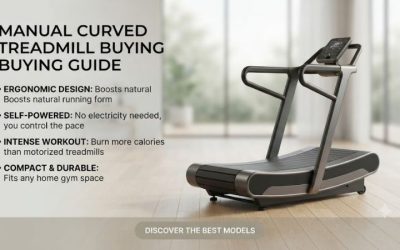
Compare the best manual curved treadmills for small spaces. Review compact footprints, slat-belt engineering, magnetic resistance, and ceiling requirements.
Curved manual treadmills offer unmatched athletic conditioning, natural gait recruitment, and zero-electricity operation, but their rigid slat-belt architecture presents distinct spatial challenges for compact home gyms. Because curved decks rely on a continuous loop of heavy rubber or composite slats rotating around precision bearings rather than a thin belt over a flat deck, they cannot fold vertically or collapse under furniture. Integrating a motorless curved runner into an apartment, spare room, or small garage requires evaluating total operating length, step-up entry height, frame curb weight, and transport maneuverability. This guide analyzes the best compact manual curved treadmills on the market, assessing verified dimensions, mechanical resistance systems, and practical spatial safety clearances.
Quick Verdict
For trainees seeking the absolute shortest footprint without abandoning proper sprint mechanics, the Bells of Steel Wooden Residential Manual Treadmill serves as the best ultra-compact pick, measuring just 55.75 inches long. Runners prioritizing precision biomechanics and low-impact ergonomics in a condo-friendly frame will find the TrueForm Trainer to be the best overall compact curved platform due to its gentle 2.5-inch curve and sub-64-inch profile. Budget-conscious home gym owners looking for dynamic workout variety should choose the Sunny Health & Fitness SF-X7110 for its integrated 8-level magnetic resistance and manageable width. If heavy athletic sprint durability and commercial bearing assemblies take priority, the AssaultRunner Pro remains the benchmark for home athletic training.
Quick Comparison Table
| Product | Best For | Key Specifications | Main Advantage | Trade-Off |
| TrueForm Trainer | Best Overall Compact Runner | Manual Slat Drive; 64″ L x 31″ W x 63″ H; 17″ x 54″ Deck; 400 lb Capacity | Shallow 2.5″ curve promotes natural gait; compact 64″ length | Heavy frame (270 lb) lacks integrated magnetic resistance |
| Bells of Steel Wooden Manual | Best Ultra-Short Footprint | Manual Slat Drive; 55.75″ L x 31.5″ W x 61″ H; 17.3″ x 47″ Deck; 396 lb Capacity | Shortest length in category (55.75″) fits tight spaces easily | 47″ belt length restricts long, high-speed sprinting strides |
| Sunny Health & Fitness SF-X7110 | Best Budget with Resistance | Manual Magnetic (8 Levels); 67.7″ L x 29.9″ W x 59.1″ H; 17.7″ x 59″ Deck; 330 lb Capacity | Built-in 8-level magnetic brake allows sled pushes and walks | Narrower frame features lighter structural components |
| SB Fitness Equipment CT400 | Best Lightweight Curved Deck | Manual Magnetic (3 Levels); 72″ L x 30″ W x 62″ H; 18″ x 60″ Deck; 450 lb Capacity | Relatively lightweight 145 lb frame rolls smoothly on casters | 72″ overall length requires careful room measuring |
| Assault Fitness AssaultRunner Pro | Best for Athletic HIIT Intervals | Manual Slat Drive; 69.9″ L x 31.7″ W x 64.4″ H; 17″ x 62″ Deck; 350 lb Capacity | Commercial-grade drivetrain with fast acceleration response | Heavy 289 lb deadweight makes frequent room shifts difficult |
| IN10CT Health Runner | Best Low-Step Entry Clearance | Manual Slat Drive; 69″ L x 32″ W x 61.5″ H; 17.2″ x 61″ Deck; 400 lb Capacity | Low deck entry profile pairs well with 8-foot home ceilings | Basic LCD monitor with minimal onboard metric analysis |
How We Selected
Evaluating manual curved treadmills for space-constrained residential settings requires strict mechanical scrutiny rather than standard commercial gym metrics. Our editorial research examined manufacturer mechanical blueprints, frame weld materials, bearing track assemblies, user manuals, and published structural load capacities.
Essential Evaluation Criteria:
- Overall In-Use Footprint: Commercial curved treadmills routinely exceed 76 to 84 inches in length. We prioritized compact residential and light-commercial frames measuring between 55 and 72 inches to maximize usable perimeter space.
- Curve Geometry and Deck Dimensions: We evaluated curve radius and slat depth. A shallow curve facilitates distance running and steady walking, while aggressive curves demand precise foot placement. We verified that belt lengths support natural stride mechanics without excessive machine length.
- Internal Resistance Systems: We distinguished between frictionless free-spinning slat tracks (engineered purely for running and sprinting) and models featuring adjustable magnetic resistance brakes, which enable slow sled-push conditioning within a stationary footprint.
- Mobility and Weight Distribution: Since curved treadmills cannot fold, repositioning depends entirely on frame balance, integrated transport wheels, and lifting handles. We assessed total machine weight against caster diameter and mobility leverage.
- Vertical Entry and Ceiling Clearances: Curved treadmills elevate the runner higher off the floor than standard flat motorized decks. We tracked step-up platform heights and apex curve elevations to establish realistic minimum room ceiling heights.
Detailed Product Recommendations
TrueForm Trainer
Best For: Runners seeking a biomechanically sound, compact curved treadmill engineered to promote midfoot striking without dominating a residential room.
Why We Picked It: The TrueForm Trainer condenses the legendary running ergonomics of commercial slat decks into a residential footprint measuring only 64 inches long. Unlike aggressive curved decks that force an artificial uphill sprint angle, the Trainer utilizes a subtle 2.5-inch curve radius. This shallow curve rewards proper upright posture and natural cadence while keeping the machine’s overall profile manageable for residential rooms and small garage spaces.
Key Specifications:
- Drive Type: Non-motorized manual slat belt
- Resistance: Dynamic user-generated (no magnetic brake)
- Running Surface: 17″ W x 54″ L
- Dimensions: 64″ L x 31″ W x 63″ H
- Machine Weight: 270 lb
- Weight Capacity: 400 lb
Features & Benefits: The TrueForm Trainer features molded elastomer thermoplastic polyurethane (TPU) slats mounted on precision steel ball bearings. This construction eliminates belt slippage and drastically dampens acoustic vibrations through the floor. The minimal battery-powered digital console tracks speed, pace, distance, and time without requiring an AC wall outlet, allowing flexible placement anywhere in a room.
Performance & Practical Use: Operating the Trainer requires immediate core engagement and a balanced foot strike directly beneath the center of mass. Running forward on the shallow curve increases belt speed instantly, while drifting toward the center stabilizes pace. Because the deck is responsive and smooth, transitioning from a walking warm-up to threshold paces feels fluid. The heavy 270-pound frame eliminates side-to-side wobble during aggressive running, though its weight requires deliberate effort when rolling across rubber floor mats.
What Makes It Different: The 2.5-inch curve is the shallowest in the category, producing the closest indoor simulation to outdoor road running while keeping total machine length to a compact 64 inches.
Pros:
- Compact 64-inch overall length fits tighter footprints than standard commercial units.
- Shallow curve radius enforces correct gait without altering running mechanics.
- Heavy-duty 400-pound user capacity built on a reinforced steel chassis.
Cons:
- 270-pound machine weight makes moving it across thick carpet difficult.
- Lacks adjustable magnetic resistance for simulated sled pushing.
Buy If: You want a durable running-focused curved treadmill with elite gait feedback that takes up less than 5.5 feet of floor length.
Skip If: You want variable magnetic resistance settings for high-drag power walking and sled simulation.
Bells of Steel Wooden Residential Manual Treadmill
Best For: Apartment dwellers and tight home gym owners who need the absolute smallest curved treadmill footprint available.
Why We Picked It: At just 55.75 inches in total length, the Bells of Steel Wooden Residential Manual Treadmill is the shortest functional curved slat-belt runner on the residential market. Most curved machines require over six feet of horizontal clearance; this unit cuts that down significantly by optimizing its slatted track to a focused 47-inch running length. Its unique wooden side frame panels also blend seamlessly into residential living spaces where industrial steel look out of place.
Key Specifications:
- Drive Type: Non-motorized manual slat belt
- Resistance: User-propelled (free-spinning bearing assembly)
- Running Surface: 17.3″ W x 47″ L
- Dimensions: 55.75″ L x 31.5″ W x 61″ H
- Machine Weight: 209.4 lb
- Weight Capacity: 396.8 lb
Features & Benefits: The chassis combines alloy steel crossmembers with multi-ply wood aesthetic side fairings, providing structural rigidity while reducing harsh resonant vibration. The deck utilizes flexible nylon composite slats designed to absorb foot impact shock. An integrated front phone holder and battery-powered LCD monitor provide essential pacing feedback without electrical cords.
Performance & Practical Use: The 8.4-degree curve angle provides an intuitive acceleration zone near the front roller. For power walking, steady jogging, and short sprint bursts, the 47-inch track provides sufficient foot clearance for trainees under six feet tall. The self-powered belt begins rotating with moderate forward lean, and decelerating requires simply easing back toward the curve’s center. However, athletes with long sprint strides may find the 47-inch belt limiting during full-extension sprints.
What Makes It Different: It delivers genuine curved slat-belt training in a frame measuring less than 56 inches long—nearly a foot shorter than typical industry models.
Pros:
- Industry-leading compact 55.75-inch frame length fits into tight room alcoves.
- Furniture-grade wood panel aesthetics soften the visual impact in residential homes.
- High 396.8-pound user weight limit despite its smaller footprint.
Cons:
- 47-inch running belt length restricts extended sprint strides for tall runners.
- Absence of auxiliary handrail extensions limits low-angle pushing drills.
Buy If: Floor space is your strictest constraint and you need a compact, stylish curved treadmill for walking and jogging.
Skip If: You are an over-6-foot competitive athlete requiring an extended 60-inch track for all-out sprinting.
Sunny Health & Fitness SF-X7110
Best For: Budget-conscious buyers seeking an all-in-one curved conditioning platform that integrates progressive magnetic resistance into a slim chassis.
Why We Picked It: The Sunny Health & Fitness SF-X7110 solves the primary versatility limitation of entry-level curved treadmills by integrating an 8-level magnetic braking system. Many compact runners operate strictly as free-spinning tracks; the SF-X7110 allows users to dial up magnetic drag to simulate uphill walks and heavy sled pushes. With a narrow sub-30-inch width, it slips easily through standard residential interior doorways.
Key Specifications:
- Drive Type: Non-motorized slat belt with magnetic resistance
- Resistance: 8 selectable magnetic levels
- Running Surface: 17.7″ W x 59″ L
- Dimensions: 67.7″ L x 29.9″ W x 59.1″ H
- Machine Weight: 186 lb
- Weight Capacity: 330 lb
Features & Benefits: The mechanical resistance lever mounted near the handrails shifts a series of rare-earth magnets closer to an internal conductive flywheel, smoothly adjusting drag from completely free-spinning (Level 1) to high-load resistance (Level 8). The multi-grip handlebar assembly includes low horizontal bars that support forward-leaning sled pushes, targeting the quadriceps and calves without requiring separate outdoor sled equipment.
Performance & Practical Use: At Level 1, the slatted belt turns easily, accommodating smooth walking and moderate pace running. Dialing the lever to Levels 5 through 8 transforms the machine into a formidable strength-endurance tool: the user must drive hard through the forefoot to cycle the slats, delivering intense cardiovascular and muscular burn at low speeds. At 186 pounds, the frame is manageable for one person to pivot and steer via its front transport wheels and rear lifting handle.
What Makes It Different: It combines a generous 59-inch running surface with an 8-level magnetic brake while maintaining a narrow 29.9-inch profile that fits through standard interior doorways.
Pros:
- 8 levels of magnetic resistance expand workouts from running to sled pushes.
- Slim 29.9-inch overall width fits through residential door openings without disassembly.
- Manageable 186-pound machine weight improves room-to-room portability.
Cons:
- Console display is basic with modest viewing angles.
- Lighter steel chassis exhibits minor flex during explosive top-speed sprint starts.
Buy If: You want a versatile conditioning machine that combines curved running with high-resistance power walking on a moderate budget.
Skip If: You require a commercial-grade, heavy steel frame built purely for high-velocity sprint training.
SB Fitness Equipment CT400
Best For: Trainees wanting a full 60-inch running deck on an exceptionally lightweight frame that is easy to relocate in multi-use rooms.
Why We Picked It: High structural weight is the primary enemy of small-space fitness equipment. While most curved treadmills weigh between 260 and 350 pounds, the SB Fitness CT400 weighs just 145 pounds. By utilizing high-tensile flexible composite slats and an optimized alloy framework, the CT400 provides a full 60-inch running track without the immense deadweight that makes other commercial units permanent fixtures.
Key Specifications:
- Drive Type: Non-motorized slat belt with magnetic control
- Resistance: 3 magnetic resistance levels
- Running Surface: 18″ W x 60″ L
- Dimensions: 72″ L x 30″ W x 62″ H
- Machine Weight: 145 lb
- Weight Capacity: 450 lb
Features & Benefits: The CT400 incorporates a 3-stage magnetic resistance system, allowing users to toggle between free run, moderate resistance, and high resistance. Its running surface consists of individual shock-absorbing rubberized slats riding on high-speed sealed bearings. An oversized rear transport handle and wide front polyurethane wheels allow single-person maneuvering across hard flooring and low-pile carpets.
Performance & Practical Use: The 145-pound structure feels surprisingly planted during use, supported by wide front stabilizer feet with adjustable levelers. The 18″ x 60″ deck provides ample margin for error, allowing runners to open their stride fully without clipping the front cowl or side rails. Transitioning the magnetic brake into setting 3 creates a heavy walking resistance, though it does not reach the near-immovable lock of dedicated 8-level magnetic systems.
What Makes It Different: It is one of the lightest full-length curved treadmills on the market (145 lb), pairing high user capacity (450 lb) with manageable mobility.
Pros:
- Ultra-lightweight 145-pound build allows genuine single-person room repositioning.
- Generous 18″ x 60″ belt surface accommodates full-stride running safely.
- Robust 450-pound manufacturer load rating.
Cons:
- 72-inch overall frame length requires dedicated room floor space.
- 3 magnetic resistance settings offer limited adjustment granularity.
Buy If: You need a full-length running track and high weight capacity, but need to roll the machine out of the way regularly.
Skip If: Your room layout cannot accommodate a 6-foot overall equipment length.
Assault Fitness AssaultRunner Pro
Best For: High-intensity interval trainees and CrossFit enthusiasts who demand proven mechanical durability and instant sprint acceleration.
Why We Picked It: The AssaultRunner Pro is a proven benchmark in athletic non-motorized training. Engineered to withstand intense commercial gym intervals, it fits into residential spaces requiring rugged hardware that never needs an outlet. Its heavy steel frame, precision bearing track, and balanced slatted belt respond instantly to cadence changes, making it superior for rapid high-intensity interval training (HIIT).
Key Specifications:
- Drive Type: Non-motorized manual slat belt
- Resistance: Dynamic user-generated (limitless top speed)
- Running Surface: 17″ W x 62″ L
- Dimensions: 69.9″ L x 31.7″ W x 64.4″ H
- Machine Weight: 289.2 lb
- Weight Capacity: 350 lb
Features & Benefits: Built around a heavy-gauge tubular steel frame, the AssaultRunner Pro uses solid rubber-coated slats rated for 150,000 miles of operation. The drive system utilizes dual sealed bearing tracks that guide the belt with minimal lateral play. The console features high-contrast LCD readouts with pre-programmed interval modes (such as 20/10 intervals, target time, and target distance) and Bluetooth/ANT+ heart rate pairing.
Performance & Practical Use: Accelerating on the AssaultRunner Pro is seamless: stepping forward onto the curvature increases rotational belt speed instantly, with no motor hesitation. Deceleration is equally smooth when shifting stride toward the center of the deck. Its 289-pound structural weight ensures zero frame walk or lateral shudder during max-effort sprints. However, this heavy mass means moving it requires significant effort, even with the integrated rear handle and transport wheels.
What Makes It Different: Commercial-grade drive components and high-tensile steel construction deliver unmatched sprint stability and immediate speed changes in a sub-70-inch footprint.
Pros:
- Industrial drivetrain rated for 150,000 miles of maintenance-free use.
- Instant speed responsiveness engineered specifically for HIIT athletic conditioning.
- Zero electrical draw; operates cleanly anywhere in a small home gym.
Cons:
- Substantial 289-pound weight makes transport across rugs or thresholds difficult.
- Frame does not fold, requiring a permanent 70-inch footprint.
Buy If: You prioritize athletic sprint conditioning, rock-solid stability, and proven mechanical durability.
Skip If: You have a weak back, live up multiple flights of stairs, or need a machine that can be tucked out of sight easily.
IN10CT Health Runner
Best For: Basements and low-ceiling workout spaces requiring an athletic curved deck with a low entry step-up height.
Why We Picked It: One of the most significant hazards of installing a curved treadmill in a residential home is low ceiling clearance. The IN10CT Health Runner solves this by engineering a low-profile curved chassis whose lowest central running point sits lower to the floor than many high-arched commercial competitors. Measuring 69 inches long and 32 inches wide, it balances full-stride functionality with safe vertical headroom.
Key Specifications:
- Drive Type: Non-motorized manual slat belt
- Resistance: Dynamic user-generated (frictionless bearing system)
- Running Surface: 17.16″ W x 61″ L
- Dimensions: 69″ L x 32″ W x 61.5″ H
- Machine Weight: 286 lb
- Weight Capacity: 400 lb
Features & Benefits: The IN10CT Health Runner utilizes slatted rubber treads reinforced with internal composite ribs, driven by an under-deck dual-pulley guidance track. This track system prevents slats from shifting off-center during lateral foot strikes. Its corrosion-resistant powder-coated frame includes ergonomic handrails that wrap cleanly around the front without protruding into the user’s running space.
Performance & Practical Use: The bearing array provides a responsive, low-friction glide that allows smooth transitions from slow walking to continuous jogging and top-end sprints. The curve angle provides steady feedback, assisting the runner in keeping their hips extended and foot strikes situated under the pelvis. Operating acoustic levels are low, producing primarily the rhythmic contact sound of shoes on rubber slats rather than the motor whine of electric machines.
What Makes It Different: A compact 69-inch length combined with a low-clearance running trough makes it uniquely adaptable to rooms with standard 8-foot ceilings.
Pros:
- Low deck step-up profile preserves essential head clearance under low ceilings.
- Sturdy 400-pound user weight capacity built on corrosion-resistant steel.
- Slatted rubber track provides excellent joint cushioning compared to hard asphalt.
Cons:
- The digital display monitor is basic and lacks advanced backlight options.
- At 286 pounds, it is heavy and demands a permanent floor allocation.
Buy If: You have limited vertical ceiling height but still want a full-sized 61-inch curved running track.
Skip If: You want a lightweight machine that can be rolled into a storage closet between workouts.
Comprehensive Buying Guide: Choosing a Manual Curved Treadmill for Small Spaces
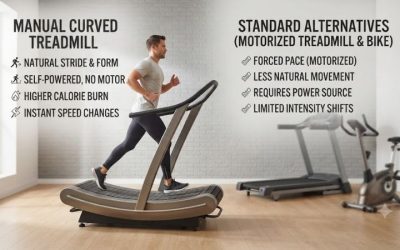
Manual curved treadmills operate on fundamental Newtonian mechanics: gravity, friction, and the kinetic energy of the user’s body. Unlike motorized treadmills that pull the user’s foot backward via an electric motor, a curved manual treadmill features a concave deck on precision low-friction bearings. When the user steps forward onto the upward slope of the curve, gravity and body weight pull the slat downward and backward, rotating the belt.
Selecting a curved manual treadmill for a confined space involves unique trade-offs. The mechanical components that make these machines durable—steel frame members, bearing assemblies, and interconnected composite slats—prevent them from folding. To select the right model for your home footprint, evaluate the following mechanical and spatial factors.
1. The Non-Folding Reality: Footprint vs. Functional Clearance
The primary misconception regarding curved treadmills in small spaces is assuming their physical footprint equals their required operating space.
+------------------------------------------------------------------+
|                   TOTAL OPERATING ENVELOPE                       |
|                                                                  |
|   Side Clearance (18"-24")        Side Clearance (18"-24")       |
|      |                               |                           |
|      v                               v                           |
|    +---+---------------------------+---+                         |
|    |   |    CURVED SLAT DECK       |   |                         |
|    |   |                           |   |                         |
|    |   |   (e.g., 17" x 54-61")    |   |                         |
|    +---+---------------------------+---+                         |
|                      |                                           |
|                      v                                           |
|          Rear Safety Clearance (36"-48")                         |
|                                                                  |
+------------------------------------------------------------------+
- Physical Footprint: Compact curved machines range from 55.75 to 72 inches in length and 29 to 32 inches in width. Unlike standard electric treadmills, the slatted running track cannot pivot upward on a hydraulic folding hinge. Where it sits is where it stays during use.
- Rear Operating Clearance: You must maintain a minimum of 36 to 48 inches of completely unobstructed space behind the machine. Because manual treadmills accelerate instantly to match user output, a sudden loss of balance during an interval can eject a runner backward. Ensuring open space behind the rear roller prevents dangerous impact against walls or gym furniture.
- Side Clearance: Maintain at least 18 to 24 inches on both sides to allow safe stepping onto the side foot rails if you need to stop your stride abruptly.
2. Ceiling Height Calculations for Curved Decks
Curved treadmills feature elevated front and rear rollers, meaning the user runs noticeably higher off the floor than on a motorized flat deck. Standard flat treadmills have an entry height of 6 to 8 inches; curved treadmills elevate the runner’s feet 11 to 15 inches off the ground at the front apex.
To ensure your home gym room or basement can accommodate a curved runner, use this formula:
$$\text{Minimum Ceiling Height} = \text{User Height} + \text{Treadmill Step-Up Apex} + \text{Running Head Bounce Buffer}$$
Where:
- User Height: The height of the tallest user in athletic shoes.
- Treadmill Step-Up Apex: The highest point of the running deck curve from the floor (typically 12 to 15 inches).
- Running Head Bounce Buffer: A safety clearance buffer of 8 to 12 inches to account for vertical head oscillation during running gait flight phases.
Example Scenario: A 6-foot-1-inch (73-inch) runner training on a curved treadmill with a 13-inch apex height, plus a standard running bounce buffer of 10 inches:
$$73” + 13” + 10” = 96” \text{ (8.0 feet)}$$
In a room with an 8-foot (96-inch) ceiling, that runner will operate with roughly one to two inches of total clearance. If your space features ceiling heights below 8 feet (common in basements), you must prioritize low-profile frames like the IN10CT Health Runner or TrueForm Trainer, or restrict workouts to walking and controlled jogging.
3. Machine Weight and Residential Portability
Curved manual treadmills achieve durability through heavy steel frameworks and dense slat loops. A machine that cannot fold must be wheeled away when the floor space is needed for other training modalities.
- Weight Classes:
- Lightweight (140 to 190 lb): Models like the SB Fitness CT400 or Sunny SF-X7110. A single adult can easily tilt the frame onto its wheels and roll it across a level room.
- Heavy-Duty (260 to 300+ lb): Models like the AssaultRunner Pro or TrueForm Trainer. Moving these units across rubber gym mats or carpet requires substantial physical effort and is impractical for daily breakdown.
- Mobility Hardware: Look for solid polyurethane wheels mounted on the front crossmember and a dedicated lifting handle integrated into the rear frame. Avoid machines that require lifting by the plastic cosmetic cowls.
4. Free-Spinning vs. Magnetic-Brake Resistance
Different curved treadmills serve different conditioning objectives based on their drivetrain design:
- Free-Spinning Slat Systems:
- What It Is: The belt rotates solely on frictionless sealed ball bearings without artificial drag. Speed is governed 100% by where your foot strikes the curve.
- Why It Matters: Ideal for authentic running form, continuous cadence work, and maximal sprint intervals. It simulates free road sprinting with zero motor assistance.
- Trade-Off: Cannot be set to high resistance for strength-focused hiking or simulated heavy sled pushes.
- Magnetic-Brake Resistance Systems:
- What It Is: An adjustable eddy-current magnetic brake applies resistance to the internal flywheel via a console lever.
- Why It Matters: Allows users to perform heavy sled pushes, high-resistance power walks, and anaerobic leg-drive intervals without needing extra floor space for an actual weighted sled.
- Trade-Off: Adds internal complexity and mechanical drag, which can make effortless free-running feel slightly less fluid on entry-level models.
5. Running Surface Dimensions and Stride Mechanics
In a space-constrained home, saving every inch of deck length is tempting. However, undersized running surfaces introduce practical athletic trade-offs:
- Belt Width: A 17-to-18-inch belt width is standard for compact curved treadmills. While narrower than commercial motorized decks (often 20 to 22 inches), it is entirely functional because running on a curve naturally funnels your foot strike toward the center track.
- Belt Length:
- 47 to 50 Inches: Excellent for small rooms and power walking, but restricts full sprinting extension for runners over 6 feet tall.
- 54 to 62 Inches: The recommended target for sprint training, interval work, and taller athletes, requiring around 5.5 to 6 feet of total floor length.
Frequently Asked Questions
Can a curved manual treadmill fold up for storage?
No. Curved manual treadmills cannot fold. Their running decks are built from interconnected rubber or composite slats that ride inside heavy structural side channels fitted with dozens of sealed ball bearings. This rigid architecture provides structural stability and smooth rotation, but it makes vertical folding mechanically impossible. If you purchase a curved treadmill, you must allocate a permanent horizontal floor footprint.
How much ceiling clearance do I need for a curved manual treadmill?
You should have your personal height plus at least 22 to 24 inches of clearance. Curved treadmills sit higher off the floor than standard flat treadmills, with deck heights reaching 12 to 15 inches at the front and rear curves. When you add 8 to 10 inches of vertical head oscillation that occurs during the flight phase of running, a standard 8-foot (96-inch) ceiling is the practical minimum for runners taller than 6 feet.
Are curved manual treadmills good for walking, or only sprinting?
They are exceptional for both walking and sprinting. Walking on a curved surface demands continuous hamstring and glute engagement because you must actively push the belt backward with every step. When paired with models that feature adjustable magnetic resistance, walking on a curved treadmill delivers an intense, low-speed cardiovascular and muscular workout with zero motor noise.
Do manual curved treadmills require electricity or wall outlets?
No. Curved manual treadmills are 100% self-powered. The motion of your feet against the curved deck drives the belt assembly. The simple digital consoles that track speed, distance, time, and heart rate operate on standard AA or AAA batteries. This allows you to position the machine anywhere in your home—including balconies, garages, or central living rooms—without running power extension cords across the floor.
How loud is a curved manual treadmill in an apartment?
A curved manual treadmill eliminates electrical motor whine, but it creates mechanical noise. Sound is produced by the slats cycling over the internal roller bearings and your running shoes contacting the rubber tread. In an apartment or upstairs room, the low-frequency rhythmic impact of running can transfer through the subfloor. Placing a high-density 6 mm to 9 mm rubber equipment mat beneath the frame isolates vibrations and prevents complaints from neighbors below.
Why are manual curved treadmills heavier than flat motorized treadmills?
Manual curved treadmills rely on heavy steel frames, thick elastomer slats, dual bearing rails, and balanced internal flywheels to create smooth, steady rotational inertia without a motor. A lightweight frame would slide across the floor or shudder under the dynamic impact of a sprinting runner. This structural mass ensures stability, but it means home gym owners must rely on front transport wheels and rear handles when moving the machine.
Conclusion
Integrating a manual curved treadmill into a small space requires selecting a machine whose length, structural mass, and curve geometry fit your home’s physical constraints. If floor space is severely limited, the Bells of Steel Wooden Residential Manual Treadmill provides the shortest overall length in the category at under 56 inches. Trainees looking for optimal running biomechanics in a compact, durable frame will find the TrueForm Trainer to be the best overall pick for natural stride training. If you desire variable magnetic resistance for simulated sled work within a narrow 30-inch frame, the Sunny Health & Fitness SF-X7110 offers exceptional versatility. Measure your ceiling height, confirm your rear safety buffer, and select the compact curved platform that best supports your home training objectives.
Write Your Review
No reviews yet. Be the first to share your experience!