
Our Top Picks
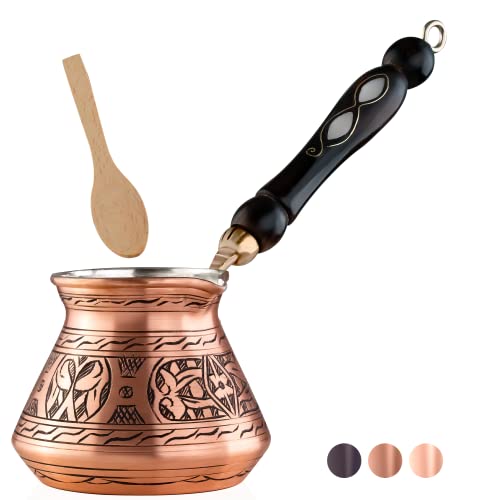 BCS 12 oz Handmade Copper Turkish Coffee Pot12 Ounces3.15 x 3.15 x 3.35 inches0.6 poundsCheck on Amazon
The best Turkish coffee pots for most home brewers are heavy-gauge copper cezves with a tin-lined interior, while stainless steel is the practical choice for induction cooktops and ceramic is best for gentle, traditional-looking brewing when pouring control matters less.
A Turkish coffee pot, also called a cezve or ibrik, is designed for finely ground coffee, water, and foam-building heat rather than filtered coffee. The right choice depends less on appearance than on four details: how many cups you make, whether your stove is induction-compatible, how safely the handle stays cool, and whether the spout gives you a controlled pour.

DEMMEX Copper Turkish Greek Arabic Coffee Pot Cezve Ibrik Briki, 3 Servings
Chosen because it specifies 3 Servings.
View on Amazon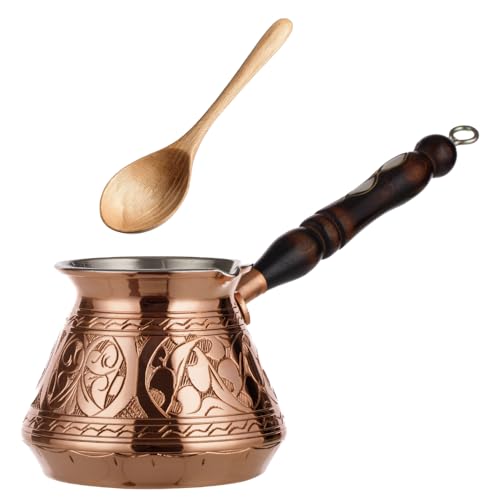
DEMMEX 1mm Thick Copper Turkish Coffee Pot Cezve, Handmade, 3 Servings
Chosen because it specifies Handmade and 3 Servings.
View on AmazonBCS 12 oz Handmade Copper Turkish Coffee Pot, Hand-Engraved Cezve & Spoon
Chosen because it specifies Hand-Engraved Cezve & Spoon.
View on Amazon
PC Series (Large - 14 fl oz) - Thickest Solid Copper Engraved Turkish Greek Arabic Coffee Pot Wooden Handle Heavy Duty, Stovetop Coffee Maker, Jazzve, Cezve, Ibrik with Hammered Base
Chosen because it specifies 14 fl oz) and Stovetop Coffee Maker.
View on AmazonQuick comparison: copper, stainless steel, and ceramic cezves
| Pot type | Typical capacities | Approx. empty weight | Handle heat protection | Stovetop compatibility | Pouring control | Best for |
|---|---|---|---|---|---|---|
| Tin-lined copper | 100–700 ml | 180–500 g | Wood or heat-resistant composite handles are safest; metal handles heat quickly | Gas and electric; induction only with a suitable adapter or magnetic base | Very good when the spout is narrow and sharply formed | Traditional brewing, frequent use, precise foam control |
| Stainless steel | 200–1,000 ml | 250–650 g | Hollow or silicone-covered handles reduce heat transfer; solid metal handles need caution | Gas, electric, and many induction models; verify the base | Good on narrow-spout designs; broad rims can drip | Durability, easy cleaning, induction cooking |
| Ceramic or earthenware | 250–600 ml | 500–1,200 g | Handles usually stay cooler, but the body and rim retain heat | Gas or electric only if explicitly marked stovetop-safe; not automatically induction-safe | Fair to good; thick rims and heavier bodies make small pours slower | Slow, gentle brewing and serving directly from the pot |
Capacities are approximate because manufacturers measure them differently. A nominal 300 ml pot may be filled safely to only 220–250 ml if you need room for foam. Turkish coffee is commonly served in small cups holding about 60–90 ml, but the coffee grounds and foam occupy part of the pot.
Our picks by brewing situation
Best overall: a 300–400 ml tin-lined copper cezve
For one to three small servings, a 300–400 ml copper pot offers the most responsive heat control and the strongest traditional credentials. Copper heats quickly, so you can move the pot off the burner as the foam rises instead of waiting for a thick vessel to react. A narrow neck helps concentrate foam and a pointed spout makes it easier to divide the coffee between cups.
Look for copper at least about 1 mm thick, a securely riveted handle, and a food-safe tin lining. Bare copper should not be used as the interior cooking surface for coffee. The lining will gradually wear, especially if you scrub it with abrasives, and it may eventually need professional retinning.
Best for induction: a stainless-steel cezve with a magnetic base
Stainless steel is the sensible choice when induction compatibility is non-negotiable. Choose a model that explicitly states induction suitability and has a flat, magnetic base. A decorative stainless pot with a rounded bottom may not work efficiently, even if the body itself is made from steel.
Stainless steel is slower to respond than copper, which can make foam easier to overshoot. Use a lower setting, keep the pot centered, and remove it from the heat as soon as the foam begins to climb. A three-layer or encapsulated base distributes heat more evenly than a very thin single layer.
Best for low-maintenance ownership: stainless steel with a hollow handle
If the pot will be used several times a week, stainless steel avoids the delicate interior lining found in traditional copper models. It does not require polishing, tolerates normal hand washing, and is less vulnerable to dents. A hollow, riveted handle is preferable to a solid metal handle because it slows heat transfer.
This is also the better option for a busy kitchen where the pot may be washed soon after brewing. Stainless steel still benefits from gentle care: coffee oils can leave a film, and abrasive scouring pads can create scratches that make the surface harder to keep clean.
Best for gentle brewing and serving: a stovetop-safe ceramic pot
Ceramic distributes heat gradually and retains it after removal from the burner. That can produce a slower, more forgiving brew, but it reduces your ability to make rapid heat adjustments. Ceramic is also heavier and more breakable, so it suits a fixed brewing area rather than a crowded drawer.
Do not place an ordinary decorative ceramic vessel directly on a burner. Thermal shock can crack it. The product must be labeled for stovetop use, and you should avoid moving a hot pot onto a cold or wet surface.
Capacity: choose by servings, not the label
| People or servings | Useful pot capacity | Approximate coffee output | Why this size works |
|---|---|---|---|
| 1 small cup | 100–150 ml | 60–90 ml | Leaves enough headroom for foam without using an oversized pot |
| 2 small cups | 200–300 ml | 120–180 ml | Good balance between surface area, control, and pouring speed |
| 3–4 small cups | 400–600 ml | 240–360 ml | Useful for guests, though foam control becomes more demanding |
| 5–6 small cups | 700–1,000 ml | 420–600 ml | Convenient volume, but often less precise for a single serving |
A practical calculation is to multiply the serving size by the number of cups, then add roughly 25–35% headroom. For three 75 ml cups, 225 ml of finished coffee needs a pot around 300 ml: 225 ÷ 0.75 = 300 ml. This is a reason to avoid making one cup in a 700 ml pot, where the shallow coffee layer can heat unevenly and the foam is harder to judge.
Handle and spout details that matter
- Handle attachment: Rivets are easy to inspect and usually preferable to a loose-looking crimp or thin welded joint.
- Handle length: About 10–15 cm keeps your hand away from the burner while remaining easy to control.
- Heat protection: Wood and heat-resistant composite handles feel safer, but any handle can become hot where it meets the pot. Keep a dry cloth or mitt nearby.
- Spout shape: A narrow, pronounced spout gives better control when distributing foam. A wide pouring lip is faster but more likely to drip.
- Rim geometry: A clean, even rim helps you pour without coffee running down the outside. Check that it is not sharp or visibly distorted.
- Balance: The handle should counter the weight of the filled pot. A long handle attached too high can make a small cezve feel awkward.
Decision matrix for choosing your pot
| Your situation | Recommended material | Target capacity | Features to prioritize |
|---|---|---|---|
| First cezve and limited budget | Stainless steel | 300–400 ml | Magnetic flat base, hollow handle, narrow spout |
| Experienced brewer seeking traditional control | Tin-lined copper | 200–400 ml | Thick copper, secure rivets, well-shaped spout |
| Induction cooktop | Induction-rated stainless steel | 300–600 ml | Magnetic base, stable footprint, easy-to-read capacity |
| Daily brewing and minimal maintenance | Stainless steel | 300–500 ml | Dishwasher guidance, smooth interior, replaceable or durable handle |
| Occasional serving and decorative presentation | Stovetop-safe ceramic | 300–600 ml | Thermal-shock guidance, broad stable base, comfortable handle |
| Small kitchen or single-cup routine | Copper or stainless steel | 100–200 ml | Compact footprint, precise spout, short heating time |
How to brew without sacrificing foam
- Measure cold water into the pot, leaving at least 1.5–2 cm below the rim.
- Add finely ground coffee and sugar if desired. Stir before heating so the grounds are evenly dispersed.
- Use low to medium-low heat. A high flame can scorch the coffee and make the foam rise too abruptly.
- Watch the surface rather than waiting for a vigorous boil. When foam expands toward the rim, remove the pot for several seconds.
- Pour slowly, distributing foam first if you are serving multiple cups. A narrow spout makes this step easier.
Do not repeatedly boil the coffee hard. It can flatten the foam, increase bitterness, and make cleanup more difficult. For a shared pot, divide a little foam into each cup, then return the pot briefly to low heat before completing the pour.
Cleaning, wear, and ownership costs
Rinse the pot soon after use and wash it by hand with warm water and a soft sponge. Dry the exterior promptly, especially on copper, where trapped moisture can encourage discoloration. Avoid detergents and abrasive pads on tin-lined copper unless the manufacturer specifically permits them.
The part most likely to wear on copper is the tin lining, not the copper body. Dark spots, exposed copper, deep scratches, or a lining that appears detached are reasons to stop using the pot until it is professionally inspected or relined. Stainless steel is less demanding, but its handle fasteners, base, and spout are still potential failure points. Ceramic’s main risks are chips, cracks, and thermal shock.
General market prices in 2026 are often about $15–$35 for basic stainless steel, $25–$80 for a well-made copper cezve, and $30–$100 or more for decorated or artisan ceramic models. A cheaper pot can be good value if the base is suitable for your stove and the handle is secure; paying more does not compensate for the wrong capacity or incompatible cooktop.
Final recommendation
Choose a 300–400 ml tin-lined copper cezve if you value traditional brewing and precise response. Choose a magnetic-base stainless-steel model if you use induction, want the easiest ownership, or need a durable everyday pot. Choose stovetop-safe ceramic when gentle heat, heat retention, and serving presentation matter more than rapid control. In every case, prioritize the correct capacity, a stable handle, and a narrow controlled spout over decorative details.










Write Your Review
No reviews yet. Be the first to share your experience!