
Our Top Picks
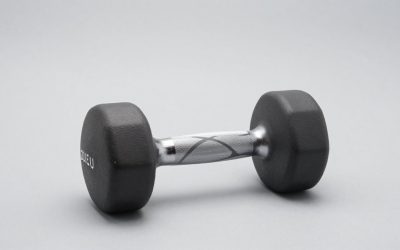
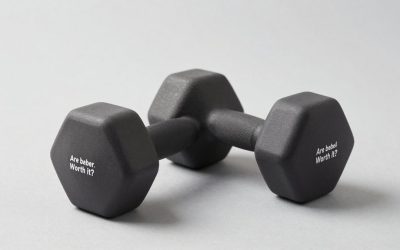
 Amazon Basics Rubber Hex Dumbbell Hand Weight with15 pounds11.68 x 4.53 x 3.98 inches15 PoundsCheck on Amazon
Pros & cons
- Rubber-encased head reduces noise and protects floors when set down
- Hexagon ends keep it from rolling away during a workout
- Contoured handle gives a comfortable, secure hold
- Sold as a single dumbbell, not a matched pair
- Fixed 15-pound weight cannot be adjusted
 Amazon Basics Rubber Hex Dumbbell Weight with Comfortable40 Pounds14 x 6.3 x 0.04 inches40 PoundsCheck on Amazon
Pros & cons
- Rubber-encased 40-pound head resists chipping and floor damage
- Hexagon shape keeps it stable in storage
- Textured grip stays comfortable through heavier lifts
- Sold individually, so a matching pair costs extra
- Fixed weight offers no way to scale down for warm-ups
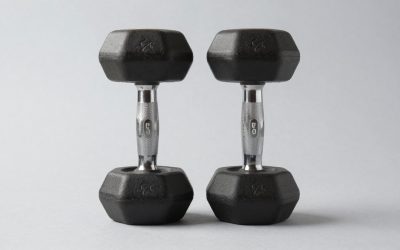
The best rubber hex dumbbells for most home gyms are a medium-to-heavy set with low-odor rubber, fully knurled steel handles, accurate weight markings, and a rack footprint that leaves room to lift safely; for most buyers, a reputable commercial-style set from Rogue or REP is a better long-term choice than the cheapest coated set.
Quick picks by home-gym situation
| Situation | Best choice | Useful range or specification | Why it fits |
|---|---|---|---|
| First home gym on a budget | Individual rubber hex dumbbells bought gradually | 5–50 lb pairs; approximately $1.25–$2.50 per lb | You can cover common exercises without paying for unused heavy weights. |
| Frequent strength training | Commercial-style set from Rogue or REP | 5–100 lb or 5–125 lb pairs; solid heads and textured steel handles | Better finish consistency, handle feel, and long-term replacement availability. |
| Small room or apartment | Rubber hex pairs to 40 or 50 lb, stored vertically or on a compact tray | About 8–10 pairs; roughly 3–5 sq. ft. of rack floor space | Hex heads reduce rolling, while a compact rack prevents a floor-level obstacle course. |
| Heavy presses, rows, and split squats | Large fixed-head dumbbells with a flat hex profile | 60–100 lb pairs; heads at least about 6–8 in. across | More stable between repetitions and less likely to roll when set down. |
| Occasional general fitness | Pairs from 5–30 or 5–50 lb | Six to ten pairs, depending on increments | Enough progression for presses, rows, lunges, curls, and carries without excessive cost. |
What matters most when comparing rubber hex dumbbells
Rubber odor and durability
New rubber dumbbells often smell because the rubber compound and manufacturing residues release volatile compounds after packaging. Odor usually fades over several days or weeks, but it is not a reliable indicator of quality by itself. A strong smell that remains after repeated cleaning and ventilation is a reason to reconsider the set, particularly in a small, poorly ventilated room.
Amazon Basics Rubber Hex Dumbbell Hand Weight with Comfortable Grip for Home and Gym, 15 Pounds, Single
Chosen because it specifies 15 Pounds and Single.
View on Amazon
CAP Barbell 30 LB Coated Hex Dumbbell Weight, New Edition
Chosen because it specifies New Edition.
View on Amazon
CAP 20lb Rubber Coated Hex Dumbbell, Comfort Grip, Free Weights, Pair
Chosen because it specifies Comfort Grip and Free Weights.
View on AmazonAmazon Basics Rubber Hex Dumbbell Weight with Comfortable Handle for Home Gym Workout, 40 pound, Single, Black
Chosen because it specifies 40 pound and Single.
View on AmazonLook for solid rubber heads rather than thin rubber sleeves fitted over a fragile core. Solid heads generally tolerate repeated set-downs better, although no fixed dumbbell should be dropped from overhead onto concrete. Rubber can eventually split at the handle junction, flatten on one side, or become sticky when exposed to heat, oil, or harsh solvents. The handle joint and the outer corners of the hex heads usually show wear before the broad faces do.
Commercial-style rubber dumbbells commonly cost about $1.25–$3 per pound, depending on weight, brand, and whether they are sold individually or as pairs. The lowest price is attractive for light weights, but replacement can be difficult if a single dumbbell develops a defect or if the manufacturer changes its head dimensions between production runs.
Handle knurling and diameter
Handle comfort affects whether a dumbbell feels secure during rows, presses, and carries. A good handle has enough knurling to resist rotation without feeling like a file. Very aggressive, sharp knurling can irritate the palm during high-repetition work, while shallow or polished knurling becomes slippery with sweat.
Many fixed dumbbells use handles approximately 25–32 mm in diameter. Around 28–30 mm suits a broad range of users; smaller hands may prefer the lower end, while larger hands may appreciate a thicker handle. Check whether the handle is knurled across its usable length or only in the center. Center-only knurling is comfortable for many exercises, but longer continuous knurling can provide more grip options for carries and high-volume training.
Inspect the transition from handle to head. A smooth, rounded shoulder is less likely to pinch the hand during pressing, while a sharp metal edge can become an annoyance even if the knurling itself is good.
Hex geometry and stability
“Hex” does not mean every dumbbell has the same shape. Some heads have broad, nearly rectangular faces; others use narrower faces and more pronounced corners. Broad, flat faces are useful for renegade rows, push-up variations, and storage on the floor. They also make the dumbbell less likely to roll into furniture.
Geometry affects exercise clearance as weights become heavier. A large 80 lb dumbbell can have heads roughly 7–9 inches across and may contact the floor or torso sooner than a slimmer design. That extra size can improve stability but may be inconvenient for chest presses, seated shoulder presses, and movements requiring the dumbbells to pass close to the body.
Before buying a heavy set, measure the space between your rack shelves and the floor. Also measure the width of your hands and forearms in the positions you use for pressing. A dumbbell that is stable on the floor but too bulky for your movement pattern is not a good match.
Weight accuracy and increments
Fixed dumbbells are commonly sold in 2.5 lb increments through about 20 or 25 lb, then in 5 lb increments. Some sets include unusual intermediate sizes, but a complete range is more useful than a few isolated heavy pairs. A practical home-gym sequence might be 5, 10, 15, 20, 25, 30, 35, 40, 45, and 50 lb.
Small manufacturing variation is normal, but visibly different head sizes or large discrepancies between the left and right dumbbells are not desirable. If accuracy matters, weigh each pair on a calibrated household or shipping scale when it arrives. Weigh the dumbbell with the scale on a hard, level surface and record the results. Do not assume that a heavier rubber head means a heavier dumbbell; the metal core and rubber density vary by design.
Rubber hex dumbbell comparison
| Design | Typical weight range | Odor expectation | Floor protection | Rack requirement | Best use |
|---|---|---|---|---|---|
| Economy rubber hex | 5–50 lb, sometimes higher | Often stronger when new | Good on rubber flooring; less forgiving on bare wood | Two- or three-tier rack recommended | Occasional training and gradual expansion |
| Commercial solid-rubber hex | 5–100 or 125 lb | Usually more controlled, but still needs ventilation | Good impact and noise reduction | Heavy-duty three-tier rack for full sets | Frequent strength training |
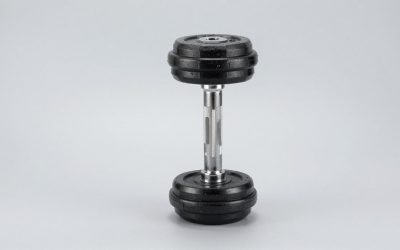
| Rubber-coated iron hex | 2.5–50 lb | Usually less rubber by volume | Protective coating can chip at corners | Compact rack or tray | Light to moderate home workouts |
| Urethane hex dumbbell | 5–100 lb or more | Typically lower odor | Very good, but still not intended for repeated drops | Commercial rack; heavier units need strong shelves | Premium, high-frequency gyms |
Floor protection and rack-storage realities
Rubber heads protect floors better than bare cast iron, but they do not make dropping weights harmless. Repeated impact can dent wood, damage tile grout, mark vinyl, and loosen the dumbbell’s internal structure. Use at least 8–12 mm rubber flooring for ordinary home lifting; thicker 15–20 mm flooring is more appropriate where heavy dumbbells may be set down forcefully. A lifting platform or extra rubber tiles under the rack can protect the most heavily used area.
Storage is frequently underestimated. Ten pairs from 5 to 50 lb may weigh approximately 550 lb in total. A rack must support the combined load, not merely the heaviest pair. A three-tier rack is space-efficient, but the lowest shelf needs enough clearance for large heads, and the frame should sit level on the floor. A tray or stand is adequate for a few pairs, but floor storage becomes inconvenient once the set exceeds roughly four or five pairs.
Allow at least 24–36 inches of clear space in front of the rack so you can lift a dumbbell without striking the frame. Keep the rack away from direct sunlight and radiators, which can accelerate rubber aging.
A practical way to build a set
-
Choose your starting range from your actual exercises. For general training, 5–30 lb pairs cover many movements; regular strength training usually justifies 5–50 lb.
-
Buy matching pairs rather than isolated heavy dumbbells. Bilateral exercises require equal loading, and mismatched head geometry feels awkward when switching hands.
-
Add intermediate weights before jumping to very heavy pairs. A 5 lb increase on each hand adds 10 lb to the exercise, which can be a substantial progression.
-
Measure the rack, doorway, and storage path before ordering. A 100 lb dumbbell can be manageable to lift but difficult to carry safely through a narrow room.
-
Ventilate and wipe the dumbbells on arrival. Use mild soap diluted in water, a damp cloth, and a dry towel. Avoid petroleum-based cleaners, bleach, and solvents that can weaken or swell rubber.
For example, buying ten pairs from 5 to 50 lb means 550 lb of dumbbells. If the set costs $1.75 per pound, the dumbbells alone cost about $962.50 before tax and shipping. A set used twice weekly for three years provides approximately 312 training sessions, or about $3.09 per session before considering the rack and flooring. Buying only the pairs that match your program can reduce the initial cost substantially.
Final buying recommendation
Choose commercial-style solid-rubber hex dumbbells when you train several times per week, care about consistent handles, or expect the set to last for years. Choose economy rubber hex dumbbells when budget is the priority and you can inspect the handles, head seams, and weight markings before expanding the set. For a compact home gym, prioritize flat stable geometry, moderate increments, and a properly rated rack over the widest possible weight range. The best rubber hex dumbbells are the ones whose grip, dimensions, accuracy, and storage demands suit your room and your training—not simply the set with the lowest price per pound.
Write Your Review
No reviews yet. Be the first to share your experience!