
Key takeaways
What's inside
Best weight dumbbells is really a question about range rather than a single number. The load you press is roughly half the load you row, and both climb within a year of consistent training. This guide sets out what each movement actually needs, and which sets cover that whole spread without forcing a second purchase later.
As an Amazon Associate we earn from qualifying purchases at no extra cost to you. Product prices and availability are accurate as of the date shown and are subject to change.
As an Amazon Associate we earn from qualifying purchases at no extra cost to you. Product prices and availability are accurate as of the date shown and are subject to change.




By Chris Parker
🛒 Best Price Today on Amazon
Prime members get fast, free shipping on everything above, plus member-only deals. New members get a 30-day free trial — cancel anytime.
Start 30-Day Prime Free Trial →See Today’s Amazon DealsHow to Choose the Right Dumbbell Weight
Buying by a single number is the most common home gym mistake, and it is expensive because the fix is usually a second set. The best weight dumbbells cover a spread of loads instead, and the four criteria below determine how wide that spread has to be for your particular training.
Matching Weight to Movement, Not to Yourself
Different lifts sit in different bands. Lateral raises and rear delt work rarely exceed 20 lb (9 kg); curls and shoulder presses land somewhere between 20 and 45 lb (9-20 kg); rows, goblet squats and split squats climb past 60 lb (27 kg) faster than most people expect them to.
That means the honest answer is a fourfold spread — roughly 10 to 50 lb for a beginner, or 15 to 80 lb for someone with a couple of training years behind them. Buying a single pair at your pressing weight leaves both ends of your programme unserved from the first week, which is why the best weight dumbbells are sold as a range.
Increment Size and How Long the Set Lasts
Small increments matter far more at light loads than heavy ones. Moving from 15 to 20 lb on a lateral raise is a 33 percent jump, while the same 5 lb step from 65 to 70 lb on a row is under 8 percent. That asymmetry is why the best weight dumbbells offer 2.5 lb (1.1 kg) steps at the bottom.
Above 50 lb, 5 lb increments are fine and effectively universal across the category. If you are deciding between two sets and only one offers fine increments below 25 lb, that is still the more useful design for the majority of training programmes people actually follow at home.
Adjustable, Fixed or a Combination of Both
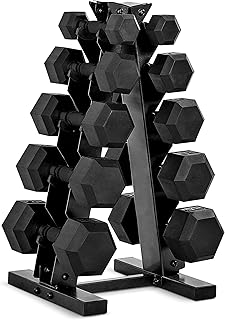
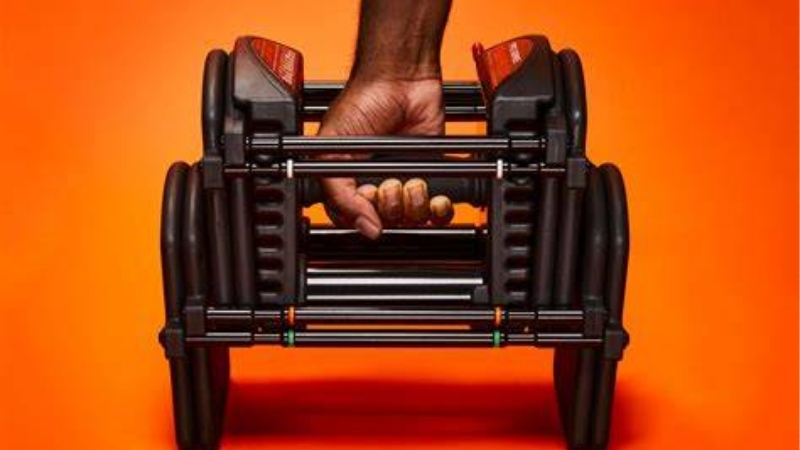
Adjustable sets replace between 10 and 17 pairs, so they are the default answer for the best weight dumbbells when floor space is the binding constraint. Fixed rubber hex dumbbells cost less per pound, have nothing to break and can be set down instantly, but a genuinely useful range means five or six pairs plus a rack to hold them.
The middle path most people arrive at eventually is one adjustable set plus a single fixed heavy pair at the weight they row most. It costs a little more than either approach alone but removes the changeover delay on the movement you repeat more often than any other.
Footprint: The Number That Decides the Format
A single adjustable pair sitting in its cradles occupies roughly 32 x 12 in (81 x 30 cm) of floor and stands about 9 in (23 cm) tall. A fixed set running 10 to 50 lb in 5 lb pairs needs a rack near 48 x 20 in (122 x 51 cm) and puts roughly 500 lb (227 kg) onto that patch of floor.
In an upstairs apartment, that loading figure matters as much as the area does. Measure the spot you intend to use, consider what the floor structure sits on, and remember that dumbbells stored under a bed still need clearance to slide out without lifting the frame.
Top Picks: Best Weight Dumbbells by Range
Each of the best weight dumbbells options below is grouped by the range it serves rather than by brand, so you can match it to where your training genuinely sits today and where it will be in two years. The table gives the deciding specs before the individual write-ups explain the trade-offs.
| Set | Range per hand | Increment | Best suited to | Price tier |
|---|---|---|---|---|
| Bowflex SelectTech 552 | 5-52.5 lb (2.3-24 kg) | 2.5 lb | First set, all-round | Mid |
| NÜOBELL 80 lb | 5-80 lb (2.3-36 kg) | 5 lb | Buying once | Premium |
| PowerBlock Elite EXP | 5-50 lb, expandable | 2.5 lb | Building gradually | Mid |
| FLYBIRD 55 lb Adjustable | 5-55 lb (2.3-25 kg) | 5.5 lb | Budget entry | Budget |
| Amazon Basics Rubber Hex | Single fixed pair | n/a | Heavy rows, circuits | Budget |
| Yes4All Spinlock Set | Plate-loaded | Plate steps | Lowest cost per lb | Budget |
Bowflex SelectTech 552
The most common first set in home gyms, and for defensible reasons. The 2.5 lb increments below 25 lb are exactly what light accessory work requires, the dial changes weight in about three seconds, and 52.5 lb covers pressing and curling comfortably for most people’s first two or three years.
Where it falls short is rowing and lower-body work, which pass 52.5 lb sooner than buyers expect. It also cannot be dropped, and the dumbbell must return fully to its cradle to change weight, which makes circuit-style sessions noticeably slower than they would be with fixed pairs on a rack.
NÜOBELL 80 lb
This is the set to buy if you want to make one purchase and stop thinking about the problem. Eighty pounds per hand covers heavy rows and split squats, the twist-handle mechanism is the quickest available, and the metal plates feel closer to a real dumbbell than plastic-shrouded alternatives do.
It uses 5 lb steps throughout the range, so light isolation work loses the fine progression that cheaper sets offer at the bottom end. The price is also roughly double an entry set, and the twist mechanism carries more moving parts that need keeping clean in a dusty garage.
PowerBlock Elite EXP
The expandable design lets you begin at 50 lb and add kits to reach 70 or 90 lb as you get stronger, spreading the cost across several years rather than one purchase. The 2.5 lb adder weights sitting inside the block give the fine progression that dial sets simply cannot offer above 25 lb.
The block shape is the acquired taste here. Your hand sits inside a cage, which limits wrist rotation and feels genuinely unfamiliar for the first few sessions. If you have strong preferences about grip feel, try to handle one somewhere before committing to the full expandable system.
FLYBIRD 55 lb Adjustable Dumbbell
The value option that still reaches a useful top end. Fifty-five pounds per hand is enough for most pressing and moderate rowing, and it costs well under half of what the premium sets ask, which makes it a sensible entry for someone still testing whether home training will stick.
The 5.5 lb increment is a metric-derived oddity that makes tracking loads slightly awkward across a training log. Build quality is the other open question — the shroud is thinner than premium sets, and this is the option most likely to develop rattle or a stiff dial after a year.
Amazon Basics Rubber Encased Hex Dumbbells
One fixed pair at the weight you row or goblet squat most is arguably the highest-value single purchase in this whole category. There is no mechanism to jam, no cradle to return to, and the rubber encasing protects both your floor and the dumbbell when a set ends abruptly.
The cost is space and inflexibility — one pair, one weight, and roughly 30 x 10 in (76 x 25 cm) of permanently occupied floor. Buy them as a supplement to an adjustable set rather than attempting to build a full working range out of fixed pairs alone.
Yes4All Adjustable Spinlock Set
Plate-loaded spinlock handles remain the cheapest route to a wide range and the lowest cost per pound available anywhere. If budget is the constraint that decides everything, this gets you training this week with the option to add plates gradually as your working loads climb.
Changing weight takes 30-60 seconds per dumbbell rather than three, and spinlock collars can work loose during high-rep sets unless tightened firmly. Structure your sessions so you are not changing loads between every single set, and check the collars before any heavy pressing.
Frequently Asked Questions
These four questions account for most of the confusion around choosing the best weight dumbbells for a first purchase, and they are worth answering before you compare specific sets. Each one changes what you should buy rather than simply how you should train.
What dumbbell weight should a beginner start with?
Most beginners are best served by a range of roughly 10-40 lb (4.5-18 kg) rather than one weight, pressing somewhere around 15-25 lb and rowing around 25-40 lb. Choose a load where the tenth repetition feels hard but your technique does not visibly change, then progress from that point.
Is one pair of dumbbells enough?
Only briefly. The best weight dumbbells span a range because a single pair is either too heavy for lateral raises or too light for rows, and the mismatch means you start quietly skipping movements to avoid it. An adjustable set, or two well-chosen fixed pairs at opposite ends of your range, resolves the problem for far longer.
Are adjustable dumbbells worth it over fixed ones?
In a home gym, usually yes, because floor space is the scarce resource and one adjustable pair replaces an entire rack. Fixed dumbbells win on durability, changeover speed and the freedom to set them down hard, which is why many people end up owning a small number of both.
How do I know when to add weight?
Add one increment when you can complete every prescribed repetition with two still in reserve on your final set. If the new load drops you below your target rep range, stay there and build back up rather than dropping the weight again, which is what stalls most home programmes.
See More:
- Ankle weights best
- Best rated ankle weights
- Best home workout equipment budget
- Best resistance bands for men
Final Thoughts
The best weight dumbbells for you are defined by a range rather than a single number: roughly 10-50 lb if you are starting out, or 15-80 lb if you already train and want to buy only once. Prioritise small increments at the light end and enough top-end load for rows. Measure the floor space and check what your floor can carry before ordering.


Write Your Review
No reviews yet. Be the first to share your experience!