
Key takeaways
What's inside
Best size kettlebell for men is really two questions: what weight to start swinging, and what weight to press. Those two answers are rarely the same bell, and the 4 kg (roughly 9 lb) gap between standard sizes is what makes the decision harder than it should be. Movement decides weight, not body size.
As an Amazon Associate we earn from qualifying purchases at no extra cost to you. Product prices and availability are accurate as of the date shown and are subject to change.
As an Amazon Associate we earn from qualifying purchases at no extra cost to you. Product prices and availability are accurate as of the date shown and are subject to change.


By Chris Parker
🛒 Best Price Today on Amazon
Prime members get fast, free shipping on everything above, plus member-only deals. New members get a 30-day free trial — cancel anytime.
Start 30-Day Prime Free Trial →See Today’s Amazon DealsHow to Pick the Best Size Kettlebell for Men
Weight selection depends on the movement rather than on the person holding it. A swing is a hip movement that tolerates load well, while an overhead press is limited by the shoulder. Buying one bell for both usually means it is too light for one job and too heavy for the other. Split the roles and both get easier.
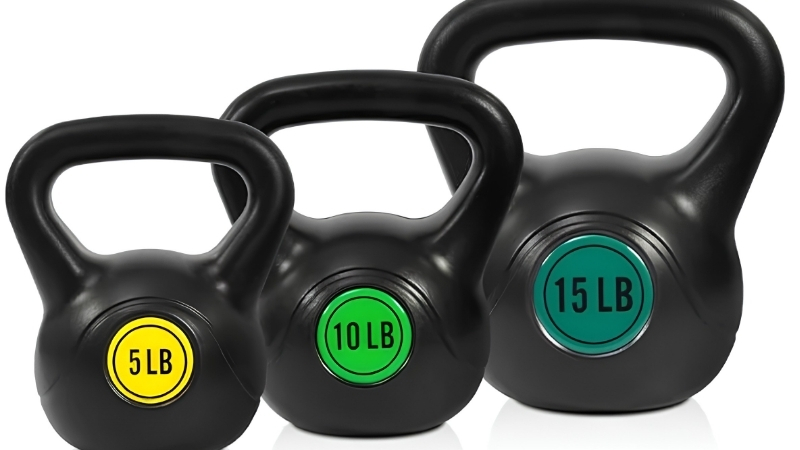
Starting Weights by Movement
For two-handed swings, 16 kg (35 lb) is the weight most commonly recommended as a starting point for men with some training history, and 12 kg (26 lb) suits anyone newer to hinging. Training background matters far more than any general rule, so treat these as a starting point rather than a prescription.
Pressing and getting overhead is different: 12 kg (26 lb) is a realistic starting press for many, while the same person swings 16 or 20 kg comfortably. Goblet squats usually sit between the two. If you are choosing between two weights for a first purchase, take the lighter one and add repetitions. Volume covers what weight cannot.
The 4 kg Jump and How to Bridge It
Cast iron bells step in 4 kg (9 lb) increments, which is a large relative jump in the 12 to 20 kg range. Going from 16 kg to 20 kg is a 25 percent increase, and there is no smaller step available in fixed bells, unlike the 2.5 lb plates that keep barbell training moving. The gap is the reason people stall between bells.
You bridge that gap with repetitions, tempo or an adjustable bell rather than with a new purchase every few months. Most people find the best size kettlebell for men is actually two bells: one for pressing and technique, one heavier for swings and carries, bought a few months apart. Two bells beat one compromise weight.
Footprint, Storage and Floor Protection
Swings need a clear area of roughly 6 x 6 ft (1.8 x 1.8 m), and getting overhead needs about 12 in (30 cm) above your raised hand, so an 8 ft (2.4 m) ceiling works for most people but not for everyone. Measure the swing area and the ceiling before ordering anything. Light fittings matter more than plaster height.
Storage is what multiplies with bells. Two or three kettlebells occupy roughly 2 x 2 ft (60 x 60 cm) against a wall, and they mark carpet and laminate if left loose. Rubber matting of 3/4 in (19 mm) under the training area is the cheapest way to protect the floor beneath them. Storage grows faster than the collection does.
Top Picks: Bells Covering the Useful Range
The six below cover a light bell for pressing, a mid bell for swings, a heavy bell for carries and an adjustable unit that replaces the first two. Buy one bell, train with it for a couple of months, then add the second based on what has actually become too light. Buying all three at once is rarely necessary.
| Product | Type | Typical use | Best for |
|---|---|---|---|
| Amazon Basics Cast Iron | Fixed bell | 12 kg press work | First bell |
| Yes4All Powder Coated | Fixed bell | 16 kg swings | Main swing bell |
| Kettlebell Kings Powder Coat | Fixed bell | 20 to 24 kg | Heavy swings |
| CAP Competition Bell | Steel bell | Any weight | Matching handles |
| Bowflex SelectTech 840 | Adjustable | Light to mid | Bridging jumps |
| Yes4All Kettlebell Rack | Storage | Two or three bells | Tidy floors |
Amazon Basics Cast Iron Kettlebell
A 12 kg (26 lb) cast iron bell is the sensible first purchase for anyone who wants to press, do Turkish get-ups and learn the swing without overloading the pattern. Amazon Basics bells are plain, cheap and available in every common weight, which is exactly what a first bell needs to be. It is the best size kettlebell for men learning to press.
The finish is basic and the handle can carry a casting seam, so run a hand around it before your first session and file anything rough. It will feel light for swings within a couple of months, which is normal rather than a fault, and it stays useful for pressing indefinitely. Presses progress far more slowly than swings.
Yes4All Powder Coated Kettlebell
At 16 kg (35 lb), this is the bell most men end up swinging with, and powder coat survives high repetitions without stripping skin. It costs slightly more than painted cast iron and holds grip far better once hands are damp. For swings it is the best size kettlebell for men with training behind them.
Casting quality varies a little between units, and the handle is thicker than a competition bell, which matters if you have smaller hands. It is a working tool rather than a showpiece, so expect the coating to wear at the contact points over a few years of regular use. That wear is cosmetic rather than structural.
Kettlebell Kings Powder Coat Kettlebell
For the 20 to 24 kg (44 to 53 lb) range, finish quality starts to matter more, because heavier bells punish a rough handle on every repetition. Kettlebell Kings bells are consistently finished with smooth handles and no seam to catch on the down phase of a clean or a snatch. Heavier bells punish a rough handle fastest.
They cost noticeably more than budget cast iron, which is difficult to justify if you swing occasionally rather than several times a week. Buy at this level when kettlebell work is the centre of your training and you are handling the bell for hundreds of repetitions each session. Volume is what justifies the price here.
CAP Competition Kettlebell
Competition bells keep identical dimensions at every weight, so the handle and the body feel the same whether you hold 16 kg or 24 kg. That consistency matters once you own several bells, because your technique does not have to change as the load goes up through the range. Matching handles pay off across a whole set.
They cost more per bell and the handles are narrower than cast iron, which some larger hands dislike for two-handed swings. Steel also marks floors more readily than a coated bell. Buy competition bells if you plan a matching set rather than one or two bells bought in isolation. Mixing them with cast iron feels inconsistent.
Bowflex SelectTech 840 Adjustable Kettlebell
An adjustable bell answers the 4 kg jump directly, covering roughly 8 to 40 lb (3.5 to 18 kg) in one unit, so you can add a small step instead of buying a whole new bell. In a small room it also removes the storage problem that comes with owning three separate kettlebells. Small steps are its clearest advantage.
The body is bulkier than a fixed bell, which is noticeable in the rack position against the forearm, and it must never be dropped. Use it for swings, goblet squats and presses rather than for snatches, where the bell rotates over the wrist and a bulky body is unwelcome. Never drop it, on any surface at all.
Yes4All Kettlebell Storage Rack
Once you own two or three bells, a rack keeps them off the floor and out of the walkway. It also puts the working weight at a sensible height, which matters more than it sounds when the alternative is lifting a 24 kg bell off the ground before every single set. It also keeps the walkway clear of hazards.
Racks take floor space that a small room may not have, and budget frames wobble with heavier bells loaded on the upper tier. Check the stated capacity and the spacing before ordering, since competition bells and cast iron bells have quite different base dimensions on the same shelf. Check the tier spacing before ordering one.
Frequently Asked Questions
Four questions cover most of what people ask before buying a first or second bell. They are about weight selection and progression rather than programming, because the weight you choose is the decision that is genuinely expensive to get wrong once the bell has been delivered. Weight answers most of them.
Is 16 kg the right starting weight?
For two-handed swings it is the weight most commonly suggested for men with some training background, but pressing and get-ups usually need something lighter. Training history matters more than any general figure, so if you are between two sizes, take the lighter bell and add repetitions instead. Technique should never be the thing that gives way.
How do I know when to move up?
When a set of swings finishes with the same effort it started with, and technique holds throughout, the bell has become a warm-up. That usually arrives within a few months on swings and far more slowly on presses, which is why the two movements end up on different bells. Track the sets rather than guessing at it.
Should I buy an adjustable bell instead?
If storage is tight or you want smaller steps, yes. If you already know your weights and train heavy, fixed bells feel better in the rack position and have nothing to fail. Many home setups end up with one adjustable unit plus one heavy fixed bell for swings. That combination covers the best size kettlebell for men in most homes.
How many bells do I actually need?
Two covers almost everything: a lighter bell for pressing and technique, a heavier one for swings and carries. A third fills the gap as you progress, which is how most people end up owning the best size kettlebell for men in two sizes rather than trying to find it in a single bell that does both jobs badly.
See More:
Final Thoughts
The best size kettlebell for men depends on the movement rather than the person: lighter for pressing, heavier for swings, with repetitions bridging the 4 kg jumps between them. Start with one bell, add the second when the first stops being hard, and put matting down before either arrives. Then progress with repetitions between jumps.



Write Your Review
No reviews yet. Be the first to share your experience!