
Key takeaways
What's inside
Best flooring for home gym over concrete has to do two jobs at once: cushion the iron you drop and stop a cold slab from wicking moisture into a mold problem. Nail the thickness and the vapor barrier, and a bare garage or basement becomes a safe training floor that protects both your joints and the concrete beneath it.
As an Amazon Associate we earn from qualifying purchases at no extra cost to you. Product prices and availability are accurate as of the date shown and are subject to change.
By Chris Parker
🛒 Best Price Today on Amazon
Prime members get fast, free shipping on everything above, plus member-only deals. New members get a 30-day free trial — cancel anytime.
Start 30-Day Prime Free Trial →See Today’s Amazon DealsHow to Choose the Right Best Flooring for Home Gym Over Concrete
Two numbers decide almost everything: the thickness of the mat and the footprint it will cover. Settle both before you shop, because the best flooring for home gym over concrete depends on what you drop, how damp your slab runs, and how much ceiling you can spare.
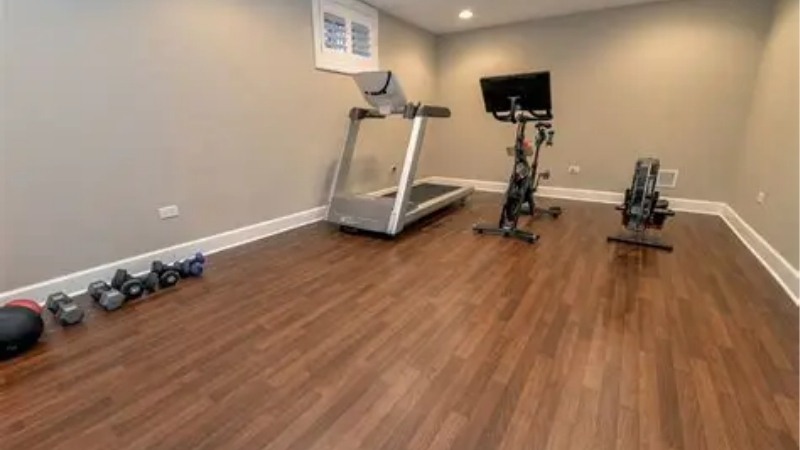
Thickness Versus What You Actually Drop
For general strength work, 3/8 in (9.5 mm) rubber is the baseline over concrete. It rides over minor slab imperfections and absorbs the shock of dumbbells and kettlebells. Cardio-only rooms can drop to 8 mm (0.31 in) foam-backed tiles, while any barbell drop zone wants 1/2 in (12.7 mm) or thicker.
Density matters as much as height. A dense 3/8 in vulcanized mat beats a spongy 1/2 in foam tile under a loaded bar. If you deadlift heavy or drop bumpers, add a plywood platform in the bar path rather than trusting a thin sheet to save the slab.
Footprint, Ceiling Clearance and Layout
Footprint is the buying filter people skip and regret. Measure the exact rectangle you will train in, add clearance for a bar or rower to slide, then choose rolls or tiles. Rolls (commonly 4 ft / 122 cm wide) suit clean rectangles; interlocking tiles fill odd corners.
Thickness also eats headroom. On concrete you rarely notice half an inch, but if you press overhead in a low garage, 1/2 in (12.7 mm) plus shoes can matter. Measure your actual space before ordering, or a roll that lands an inch short of the wall will look unfinished and shift underfoot.
Moisture Control Over Concrete
Concrete is porous and wicks ground moisture; trapped under a mat, that turns into mold. Tape a square of plastic to the slab for 48 hours first. Condensation underneath means you need a 6 mil vapor barrier or a dimpled underlayment before any flooring goes down.
Basements and slabs below grade are the usual offenders. Sealing the concrete or laying a barrier is cheap insurance next to replacing warped tiles a year later. With the best flooring for home gym over concrete, moisture is a real durability factor, not just comfort underfoot.
Material, Format and Budget Tiers
The mid tier is where the good choices cluster: dense recycled rubber rolls and tiles that handle mixed strength and cardio without drama. Drop below that band and you trade steel for sponge — thin EVA foam that dents permanently under a rack leg and telegraphs every bump in the slab.
Recycled black rubber with EPDM fleck dominates the value end; virgin rubber and USA-made TPE sit at the top with lower odor and cleaner looks. There are no apps or gimmicks in this category, so spend the difference on thickness and coverage instead of colour. Interlocking tiles win for DIY and rentals; seamless rolls give the cleanest finish but are heavy to wrangle solo.
Top Picks for the Best Flooring for Home Gym Over Concrete
These seven cover the honest range for the best flooring for home gym over concrete — budget stall mats, DIY interlocking tiles, seamless rolls and low-odor premium options. Match the thickness to your heaviest lift and the coverage to your measured footprint. All are widely stocked on Amazon.
| Product | Format | Thickness | Best for |
|---|---|---|---|
| Traxxon by FlooringInc Roll | Seamless roll | 3/8 in (9.5 mm) | Clean rectangular garages |
| IncStores Sport-Lock Tiles | Interlocking | 3/8 in (9.5 mm) | Renters, DIY installs |
| American Floor Mats Fit-Lock | Interlocking | 3/8 in (9.5 mm) | Finished-look corners |
| American Floor Mats Stall Mats | Cut mat | 1/2 in (12.7 mm) | Budget drop zones |
| SUPERJARE Rubber-Top Foam | Interlocking | ~0.56 in (14 mm) | Cardio, light dumbbells |
| Rubber-Cal Elephant Bark | Seamless roll | 3/8 in (9.5 mm) | Base under a platform |
| Baselayer Balance TPE Tiles | Interlocking | 1/2 in (12.7 mm) | Odor-sensitive indoor rooms |
Traxxon by FlooringInc Rubber Gym Flooring Roll
Made in the USA from recycled black rubber with a blue and grey EPDM fleck, this roll runs 3/8 in (9.5 mm) thick, covers 40 sq ft at 4 x 10 ft (122 x 305 cm), and weighs about 2.1 lb per sq ft (~10 kg/m2). It lays flat on concrete without adhesive, repositions anytime, and has a textured surface for wet or dry traction.
The trade-off is handling: a 40 sq ft roll is heavy and awkward for one person, and it needs a day or two to relax flat after unrolling, with ends that can curl. It is not a bumper drop pad, so add a platform in the bar path. Best for lifters who want a near-seamless finish in a rectangular room.
IncStores Sport-Lock 3/8-Inch Interlocking Rubber Tiles
These 3/8 in (9.5 mm) recycled-rubber puzzle tiles sell in 8-packs, lock without adhesive, and are slip resistant. They shine under a bench or machine and let you expand a room one section at a time — the easy DIY route for a garage or basement.
Puzzle seams can gap if the slab is not flat, and the outer edges need trimming for a wall-to-wall look. Fresh recycled rubber also carries a “new tire” smell for the first weeks in a closed room. Best for renters and anyone who wants a floor they can rearrange later.
American Floor Mats Fit-Lock 3/8-Inch Rubber Tiles
Commercial-grade recycled rubber in 24 x 24 in (61 x 61 cm) tiles at 3/8 in (9.5 mm), sold as sets with corner, border and center pieces so the finished area has clean edges. Non-porous and flat-laying, it is a tidy step up from raw stall mats.
It costs more per sq ft than budget foam and demands a little planning — you count corner, border and center tiles to fit your layout. Do not drop bumpers directly on it. Best for a strength corner where you want a finished, professional look.
American Floor Mats Heavy-Duty Stall Mats
Solid black 1/2 in (12.7 mm) rubber stall mats in 4 x 6 ft (122 x 183 cm) sheets deliver the lowest cost per sq ft for heavy zones. The density handles racks, machines and dropped dumbbells without flinching, which is why garage lifters have used them for years.
They are very heavy to carry and cut, seams between mats need taping, and the rubber odor is strong at first, so confirm the listing is indoor-rated to limit off-gassing. Best for a budget drop zone where looks matter less than toughness.
SUPERJARE Rubber-Top EVA Foam Tiles
High-density EVA foam with a bonded rubber top, roughly 0.56 in (14 mm) thick, sold in 12-tile 48 sq ft interlocking sets. It is light, warm and quiet underfoot — pleasant for cardio, stretching and light dumbbell work.
The foam core dents permanently under point loads like rack feet, and it is not for barbell drops or heavy lifting; the rubber top helps but this is a light-duty surface. Best for a cardio-only zone or a kids’ play corner.
Rubber-Cal Elephant Bark Rubber Flooring
A dense vulcanized rubber roll at 3/8 in (9.5 mm), water-resistant with a textured “bark” surface, sold by the linear foot so you can size it to the room. It rides over minor slab bumps and makes a durable seamless base.
Like every roll it is heavy and best cut and placed by two people, and the texture traps dust, so plan on regular sweeping. It is not a bumper drop pad on its own. Best for lifters who want a solid base layer under a dedicated platform.
Baselayer Balance Series 1/2-Inch TPE Tiles
Made in the USA, these 1/2 in (12.7 mm) TPE tiles are rubber-like but not foam, with essentially no off-gassing smell, sold in 6-packs covering 15 sq ft. That makes them the clean pick for an indoor room where odor is a dealbreaker.
They cost well above recycled-rubber tiles and are still not rated for heavy barbell drops. Under cardio machines and for general training in a finished basement, though, they are excellent. Best for odor-sensitive indoor spaces.
Frequently Asked Questions
Quick answers to the questions that come up most when people are choosing the best flooring for home gym over concrete.
Do I need a vapor barrier over concrete?
Test first: tape a plastic square to the slab for 48 hours. If condensation forms underneath, lay a 6 mil vapor barrier or a dimpled underlayment before your flooring, especially in a basement or below-grade garage. A dry slab that passes the test can usually take mats directly.
Can I drop bumper plates on 3/8-inch rubber?
Not repeatedly. A 3/8 in (9.5 mm) mat cushions general lifting, but hard bumper drops belong on 1/2 in (12.7 mm) rubber or a dedicated wooden platform in the bar path. Treating a thin sheet as a drop pad cracks tiles and can telegraph impact into the concrete.
Rolls or interlocking tiles for a garage?
Rolls give the cleanest, near-seamless finish in a big rectangle but are heavy to install solo. Interlocking tiles are the DIY-friendly choice for odd shapes, partial coverage or rentals, and you can pull them up and rearrange them later.
Will rubber flooring stain my concrete?
Recycled rubber can stain unsealed concrete over time, particularly if moisture is present. Sealing the slab first prevents both staining and mold, and it makes the floor easier to clean if you ever remove the mats.
See More:
- Best collapsible exercise bike
- Best fold away exercise bike
- Best exercise bike folding
- Best home upright exercise bike
Final Thoughts
For most home lifters, the best flooring for home gym over concrete is a dense 3/8 in (9.5 mm) rubber roll or tile, stepped up to 1/2 in (12.7 mm) or a platform wherever a loaded bar comes down. Sort out moisture first, measure your footprint honestly, and the best flooring for home gym over concrete will quietly outlast the rest of your gym.
As an Amazon Associate we earn from qualifying purchases at no extra cost to you. Product prices and availability are accurate as of the date shown and are subject to change.






Write Your Review
No reviews yet. Be the first to share your experience!