
When you compare neoprene dumbbells vs alternatives, start with grip feel, the weight your exercises require, and how often you change loads. Neoprene pairs suit ready-to-use light resistance. Vinyl can fill the same job, rubber hex can extend the range, and adjustable weights or bands change the storage and setup.
Quick comparison table
The closest match is another fixed dumbbell with a similar load and shape. Alternatives become more distinct as you move from covered fixed handles to equipment with moving parts or elastic resistance. Compare the complete setup for your intended exercises, including any anchor, tray, rack, or compatible storage surface.
| Equipment | What changes in use | Typical reason to choose it | Main trade-off |
|---|---|---|---|
| Neoprene dumbbells | Fixed load with a covered handle and heads on common models | Light paired work and a covered grip | More units needed as you add weights |
| Vinyl-coated dumbbells | Similar fixed loading with a different coating and grip finish | A comparable light setup when the selected weight and handle fit | Surface feel varies by model |
| Rubber hex dumbbells | Rubber-covered heads with an exposed metal grip on many designs | A broader heavy fixed-weight range and positive head geometry for set-downs | Higher-load pairs add storage weight and bulk |
| Bare cast-iron dumbbells | Fixed resistance with exposed iron on common one-piece designs | Simple construction and an uncoated grip | Direct metal contact with the floor or rack |
| Adjustable dumbbells | Change loads through a selector or manually loaded plates | Many settings with fewer separate handles | Cradles, collars, or other parts add setup requirements |
| Resistance bands | Tension depends on stretch and line of pull | Portable resistance and anchor-based exercises | Setup and tension vary across the movement |
Compare the physical designs before the price
Neoprene is itself a synthetic rubber. In home-gym product names, a neoprene dumbbell often means a fixed weight with a covered handle and heads. “Rubber hex” often describes a dumbbell with rubber-covered ends and an exposed handle. The position of the coating matters more than the category label.
Manufacturer examples make the practical differences concrete. Perform Better lists its neoprene and vinyl covered pairs at 1–10 lb, plus 12 and 15 lb. Rogue lists rubber hex pairs from 2.5 through 125 lb and specifies a metal grip diameter that varies by load. REP QuickDraw starts at 5 lb and reaches 30, 40, 50, or 60 lb per hand depending on the configuration. These examples establish plausible ranges for the named products. Other models can offer different settings and dimensions.
For a fair purchase comparison, hold the equipment job constant. If you need a single 5 lb pair, compare the grip, package quantity, and delivered price for two. If you need several loads or more than 15 lb, include every fixed pair or the exact adjustable configuration needed to cover the same exercises.
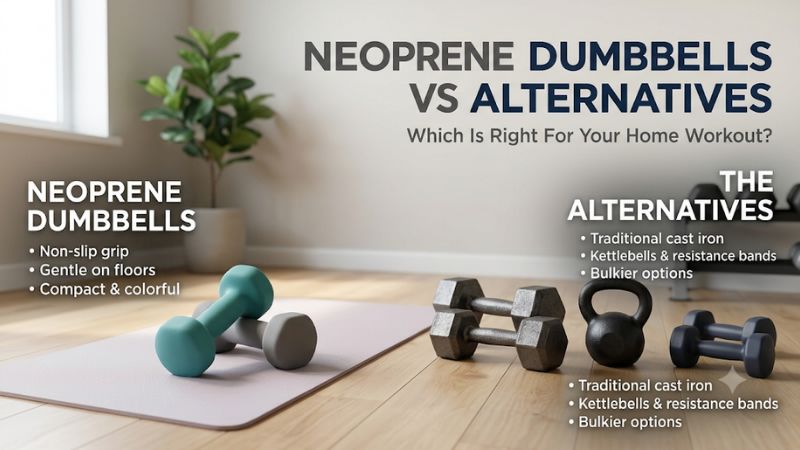
Neoprene dumbbells vs vinyl and rubber hex
Vinyl and rubber hex represent two common paths away from a neoprene dumbbell. Vinyl can offer a near-identical weight range while changing how the handle feels. Rubber hex can preserve a familiar fixed load while replacing the covered grip and extending the amount of weight you can get per hand.
Vinyl is the closest substitute for fixed light work
At the same nominal weight and comparable geometry, both a vinyl-coated and a neoprene-coated pair can serve exercises such as curls, raises, and light presses. Choose by the grip you prefer and the settings offered by the exact product line. A color system or head shape can also affect how easy the pair is to use and organize.
Vinyl products often have a smoother-looking exterior, while many neoprene products use a matte finish. Actual grip feel varies with the manufacturer, the coating texture, and your hands. Compare the same weight in both materials if you can, paying attention to comfort and control during a normal grip rather than testing the surface by appearance.
A practical example is someone who uses 3 lb and 5 lb for two accessory exercises. If both finishes offer those loads, there is little reason to pay for a larger bundle simply because it contains a coating you usually prefer. A comfortable matched pair and suitable storage surface solve most of the decision.
Rubber hex makes sense when your plan extends to heavier loads
A rubber hex line can offer both light accessories and substantially heavier working pairs. The common format uses covered heads and a metal handle. If you appreciate knurling and expect to buy 20, 30, or 50 lb sets later, starting with a fixed hex line can make the overall setup more consistent.
A 10 lb comparison shows why grip measurements matter. Rogue lists a 25 mm handle for its rubber hex weights through 10 lb. Gaiam lists a 1.62 in handle, about 41 mm, on its 10 lb neoprene hand weight. The two products offer the same labeled mass. The difference in grip diameter is large enough to affect how your fingers close around the handle.
Consider the space required to store every pair you intend to buy. A rubber hex line can go much heavier, and a complete selection takes more money and room than a few hand weights. If your needs are split, use a light neoprene pair for accessories and choose a heavier rubber hex pair for the exercises that need it.
Compare floor contact and head stability separately
Both neoprene and conventional rubber heads can provide a covered contact surface. Head geometry affects rolling on a level floor. A flat side helps with placement, while coating changes the direct contact between the core and the floor. The same product can perform both functions, and each depends on the exact design.
If you have a delicate floor, use controlled set-downs and check equipment and floor guidance. Neither coating gives a universal guarantee against marks or impact. For a heavily loaded rack, look at the feet, equipment mass, and suitability of the surface underneath, since most of the stored load transfers through the rack’s support points.
When an exercise uses a dumbbell as a support point, consult the product guidance and choose a stable setup. A low-profile shape can be helpful for resting between sets. Supporting body weight introduces additional forces that depend on the exact equipment and floor.
Neoprene dumbbells vs bare iron and adjustable weights
Bare iron keeps the familiar shape of a fixed dumbbell but changes what touches the hand and floor. Adjustable equipment introduces a load-change procedure in exchange for a wider range on fewer handles. Both can outperform a light fixed bundle on particular purchase criteria when used for the right role.
Bare iron suits buyers comfortable with an uncoated handle
A one-piece fixed iron dumbbell can offer a straightforward weight at an attractive price. The uncoated handle and heads may feel firmer than a fully covered hand weight. If you already train on a suitable platform and prefer the feel of iron, the coating becomes less important than handle shape, head finish, and price.
Inspect how the ends meet the floor or rack. Bare metal can contact the surface directly, so use a compatible protective surface and controlled placement. In a shared room with finished furniture, a covered hand weight may be more pleasant to set down and pick up repeatedly. Check the care instructions for both coatings and any exposed iron.
Compare cost within the weight you need. A low-cost 10 lb iron pair can make sense if you will use it for presses and rows. If you need 1 through 5 lb options, compare the available coated and uncoated lines directly rather than assuming they share the same choices.
Selector adjustables earn their price when you use many settings
An adjustable pair may consolidate several fixed loads into two handles. For a program with regular dumbbell presses, rows, and lower-body exercises, the range can cover more than a typical neoprene rack. A cradle-based system needs room for both trays and for a controlled return after each set.
Check the minimum, the actual steps, and whether the listed package includes two dumbbells. A setup that starts at 5 lb can leave out lighter raises or other accessories. A set with only 5 lb increases can miss a useful 6, 7, or 8 lb weight. Read the full selector schedule before judging how well it replaces the fixed pairs you use.
A useful hybrid is one light neoprene pair and a selector pair that handles the heavier program. The fixed pair can stay ready while both adjustable dumbbells are set for presses or rows. The extra small pair earns its storage when the transition happens repeatedly or when the selector lacks the light setting entirely.
Manual adjustable handles change the setup for heavy use
Plate-loaded handles use collars or model-specific screws to capture plates. They can give a buyer access to heavier loads without paying for an integrated selector. If you already own verified compatible plates, the extra purchase may mainly be handles and the necessary fasteners.
Check the minimum working weight after installing the required hardware. A loadable handle can start heavier than several neoprene sizes before adding any plates. Also consider length. Long sleeves can limit how close the dumbbells come in presses or how comfortably the plates pass beside your legs in a hinge.
Manual changes are easier when you train straight sets with time between load changes. If a session moves quickly through light and moderate loads, a fixed pair at each frequently used weight may work better. The right comparison considers how often the plate-loading effort will occur, in addition to how much weight the equipment can hold.
Neoprene dumbbells vs resistance bands
A neoprene dumbbell applies gravity to a fixed mass. A band develops tension as it stretches, and the direction of that tension depends on how you hold or anchor it. The distinction matters most when you want to reproduce a load or train along a line a free weight cannot provide from the same position.
Bands suit portable workouts and horizontal lines of pull
A loop or tube band occupies little storage space and can provide resistance from a suitable anchor. That is useful for a standing horizontal pull or press when a dumbbell’s downward pull would require changing your body position. If portability or anchor-based exercises define your setup, bands can be a practical primary purchase.
The force changes with stretch. A band may feel light near the starting position and stronger farther into the movement. Your height, distance from the anchor, grip position, and starting tension all change the result. Check how the manufacturer defines any marked range and keep anchors and attachments within their intended use.
Record which band you use and how it is positioned if you want repeatable sessions. Inspect for wear and use a secure compatible anchor. A fixed dumbbell may be simpler when you want a known nominal load with very little setup, particularly for a row or press you already perform with free weights.
Dumbbells simplify repeated load selection
Picking up a labeled 5 lb pair makes the external mass easy to repeat. Mechanical demand still changes with body position and leverage. A lateral raise with a bent elbow and a straight-arm variation can feel different with the same dumbbell, so record the exercise and form variation alongside the weight.
A band can train overlapping muscles, but a band label cannot be treated as a direct conversion into dumbbell pounds. Choose by the movement, its intended range, and which parts of the movement you want to load. If cost is similar, an inexpensive pair is often the straightforward choice for a consistent light free-weight exercise.
Choose by the exercises that make up your week
The best option is the one that covers regular work at a total cost and footprint you can manage. List how many exercises use each load and how frequently you transition between them. This brings the practical advantages of each design into focus before you compare a finish or a brand.
Light accessories and short routines
If you use two or three light weights for accessory work, compare neoprene and vinyl at those exact loads. Check handle shape and package size, then choose the setup that can stay readily accessible. One pair can be enough if almost every exercise shares the same setting.
If you exercise away from home often, a band may be more practical for travel. A light dumbbell pair can stay at home for the free-weight movements you want to keep consistent. That lets each purchase solve a specific constraint without duplicating several pieces of equipment.
Broad strength training in a small room
A selector pair with a useful maximum can cover multiple presses, rows, and lower-body exercises in less storage space than a broad collection of fixed pairs. Compare tray dimensions and minimum weight, then add a light fixed pair only if you have a real exercise that falls below the range or between steps.
If you need frequent sets at two weights at the same time, fixed pairs can still be easier. For example, two household members can work at 8 and 15 lb simultaneously. An adjustable pair offers several sequential settings, and simultaneous use of nearly any two paired settings requires more equipment.
A dedicated home gym with rising load needs
Rubber hex pairs make sense when you want a permanent progression of fixed weights and have suitable storage. Manual plate-loaded handles can be useful if you already own compatible plates and can accept changes between sets. For heavy compound lifts, evaluate which system makes the start, end, and set-down of each movement manageable.
A few neoprene pairs can keep a role in the larger gym. Light warm-ups, accessories, and shared workouts can benefit from dedicated loads that stay ready. Decide how many light pairs your actual program uses while the heavier equipment handles the work that needs a wider range.
Frequently asked questions
Alternative equipment usually changes more than the number on the label. Check the handle, weight path, and setup needed for the same exercise before making a substitution. These questions focus on the most common points of overlap between light coated dumbbells and other home-gym options.
Are neoprene and vinyl dumbbells equally useful at the same weight?
They can be interchangeable for many fixed-weight exercises if the grip and dimensions suit you. Coating feel, head size, and how a weight settles on the floor can vary. Compare the actual product instead of assuming material alone determines comfort or durability.
Can I replace a 10 lb neoprene pair with rubber hex?
Yes. A matched 10 lb rubber hex pair supplies the same nominal load. Expect a possible change in handle size and head geometry. Check whether the exposed grip and weight shape work for the exercise and feel comfortable over a full set.
Is an adjustable dumbbell a replacement for a 1–3 lb set?
Only if the specific adjustable product includes the required settings and can be used comfortably at those loads. Many general-purpose strength adjustables start higher. A small fixed pair can fill one light setting while adjustable weights provide the rest of the range.
Which option is easier to keep on a finished floor?
Assess contact surface, overall load, and manufacturer guidance. Light coated fixed weights can be easy to place on a compatible surface. Heavy adjustable trays and racks have their own contact points and may require a different solution. Use controlled set-downs and verify the suitability of any mat or liner.
Should I choose bands if storage is my main concern?
Bands take very little storage and suit programs built around compatible anchors or positions. If you prefer exercises with a repeatable fixed load and no anchor, one compact pair also takes little space. Choose by how you plan to train when the equipment is out and in use.
Conclusion
Choose neoprene dumbbells when a few light fixed loads and a covered handle fit your routine. Vinyl is a close substitute when its grip feels right. Rubber hex suits a wider heavy-load range, bare iron can serve a straightforward fixed-weight setup, and adjustable pairs consolidate multiple loads. Choose bands when portability or a different line of pull adds something your free weights cannot provide in the same position.
More from Amazon
Programs that pair well with the guide above. Offers and eligibility are set by Amazon and may change.
Free shipping on eligible items, Prime Video and more. Eligible new members can start with a free trial.
Start a Prime free trialA Prime membership for ages 18-24 with a trial period. Eligibility is set by Amazon.
See Prime for Young AdultsAudiobooks and podcasts to listen to on the go. Eligible new members can start with a free trial.
Try Audible freeAd-free music streaming. Eligible new subscribers can start with a free trial.
Try Music Unlimited freeAs an Amazon Associate we earn from qualifying purchases.
Write Your Review
No reviews yet. Be the first to share your experience!